
DLSS in sim racing is mainly useful as an upscaler. It renders the game at a lower resolution and rebuilds a sharp image, so your GPU has headroom for triples or VR. Frame generation is a different tool. It adds frames you see but not frames the game reads your inputs on, and in a sim that is the wrong trade for most drivers.
Checked on 15 October 2026 against NVIDIA's DLSS and RTX games list (last updated 13 October 2026), AMD's FSR supported games page, the Steam patch notes of each sim, NVIDIA's DLSS 4.5 announcement (31 March 2026) and AMD's FSR 3.1 release post on GPUOpen (9 July 2024). I could not load Intel's XeSS games list, so XeSS is only marked where a game's own notes mention it. I do not quote FPS numbers here, because I have not benchmarked these games for this page.
What the upscalers do
Every upscaler works the same way at the top level. The game draws fewer pixels, then a smart filter fills in the rest.
- DLSS Super Resolution (NVIDIA). Renders at a lower resolution and uses an AI model to rebuild the image. It runs on GeForce RTX cards.
- DLAA (NVIDIA). The same model used at full resolution. No speed gain, only cleaner edges.
- DLSS Ray Reconstruction (NVIDIA). Replaces the denoisers in games that use ray tracing. In racing, F1 25 is the only sim on NVIDIA's list with it.
- AMD FSR. FSR 1 is a spatial upscaler: it works on one frame at a time. FSR 2 and 3 are temporal: they use data from previous frames. AMD's newest ML based version, which it calls FSR "Redstone", runs on Radeon RX 9000 cards, and the upscaling part also on RX 7000 with a recent driver.
- Intel XeSS. Intel's upscaler. It also works on other brands' GPUs.
Kunos explained the old split well in the ACC 1.8 notes (24 November 2021). DLSS is temporal with its own anti aliasing. FSR 1 is spatial and can sit on top of the game's own TAA.
So what does that mean for you? Temporal upscalers usually look sharper in motion. Spatial ones are simpler and cheaper.
What frame generation does
Frame generation does not upscale anything. It creates new frames between two real ones.
- DLSS Frame Generation. One generated frame per real frame. RTX 40 and 50 Series.
- DLSS Multi Frame Generation. Up to 4X on RTX 50 Series. NVIDIA's DLSS 4.5 update (31 March 2026) added a 6X mode, five generated frames for every rendered one.
- Dynamic Multi Frame Generation. NVIDIA says it only generates the frames needed to reach your target frame rate or your monitor's refresh rate, and changes the multiplier as the load changes.
- FSR Frame Generation. AMD's version. The ML based one needs an RX 9000 card.
Why frame generation adds input lag
To build a frame between frame A and frame B, the GPU needs frame B first. So the newest real frame is held back while the in between frames are shown.
Your inputs are still read at the real frame rate. If the game renders 60 real frames and shows 120, the car still responds to your hands 60 times a second, plus that extra wait.
NVIDIA pairs frame generation with Reflex to cut the extra delay. In its DLSS 4.5 announcement it claims "minimal impact to responsiveness". That is a vendor claim, not a measurement I can check for sims.
AMD is more direct. Its FSR 3.1 post says it is "highly recommended" to run at a minimum of about 60 FPS before frame generation, partly to mitigate the latency it adds.
Why that matters more in a sim than in other games
In most games a few milliseconds of delay go unnoticed. In a sim they land exactly where you work.
Catching a slide is a loop. The rear steps out, the force feedback and the picture tell you, you counter steer. Any delay in that loop means you react to where the car was, not where it is.
Same on the brakes. Trail braking into a slow corner is about feeling the front load and releasing at the right rate. You want the picture and the wheel to agree.
So my priorities in a sim are clear:
- Consistent frame time. A steady 90 is better than 140 that drops to 70 in the first corner with 30 cars.
- Low input latency. That is real frames, not generated ones.
- A clear far view. You need to see the braking marker and the apex, not count leaves.
- Peak FPS comes last.
Which sims support DLSS, FSR and XeSS
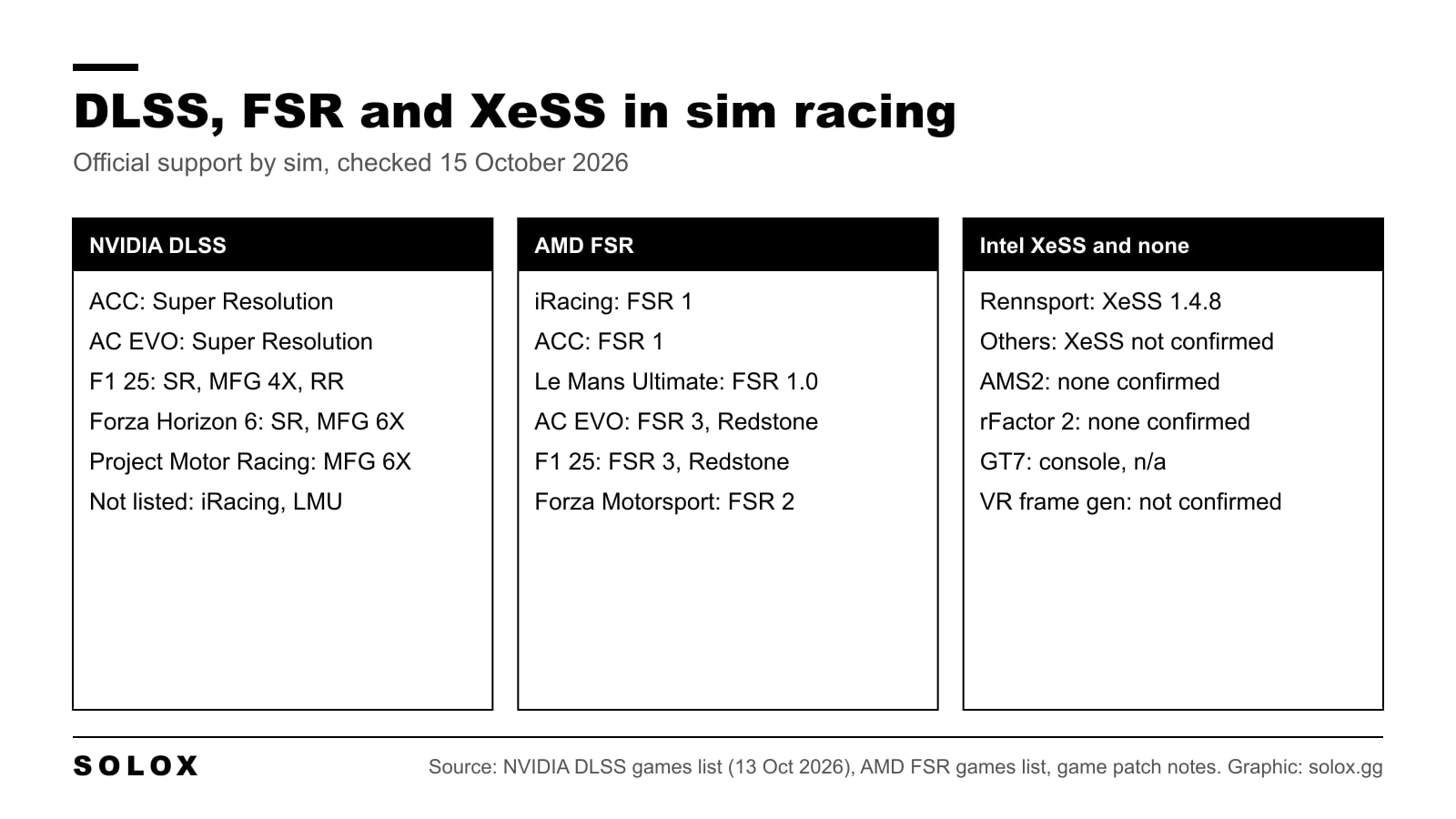
This table uses only NVIDIA's list, AMD's list and each game's own patch notes. If none of those confirm a feature, it says "not confirmed". That does not mean the game lacks it. It means I could not prove it from an official source.
| Sim | DLSS (NVIDIA list) | FSR (AMD list or game notes) | XeSS | Source |
|---|---|---|---|---|
| iRacing | Not listed, not confirmed | FSR 1 | Not confirmed | AMD list |
| Assetto Corsa Competizione | Super Resolution | FSR 1 | Not confirmed | NVIDIA list, AMD list, ACC v1.8 notes (24 Nov 2021) |
| Assetto Corsa EVO | Super Resolution, model upgradable via NVIDIA app | FSR "Redstone", FSR 3 | Not confirmed | NVIDIA list, AMD list, EVO 0.5 notes (Feb 2026, DLSS updated to 4.5) |
| Le Mans Ultimate | Not listed, not confirmed | FSR 1.0 (added in V1.4) | Not confirmed | LMU V1.4 notes (28 Jul 2026) |
| Automobilista 2 | Not listed | Not listed | Not confirmed | Absent from both lists and AMS2 Steam notes |
| rFactor 2 | Not listed | Not listed | Not confirmed | Absent from both lists and rF2 Steam notes |
| F1 25 | Super Resolution, Frame Gen, Multi Frame Gen up to 4X, Ray Reconstruction, DLAA | FSR "Redstone" via driver upgrade, FSR Frame Gen, FSR 3 | Not confirmed | NVIDIA list, AMD list |
| Forza Motorsport | Super Resolution, DLAA | FSR 2 | Not confirmed | NVIDIA list, AMD list |
| Forza Horizon 6 | Super Resolution, Frame Gen, Multi Frame Gen up to 6X, DLAA | FSR "Redstone", FSR 3 | Not confirmed | NVIDIA list, AMD list |
| Gran Turismo 7 | n/a, PlayStation only | n/a | n/a | Console game |
| EA Sports WRC | Super Resolution | FSR 2 | Not confirmed | NVIDIA list, AMD list |
| Project Motor Racing | Super Resolution, Frame Gen, Multi Frame Gen up to 6X | FSR "Redstone", FSR Frame Gen, FSR 3 | Not confirmed | NVIDIA list, AMD list |
| Rennsport | Not listed. Game notes list a DLSS option | FSR "Redstone", FSR Frame Gen, FSR 3 (FSR 3.1 added in Beta 1.11.0) | XeSS 1.4.8 | AMD list, Rennsport Beta 1.11.0 notes (23 Oct 2024) |
Two things stand out. The sims most people race online every night, iRacing and Le Mans Ultimate, only have the simplest FSR. And Automobilista 2 and rFactor 2 have nothing official at all.
If your GPU is the limit in those, the fix is still in the graphics menu. My iRacing graphics settings and ACC graphics settings go through what to lower first.
DLSS and FSR on triple screens
Triples are where an upscaler earns its place. You are pushing three times the pixels, and the side screens matter for racing close.
Here is what the developers have said officially:
- ACC. The v1.8 notes say DLSS and FSR are "selectable and functional" in triple screen and VR modes. The same notes say FSR does not work with the Projection Correction view setting.
- Assetto Corsa EVO. Release 0.2 (May 2025) stopped VR and triple screen mode from switching DLSS off. Update 0.7 (June 2026) fixed and enabled the FSR path in VR and triple screen.
For the other sims I found no official statement on upscaling with triples, so I will not guess. If you are still building the rig, my triple monitor guide covers the setup side.
DLSS and FSR in VR
VR is the hardest case. Two eyes, high refresh, and any stutter goes straight to your stomach.
What the developers have published:
- ACC. DLSS and FSR both work in VR, per the v1.8 notes.
- Le Mans Ultimate. V1.4 (28 July 2026) added FSR 1.0, added VR support to FSR and added native OpenXR. Patch 1 (10 August 2026) fixed driver labels not showing in VR with FSR on.
- Assetto Corsa EVO. Update 0.8 (July 2026) gave VR its own video profile, foveated rendering and a "prefer FPS over latency" mode.
I found no official statement from any of these studios about frame generation in VR. So I treat it as not supported until a developer says otherwise.
In VR I would use the upscaler and leave frame generation alone. Your head movement is an input too. If more on VR performance helps, start with my sim racing VR guide.
What I would run
No benchmark numbers here, because they change with every driver and patch. These are priorities, and you test them on your own rig.
- Start native. If you hold a steady frame rate at your monitor's refresh, with a full grid at night or in rain, leave upscaling off or use DLAA.
- Then the upscaler. If you drop frames, turn on DLSS Super Resolution (or FSR, or XeSS) at the quality preset before you cut the visible stuff. In iRacing and Le Mans Ultimate that means FSR 1.
- Lock a cap. Set a frame rate you can hold in the worst case. A flat line beats a high average.
- Frame generation last. Only if your real frame rate is already at AMD's suggested 60 or more, and you are in single screen. In a race car I would keep it off.
- Turn on Reflex where a game offers it. Rennsport listed Reflex stutter as a known issue in Beta 1.11.2 (November 2024), so check the latest notes for your sim.
If you are choosing a card, my GPU guide for sim racing and best GPUs for iRacing and Assetto Corsa help you size it for triples or VR.
FAQ
Does iRacing have DLSS?
iRacing is not on NVIDIA's DLSS list as of 13 October 2026, and I found no official note of it. AMD lists iRacing with FSR 1.
Does ACC support DLSS?
Yes. Kunos added DLSS 2.0 and FSR in ACC v1.8 in November 2021. Both work in triple screen and VR modes.
Does Le Mans Ultimate have DLSS?
Not confirmed. LMU is not on NVIDIA's list. Studio 397 added AMD FSR 1.0, including VR support, in V1.4 on 28 July 2026.
Is FSR or DLSS better for sim racing?
On an RTX card, use DLSS where the game has it. It is temporal and usually holds up better in motion. On AMD, or in games that only offer FSR 1, use FSR. Test both on your own setup.
Does frame generation add input lag?
Yes. It needs the next real frame before it can show the generated one, and inputs are still read at the real frame rate. AMD recommends at least about 60 FPS before frame generation.
Should I use frame generation in VR?
I would not. None of the sim developers I checked has confirmed frame generation support in VR.
Which racing games support DLSS Multi Frame Generation?
On NVIDIA's list: F1 25 (up to 4X), Forza Horizon 6 and Project Motor Racing (both up to 6X). It needs an RTX 50 Series card.
Does DLSS work with triple screens?
In ACC and Assetto Corsa EVO, yes, per their patch notes. For other sims I found no official statement.