
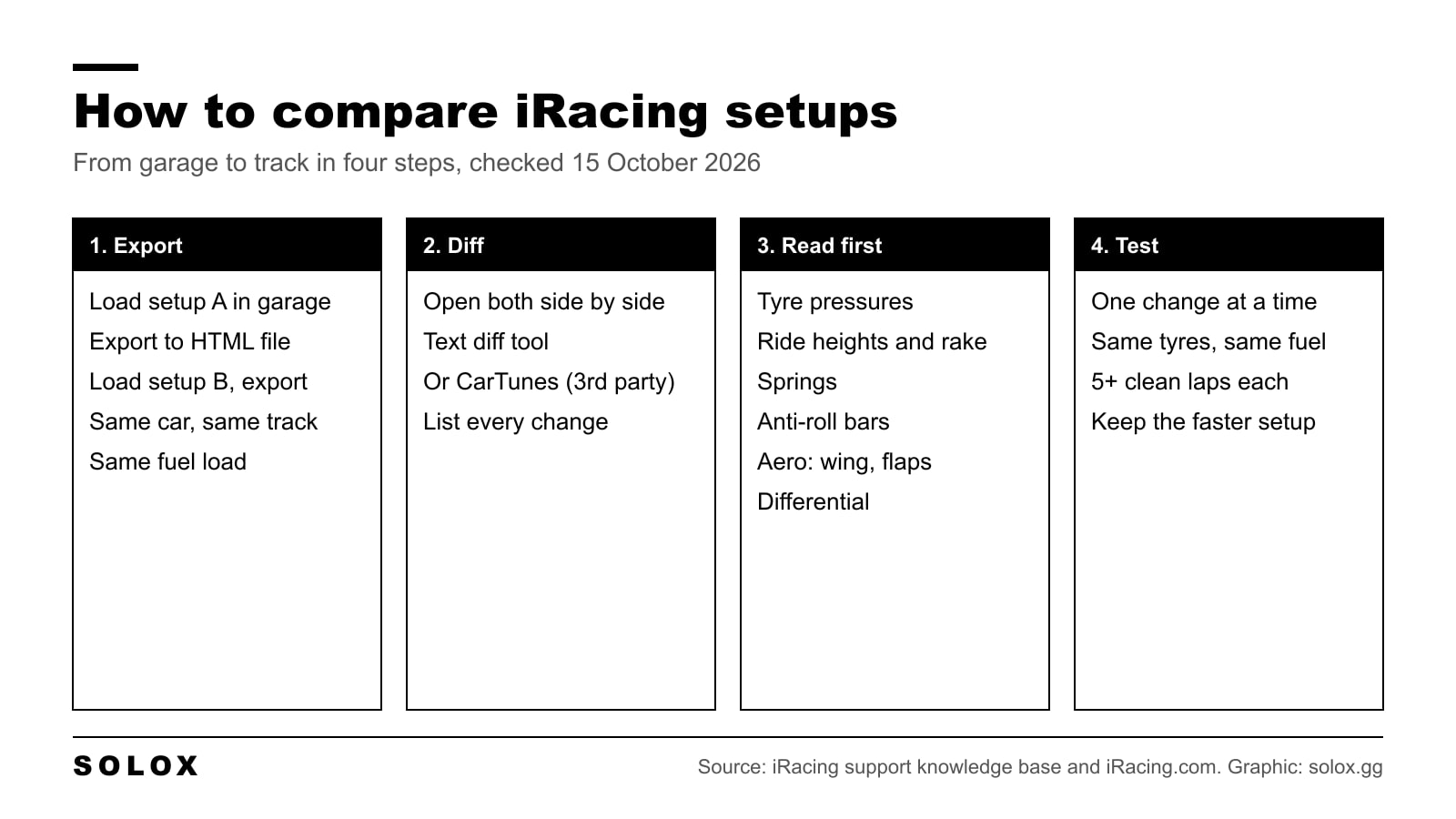
To compare setups on iRacing, export both setups from the garage to HTML, put the two files side by side and list every line that is different. iRacing has no documented button that compares two setups for you, so the diff is on you or on a third-party tool. Then read the changes in a fixed order, starting with tyre pressures and ride heights, and test them one at a time.
Checked on 15 October 2026 against the iRacing support knowledge base articles "Load Custom Setups onto your Racecar!" and "Where does the Simulator place my Chassis Setup files when I save them?" (both last modified 9 September 2025), iRacing.com's Commodore's Garage #26 (2 June 2017) and the CarTunes repository on GitHub (release 0.3.0, 25 January 2022). Where iRacing has not published something, I say so instead of filling the gap.
Understanding iRacing Setup Comparisons
A setup comparison answers one question: what is different between the car I have and the car that is faster?
That second car can be a paid setup, a teammate's shared setup, the iRacing baseline, or your own setup from last week. The method is the same in every case.
In real racing this is how a debrief works. The engineer does not ask how the car "felt better". He puts two sheets next to each other and asks what changed. Sim racing is no different. If you cannot name the change, you cannot learn from it.
Fixed vs open setups
This only matters in open setup series. In a fixed series everyone runs the same setup and you cannot change it, so there is nothing to compare except your driving.
In open series you can change almost everything the real car allows. That is where comparing setups pays off, because the gap between two setups can be bigger than the gap between two drivers.
Why bother comparing at all
Because loading a fast setup and driving it teaches you nothing. You get the lap time once, and next season you are lost again.
Compare it with what you had and you see exactly what the setup builder did. More rake. Softer rear bar. Lower rear pressures. Those are the lessons you carry to the next car.
Does iRacing have a built-in setup comparison?
No, not that iRacing documents. I checked the support knowledge base and found no article that describes comparing two setups side by side inside the sim.
What the knowledge base does document, in "Load Custom Setups onto your Racecar!":
| Garage action | What it does |
|---|---|
| My Setups (under File Actions) | Opens the setups saved for this car |
| Save As | Saves the current setup after you press Apply |
| Share | Sends the setup to drivers in the session, or only to your Team or Club |
| Shared Setups | Opens setups other drivers shared with you |
| Notes tab | Shows guidance on which setup to use |
Two details from that article help when you compare. A shared setup only reaches drivers who are connected when you share it. And a setup file you drop into the folder shows up after you close and reopen the garage screen, without restarting iRacing.
So the in-sim tools load, save and share setups. Comparing them is done outside the sim.
Step 1: Export both setups from the garage
iRacing's own Commodore's Garage column (#26, June 2017) describes an Export button on the Setup Garage menu. It creates an HTML file of whatever setup is loaded at that moment.
The column says the export covers almost everything, from springs and shocks to tyre data, and it keeps corner weights and deflections too. Tyre data is only there when you have just done a run and the data is available.
That last point matters. Export right after a run if you want the hot tyre data in the file.
The current support knowledge base does not have its own article on Export, and the column does not say where the HTML file is saved. Check the location the first time you use it, and keep your exports in one folder of your own so you can find them later.
How I would run it:
- Load setup A in the garage. If you want tyre data in the file, do your run first.
- Export it. Rename the file so you know what it is, for example the car, track and source.
- Load setup B and do the same.
- Keep the car, the track and the fuel load the same for both. Fuel changes weight, and weight changes ride heights and corner weights, so a different fuel load makes the diff lie to you.
Where the setup files themselves live
The saved setups are not the exports. According to iRacing's support article, they go in your Documents folder:
Documents\iRacing\setups\[car folder]
The car folder is created the first time you drive that car. Its name does not always match the car's name, so do not guess. Open My Setups or Save As in the garage and the exact folder is shown at the top of the window.
For the full folder walk-through, I covered it in where to put iRacing setups and how to install iRacing setups.
Diff the exports, not the saved setup files. The saved file is what the sim loads, and iRacing does not publish its format. The HTML export is the one meant for people to read.
Step 2: Diff the two files
You have two HTML files. Now find every difference.
By eye. Open both in your browser, in two windows side by side, and go section by section. It is slow, but on a car with a short setup sheet it works fine.
With a text diff tool. Any tool that compares two text files will mark the lines that changed. On Windows, the built-in fc command compares two files from the command prompt. Code editors such as Visual Studio Code can open two files in a compare view. HTML markup can make the output noisy, so if it is hard to read, go back to the browser view and use the diff only to find which sections changed.
With CarTunes (third party). CarTunes is a free, open-source app on GitHub, built only for comparing iRacing setup exports. You export setups from the garage, and it shows them side by side, with increased values in green and decreased values in red. It is MIT licensed. Its latest release is 0.3.0 from 25 January 2022, and the last code push was in May 2023. That is old. iRacing's garage has changed since, so treat it as "may still work", and check before you rely on it.
There are other community tools that read the setup stored in telemetry files. I could not find an official download page or a primary source for the ones I looked at, so I am not linking them here. If you use one, download it only from the developer's own page.
Whatever you use, write the result down as a short list. Parameter, value in A, value in B. That list is your debrief sheet.
Step 3: Read the differences in the right order
A GT3 or prototype setup sheet has dozens of lines. Most diffs between two good setups come down to a handful of them. This is the order I read them in, because it goes from the things that change the car most to the things that fine-tune it.
| Order | Parameter | What a change usually tells you |
|---|---|---|
| 1 | Tyre pressures | How the setup builder wanted the tyres to work. Pressure changes the contact patch and how fast the tyre comes in |
| 2 | Ride heights and rake | Platform and aero balance. More rake usually moves aero balance forward |
| 3 | Springs | How the car rides kerbs and bumps, and how much it pitches and rolls |
| 4 | Anti-roll bars | Mid-corner balance. A stiffer bar on one axle usually gives that end less grip |
| 5 | Aero (wing, flaps, splitter if the car has them) | Top speed against downforce, and front to rear aero balance |
| 6 | Differential | Behaviour on entry and on throttle exit |
Tyre pressures first
Start here because pressures are the easiest thing to get wrong and they change everything else. A setup that looks completely different can be the same setup with different pressures for a different track temperature.
Look at cold pressures in both setups. If your export has run data, look at the hot pressures and tyre temperatures as well. If you need help getting heat in before you judge them, I wrote up how to heat up tyres in iRacing.
Ride heights and rake
Ride height is where most fast setups hide their speed on downforce cars. Compare front and rear separately, then work out the rake (rear minus front).
The export also gives you corner weights. If they are different between A and B, check the fuel and the spring perches before you blame anything else.
Springs and anti-roll bars
Read these as a pair. Springs carry the car on bumps and kerbs. Bars mostly control roll in the corner.
If setup B is faster in slow corners and the only big change is the rear bar, that is your answer. If springs and bars changed together, test them separately or you will never know which one did the work.
Aero
On cars with a rear wing, wing angle is usually the first thing setup builders move between tracks. Compare it with the track in mind. More wing at Monza and less at a tight circuit would be the wrong way round, so a diff like that tells you something is off.
Differential
The diff changes how the car turns in under braking and how it puts power down on exit. Look at preload and any ramp or lock settings the car has. Diff changes are subtle in the data and very obvious in your hands, so this is one to feel on track.
Then the rest
Dampers, camber, toe, brake bias and gearing come next. They matter, but they are fine-tuning. Do not start with them when ride heights are 5 mm apart.
Step 4: Test one change at a time
The diff tells you what changed. Only the track tells you what each change is worth.
Here is how to keep the test honest:
- Same conditions. Same track, same fuel, same tyre state. Use a test session so nothing changes between runs.
- Baseline first. Drive setup A until your laps are consistent. If your lap times spread by half a second, a 0.2 second gain is noise.
- One change per run. Take the biggest single difference from your list, apply it to setup A, save it under a new name, and drive.
- Compare laps, not feelings. Use telemetry to see where the time came from. Entry, apex or exit. My guide on using telemetry to get faster covers what to look at.
- Keep the winner. If the change is faster, it stays. If not, go back and try the next item on the list.
This is slower than loading setup B and driving. But after a few cars you will know what each parameter does, and you stop depending on whoever built the setup.
Comparing against paid and shared setups
The most common comparison is your own setup against a bought one. Most shops ship files you drop into the car folder, and some ship telemetry too. If you are choosing where to get them, start with where to get iRacing setups for free before you pay for anything.
With a shared setup from a teammate, remember the rule from the support article: you only receive it if you are connected when they share it. Save it under your own name straight away, then export it like any other setup.
One honest warning. A fast setup built for an alien's driving style can be slower for you. The diff shows you why. If the faster driver runs much less rear grip, maybe that is the change you are not ready for yet, and that is fine.
FAQ
Can you compare two setups inside the iRacing garage?
Not that iRacing documents. The support knowledge base covers My Setups, Save As, Share and Shared Setups, but no side-by-side comparison. Export both setups and compare them outside the sim.
How do I export an iRacing setup to HTML?
iRacing's Commodore's Garage column describes an Export button on the Setup Garage menu that writes an HTML file of the loaded setup. Export straight after a run if you want tyre data included.
Where are iRacing setups saved?
In Documents\iRacing\setups\[car folder]. The folder is created the first time you drive the car, and the garage shows the exact path at the top of the My Setups and Save As windows.
Is CarTunes still working in 2026?
I cannot confirm it. CarTunes is a free third-party app whose latest release, 0.3.0, came out in January 2022. It was built to compare iRacing setup exports, but test it with a current export before trusting it.
Which setup changes should I look at first?
Tyre pressures, then ride heights and rake, springs, anti-roll bars, aero and the differential. Dampers, alignment and brake bias come after those.