
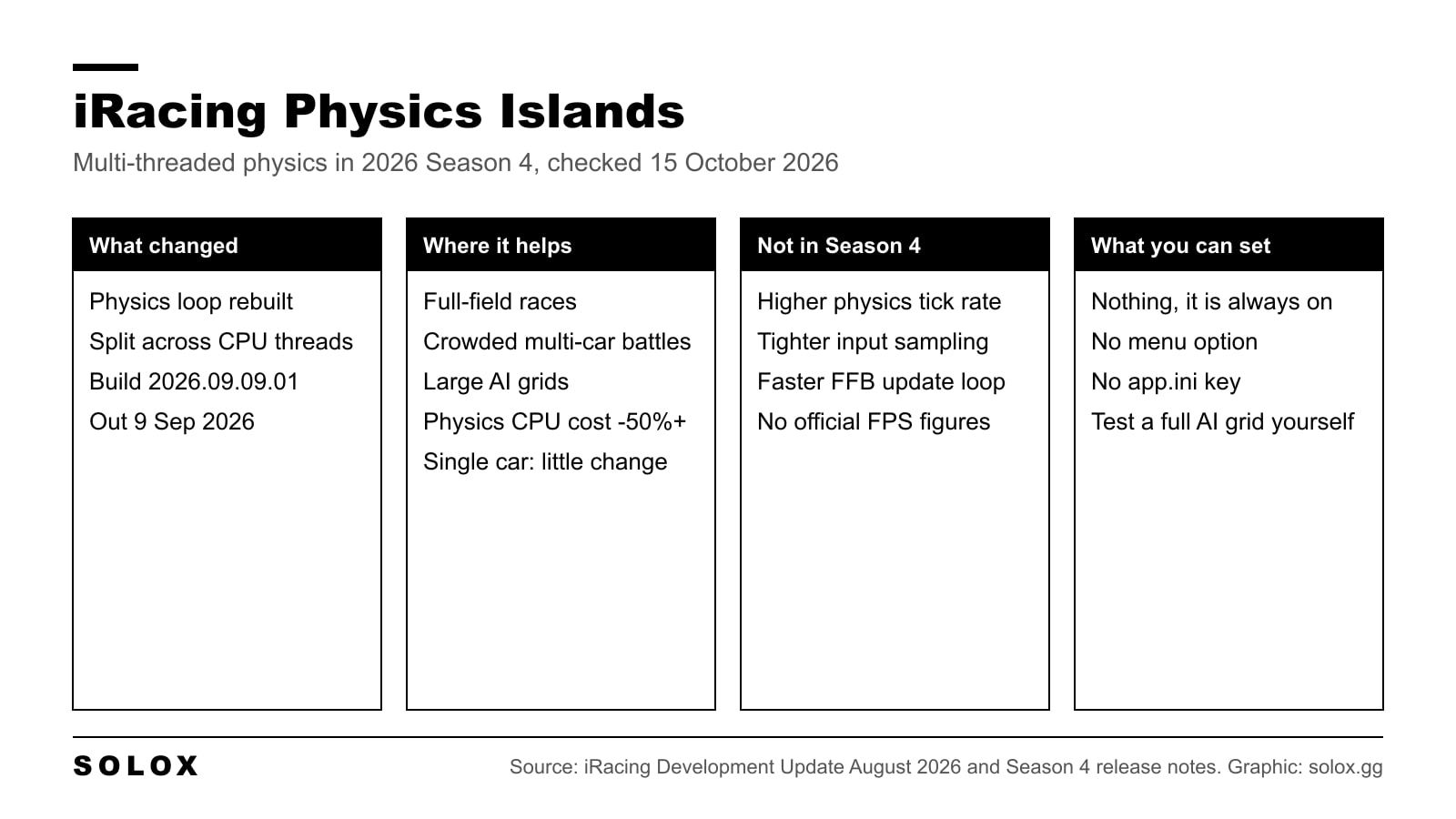
Physics Islands is iRacing's name for the multi-threaded physics engine that arrived in 2026 Season 4. The core physics update loop was refactored and split so it runs across more of your CPU threads. iRacing says that cuts the CPU cost of physics by 50% or more when the track is full of cars. Alone on track, you will barely notice it.
Checked on 15 October 2026 against iRacing's Development Update for May 2026 (28 May 2026) and August 2026 (28 August 2026), the 2026 Season 4 Initial Release Notes for build 2026.09.09.01 (9 September 2026), the Season 4 Hotfix 1 notes for 2026.09.11.01 (11 September 2026) and the Season 4 Patch 1 notes for 2026.10.01.01 (5 October 2026), all on iracing.com and support.iracing.com. Where iRacing has not published something, I say so instead of filling the gap.
What Physics Islands is
The Season 4 release notes put it in two lines. First, "Multi-threaded physics processing has been enabled." Then the detail: iRacing refactored and multi-threaded the core physics update loop, "an internal initiative we call 'Physics Islands'."
How they did it, in their words: they sliced the physics workload and parallelised the end of the physics tick. So the calculations are now spread across the CPU threads you have, instead of piling up in one place.
That is all iRacing has said about the method. They have not published how the work is split, how many threads it uses, or whether it scales differently on 6 cores against 16. I am not going to guess.
Why iRacing built it
Two reasons, both from iRacing's own dev updates.
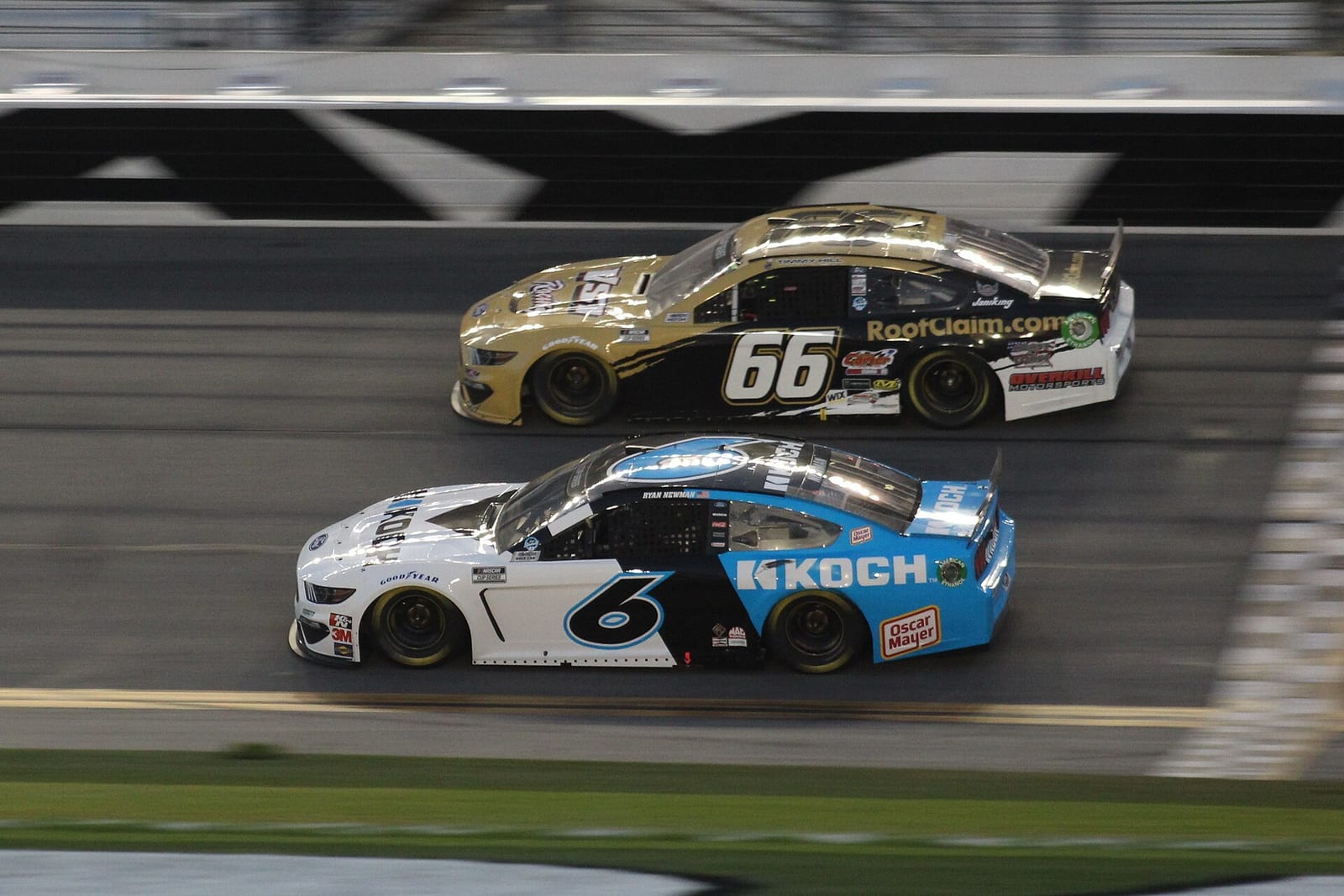
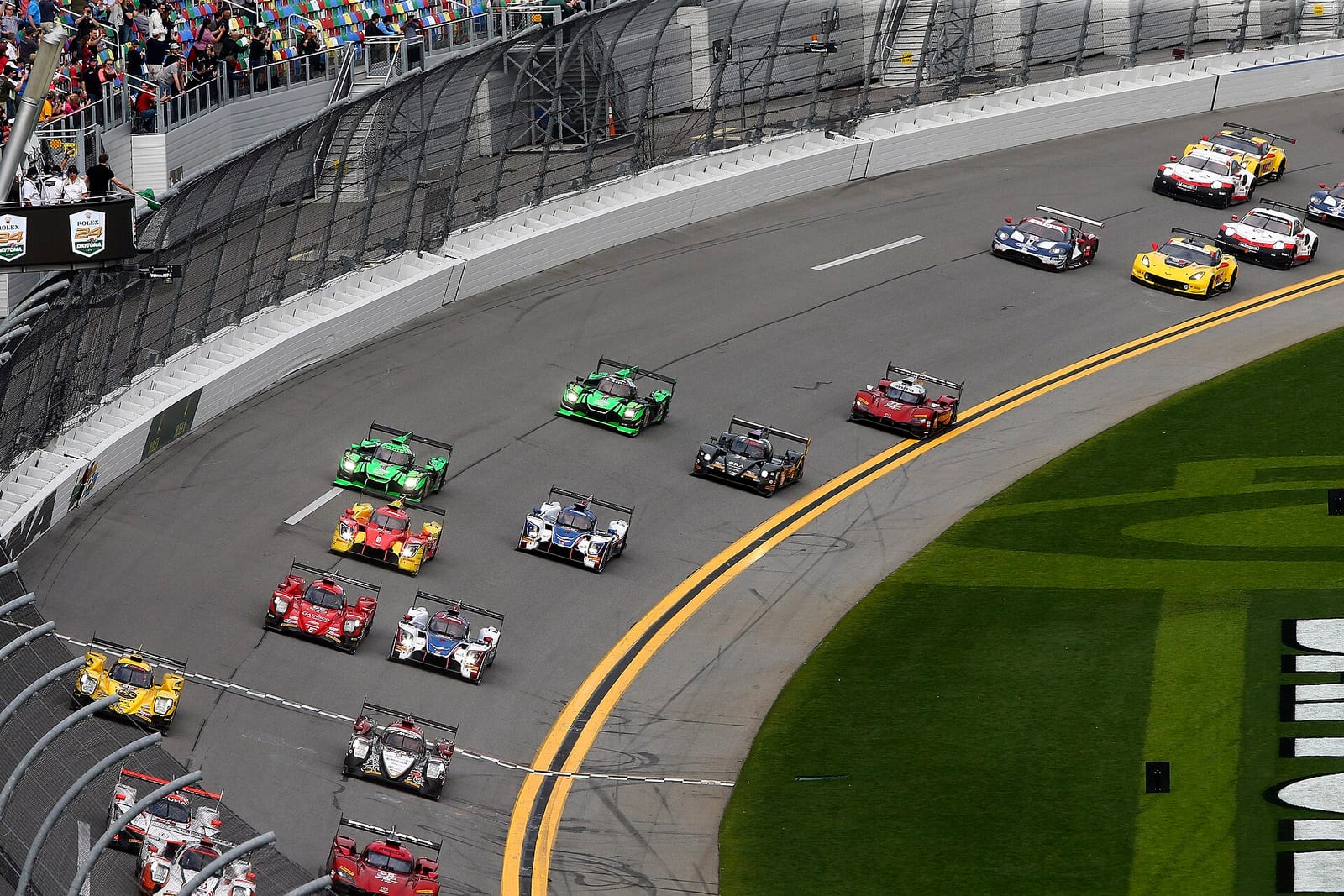
Performance in traffic. Every car on track is a physics job. Your own car, every AI car, every remote car in an online race. More cars, more work for the CPU. Spreading that work over more threads is the obvious fix.
Groundwork for the next phases. The August 2026 Development Update calls Physics Islands the first big milestone of a multi-year overhaul of the physics engine. It is the base for what comes next:
- higher physics tick rates
- tighter input sampling
- faster force feedback update loops
None of those three are in Season 4. iRacing has given no date and no target numbers for them. If someone tells you your force feedback runs faster since September, that is not what iRacing has announced.
This was not a surprise drop either. The May 2026 Development Update already described the physics update as "sliced and optimized" and said the end of the physics tick had been made safe to run multi-threaded. It was in testing then.
What changes for your CPU
This is iRacing's claim, and the conditions matter as much as the number:
| Session type | What iRacing says |
|---|---|
| Single car, test drive | Little or no measurable change |
| Full-field races | CPU physics overhead down 50% or more |
| Crowded multi-car battles | Biggest gains |
| Large AI grids | CPU physics overhead down 50% or more |
| Online races with many remote cars | Benefit, per the May 2026 update |
iRacing says this holds "across a wide range of hardware". They have not published the test machines, the methodology or the raw numbers.
Note what the 50% applies to. It is the physics overhead on the CPU, not your total CPU usage and not your frame rate. iRacing does other CPU work too, for rendering, audio and networking. So if physics was a small slice of your CPU time, halving it moves the total less than the headline suggests.
What it does to your FPS
iRacing has not published a single FPS figure for Physics Islands. Not in the dev updates, not in the release notes.
What the August update does say is that it brings frame stability and performance headroom in heavy traffic. That is a sensible claim, and here is the logic. If your PC is CPU limited at the start of a 40-car race, lowering the CPU work per frame gives the frame rate room to hold up. If your PC is GPU limited, the graphics card is the wall and a lighter CPU load changes little.
So the honest answer depends on your rig:
| Your situation | What to expect |
|---|---|
| Frame rate drops at race starts and in packs, GPU not maxed out | Most likely to gain |
| GPU at 95 to 100% everywhere | Little change, the GPU is the limit |
| Hot lapping alone | No real change, by iRacing's own account |
| Big AI grids offline | Should see the clearest difference |
To find out which one you are, watch GPU usage in your monitoring tool at a race start. If it sits well below full while frames drop, you are CPU bound. My CPU guide for sim racing explains what to look for in a processor, and if the GPU is your wall, start with making iRacing use all your GPU memory.
There are community benchmarks floating around. I have not verified any of them, so I am not quoting numbers here. The test I trust is your own, on your own PC.
Does it change multiplayer?
The physics change is on your PC. iRacing's May update says sessions with many AI or remote cars are where the gains come from, and an online race with a full grid is exactly that.
What iRacing has not said is that anything changed in the netcode, in how remote cars are shown, or in the server. The release notes for Season 4 do not mention it. So I read it as: your PC has an easier time with a full online grid, nothing more.
Settings you can change
None. There is no switch for Physics Islands.
I went through the Season 4 initial notes, Hotfix 1 and Patch 1. None of them mentions a menu option, a renderer setting or an app.ini entry for multi-threaded physics. It is simply on. If a forum post tells you to edit a thread count in app.ini for this, iRacing has not documented it, and I would leave the file alone.
What you can do is the usual work on the rest of the load. If you are still short of frames in traffic, the settings that cost the most are in my iRacing graphics settings guide, and the general fixes are in how to get better FPS on iRacing.
How I would test it on your PC
A simple before and after is not possible now, because the old physics loop is gone. But you can still check what it does for you:
- Open an AI race with the biggest grid your car and track allow.
- Turn on the frame rate display and your CPU and GPU monitoring.
- Note the frame rate on the grid, at the first corner and in the pack on lap 2.
- Run the same track alone in a test drive and compare.
- If the gap between alone and in traffic is small, your CPU is coping. If it is big and the GPU is not maxed out, the CPU is still your limit.
That tells you where to spend money, if anywhere. A full grid is where I would look first, because it is where Physics Islands is supposed to earn its keep.
Known issues and later patches
I checked every Season 4 release note up to today:
| Build | Date | Physics Islands related |
|---|---|---|
| 2026.09.09.01, Initial Release | 9 September 2026 | Multi-threaded physics enabled |
| 2026.09.11.01, Hotfix 1 | 11 September 2026 | Nothing. Fixes for two UI crashes and the Caterham rear suspension damage |
| 2026.10.01.01, Patch 1 | 5 October 2026 | Nothing |
iRacing has not listed a known issue tied to multi-threaded physics. The one known issue in the initial notes is the Reference Car UI not showing for VR users, which has nothing to do with physics. If you get crashes or stutter you blame on the new physics, iRacing has not confirmed any such problem, so report it on the official forums with your hardware and session details.
The same Season 4 build also changed how fuel mass affects the car's centre of gravity. That is a physics model change, separate from Physics Islands, and it can change how a car feels over a stint. More on the rest of the build in my 2026 Season 4 changes.
FAQ
What are Physics Islands in iRacing?
The name iRacing uses for its refactored, multi-threaded core physics update loop. It spreads the physics work across your CPU threads. It shipped in 2026 Season 4.
When were Physics Islands added to iRacing?
In the 2026 Season 4 Initial Release, build 2026.09.09.01, on 9 September 2026.
Do Physics Islands increase FPS in iRacing?
iRacing has not published FPS numbers. It claims CPU physics overhead drops by 50% or more in full fields, plus better frame stability. A CPU limited PC in traffic should gain the most. A GPU limited PC will see little change.
How many CPU cores does iRacing use now?
iRacing has not said. The notes only say the work is distributed across available CPU threads.
Can I turn Physics Islands on or off?
No. There is no menu option or documented app.ini setting. It is on for everyone.
Did Physics Islands change the force feedback?
Not yet. Faster force feedback update loops, tighter input sampling and higher physics tick rates are planned phases, with no date given.
Will I notice it in a test drive alone?
Probably not. iRacing says single-car sessions see little change. The gains come with many cars on track.