
Shanghai asks for a compromise. Half the lap is long corners where you want downforce, and the other half is a back straight of more than a kilometre where downforce only costs you speed.
This is the F1 2017 setup I have for it. It leans to the straight: low wings, a locked differential and a car that is soft enough to ride the kerbs.
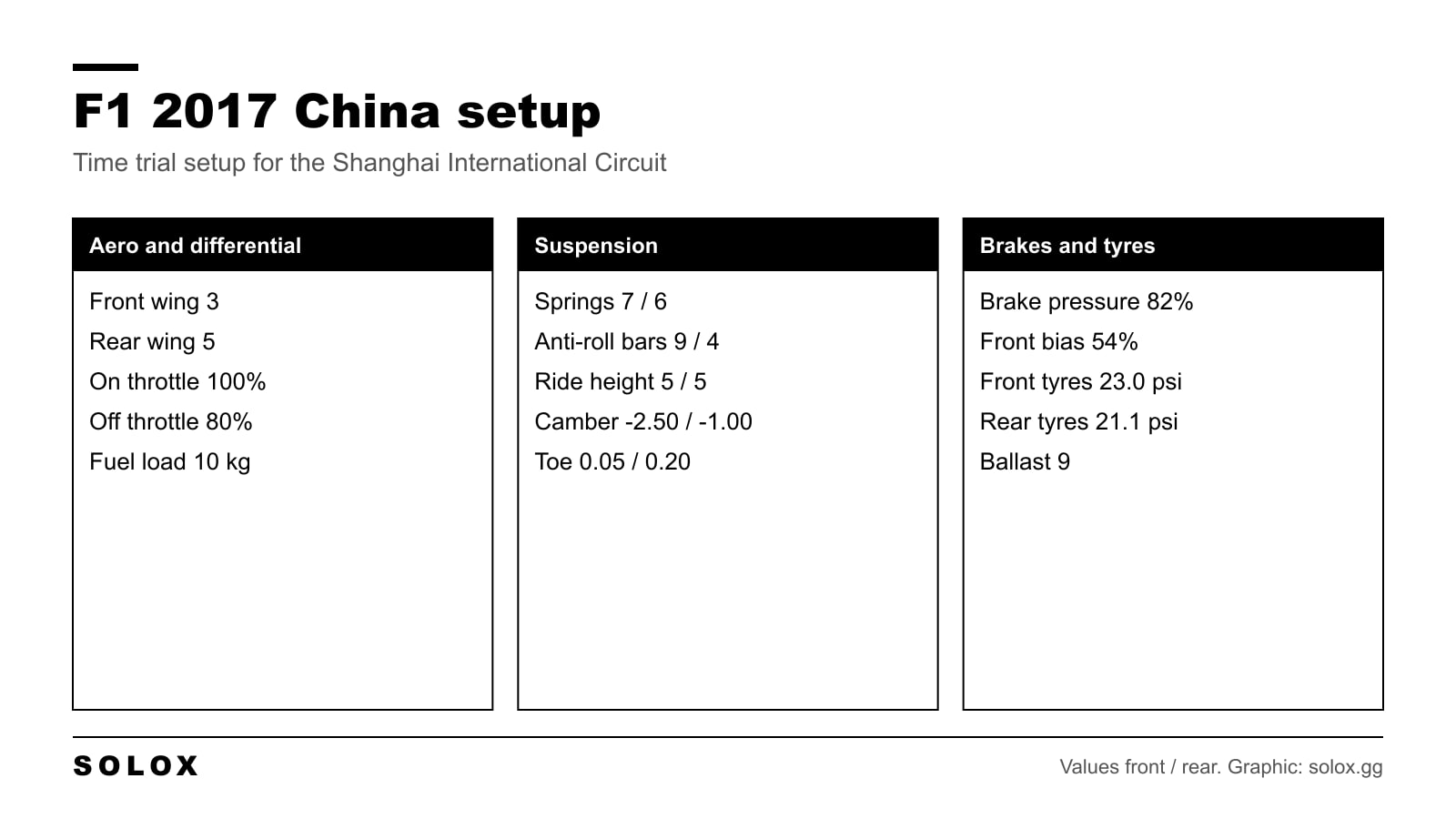
F1 2017 China setup
| Setting | Front | Rear |
|---|---|---|
| Wing | 3 | 5 |
| Differential (on / off throttle) | 100% | 80% |
| Camber | -2.50 | -1.00 |
| Toe | 0.05 | 0.20 |
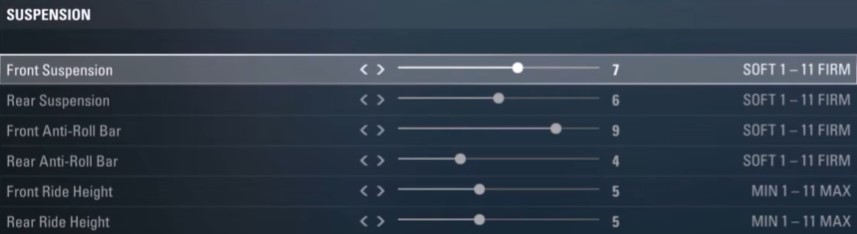
| Suspension | 7 | 6 |
| Anti-roll bar | 9 | 4 |
| Ride height | 5 | 5 |
| Tyre pressure | 23.0 psi | 21.1 psi |
| Setting | Value |
|---|---|
| Fuel load | 10 kg |
| Brake pressure | 82% |
| Front brake bias | 54% |
| Ballast | 9 |
In F1 2017 the wings, suspension, anti-roll bars, ride height and ballast all use a scale from 1 to 11.
This setup was collected for the site in 2022 from a fast time trial lap. Take it as a starting point. I explain below why the values make sense at this track and what I would change, because a setup you understand is worth more than a setup you copy.

Why this setup works at Shanghai
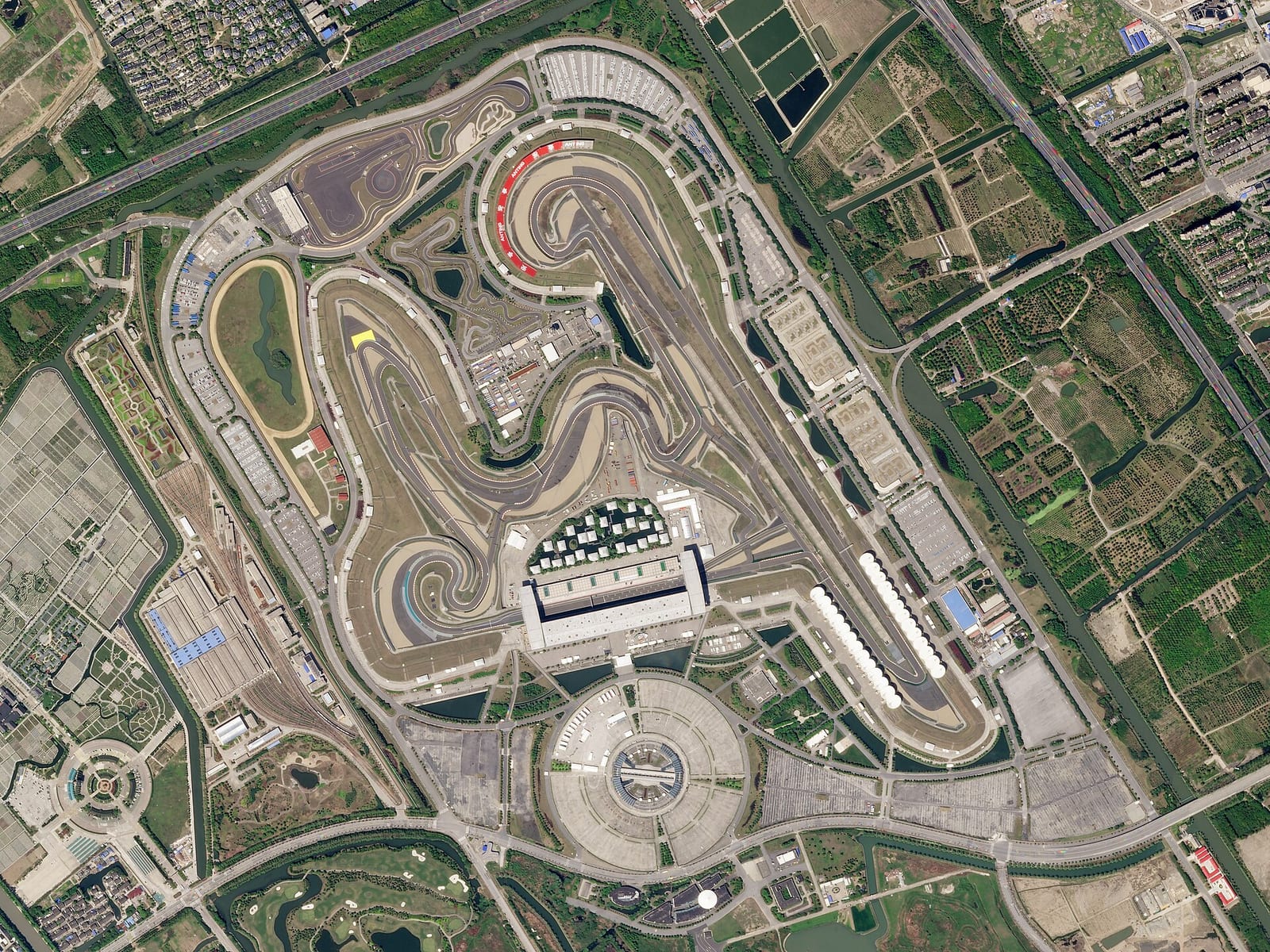
The lap is 5.451 km with 16 corners, and two things decide it.
The back straight. From the exit of turn 13 to the braking point of turn 14 you are flat for about 1.2 km. Every click of wing you carry there costs top speed, and in a race it decides if you can pass or get passed. That is why the wings are only 3 and 5.
The long corners. Turns 1 and 2 are one long right hander that tightens all the way, and turns 12 and 13 are the same idea in reverse, a corner that opens onto the straight. In both, the front left tyre does all the work for a long time.
With low wings the grip in those corners has to come from the mechanical side. So the front anti-roll bar is stiff at 9, to keep the front responsive, and the rear bar is soft at 4, so the rear tyres stay on the ground when you go to the throttle.
Differential and suspension
The on throttle differential is at 100%, fully locked. Both rear wheels push together, which gives the best drive in a straight line and out of the turn 13 exit. The price is that the car wants to go straight when you pick up the throttle, and the inside rear tyre gets dragged across the track. For one lap that is fine. For 20 laps it eats the rears.
Off throttle it is 80%. That is quite locked too, so the rear stays stable when you lift into the fast turn 7 and 8.
Suspension 7 and 6 with ride height 5 and 5 is a neutral base. Nothing extreme. The car takes the kerbs at turn 3 and at the turn 9 and 10 exit without jumping.
What to change
Change one thing at a time and do three laps before you judge it. If you change two things you never know which one worked.
| Problem | Change | Why |
|---|---|---|
| Understeer in the long turn 1 and 2 | Front wing 3 to 4 | More front grip in the corner where the front left tyre works hardest |
| Rear steps out on exit of turn 6 or turn 14 | On throttle differential 100% to 85% | The rear wheels can turn at different speeds, so the inside one spins less |
| Rear is nervous in the fast turn 7 and 8 | Rear wing 5 to 6 | More rear downforce. You lose a little on the back straight |
| Front tyres lock into the turn 14 hairpin | Brake pressure 82% to 78% | Less peak pressure, easier to control without ABS |
| Front left tyre is finished after ten laps | Front anti-roll bar 9 to 7 | A softer front loads the outside tyre less in the long corners |
| Car turns in slowly on a pad | Front brake bias 54% to 52% | More rear braking helps the car rotate on entry |
For a race
The time trial setup is too hard on the tyres for a race distance. Three changes I would make before a 25% or 50% race:
- On throttle differential 100% to 85%. The biggest one. The rear tyres last longer and the car is easier out of slow corners on full tanks.
- Front wing 3 to 4. With fuel in the car it understeers more in turn 1 and 2, and understeer there kills the front left.
- Fuel. The 10 kg is a time trial number. In a race the game sets the load for the distance.
On a pad, I would also take the brake pressure down to around 78%. It is hard to be gentle with a trigger, and Shanghai has two big stops where a locked front costs you the corner.
Where the lap time is at Shanghai
- Turns 1 and 2. Do not brake in a straight line and then turn. Carry the brake into the corner and let the speed come down as the corner tightens. Be patient. If you go to the throttle too early you run wide and lose turn 3 as well.
- Turn 6. A heavy stop into a slow right hander. Brake in a straight line, turn late, get the car straight early for the run to turn 7.
- Turns 7 and 8. The fastest part of the lap, left then right. One smooth input for each. A lift is better than a correction.
- Turns 11, 12 and 13. The most important corners of the lap, because the back straight comes after them. Go slow into 11 and 12 so you can be on full throttle early in 13. Every km/h at the exit stays with you for more than a kilometre.
- Turn 14. The hardest braking point of the lap, from top speed down to a hairpin. Brake a little earlier than you think and focus on the exit. It is also the best place to pass.
It is the same rule I give drivers in karting: the corner before the longest straight matters most. Give up the entry, win the exit.
Shanghai in 2017
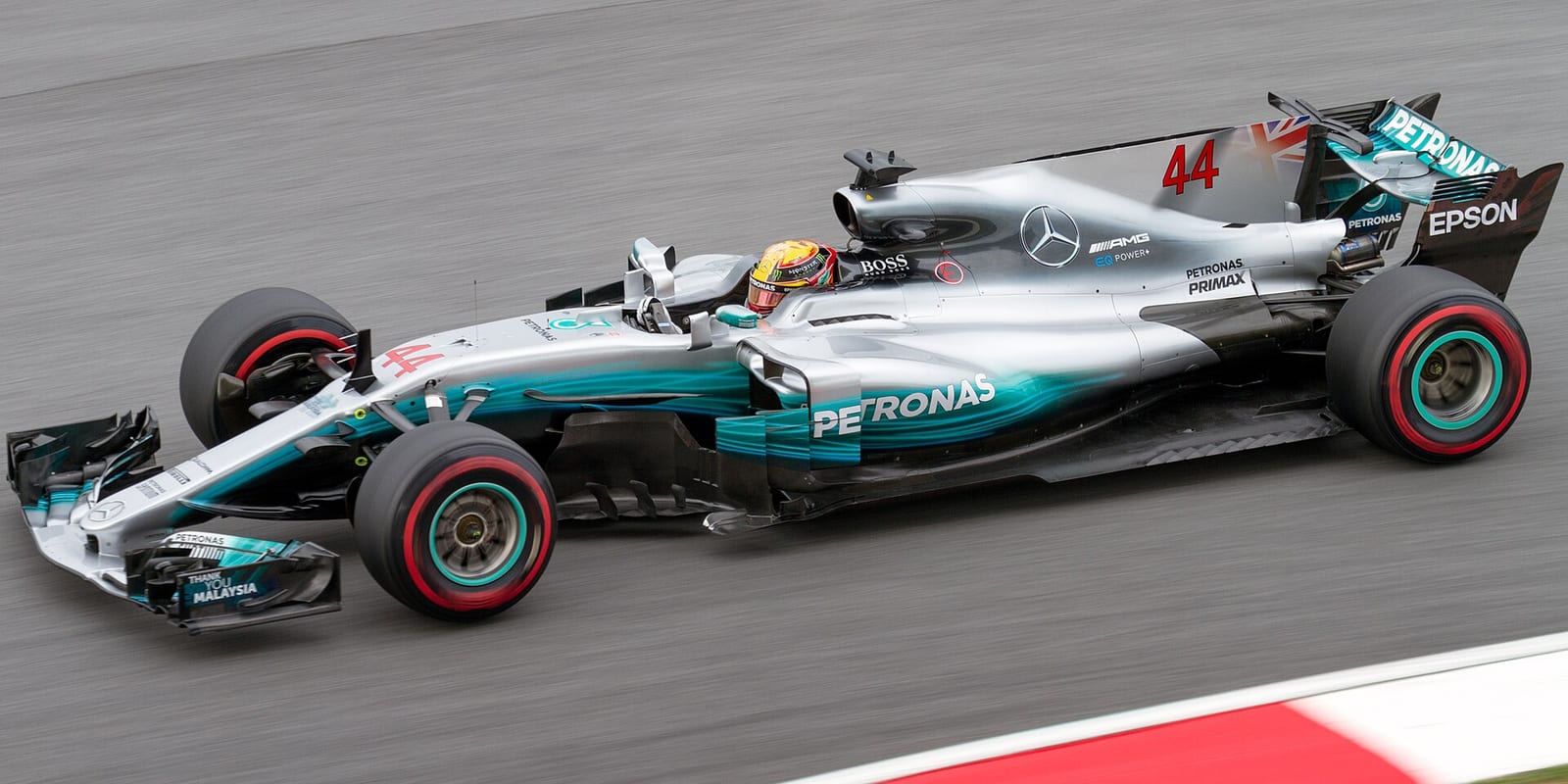
The real 2017 Chinese Grand Prix was the second round of the season, in April. Lewis Hamilton took pole in 1:31.678 and led every lap of the 56 to win for Mercedes. Sebastian Vettel was second for Ferrari and Max Verstappen finished third for Red Bull after starting 16th.
More F1 2017 setups
All 20 tracks are in my F1 2017 setups table. The rounds either side of this one are the F1 2017 Australia setup and the F1 2017 Bahrain setup, which uses the same wings as this one.
If you are on the current game, here is my F1 25 China setup.
FAQ
What is the best wing setup for China in F1 2017?
Front wing 3 and rear wing 5 for time trial. For a race I would go to 4 at the front to help the car in the long turn 1 and 2.
Why is the differential at 100% on throttle?
A locked differential gives the best traction in a straight line, which helps on the exit onto the back straight. It wears the rear tyres faster, so open it to around 85% for a race.
Does this setup work with a controller?
Yes. I would lower the brake pressure to around 78% and the on throttle differential to 85% so the car is easier on the triggers.
What tyre pressures should I use at Shanghai?
23.0 psi front and 21.1 psi rear. If the front left overheats in the long corners, soften the front anti-roll bar before you touch the pressures.
Where can I overtake at Shanghai in F1 2017?
Into the turn 14 hairpin at the end of the back straight, with DRS. Turn 6 is the second option.
Can I use this setup in the wet?
Not as it is. For rain I would add two or three clicks of wing at both ends, raise the ride height by one and open the on throttle differential.