
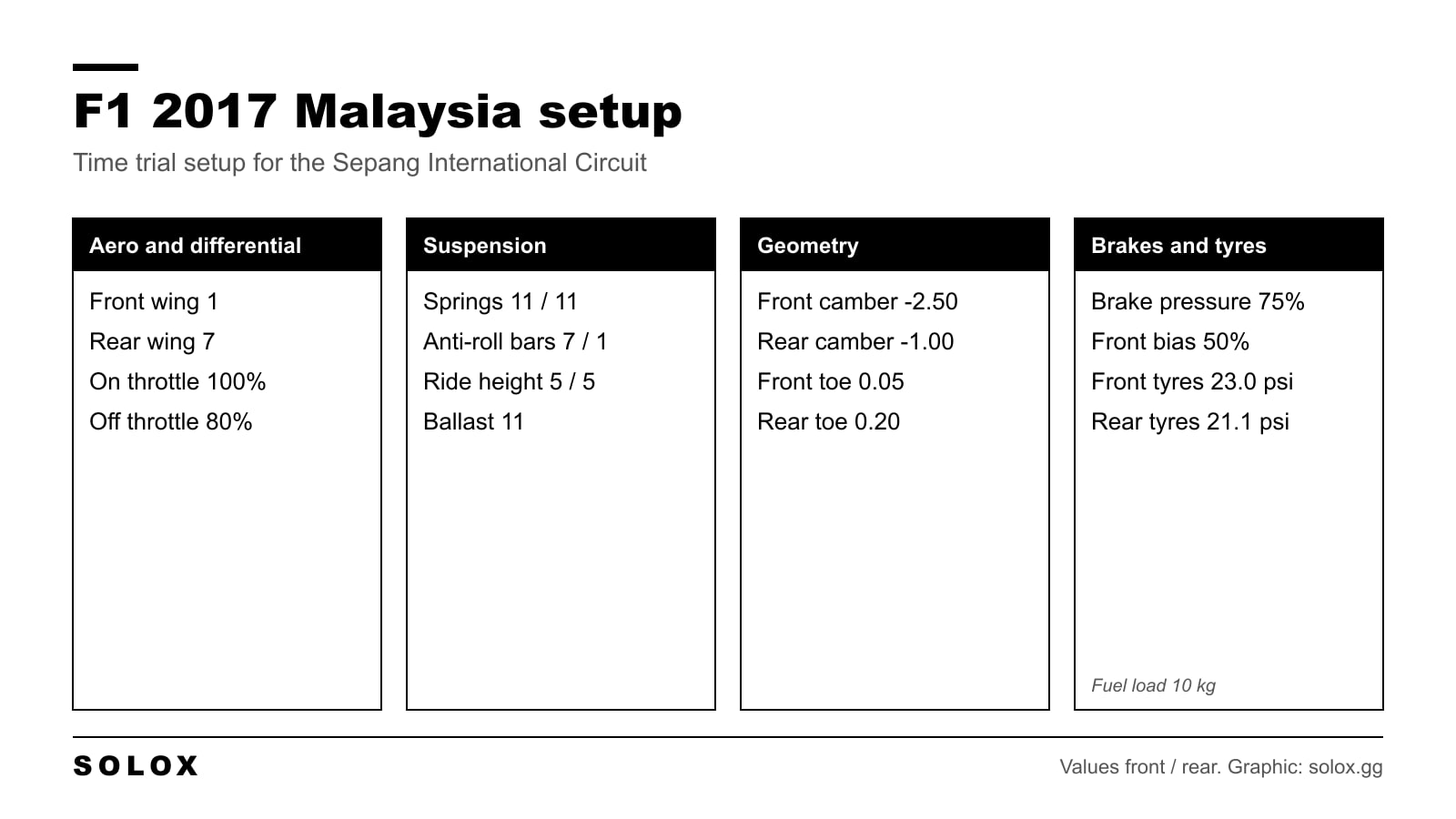
This is the F1 2017 setup for Malaysia on this site: front wing 1, rear wing 7, suspension at 11 and 11, and the differential locked on throttle. It is a time trial setup, saved with 10 kg of fuel. The full menu is in the table below, then I explain why it works at Sepang and what I would change for a race or for a pad.
It was collected in 2022 from a fast time trial lap, like the rest of my F1 2017 setups. Use it as a starting point.
F1 2017 Malaysia setup
| Setting | Value |
|---|---|
| Fuel load | 10 kg |
| Front wing | 1 |
| Rear wing | 7 |
| Differential on throttle | 100% |
| Differential off throttle | 80% |
| Front camber | -2.50 |
| Rear camber | -1.00 |
| Front toe | 0.05 |
| Rear toe | 0.20 |
| Front suspension | 11 |
| Rear suspension | 11 |
| Front anti-roll bar | 7 |
| Rear anti-roll bar | 1 |
| Front ride height | 5 |
| Rear ride height | 5 |
| Brake pressure | 75% |
| Front brake bias | 50% |
| Front tyre pressure | 23.0 psi |
| Rear tyre pressure | 21.1 psi |
| Ballast | 11 |

Why this setup works at Sepang
Sepang is 5.543 km long with 15 corners. It has two long straights joined by a hairpin, a fast change of direction at turns 5 and 6, and a lot of medium speed corners where the car is loaded for a long time. You need top speed and a stable rear at the same moment, and that is hard to get.
This setup solves it with the aero balance. The front wing is at the minimum, the rear at 7 out of 11. You carry little drag at the front, and the rear stays planted through turns 5 and 6 and through the fast left at 12 and the long right at 13.
The price is understeer. With that wing split and a front anti-roll bar at 7 against 1 at the rear, the car does not want to turn by itself. Two things bring the rotation back:
- Brake bias at 50%. That is as far rearward as the game goes. The rear helps to turn the car while you are still on the brake, which is what you want into turn 1, turn 4 and turn 15.
- Off throttle differential at 80%. Open enough for the car to rotate when you lift in the middle of the corner.
So you turn this car on the brake, not on the steering wheel. Brake in a straight line, release the pedal slowly as you turn in, and let the rear come round. If you are not used to trail braking the car will feel lazy, and the fix is in the next section.
The stiff suspension
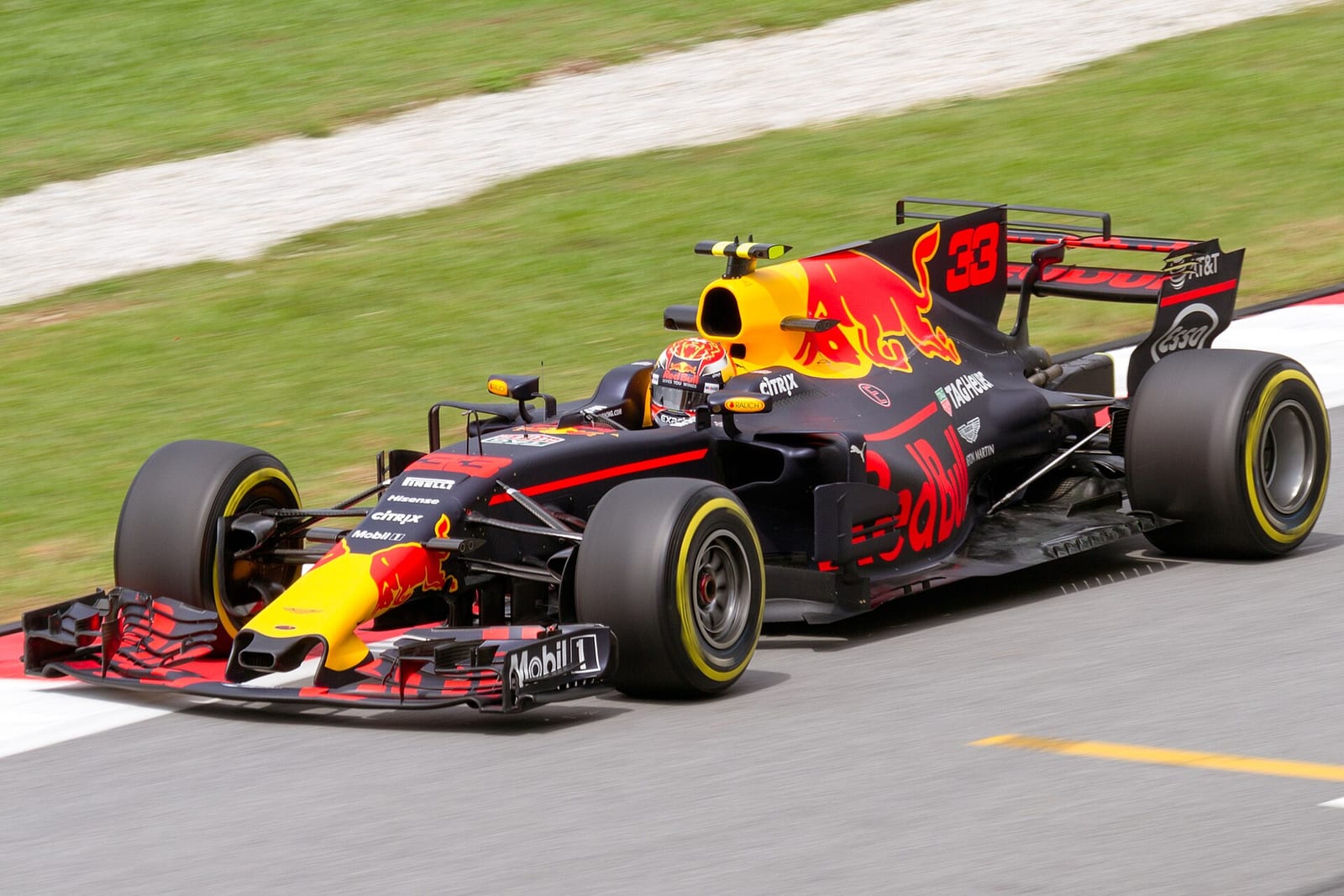
Suspension at 11 and 11 is the firmest setting in the game. A stiff car reacts faster in the change of direction at turns 5 and 6 and keeps the floor at a constant height in the long corners.
It also punishes you on the kerbs. Sepang lets you get away with it because the fast line does not need much kerb, but stay off the inside kerb at turn 2 and at the turn 9 hairpin. If the car jumps, soften both ends to 9 before you change anything else.
What to change
One change at a time, three laps, then decide.
| Problem | Change |
|---|---|
| The car will not turn in | Front wing from 1 to 2 or 3 |
| Still pushing in the middle of the corner | Front anti-roll bar from 7 to 5 |
| Wheelspin out of turn 2, turn 9 or turn 15 | On throttle differential from 100% to 85 or 90% |
| The rear moves under braking | Front brake bias from 50% to 52 or 54% |
| Front tyres lock into turn 1 or turn 15 | Brake pressure from 75% to 72% |
| The car jumps on the kerbs | Suspension from 11 to 9 at both ends |
For a race. With race fuel the car is heavier and the rear tyres work harder for the whole stint. Sepang is hot and rough on the rear tyres, with long traction zones out of slow corners. Add one or two clicks of rear wing, go to 8 or 9, and lower the on throttle differential to 90%. You lose a little on the straights and the tyres last.
On a pad. Start with the differential at 85% and brake bias at 54%. A trigger has less travel than a pedal, and this setup asks for fine control with both feet.
Where the lap time is at Sepang
Turn 1 and turn 2. A long right that tightens, then straight into a slow left that drops away. Brake late for turn 1 but keep trailing the brake deep into the corner, and give up the exit of turn 1 to be on the right line for turn 2. The exit of turn 2 matters more, because a short straight follows.
Turn 5 and turn 6. Fast left, fast right. With the rear wing at 7 the car is stable here. One clean input for each, and a small lift at most.
Turn 9. A slow uphill left hairpin. It is easy to brake too late and miss the apex. Slow in, early on the power, and be gentle with the throttle because the differential is locked.
Turn 12 to turn 14. The hardest part. You go through 12 and 13 fast and then you have to brake for 14 while the car is still turning right. Brake a little earlier than you think, with less pressure, or the inside front will lock.
Turn 15. The last hairpin, between the two long straights. It decides your speed on the main straight and is the best place to overtake. Late apex, car straight as early as you can, then full throttle.
Sepang in 2017
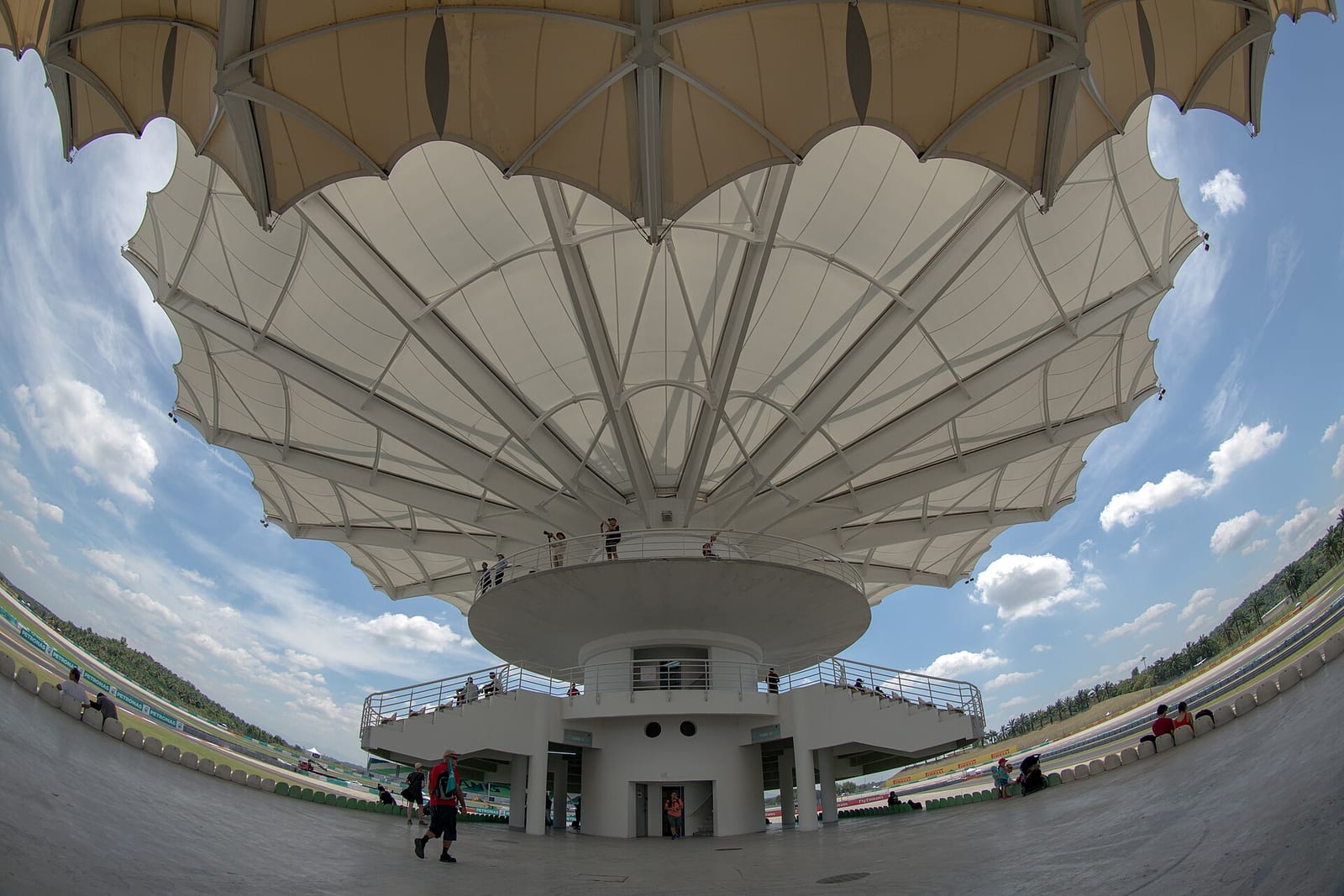
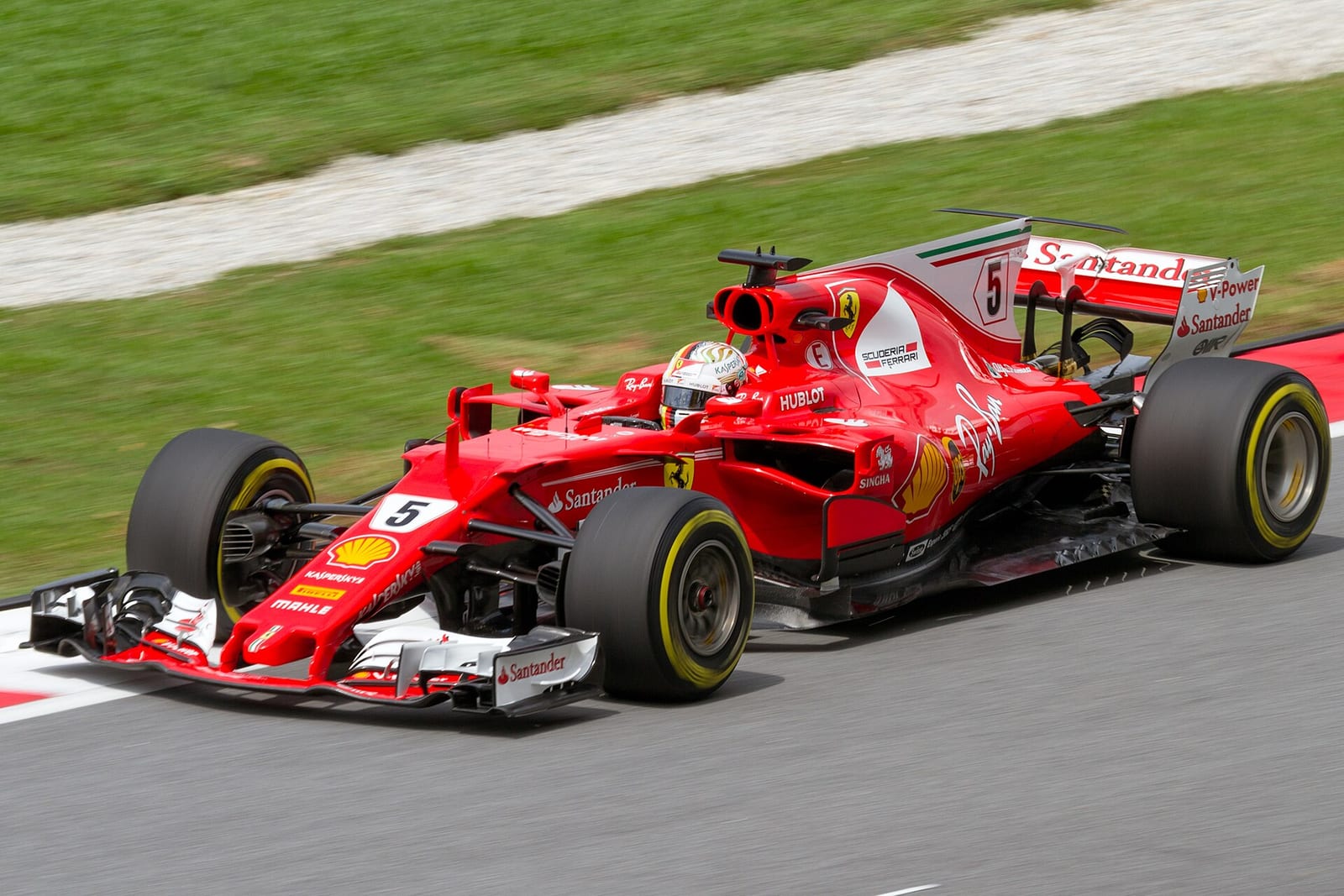
The 2017 Malaysian Grand Prix was the last one held at Sepang. Lewis Hamilton took pole position and Max Verstappen won the race, over 56 laps. It makes F1 2017 the last of the yearly F1 games with the track on the calendar.
More F1 2017 setups
Malaysia sits between two very different tracks on the 2017 calendar. The Singapore setup keeps the same stiff suspension with far more rear wing, and the Suzuka setup goes the other way with an even car, suspension at 6 and 6 and anti-roll bars at 8 and 8. All 20 tracks are in one table on the F1 2017 setups page.
FAQ
What is the best F1 2017 setup for Malaysia?
Front wing 1, rear wing 7, differential 100% on throttle and 80% off, suspension 11 and 11, anti-roll bars 7 and 1, ride height 5 and 5, brake pressure 75% with 50% front bias, and tyres at 23.0 and 21.1 psi.
What wing levels should I run at Sepang in F1 2017?
1 at the front and 7 at the rear for time trial. For a race I would go to 8 or 9 at the rear to protect the rear tyres, and to 2 or 3 at the front if the car does not turn in.
Can I use this Malaysia setup in a race?
Yes, with two changes. It is saved with 10 kg of fuel, so add one or two clicks of rear wing and lower the on throttle differential to about 90% for the extra weight and the tyre wear.
Does this setup work with a controller?
It does. Lower the on throttle differential to 85% and move the front brake bias to 54% so the car is easier to control with triggers.
Why is the suspension so stiff in this setup?
Stiff springs make the car react faster in the quick change of direction at turns 5 and 6 and keep it stable in the long corners. If the car jumps on the kerbs, soften both ends to 9.
Is Sepang in the F1 games after F1 2017?
No. The last Malaysian Grand Prix was in 2017, so the later yearly games do not have it on the calendar.