
Shanghai asks for two cars. One for Turn 1 and Turn 13, two corners that never end and eat the front left tyre. One for the back straight, which is more than a kilometre long.
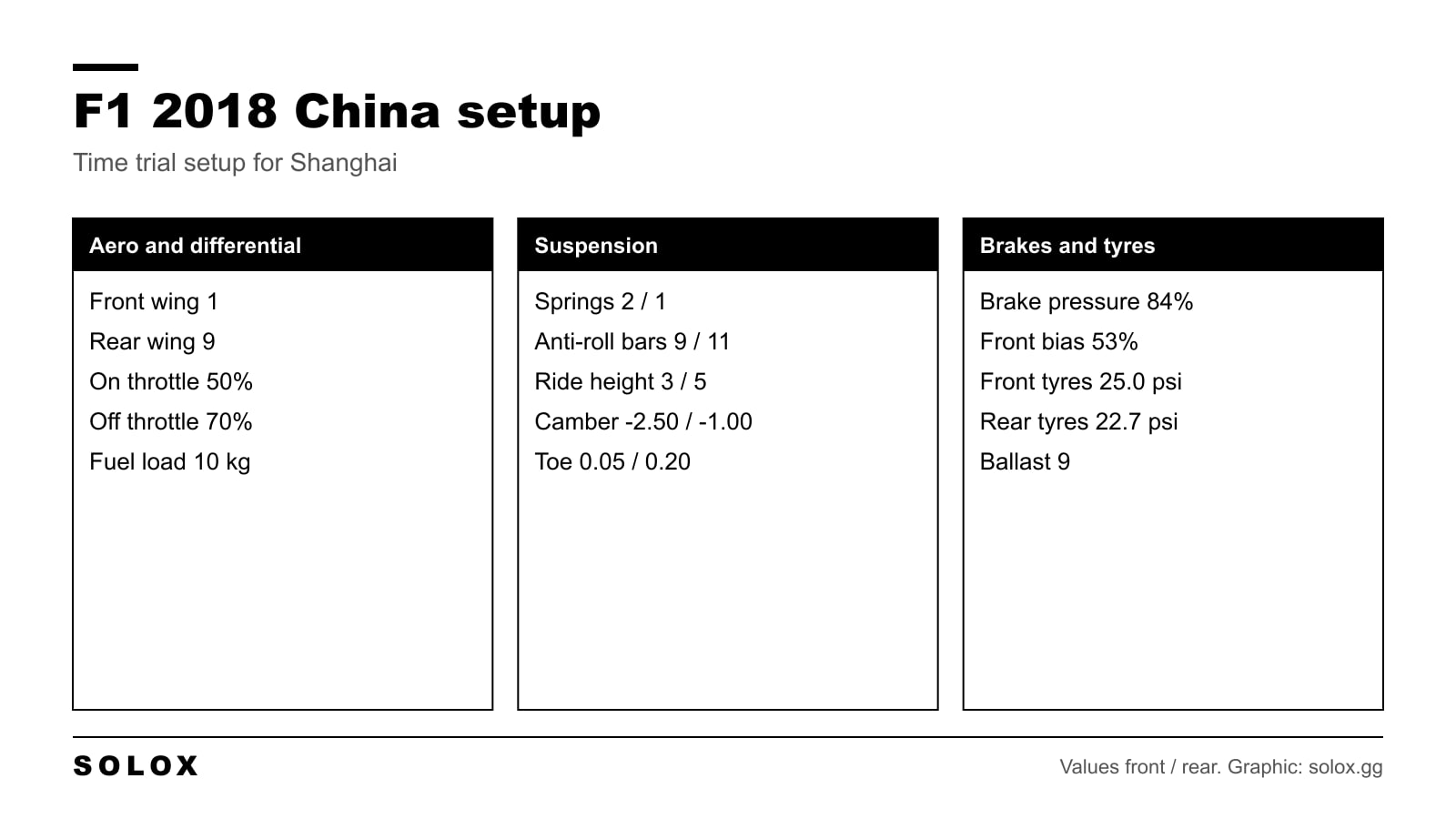
This is the F1 2018 China setup on this site: front wing 1, rear wing 9, an open differential and very soft springs. It is a time trial setup, saved with 10 kg of fuel.
F1 2018 China setup
| Setting | Front | Rear |
|---|---|---|
| Wing | 1 | 9 |
| Camber | -2.50 | -1.00 |
| Toe | 0.05 | 0.20 |
| Suspension | 2 | 1 |
| Anti-roll bar | 9 | 11 |
| Ride height | 3 | 5 |
| Tyre pressure | 25.0 psi | 22.7 psi |
| Setting | Value |
|---|---|
| Fuel load | 10 kg |
| Differential on throttle | 50% |
| Differential off throttle | 70% |
| Brake pressure | 84% |
| Front brake bias | 53% |
| Ballast | 9 |

Here is the lap the setup comes from:
Why this setup works at Shanghai
The lap is 5.451 km with 16 corners. The hard part is that the slow corners here are long. Turn 1 into Turn 2 is a spiral that tightens. Turn 13 is a banked right that opens onto the back straight. In both you are on the steering for a long time, so the car has to rotate without you forcing the front tyres.
This setup does it in an unusual way. Look at the wings first.
The wings. Front 1, rear 9. An eight click gap. On paper that is a car with a lot of understeer: all the downforce is at the back. What you get in return is a rear that never moves in Turn 7 and Turn 8, the fast part, and on the brakes at the end of the back straight.
The rest of the car gives the front back. Everything else is there to make the car turn:
- Rear anti-roll bar 11. The maximum. A stiff rear bar takes grip away from the rear in the corner and helps the car rotate.
- Ride height 3 and 5. The nose is lower than the rear. More rake puts more load on the front.
- Differential 50% on throttle. The minimum. The rear wheels are free to turn at different speeds, so the car keeps turning when you go to the power in Turn 2, Turn 3 and Turn 13.
- Front tyres at 25.0 psi. The maximum. The front responds faster.
So the balance is mechanical at low speed and aero at high speed. It is clever. It is also a setup where one change moves the whole balance, so change one thing at a time.
The geometry. Camber -2.50 and -1.00, toe 0.05 and 0.20. The least angle the menu allows, for braking, traction and speed on the straight.
Springs at 2 and 1
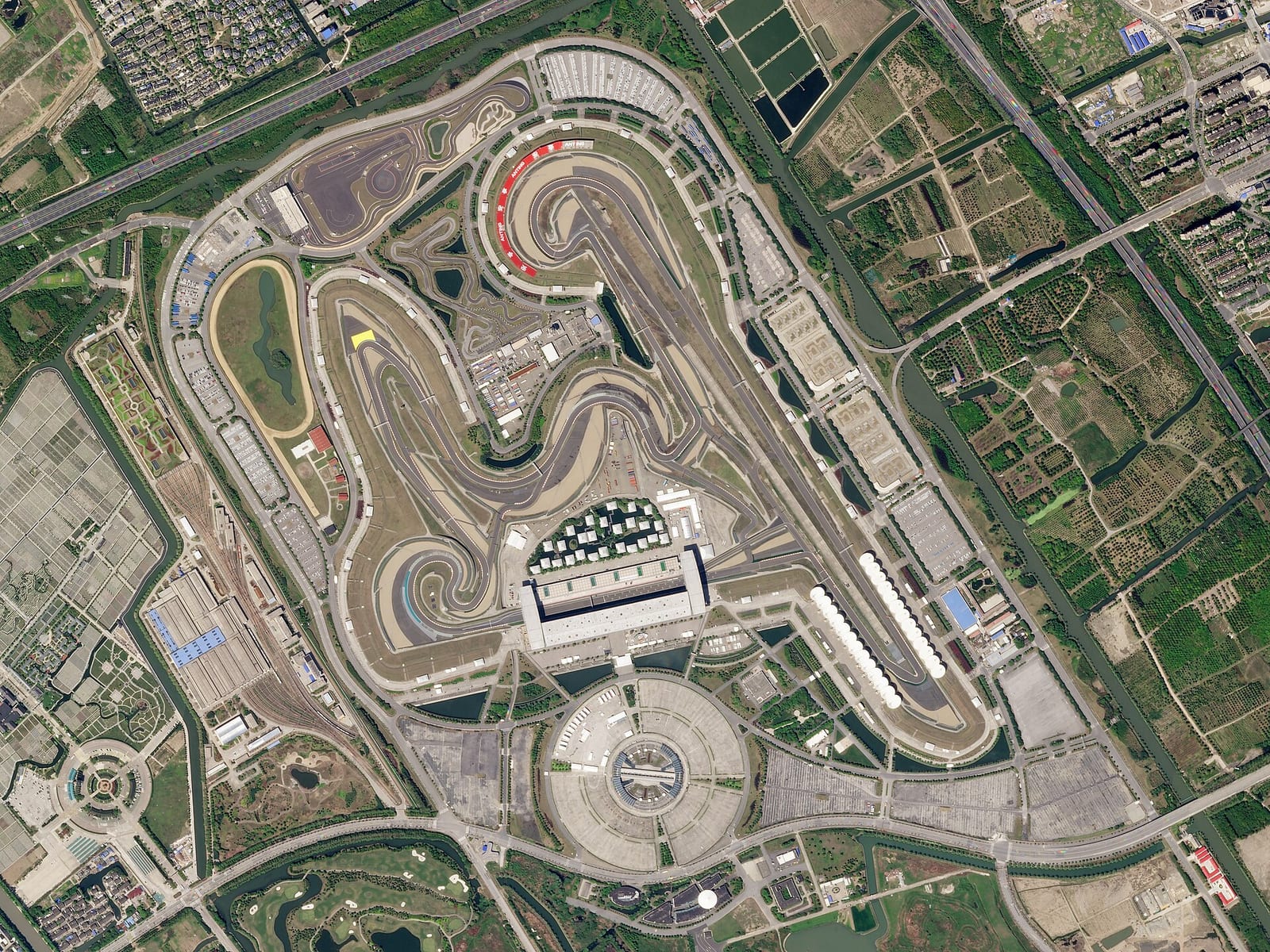
The springs are almost at the softest: 2 at the front, 1 at the rear. A soft car follows the road and gives you grip at low speed, which is where Shanghai is won. The soft rear also helps traction out of Turn 3, Turn 6, Turn 10 and the hairpin at Turn 14.
Soft springs alone would make the car lazy in the fast direction changes of Turn 7 and Turn 8. That is the job of the anti-roll bars at 9 and 11. They hold the car flat from side to side while the springs stay soft up and down.
The price: a soft rear squats on the throttle, and with the rear at 5 it has the room to. If the car feels vague at high speed, go to 3 and 3 on the springs before you touch anything else.
Brakes and tyres
Brake pressure is 84% with 53% at the front. There are two big stops: Turn 14 at the end of the back straight and Turn 6. In Turn 14 you brake in a straight line from top speed and 84% is fine. Turn 1 is different. You brake while turning, and the inside front locks if you ask too much. If that happens often, go to 80%.
The tyre pressures are high: 25.0 psi front, 22.7 psi rear. High pressure means a quick response and less drag on the straight. It also means heat. On one lap you never see it. Over a stint the front left pays for it.
What to change
One change at a time, three laps, then decide.
| Problem | Change | Why |
|---|---|---|
| The car does not turn in Turn 1 and Turn 2 | Front wing 1 to 3 | More front downforce where you are on the steering for a long time |
| Understeer in Turn 13 on the power | Front anti-roll bar 9 to 7 | A softer front bar gives the front tyres more grip in the corner |
| The rear steps out in Turn 7 and Turn 8 | Rear anti-roll bar 11 to 9 | A softer rear bar gives grip back to the rear in fast corners |
| The rear moves on the exit of Turn 3 or Turn 6 | On throttle differential 50% to 60% | A bit more lock calms the rear when one wheel spins |
| The car feels vague at high speed | Springs 2 and 1 to 3 and 3 | Less movement of the body in fast corners |
| Front tyres lock into Turn 1 or Turn 14 | Brake pressure 84% to 80% | Less peak pressure, easier to hold at the limit |
| Slow on the back straight | Rear wing 9 to 7 | Less drag, but the rear is looser in Turn 7 and Turn 8 |
For a race
This setup is closer to a race setup than most time trial ones, because the differential is already open and the springs are soft. Before a 25% or 50% race I would change this:
- Front tyre pressure 25.0 to 23.4 psi. The biggest one. The front left takes all the load in Turn 1, Turn 2, Turn 8 and Turn 13.
- Rear tyre pressure 22.7 to 21.5 psi. Cooler rears on the exits.
- Front wing 1 to 3. Less sliding at the front means less wear.
- Rear wing 9 to 8. With DRS only for part of the race, the back straight matters more.
- Fuel. The 10 kg is a time trial number. In a race the game sets the load for the distance.
On a pad, I would raise the on throttle differential to 60% and add front wing to 3. A very open differential with a trigger can make the car nervous in the long exits.
The back straight is the place to pass. In F1 2018 you manage the ERS yourself, so save the battery through the middle of the lap and use it from the exit of Turn 13 to the braking for Turn 14.
Where the lap time is at Shanghai
- Turn 1 and Turn 2. Arrive flat, brake while you turn and keep slowing down as the spiral tightens. Stay patient. If you go to the throttle before the car is pointed at Turn 3, you run wide and lose the exit.
- Turn 3. A slow left out of the spiral. Late apex, straighten the car, then full power.
- Turn 6. A heavy stop into a right hairpin. Brake in a straight line and use the open differential to rotate the car in the middle.
- Turn 7 and Turn 8. The fast left and right. Here the rear wing at 9 pays you back. Carry speed into Turn 7 and lift only as much as you need for Turn 8.
- Turn 9 and Turn 10. Two slow lefts. The second one leads onto a straight, so give up the first to get the exit of the second.
- Turn 11, Turn 12 and Turn 13. A slow left, then the long banked right. Get on the throttle early and add it bit by bit as the corner opens. Your speed here lasts the whole back straight.
- Turn 14. The hairpin. The hardest braking of the lap. Do not brake too late: a clean exit is worth more than a late entry.
- Turn 16. A fast left onto the pit straight. Use all the exit kerb.
Shanghai in 2018
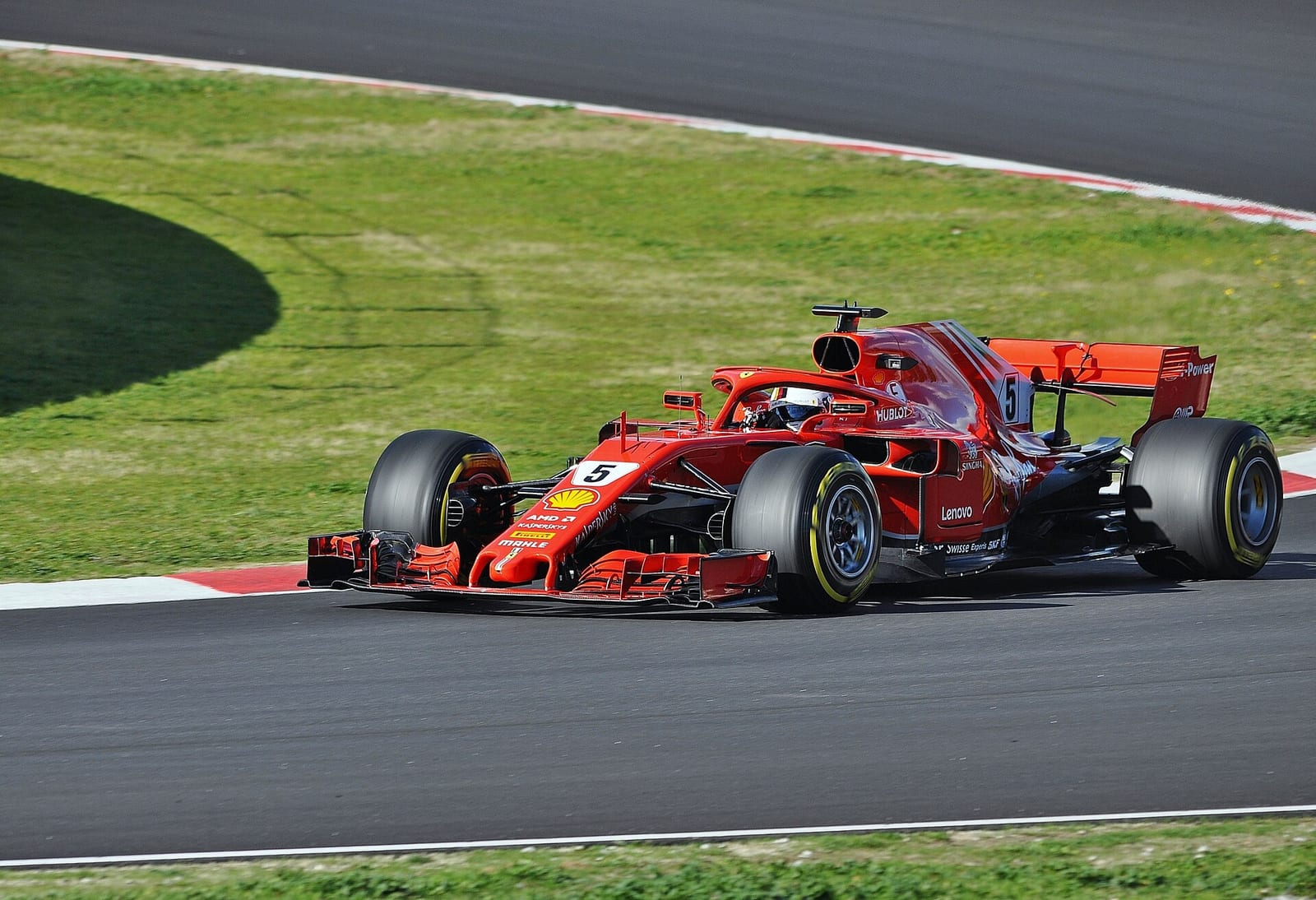
The 2018 Chinese Grand Prix was round 3 of 21, on 15 April. Sebastian Vettel took pole position for Ferrari in 1:31.095, a track record at the time. Daniel Ricciardo won for Red Bull from sixth on the grid, after his team changed his tyres under a safety car and he passed his way to the lead on fresh rubber. Valtteri Bottas was second for Mercedes and Kimi Räikkönen third for Ferrari. Ricciardo also set the fastest lap, a 1:35.785 on lap 55 of 56.
More F1 2018 setups
All the tracks are on the F1 2018 setups page. The round before China is the F1 2018 Bahrain setup and the round after it is the F1 2018 Baku setup.
For the same track in other games, here are my F1 2017 China setup, my F1 2019 China setup and my F1 25 China setup. The values do not carry over from one game to the next.
FAQ
What is the best F1 2018 setup for China?
For time trial: front wing 1, rear wing 9, differential 50% on throttle and 70% off, suspension 2 and 1, anti-roll bars 9 and 11, ride height 3 and 5, brake pressure 84% with 53% front bias, tyres at 25.0 and 22.7 psi, ballast 9.
Why is the front wing at 1 with the rear at 9?
The rear wing keeps the car stable in the fast corners and on the brakes. The front grip comes from the stiff rear anti-roll bar, the rake and the open differential. If the car does not turn for you, go to front wing 3.
Can I use this China setup in a race?
Yes, with small changes. Lower the tyre pressures to about 23.4 and 21.5 psi and add front wing to 3. The front left tyre is what limits you in a race at Shanghai.
Does this setup work with a controller?
Yes. Raise the on throttle differential to 60% and the front wing to 3 so the car is calmer on the long exits.
Which tyre wears the most at Shanghai?
The front left. Turn 1, Turn 2, Turn 8 and Turn 13 are long right handers and they all load it.
How long is the Shanghai circuit in F1 2018?
5.451 km with 16 corners. Pole position in the real 2018 race was a 1:31.095.