
The best F1 2018 setup depends on the track, but a lot of the car stays the same all season. On 17 of the 21 tracks the camber is -2.50 and -1.00 with toe at 0.05 and 0.20, and the front wing is at 1 or 2. What changes is the rear wing, the differential and the suspension. The table below has the numbers for all 21 tracks, and every track name links to its own page.
These setups were collected for this database in 2022 from fast time trial laps, and most track pages have the video of the lap. Use them as a starting point. What I add is how to read them and what to change when the car does not suit your hands.
F1 2018 setups for every track
Values are written front / rear. The differential column is on throttle / off throttle. In F1 2018 the wings, suspension and anti-roll bars use a scale from 1 to 11. The tracks are in the order of the 2018 calendar.
| Track | Wings | Differential | Suspension | Anti-roll bars | Ride height | Ballast |
|---|---|---|---|---|---|---|
| Australia (Melbourne) | 1 / 11 | 100% / 60% | 4 / 3 | 11 / 7 | 2 / 4 | 10 |
| Bahrain (Sakhir) | 1 / 8 | 100% / 75% | 7 / 2 | 9 / 4 | 3 / 3 | 8 |
| China (Shanghai) | 1 / 9 | 50% / 70% | 2 / 1 | 9 / 11 | 3 / 5 | 9 |
| Azerbaijan (Baku) | 1 / 4 | 100% / 72% | 1 / 1 | 2 / 3 | 1 / 2 | 9 |
| Spain (Barcelona) | 6 / 10 | 100% / 70% | 3 / 3 | 1 / 1 | 4 / 4 | 8 |
| Monaco | 6 / 11 | 100% / 68% | 2 / 2 | 4 / 2 | 3 / 7 | 9 |
| Canada (Montreal) | 2 / 8 | 100% / 70% | 6 / 5 | 7 / 4 | 6 / 6 | 9 |
| France (Paul Ricard) | 1 / 6 | 55% / 80% | 3 / 3 | 10 / 7 | 2 / 3 | 9 |
| Austria (Red Bull Ring) | 1 / 6 | 100% / 95% | 3 / 8 | 11 / 8 | 4 / 4 | 9 |
| Britain (Silverstone) | 2 / 6 | 80% / 90% | 6 / 6 | 11 / 8 | 4 / 5 | 8 |
| Germany (Hockenheim) | 1 / 8 | 70% / 60% | 1 / 2 | 11 / 10 | 2 / 5 | 9 |
| Hungary (Budapest) | 7 / 11 | 80% / 75% | 9 / 6 | 9 / 6 | 4 / 4 | 8 |
| Belgium (Spa) | 1 / 6 | 55% / 80% | 2 / 2 | 2 / 2 | 2 / 4 | 10 |
| Italy (Monza) | 1 / 4 | 100% / 80% | 1 / 1 | 11 / 11 | 5 / 5 | 9 |
| Singapore | 8 / 11 | 65% / 100% | 3 / 3 | 11 / 7 | 3 / 4 | 8 |
| Russia (Sochi) | 1 / 7 | 50% / 80% | 5 / 5 | 11 / 4 | 3 / 3 | 10 |
| Japan (Suzuka) | 2 / 9 | 50% / 60% | 5 / 5 | 4 / 4 | 2 / 5 | 9 |
| USA (Austin) | 1 / 8 | 100% / 60% | 2 / 2 | 11 / 8 | 4 / 5 | 8 |
| Mexico | 2 / 6 | 70% / 80% | 4 / 2 | 6 / 2 | 1 / 4 | 9 |
| Brazil (Interlagos) | 2 / 7 | 50% / 65% | 3 / 3 | 9 / 4 | 3 / 3 | 9 |
| Abu Dhabi (Yas Marina) | 1 / 5 | 50% / 70% | 1 / 2 | 4 / 3 | 4 / 4 | 9 |
Brakes, tyres and geometry
Same order as above. Tyre pressures are in psi, front / rear. Camber and toe are front / rear too.
| Track | Brake pressure | Front brake bias | Tyre pressures | Camber | Toe |
|---|---|---|---|---|---|
| Australia (Melbourne) | 80% | 53% | 21.4 / 21.1 | -3.50 / -1.60 | 0.10 / 0.35 |
| Bahrain (Sakhir) | 75% | 52% | 24.2 / 22.7 | -2.50 / -1.00 | 0.05 / 0.20 |
| China (Shanghai) | 84% | 53% | 25.0 / 22.7 | -2.50 / -1.00 | 0.05 / 0.20 |
| Azerbaijan (Baku) | 100% | 52% | 23.0 / 21.5 | -2.50 / -1.00 | 0.05 / 0.20 |
| Spain (Barcelona) | 80% | 51% | 23.4 / 21.5 | -2.50 / -1.00 | 0.05 / 0.20 |
| Monaco | 82% | 53% | 22.2 / 19.5 | -2.50 / -1.00 | 0.05 / 0.20 |
| Canada (Montreal) | 90% | 52% | 23.4 / 19.5 | -2.50 / -1.00 | 0.05 / 0.20 |
| France (Paul Ricard) | 85% | 54% | 25.0 / 20.7 | -2.50 / -1.00 | 0.05 / 0.20 |
| Austria (Red Bull Ring) | 92% | 53% | 23.0 / 20.7 | -2.50 / -1.00 | 0.05 / 0.20 |
| Britain (Silverstone) | 88% | 52% | 23.4 / 21.5 | -2.50 / -1.00 | 0.05 / 0.20 |
| Germany (Hockenheim) | 91% | 54% | 23.0 / 21.1 | -2.50 / -1.00 | 0.05 / 0.20 |
| Hungary (Budapest) | 84% | 55% | 23.0 / 21.1 | -2.50 / -1.00 | 0.05 / 0.20 |
| Belgium (Spa) | 96% | 55% | 23.8 / 22.3 | -2.50 / -1.00 | 0.05 / 0.38 |
| Italy (Monza) | 82% | 52% | 23.0 / 21.1 | -2.50 / -1.00 | 0.05 / 0.20 |
| Singapore | 80% | 54% | 23.4 / 21.1 | -2.50 / -1.00 | 0.05 / 0.20 |
| Russia (Sochi) | 100% | 52% | 25.0 / 21.5 | -2.50 / -1.00 | 0.05 / 0.20 |
| Japan (Suzuka) | 80% | 55% | 25.0 / 23.5 | -2.50 / -1.00 | 0.05 / 0.20 |
| USA (Austin) | 95% | 55% | 22.2 / 20.3 | -2.50 / -1.00 | 0.05 / 0.20 |
| Mexico | 85% | 56% | 22.2 / 22.3 | -2.70 / -1.40 | 0.10 / 0.20 |
| Brazil (Interlagos) | 90% | 52% | 21.8 / 20.3 | -2.50 / -1.00 | 0.08 / 0.29 |
| Abu Dhabi (Yas Marina) | 89% | 53% | 22.6 / 21.1 | -2.50 / -1.00 | 0.05 / 0.20 |
Fuel load is 10 kg in every one of these setups.
Tracks by downforce level
If you only have time to change one thing before a session, change the wings. This is how the 21 tracks split by rear wing.
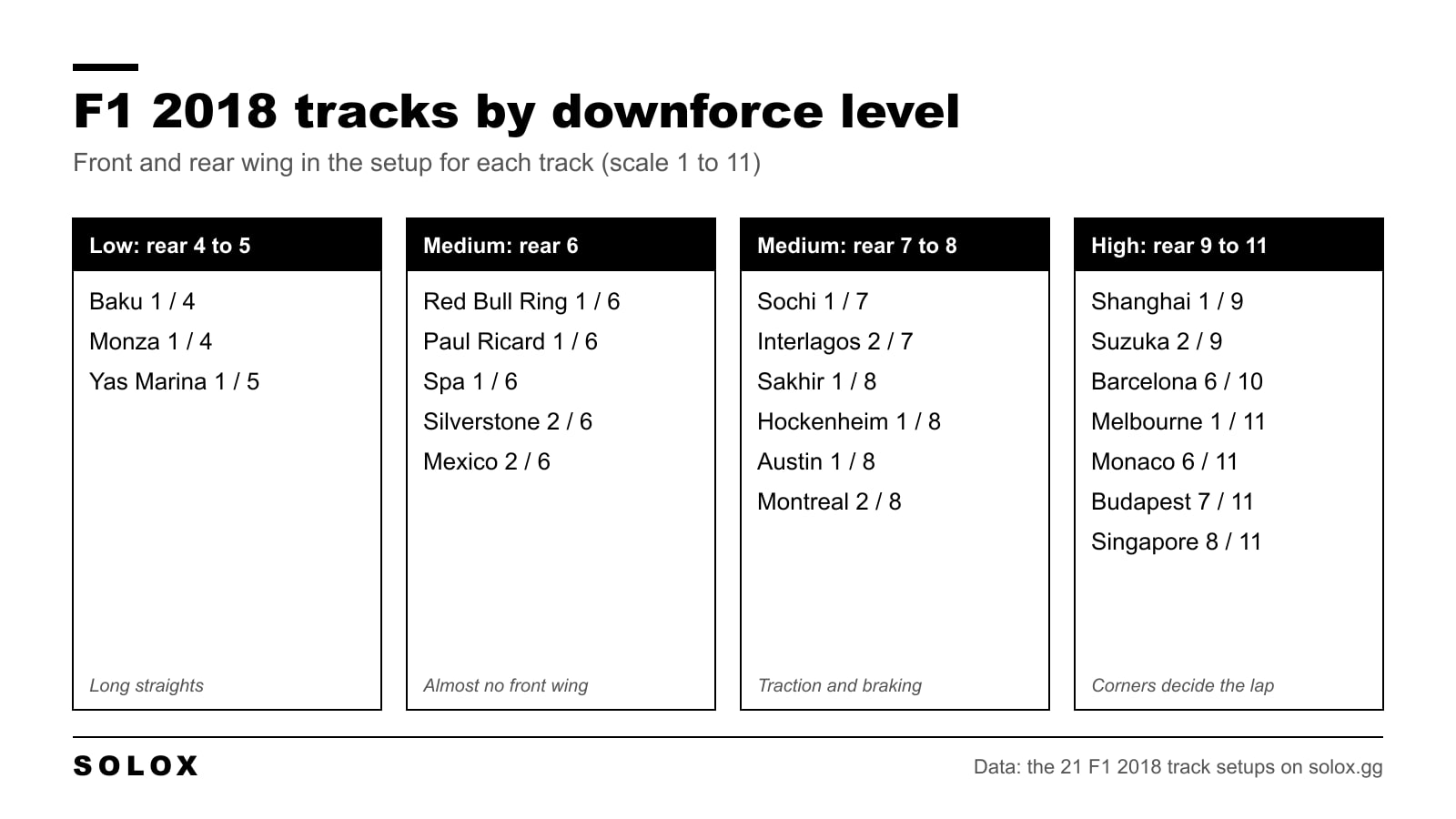
- Low downforce (rear wing 4 to 5): Baku, Monza and Yas Marina. Front wing at 1, the minimum, and just enough rear wing to keep the car straight under braking.
- Medium downforce (rear wing 6 to 8): Red Bull Ring, Paul Ricard, Spa, Silverstone, Mexico, Sochi, Interlagos, Sakhir, Hockenheim, Austin and Montreal. More than half the calendar. The front wing never goes above 2.
- High downforce (rear wing 9 to 11): Shanghai, Suzuka, Barcelona, Melbourne, Monaco, Budapest and Singapore. Only Barcelona, Monaco, Budapest and Singapore put real front wing on the car, from 6 to 8.
The thing to notice is the gap between front and rear. Melbourne runs 1 and 11, the widest split you can build in the menu. A car like that is very stable at the rear and understeers in fast corners. It is quick over one lap if you can drive around the understeer. If you cannot, add front wing two clicks at a time until the car turns.
What these setups have in common
Read the two tables side by side and a pattern comes out.
- Geometry barely moves. 17 of 21 tracks use camber -2.50 / -1.00 and toe 0.05 / 0.20, the least angle the menu allows. The exceptions are Melbourne and Mexico, which run more camber, and Spa and Interlagos, which run more toe.
- The differential comes in two schools. Nine tracks have it locked at 100% on throttle: Melbourne, Sakhir, Baku, Barcelona, Monaco, Montreal, Red Bull Ring, Monza and Austin. Five have it fully open at 50%: Shanghai, Sochi, Suzuka, Interlagos and Yas Marina. Locked is faster in a straight line out of a slow corner. Open is kinder to the rear tyres and lets the car rotate on the power.
- Front tyres run hard. Four tracks have the fronts at 25.0 psi, the maximum: Shanghai, Paul Ricard, Sochi and Suzuka. The rears are always lower, except in Mexico. Montreal and Monaco go down to 19.5 psi at the rear for traction.
- Brake bias stays in a small window. It goes from 51% in Barcelona to 56% in Mexico. Brake pressure moves much more, from 75% in Sakhir to 100% in Baku and Sochi.
- Ballast is 8, 9 or 10. Twelve tracks run 9.
- Suspension is where the setups disagree. Springs go from 1 and 1 at Baku and Monza to 9 and 6 in Budapest. Anti-roll bars go from 1 and 1 in Barcelona to 11 and 11 at Monza.
That last point matters. These laps come from more than one driving style. Do not expect the Monza car to feel like the Barcelona car with less wing. Treat each one as its own thing, and use the change table on each track page.
How to adjust a setup to your driving
A setup from somebody else's fast lap is built around their style. When I worked with engineers in F3 and F2 we never changed five things at once, and the same rule works in the game. One change, three laps, then decide.
- The car will not turn in fast corners. This is the common one with these setups, because the front wing is so low. Add one or two clicks of front wing.
- The rear steps out in fast corners. Add one or two clicks of rear wing. You lose a little on the straight and gain confidence everywhere else.
- You spin on the exit of slow corners. Lower the on throttle differential from 100% to 75 or 80%. The rear wheels can then turn at different speeds and the car puts the power down more gently.
- The car pushes wide on the power. Same change. A more open differential lets the car rotate.
- You lock the front tyres. Take 3 to 5% off the brake pressure before you touch the bias.
- You hit the kerbs and the car jumps. Raise the ride height by one click at both ends, or soften the suspension by one.
If you are on a pad, start with points 3 and 5. A trigger gives you less travel than a pedal, so a more open differential and a little less brake pressure make the car far easier to control.
One thing that is not in the setup menu: in F1 2018 you manage the ERS yourself, with the deployment modes on the wheel or pad. A good setup with the battery used in the wrong places is still a slow lap. Most of the track pages say where I would deploy and where I would recover.
From time trial to race
All 21 setups are time trial setups. With race fuel the car is heavier, the stops are longer and the rear tyres work harder. Three changes cover most tracks:
- Open the differential. If the setup has it locked at 100% on throttle, go to 75% for a race. The rear tyres last longer.
- Lower the brake pressure by 3 to 5% where it is at 90% or more. A flat spot costs you for the rest of the stint.
- Bring the wings closer together where the front is at 1 and the rear is at 8 or more. One or two clicks of front wing stop the front tyres sliding lap after lap.
Most track pages have their own race section with exact values.
Setups for the other F1 games
A setup does not carry over from one game to the next, because the handling and the setup menu change every year. Each game has its own page:
FAQ
What is the best setup in F1 2018?
There is no single one. The base that works at most tracks is camber -2.50 and -1.00, toe 0.05 and 0.20, front wing at 1 or 2 and tyres around 23.0 and 21.1 psi. Then set the rear wing for the track from the table above.
Which F1 2018 tracks need the most downforce?
Melbourne, Monaco, Budapest and Singapore run the rear wing at 11, the maximum. Singapore has the most front wing, at 8. Monza and Baku are the opposite, with 1 at the front and 4 at the rear.
Do these F1 2018 setups work with a controller?
Yes. The setup menu is the same on a pad and on a wheel. On a pad I would lower the on throttle differential to around 70% where it is locked and take a few percent off the brake pressure, because triggers are harder to modulate than pedals.
Can I use these setups in a race?
You can, with changes. They are saved with 10 kg of fuel, which is a time trial load. For a race, open the differential, lower the brake pressure a little and check the track page.
Do F1 2018 setups work in F1 2019 or later games?
No. Every game has its own handling model, so a setup that is fast in F1 2018 will not behave the same way in another year. Use the page for your game from the list above.
How many tracks are in F1 2018?
21, the full 2018 calendar, from Melbourne to Yas Marina. Paul Ricard and Hockenheim are both in the game. Every one of them has a setup in the table above.
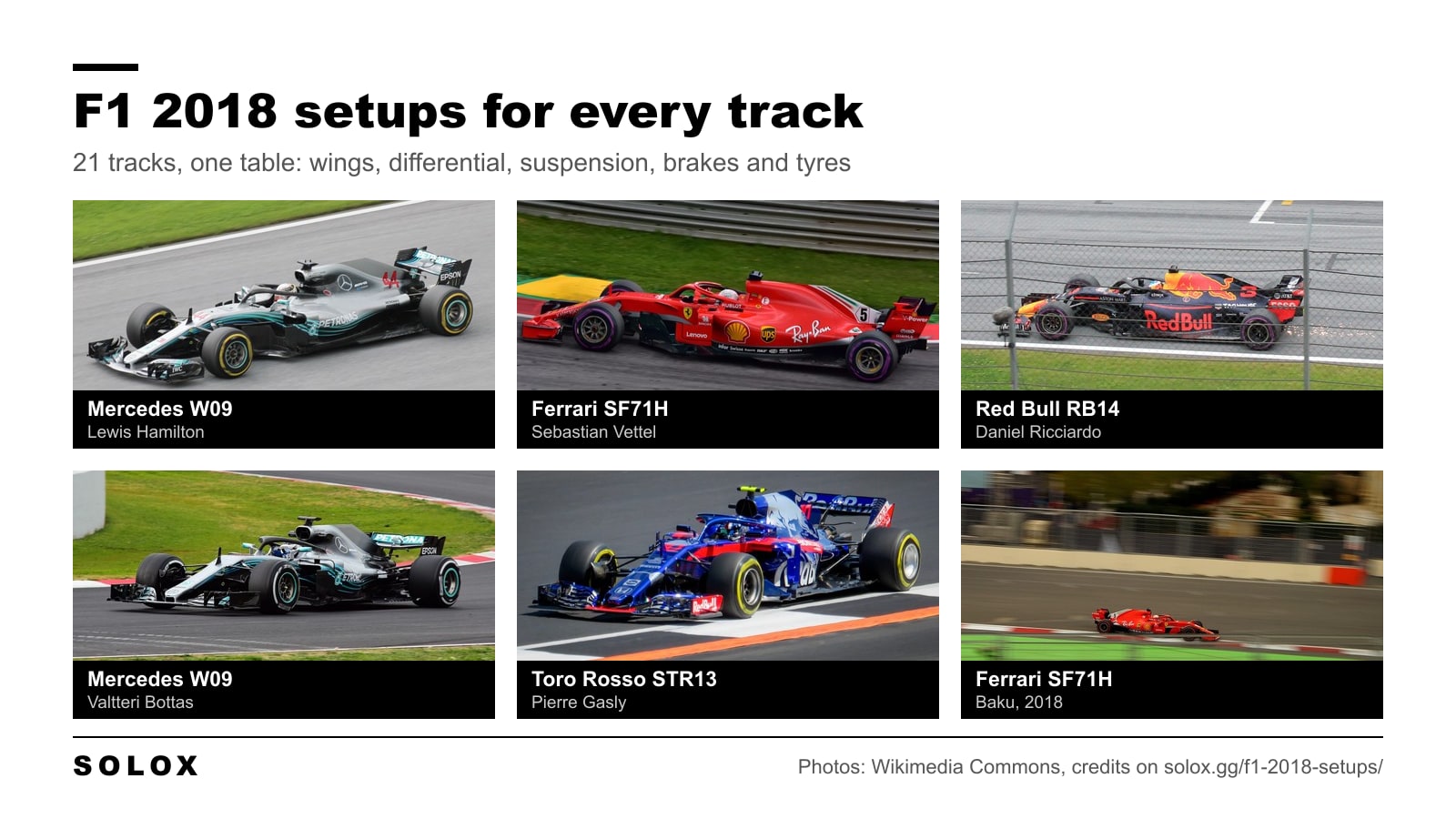
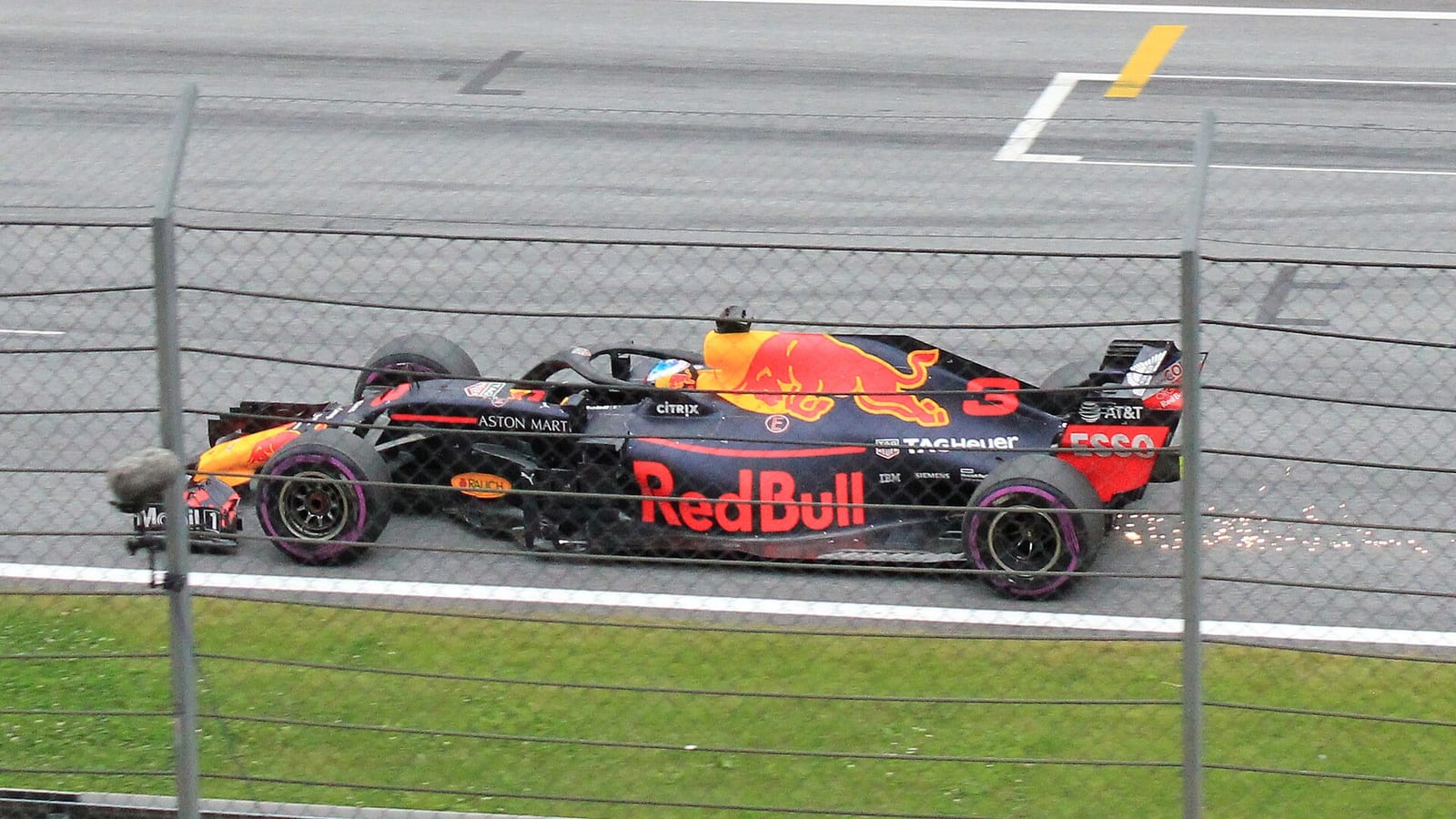
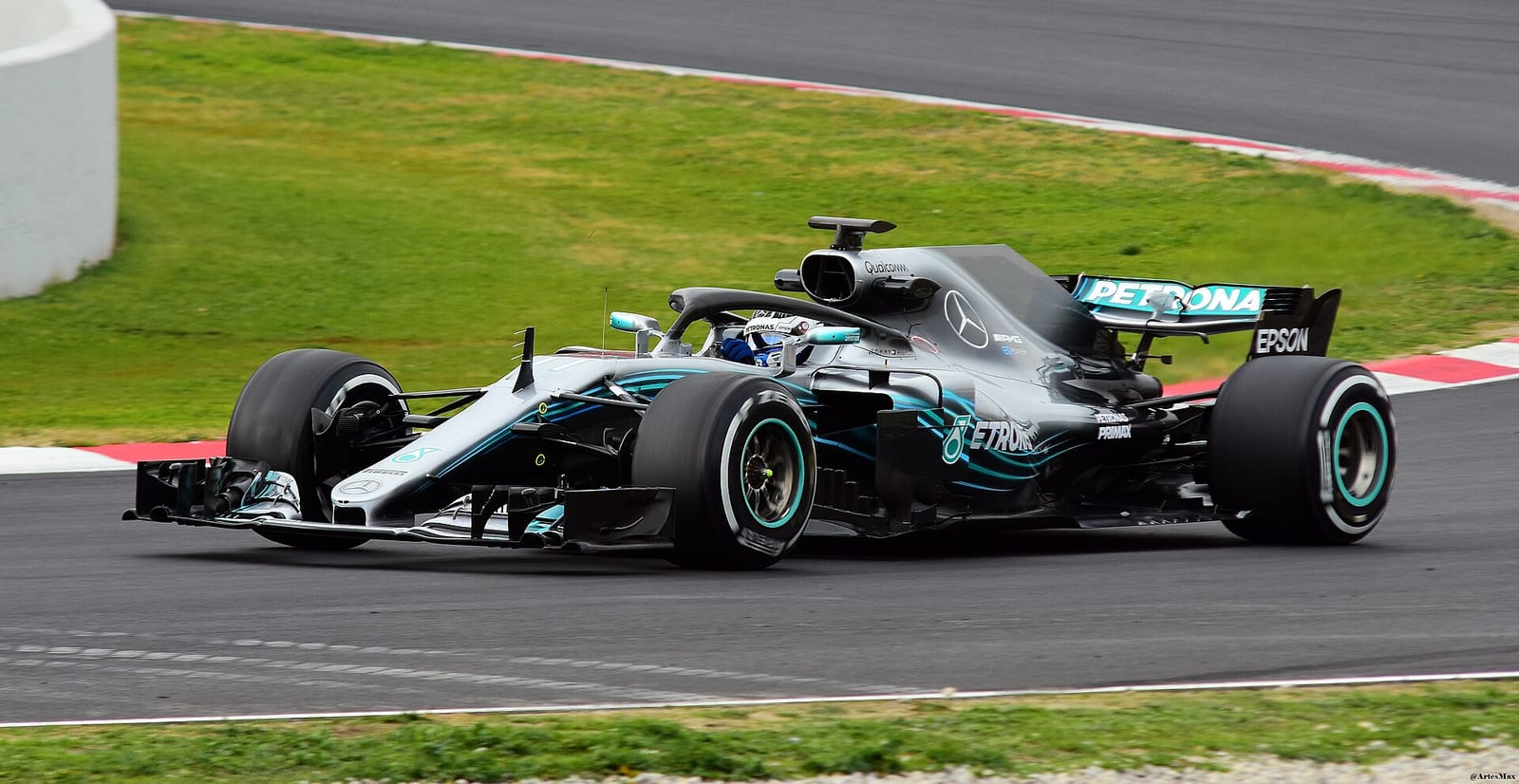
Header photos: Lewis Hamilton and Daniel Ricciardo by Lukas Raich, CC BY-SA 4.0. Sebastian Vettel in Austria by pedrik, CC BY 2.0. Valtteri Bottas by Max Artes, CC BY-SA 2.0. Pierre Gasly by Jen Ross, CC BY 2.0. Sebastian Vettel in Baku by ibrahimferhadli, CC BY-SA 4.0. All from Wikimedia Commons.