
Barcelona is the track every team tests at, and for a reason. It has every kind of corner, and nearly all of them are long. If the car has downforce and balance, it is quick here. If it does not, there is no straight long enough to hide it.
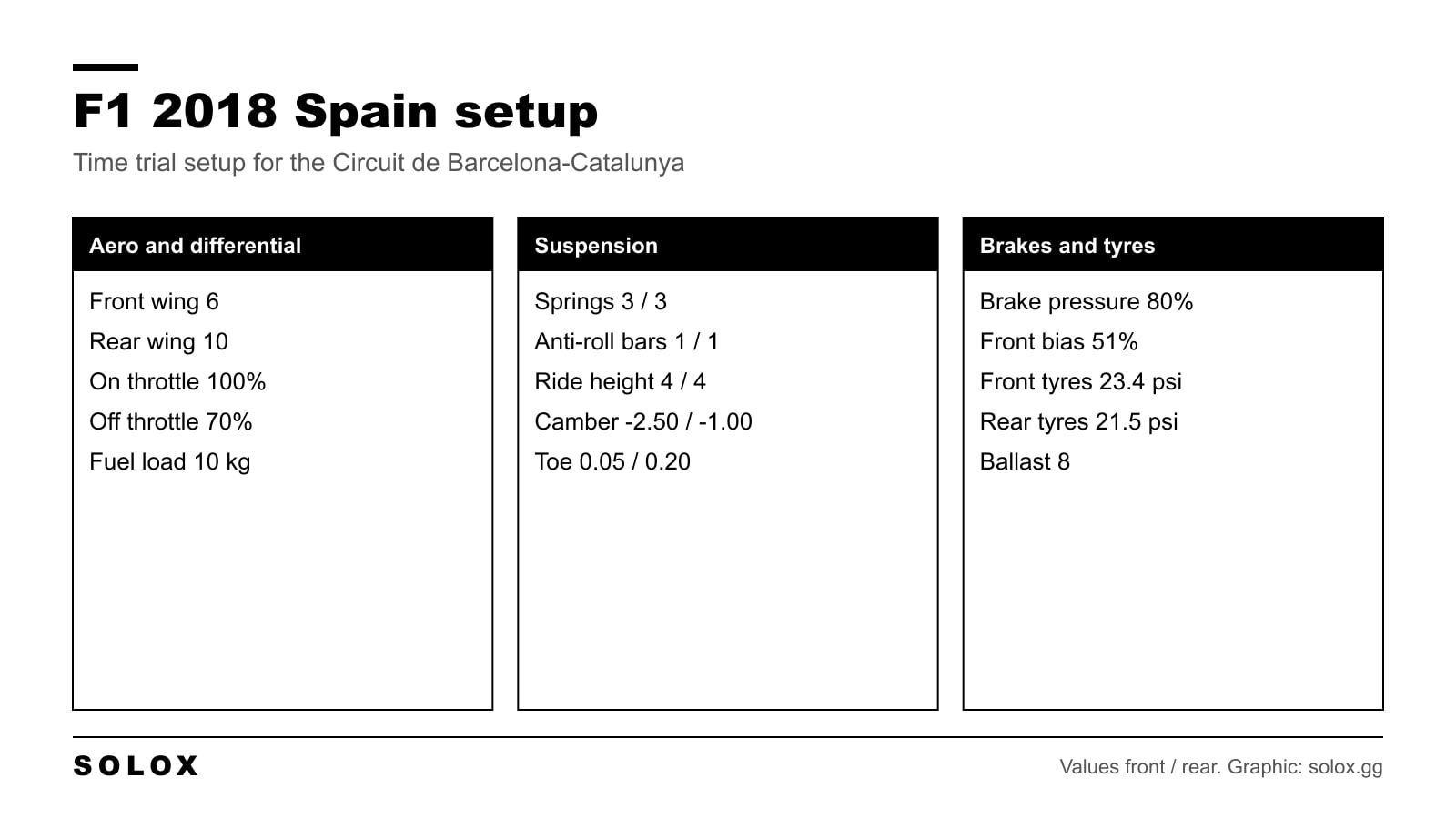
This F1 2018 Spain setup runs wings at 6 and 10, a locked differential, the softest anti-roll bars in the menu and brake pressure at 80%. It is a time trial setup, saved with 10 kg of fuel.
F1 2018 Spain setup
| Setting | Front | Rear |
|---|---|---|
| Wing | 6 | 10 |
| Camber | -2.50 | -1.00 |
| Toe | 0.05 | 0.20 |
| Suspension | 3 | 3 |
| Anti-roll bar | 1 | 1 |
| Ride height | 4 | 4 |
| Tyre pressure | 23.4 psi | 21.5 psi |
| Setting | Value |
|---|---|
| Fuel load | 10 kg |
| Differential on throttle | 100% |
| Differential off throttle | 70% |
| Brake pressure | 80% |
| Front brake bias | 51% |
| Ballast | 8 |

Here is the lap the setup comes from:
Why this setup works at Barcelona
The 2018 lap is 4.655 km with 16 corners, with the slow chicane before the last corner. One long pit straight, one shorter back straight, and corners everywhere else. Turn 3 alone lasts longer than most chicanes.
The wings. Front 6, rear 10. The menu goes to 11, so this is close to the top. You are in a corner for most of the lap, and in Turn 3 and Turn 9 the speed you carry is set by downforce and nothing else. The drag costs you on the pit straight. You get it back several times over in sectors two and three.
The differential. 100% on throttle, fully locked. In a long fast corner a locked differential makes the rear predictable. Both wheels are driven the same, so the car does not change its mind when you add throttle in the middle of Turn 3. The cost is understeer on the power in the slow last sector. The front wing at 6 and the soft front bar are there to answer that. Off throttle it is 70%.
The geometry. Camber and toe are at the least angle the menu allows: -2.50 and -1.00, 0.05 and 0.20. Barcelona is hard on the front left tyre, and less camber spreads the load across the tread.
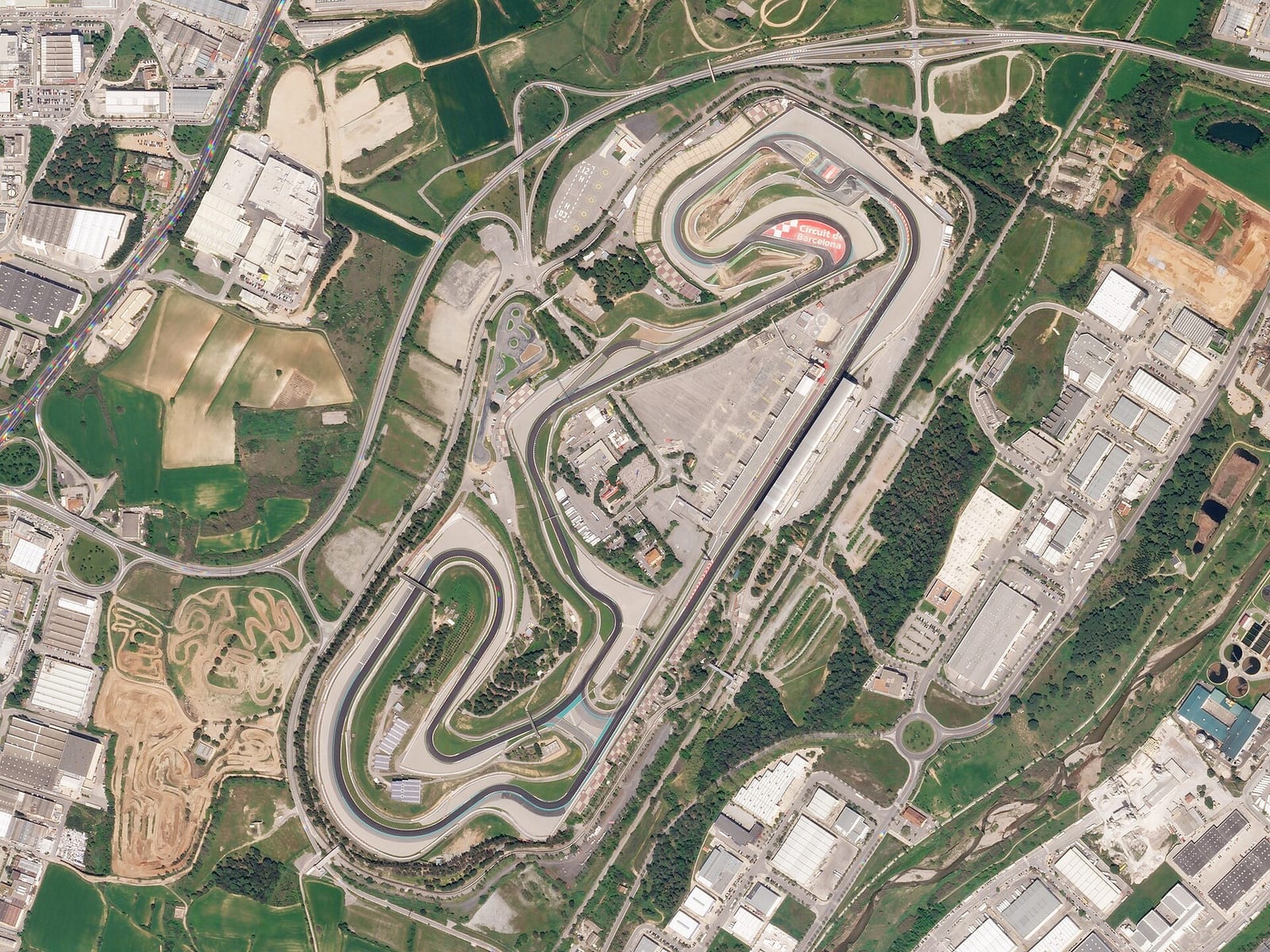
The softest bars in the menu
Springs are 3 and 3. Anti-roll bars are 1 at the front and 1 at the rear. Ride height is 4 and 4.
Bars at 1 and 1 is the softest the game allows. With wings this high the aero already gives the car a stable platform, so the bars can be soft. A soft bar lets the car roll, and the inside tyres keep doing some work in a long corner. That is grip, and it is also less heat in the outside tyres.
What you give up is response. The car is slow to change direction in Turns 1 and 2 and in the chicane. Turn in a fraction earlier than feels natural and let it settle.
Springs at 3 are on the soft side, for the kerbs in the last sector. Ride height at 4 is a safe middle value.
Tyres are at 23.4 psi front and 21.5 rear.
My F1 2018 Monza setup is the other end of the scale: almost no wing and a car built for the straights.
Brakes
Brake pressure is 80% with 51% at the front. Only my Bahrain setup runs less pressure, and no other track has the bias this far back.
There is only one big straight line stop on the lap, into Turn 1. Almost everywhere else you brake with steering on: Turn 4, Turn 5, Turn 10, the chicane. With the wheel turned, the inside front has little load and locks at once under full pressure. At 80% you can lean on the pedal while turning and the tyre keeps rolling. The bias at 51% is far back and helps the car rotate on the way in.
If you find the stop into Turn 1 too long, go up to 85% before you touch anything else.
What to change
One change at a time, three laps, then decide.
| Problem | Change | Why |
|---|---|---|
| The stop into Turn 1 is too long | Brake pressure 80% to 85% | More stopping power in a straight line |
| The rear steps out on corner entry | Front brake bias 51% to 53% | Takes braking work off the rear |
| Understeer on the throttle in the last sector | On throttle differential 100% to 80% | A more open differential lets the car rotate |
| Understeer in Turn 3 | Front wing 6 to 7 | More front load at speed |
| The car is slow to change direction | Front anti-roll bar 1 to 3 | A stiffer front bar sharpens the response |
| The rear slides in Turn 9 | Rear wing 10 to 11 | The maximum rear load |
| Too slow on the pit straight | Wings 6 / 10 to 5 / 9 | Less drag, with a little less grip everywhere |
For a race
The real race is 66 laps, and Barcelona wears tyres. Before a 25% or 50% race I would change this:
- On throttle differential 100% to 75%. The rear tyres last longer, and the car turns better on the power with a full tank.
- Brake pressure 80% to 82%. With fuel the car is heavier and the stops are longer.
- Front wing 6 to 7. The front left goes away first here. More front wing means less sliding.
- Fuel. The 10 kg is a time trial number. In a race the game sets the load for the distance.
On a pad, I would open the differential to 70% and keep everything else. The low brake pressure is already right for a trigger.
In F1 2018 you manage the ERS yourself. Use the battery out of the last corner for the pit straight and out of Turn 9 for the back straight. Recover in the last sector.
Where the lap time is at Barcelona
- Turns 1 and 2. Right then left. Brake late for the first, sacrifice it a little, and be straight and early on the throttle out of the second. That exit leads into Turn 3.
- Turn 3. The long right, flat on low fuel with these wings. Hold a tight line. If you have to lift, lift early and small.
- Turn 4. Another long right, slower. Brake while turning in, late apex, and let the car run to the exit kerb.
- Turn 5. A downhill left that tightens. Easy to lock the inside front here. The low brake pressure helps.
- Turns 7 and 8. Left then right, uphill. Use the kerb on the left and get the car straight for the climb.
- Turn 9. A fast uphill right where you do not see the exit. One of the best corners of the season. Commit on entry and use all the road out.
- Turn 10. The slow left at the end of the back straight. The second passing place after Turn 1.
- The last sector. A long right, a tight right, the chicane and the last corner. Slow, and all about traction. Do not over drive it. A clean exit from the chicane makes the pit straight.
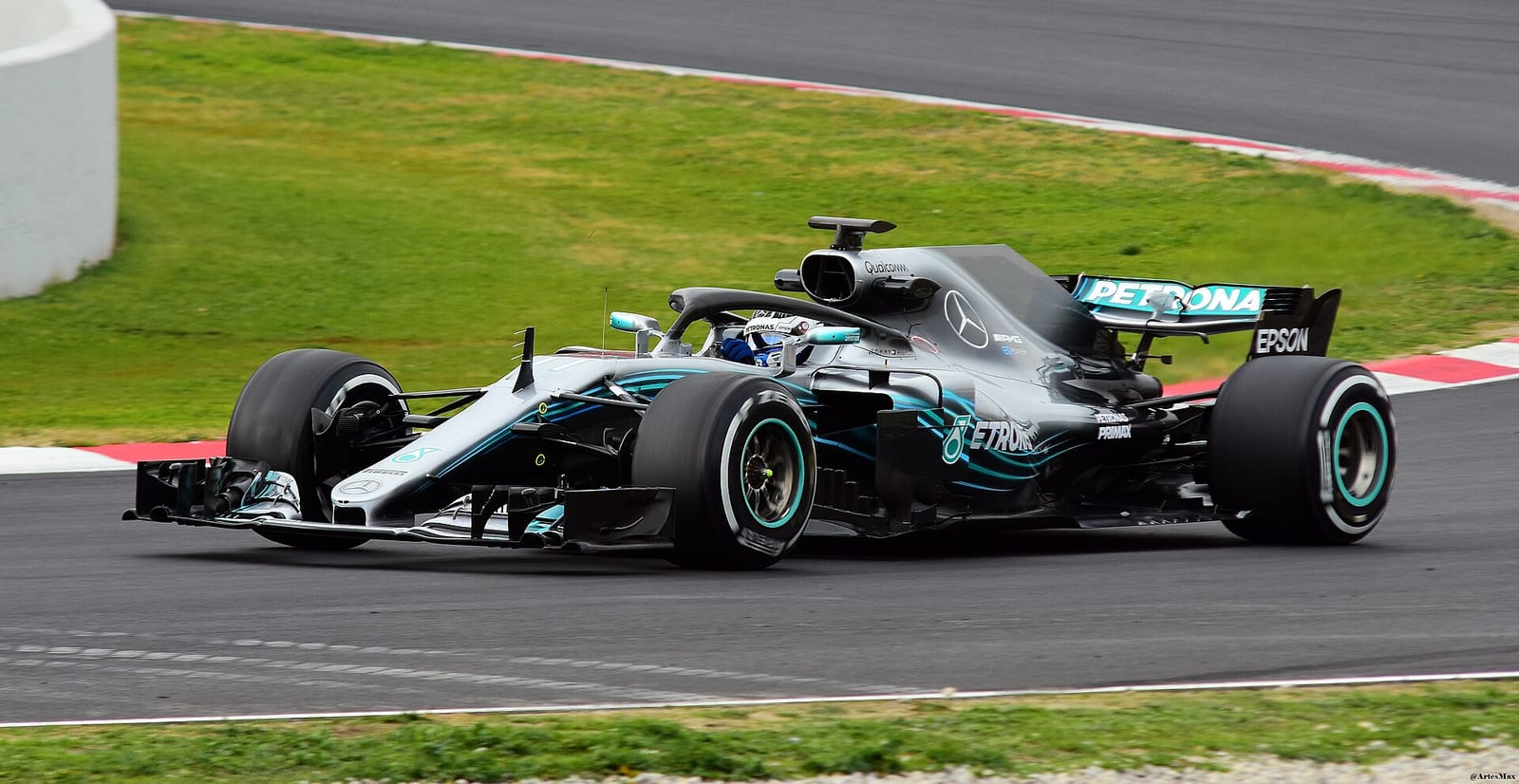
Barcelona in 2018
The 2018 Spanish Grand Prix was round 5 of 21, on 13 May. Lewis Hamilton took pole position for Mercedes with a 1:16.173 and won the race over 66 laps. Valtteri Bottas finished second, for the first Mercedes one-two of the season. Max Verstappen was third for Red Bull. Daniel Ricciardo set the fastest lap, a 1:18.441 on lap 61.
The track had been resurfaced over the winter before the race.
The chicane before the last corner was added in 2007. Formula One stopped using it in 2023, so the newer games have two fast right handers there instead.
More F1 2018 setups
All the tracks are on the F1 2018 setups page. The round before Spain is the F1 2018 Baku setup and the next one is the F1 2018 Monaco setup.
For the same track in other games, here are my F1 2017 Spain setup, my F1 2019 Spain setup and my F1 25 Spain setup. The values do not carry over from one game to the next.
FAQ
What is the best F1 2018 setup for Spain?
For time trial: front wing 6, rear wing 10, differential 100% on throttle and 70% off, suspension 3 and 3, anti-roll bars 1 and 1, ride height 4 and 4, brake pressure 80% with 51% front bias, tyres at 23.4 and 21.5 psi, ballast 8.
What wing levels should I run at Barcelona in F1 2018?
6 at the front and 10 at the rear for one lap. For a race, 7 and 10 look after the front left tyre.
Can I use this Barcelona setup in a race?
Yes, with small changes. Differential on throttle to 75%, brake pressure to 82% and front wing to 7.
Does this setup work with a controller?
It does. Open the differential to 70% on throttle so the rear does not spin up in the last sector.
Why is the brake pressure only 80%?
Because you brake while turning in most corners at Barcelona. With lower pressure the inside front tyre does not lock when the wheel is turned.
How long is Barcelona in F1 2018?
4.655 km with 16 corners, including the chicane before the last corner. The real 2018 race was 66 laps, and the pole lap was a 1:16.173.