
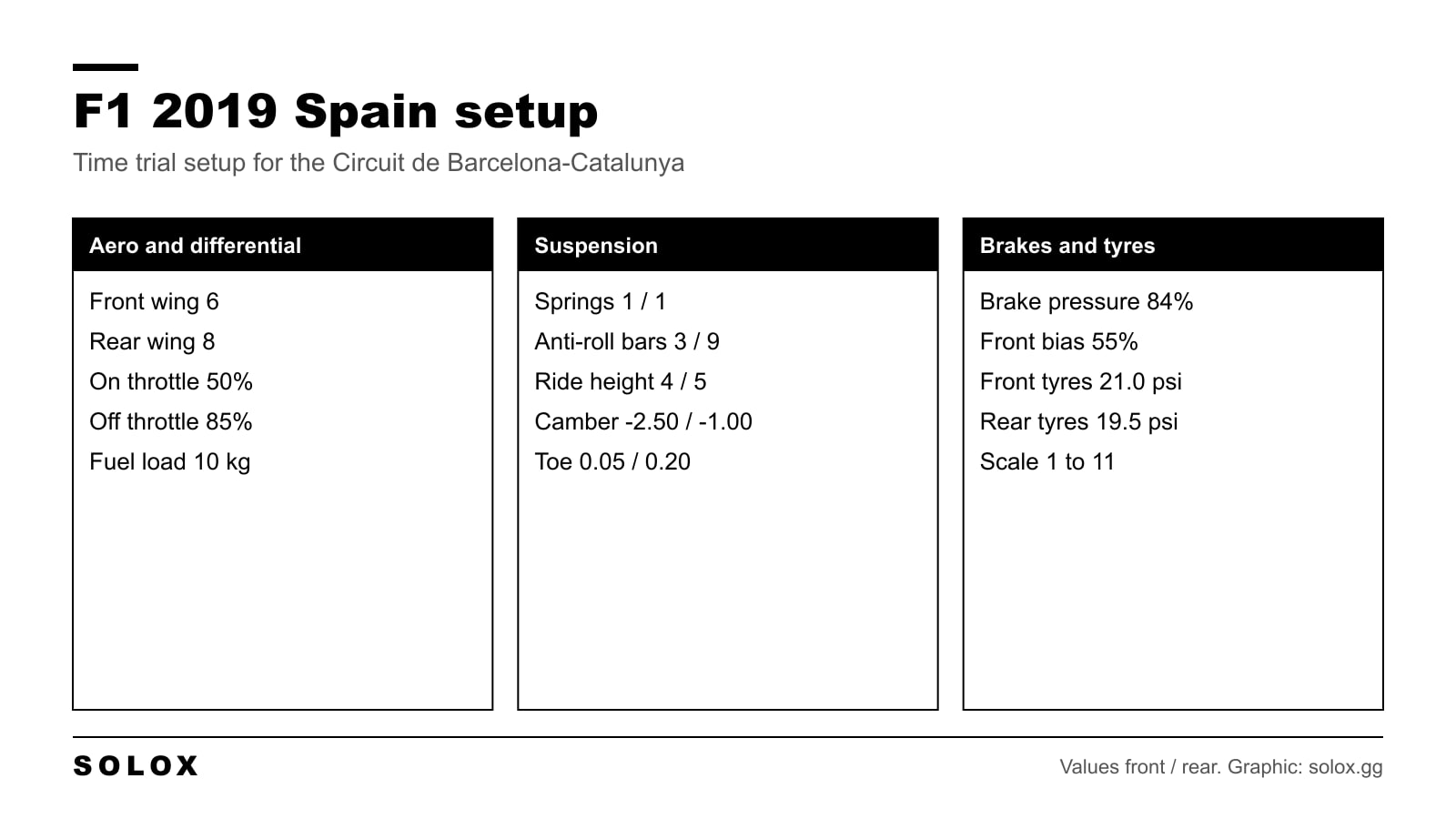
Barcelona is the track every team knows best, because for years they tested here every winter. The reason is that it has a bit of everything: two fast corners that load the car for seconds at a time, a few medium ones, and a slow last sector.
A car that is good here needs downforce first. This setup runs wings 6 and 8 with the softest springs in the menu. It is a time trial setup, saved with 10 kg of fuel.
F1 2019 Spain setup
| Setting | Front | Rear |
|---|---|---|
| Wing | 6 | 8 |
| Camber | -2.50 | -1.00 |
| Toe | 0.05 | 0.20 |
| Suspension | 1 | 1 |
| Anti-roll bar | 3 | 9 |
| Ride height | 4 | 5 |
| Tyre pressure | 21.0 psi | 19.5 psi |
| Setting | Value |
|---|---|
| Fuel load | 10 kg |
| Differential on throttle | 50% |
| Differential off throttle | 85% |
| Brake pressure | 84% |
| Front brake bias | 55% |
In F1 2019 the wings, suspension, anti-roll bars and ride height all use a scale from 1 to 11.
This setup was collected for the site in 2022 from a fast time trial lap, like the rest of my F1 2019 setups. Use it as a base and adjust it with the table further down.

The lap on board
Why this setup works in Barcelona
The Circuit de Barcelona-Catalunya in F1 2019 is 4.655 km long with 16 corners. It is the layout with the slow chicane before the last corner, which Formula 1 used from 2007 to 2022.
There is one long straight. Everything else is corners, and most of them are long. Turn 3 is a right hander you hold for several seconds. Turn 9 is fast and blind. In corners like that the wings do the work.
The wings. 6 and 8. Only Monaco, Hungary and Singapore carry more wing in my list for this game. The drag costs you on the main straight, but there is only one of those, and the time comes back in turn 3, turn 9 and the whole last sector.
The differential. 50% on throttle is fully open. It gives you the best traction out of turn 5, turn 10 and the chicane. Off throttle it is 85%, a lot more than I run at most tracks. A locked differential off throttle keeps the rear in line when you lift or brake with the car loaded. In turn 9, where you turn in at high speed with a small lift, that is what stops the rear from stepping out.
The price is understeer on entry to the slow corners. If the car will not turn into turn 10, this is the first number to bring down.
The tyre pressures. 21.0 psi front and 19.5 psi rear. Monaco is the only other track in my list this low. A softer tyre has a bigger footprint, which helps in the slow last sector where the wings do very little.
The geometry. Camber -2.50 and -1.00, toe 0.05 and 0.20. The least angle the menu allows. Barcelona is hard on the front left tyre, and less camber keeps it cooler.
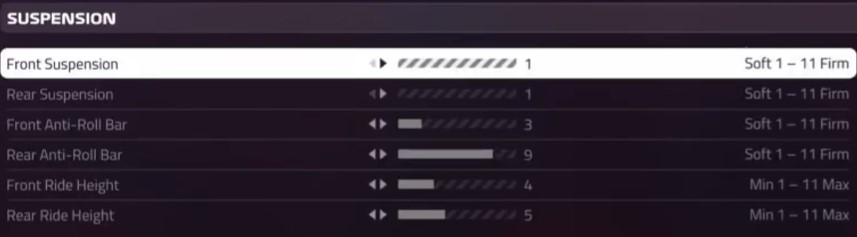
The softest springs, and a tall car
Springs at 1 and 1. You cannot go softer. Monza and Canada are the only other tracks in my list with both ends at 1.
Soft springs give you mechanical grip: the tyre follows the road and the kerb instead of skipping over it. In the chicane and in turn 7 and turn 8, where you ride the kerbs, that is free lap time.
But a soft car with a lot of wing gets pushed into the ground at speed. That is why the ride height is 4 and 5, among the highest in my list. The height is there to give the soft springs room to work. If you lower the car, stiffen the springs a click at the same time.
The anti-roll bars are 3 at the front and 9 at the rear. A soft front bar gives the front tyres grip in the long corners, and a stiff rear bar helps the car rotate. This is the part that fights the understeer from the 85% differential.
What to change
One change at a time, three laps, then decide.
| Problem | Change | Why |
|---|---|---|
| The car will not turn into turn 10 or the chicane | Off throttle differential 85% to 70% | Less lock off the throttle lets the car rotate |
| Understeer in turn 3 and turn 4 | Front wing 6 to 7 | More front downforce in the long corners |
| The rear steps out in turn 9 | Rear anti-roll bar 9 to 7 | A softer rear bar gives the rear tyres more grip |
| Front tyres lock into turn 1 or turn 10 | Brake pressure 84% to 81% | Less peak pressure, easier to hold at the limit |
| The car feels lazy in the turn 1 and turn 2 change of direction | Suspension 1 and 1 to 3 and 3 | Stiffer springs make the car respond faster |
| Too slow on the main straight | Wings 6 and 8 to 5 and 7 | Less drag. You lose a little in every corner |
| Front left tyre overheats | Front tyre pressure 21.0 to 21.8 psi | A harder tyre flexes less and makes less heat |
For a race
Barcelona wears the front left tyre. Turn 3, turn 4 and turn 9 are all long right handers and that tyre carries the car through each of them. Before a 25% or 50% race I would change this:
- Tyre pressures up to 21.8 and 20.3 psi. The minimum pressures are quick for one lap and too hot for a stint.
- Brake pressure 84% to 81%. With a full tank the fronts lock more easily into turn 1 and turn 10.
- Off throttle differential 85% to 75%. Less understeer means less sliding of the front tyres, and that saves the front left.
- Fuel. The 10 kg is a time trial number. In a race the game sets the load for the distance.
On a pad, I would keep the differential and the wings, and lower the brake pressure to around 80%. The setup is stable, which is what you need with a thumbstick.
F1 2019 has manual ERS modes. Save from turn 3 to turn 9, where you are limited by grip and extra power does little. Spend it out of the last corner and down the main straight, which is also the only real place to pass.
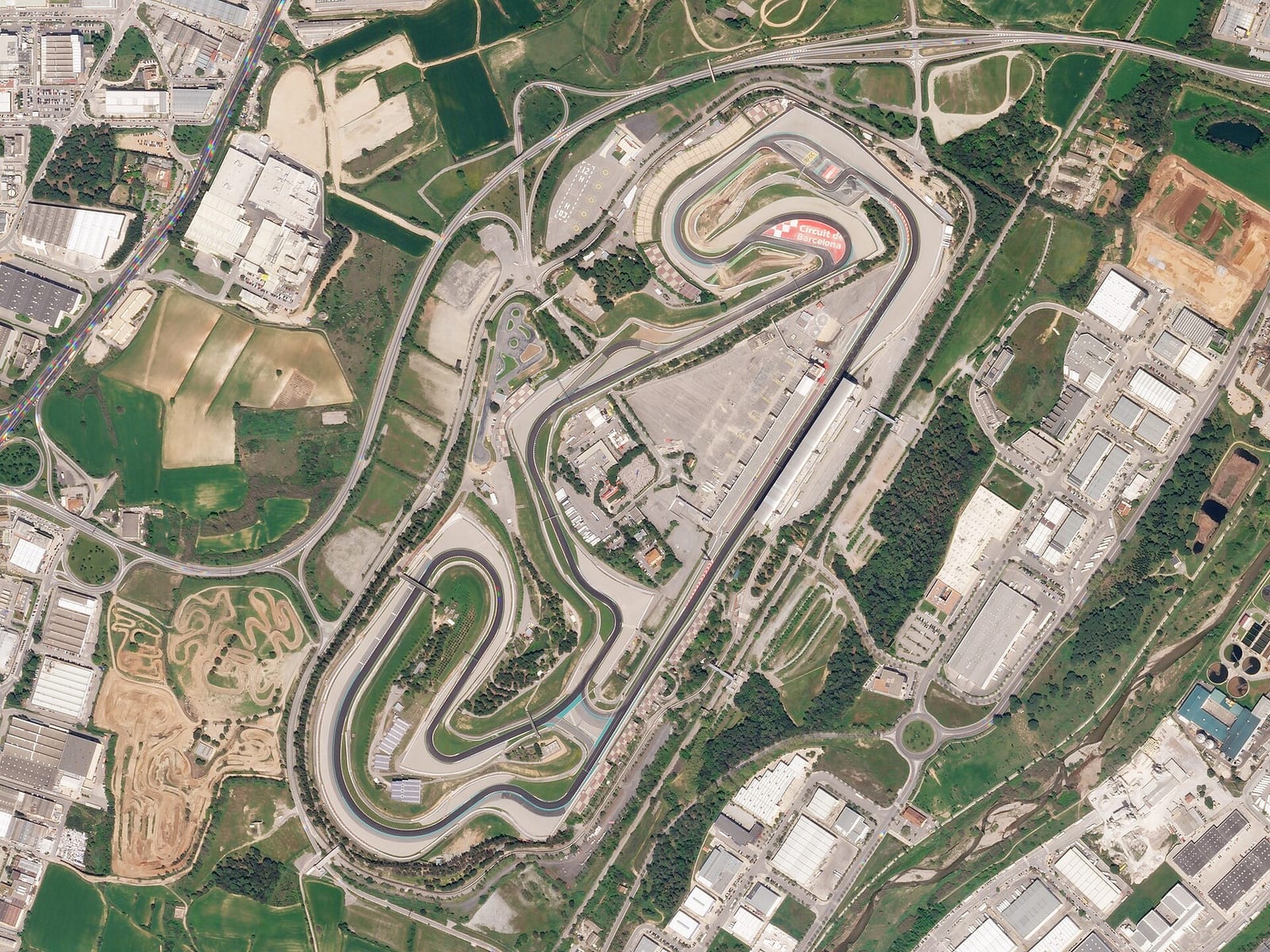
Where the lap time is in Barcelona
- Turn 1 and turn 2. A right and a left taken as one. Brake late for turn 1, but give up a little there so you are flat early out of turn 2. The exit decides your speed through turn 3.
- Turn 3. The long right hander. With this much wing it is flat or close to it. Keep the steering smooth, because every correction scrubs the front left.
- Turn 4. Another long right, with a late apex. Go in too fast and you run out of road on the exit.
- Turn 5. A downhill left. The inside front goes light and locks. Brake a touch early.
- Turn 7 and turn 8. An uphill left and right. Use the kerbs, the soft springs let you.
- Turn 9. Fast, uphill and blind. A small lift on entry, then full throttle. It leads onto the back straight, so the exit counts double.
- Turn 10. The hairpin at the end of the back straight. The second big stop of the lap. Turn late and get the car straight for the exit.
- Turn 12 and turn 13. A long right that tightens. Patience on the throttle.
- Turn 14 and turn 15. The slow chicane. Take the kerbs and think only about the exit.
- Turn 16. The last corner, flat out. What you carry out of the chicane stays with you down the whole main straight.
If you take one thing from this page: the last sector is where laps are lost in Barcelona. By then the tyres are hot from turn 3 and turn 9 and the car slides. Slow your hands down and the time comes back.
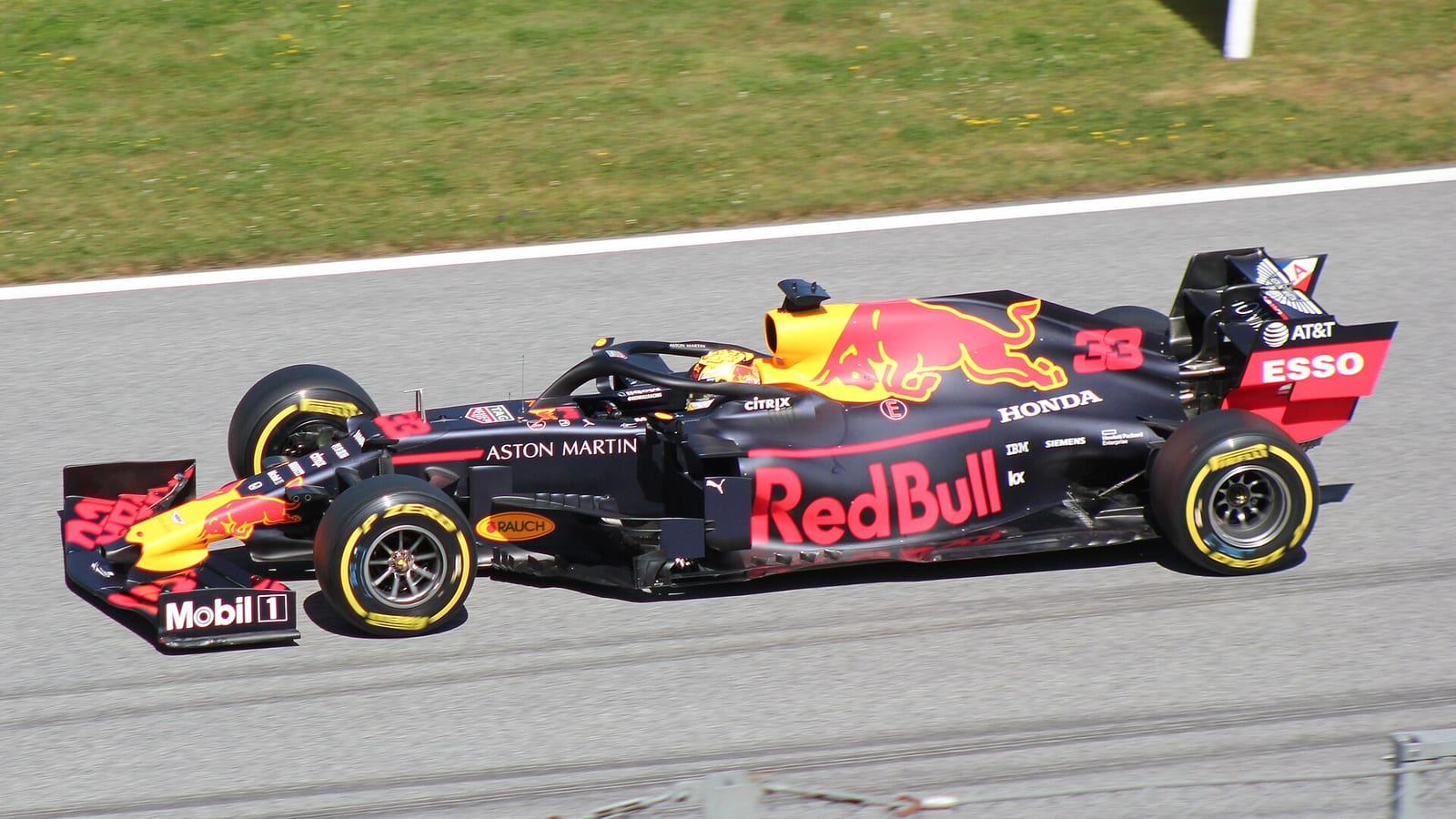
Spain in 2019
The 2019 Spanish Grand Prix was round 5 of 21, on 12 May, over 66 laps. Valtteri Bottas was fastest in all three parts of qualifying and took pole position in 1:15.406, his third pole in a row.
Lewis Hamilton made the better start from second and led into turn 1. He stayed there and won by just over four seconds from Bottas. It was the fifth Mercedes one-two in five races. Max Verstappen passed Sebastian Vettel around the outside of turn 3 on the first lap and finished third. Hamilton also set the fastest lap, a 1:18.492 on lap 54. The only safety car came on lap 44, when Lance Stroll and Lando Norris collided in turn 2.
More F1 2019 setups
All the tracks are on the F1 2019 setups page. Spain is round 5. The round before it is the F1 2019 Baku setup and the next one is the F1 2019 Monaco setup.
For the same track in other games, here are my F1 2018 Spain setup, my F1 2020 Spain setup and my F1 25 Spain setup. The values do not carry over from one game to the next.
FAQ
What is the best F1 2019 setup for Spain?
Front wing 6, rear wing 8, differential 50% on throttle and 85% off, suspension 1 and 1, anti-roll bars 3 and 9, ride height 4 and 5, brake pressure 84% with 55% front bias, and tyres at 21.0 and 19.5 psi.
What wing levels should I run in Barcelona in F1 2019?
6 at the front and 8 at the rear. It is a high downforce track. If you are losing too much on the straight, 5 and 7 is as low as I would go.
Can I use this Spain setup in a race?
Yes, with small changes. Raise the tyre pressures to about 21.8 and 20.3 psi, lower the brake pressure to 81% and bring the off throttle differential down to 75%.
Does this setup work with a controller?
Yes. It is a stable setup. I would only lower the brake pressure to around 80%.
Why is the off throttle differential so high?
To keep the rear stable when you lift into the fast corners, turn 9 above all. If it gives you too much understeer in the slow corners, lower it towards 70%.
Where can I overtake in Barcelona in F1 2019?
Into turn 1 with DRS. Turn 10 at the end of the back straight is the second place. Everywhere else is very hard.
How long is the Circuit de Barcelona-Catalunya in F1 2019?
4.655 km with 16 corners, including the chicane before the last corner. The real race is 66 laps.