
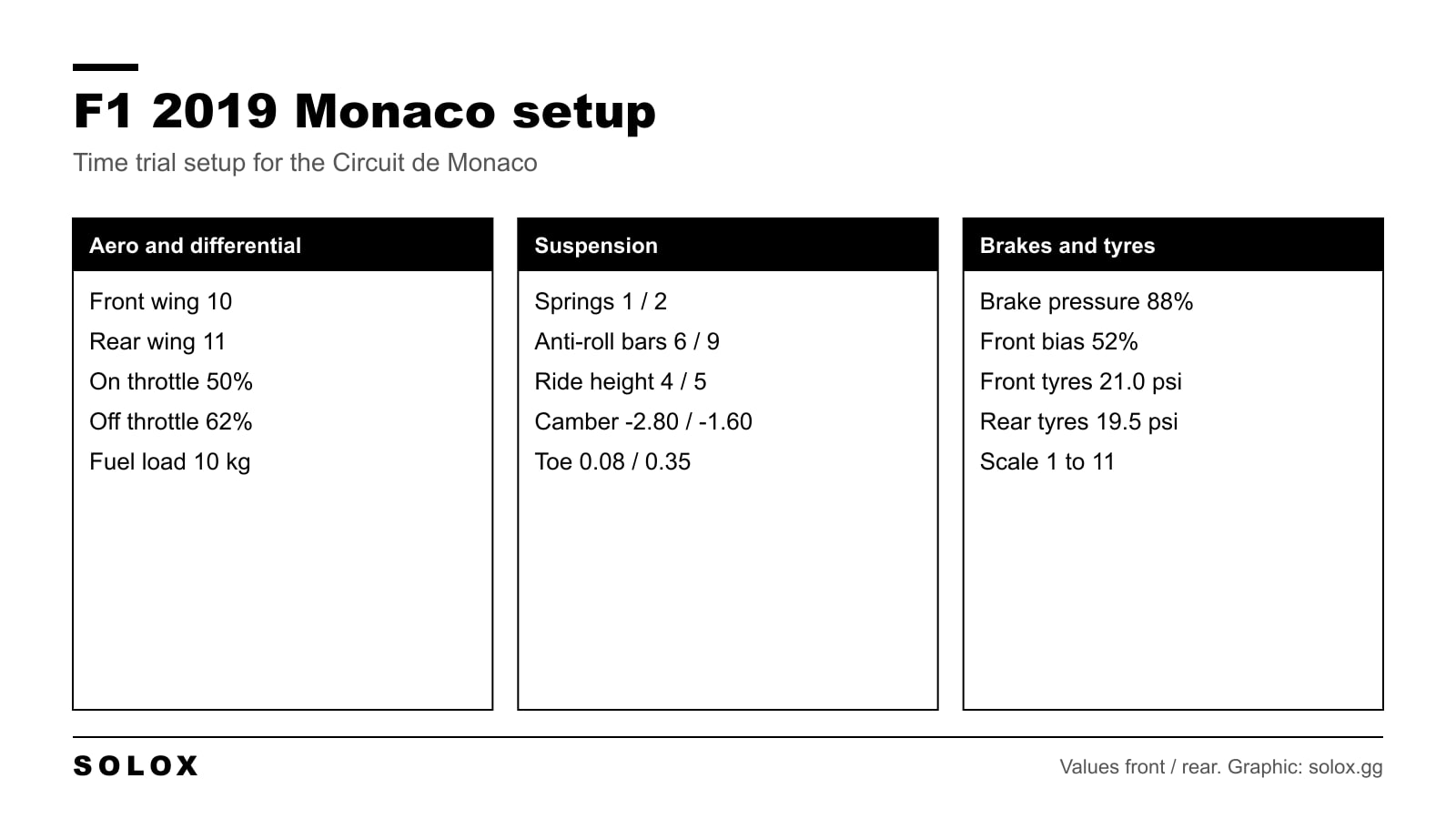
Monaco is the easiest track on the calendar to set up and the hardest to drive. You put all the wing on, you make the car soft, and then it is up to you and the walls.
This setup does that: wings 10 and 11, front springs at 1. The details that are worth a look are the brake bias and the geometry. It is a time trial setup, saved with 10 kg of fuel.
F1 2019 Monaco setup
| Setting | Front | Rear |
|---|---|---|
| Wing | 10 | 11 |
| Camber | -2.80 | -1.60 |
| Toe | 0.08 | 0.35 |
| Suspension | 1 | 2 |
| Anti-roll bar | 6 | 9 |
| Ride height | 4 | 5 |
| Tyre pressure | 21.0 psi | 19.5 psi |
| Setting | Value |
|---|---|
| Fuel load | 10 kg |
| Differential on throttle | 50% |
| Differential off throttle | 62% |
| Brake pressure | 88% |
| Front brake bias | 52% |
In F1 2019 the wings, suspension, anti-roll bars and ride height all use a scale from 1 to 11.
This setup was collected for the site in 2022 from a fast time trial lap, like the rest of my F1 2019 setups. Use it as a base and adjust it with the table further down.

Why this setup works in Monaco
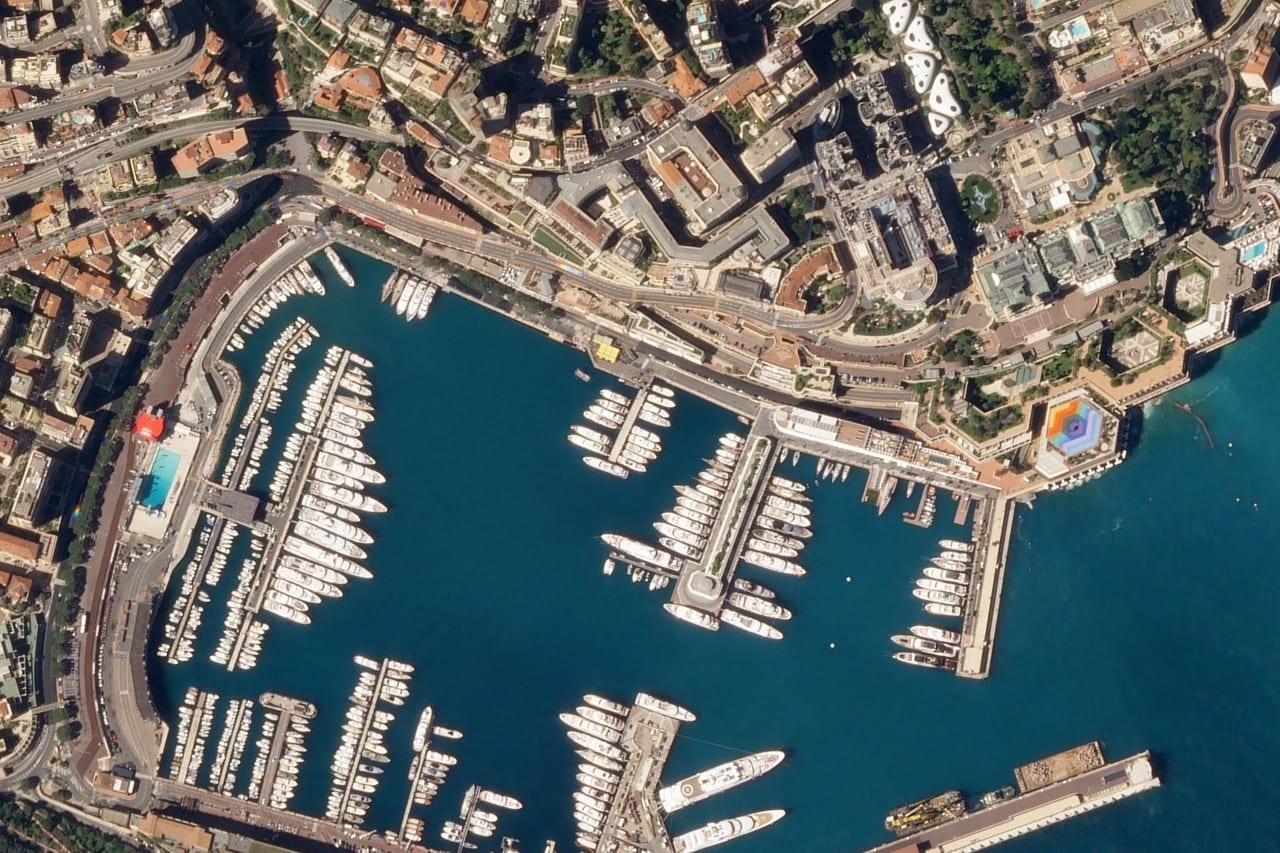
The Circuit de Monaco is 3.337 km long with 19 corners. It is the shortest and slowest lap of the season. The longest flat out part is the run through the tunnel, and even that is a curve.
The wings. 10 and 11. No other setup in my list for this game comes close. Hungary is next with 8 and 11. At these speeds the drag costs you almost nothing, and every click of wing is grip in Massenet, Casino, Tabac and the swimming pool. The front is only one click under the rear, so the car turns in as hard as it can.
The differential. 50% on throttle is fully open. Monaco is first and second gear corners with a wall on the exit, and an open differential gives you the smoothest traction. Off throttle it is 62%, a middle value that keeps the rear calm on the brakes without making the car refuse to turn.
The brakes. 88% pressure, the highest in my list, with 52% front bias, the lowest in my list. The speeds are low, so the fronts are less likely to lock from a high pedal pressure. And the bias towards the rear helps the car rotate while you trail the brake into a corner. In Mirabeau, the hairpin and Rascasse you turn and brake at the same time, and that is where it pays.
The price: the rear can lock if you brake hard with steering lock on. If the rear steps out on the brakes, move the bias forward first.
The geometry. Camber -2.80 and -1.60, toe 0.08 and 0.35. Most of my setups for this game run the menu minimum of -2.50, -1.00, 0.05 and 0.20. Monaco has a little more of everything. More front camber and front toe sharpen the turn in. More rear toe makes the rear stable when you pick up the throttle. On a track with no straights there is nothing to lose from the extra tyre scrub.
The tyre pressures. 21.0 psi front and 19.5 psi rear. Spain is the only other track in my list this low. A softer tyre has more grip at low speed.
Soft and tall
Springs at 1 and 2. Ride height at 4 and 5.
Monaco is a normal road for the rest of the year. It has bumps, drain covers, a crown in the middle and kerbs you have to touch in the chicane and the swimming pool. A soft car keeps its tyres on the ground over all of that. A tall car does not hit the road at the bottom of the hill after Casino or on the kerbs.
The anti-roll bars are 6 at the front and 9 at the rear. The front is stiffer than in most of my setups for this game. It makes the car answer the steering quickly, which you need in the swimming pool, where you change direction twice in a second. The rear at 9 helps the car rotate in the slow corners.

What to change
One change at a time, three laps, then decide.
| Problem | Change | Why |
|---|---|---|
| The rear steps out on the brakes | Front brake bias 52% to 55% | More braking at the front keeps the rear in line |
| Front tyres lock into Sainte Devote or the chicane | Brake pressure 88% to 84% | Less peak pressure, easier to hold at the limit |
| Wheelspin out of the hairpin or Rascasse | Rear anti-roll bar 9 to 7 | A softer rear bar gives the rear tyres more grip |
| Understeer in the hairpin | Off throttle differential 62% to 55% | Less lock off the throttle helps the car rotate |
| The car is nervous in the swimming pool | Front anti-roll bar 6 to 4 | A softer front end is slower to react and easier to place |
| The rear is loose in Tabac or Casino | Front wing 10 to 9 | Less front downforce moves the balance to the rear |
| The car bottoms out after Casino | Ride height 4 and 5 to 5 and 6 | More clearance over the bumps |
For a race
In a race Monaco is about not making a mistake for 78 laps. You do not need the last tenth. You need a car you can trust. Before a 25% or 50% race I would change this:
- Front brake bias 52% to 55%. A rear lock up ends in a wall. A front lock up usually ends in a slow corner.
- Brake pressure 88% to 84%. With a full tank the tyres lock sooner.
- Rear tyre pressure 19.5 to 20.3 psi. The rear tyres do all the traction work and the minimum pressure runs hot over a stint.
- Fuel. The 10 kg is a time trial number. In a race the game sets the load for the distance.
Do not touch the wings. There is no reason to.
On a pad, I would run 56% front bias and brake pressure around 82%, and soften the front anti-roll bar to 4 so the car is less sharp on the stick.
F1 2019 has manual ERS modes. Monaco uses little energy, so you can run a high mode for most of the lap. Passing is close to impossible, so in a race use the battery to defend out of Portier, through the tunnel, and out of the last corner.
Where the lap time is in Monaco
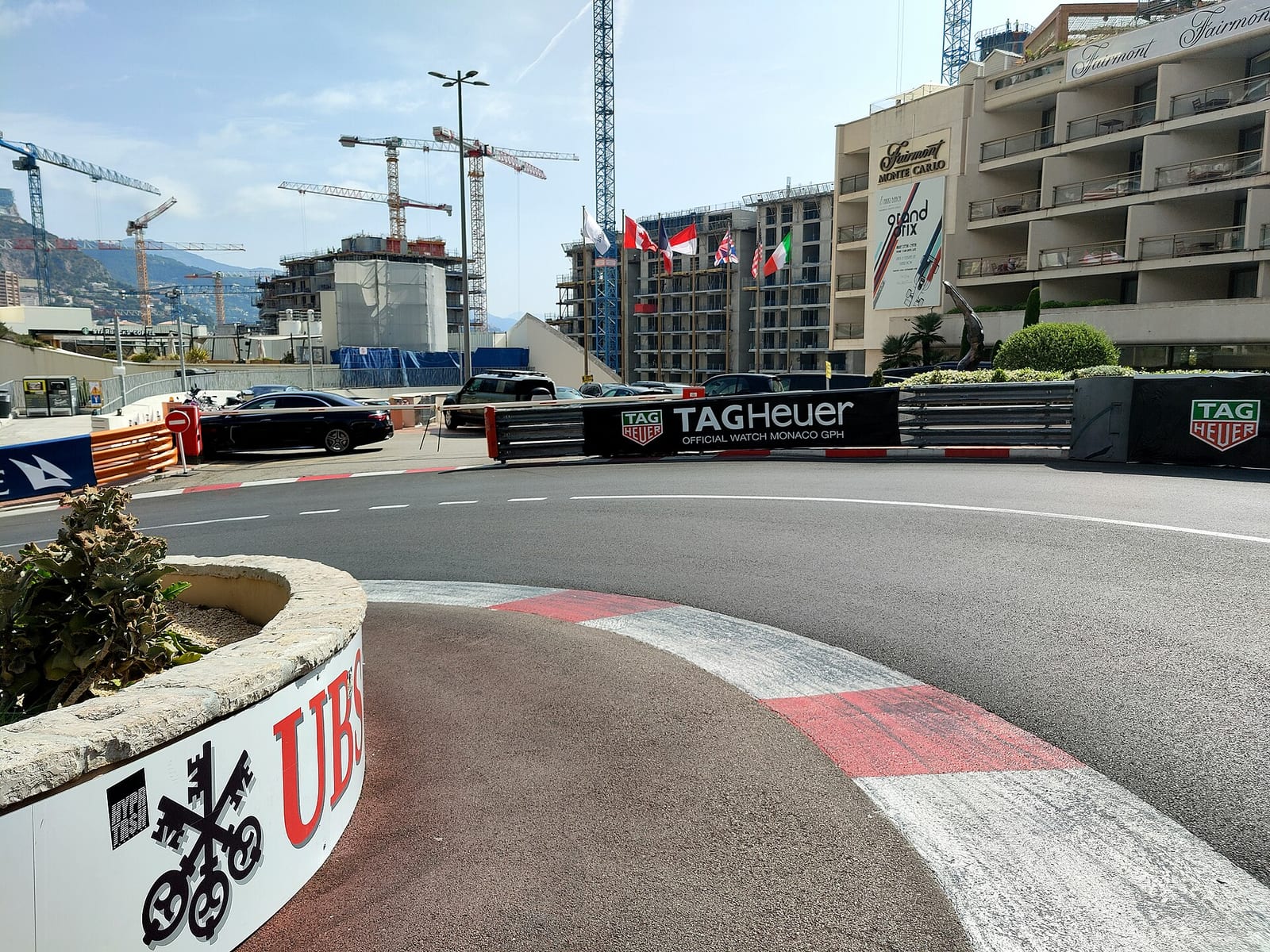
- Sainte Devote, turn 1. A tight right with a wall on the exit. Brake in a straight line and do not run wide. The exit sets your speed up the hill.
- Massenet and Casino, turn 3 and turn 4. A long blind left over the top of the hill, then a right. This is where the wing helps most. Stay close to the inside barrier in Massenet.
- Mirabeau, turn 5. Downhill and bumpy under braking. Trail the brake and let the rear bias turn the car.
- The hairpin, turn 6. The slowest corner in Formula 1. Full lock, first gear, and wait. Nothing to gain here, only to lose.
- Portier, turn 8. The most important exit of the lap. It leads into the tunnel and down to the chicane. Late apex, early throttle.
- The chicane, turn 10 and turn 11. The biggest stop of the lap, downhill out of the tunnel. Brake early the first few laps. Use the kerb on the way in, stay off the one on the way out.
- Tabac, turn 12. Fast, with the wall on the exit. One clean input.
- The swimming pool, turn 13 to turn 16. The first part is nearly flat. The second part is slower and the inside wall is right there. Touch it and the lap is over.
- Rascasse and the last corner, turn 17 to turn 19. Slow and tight. Be patient, get the car straight, then throttle.
If you take one thing from this page: build up to it. I would do ten laps at nine tenths before I pushed here. The walls do not give you a second chance, and confidence is worth more than any setup change in Monaco.
Monaco in 2019
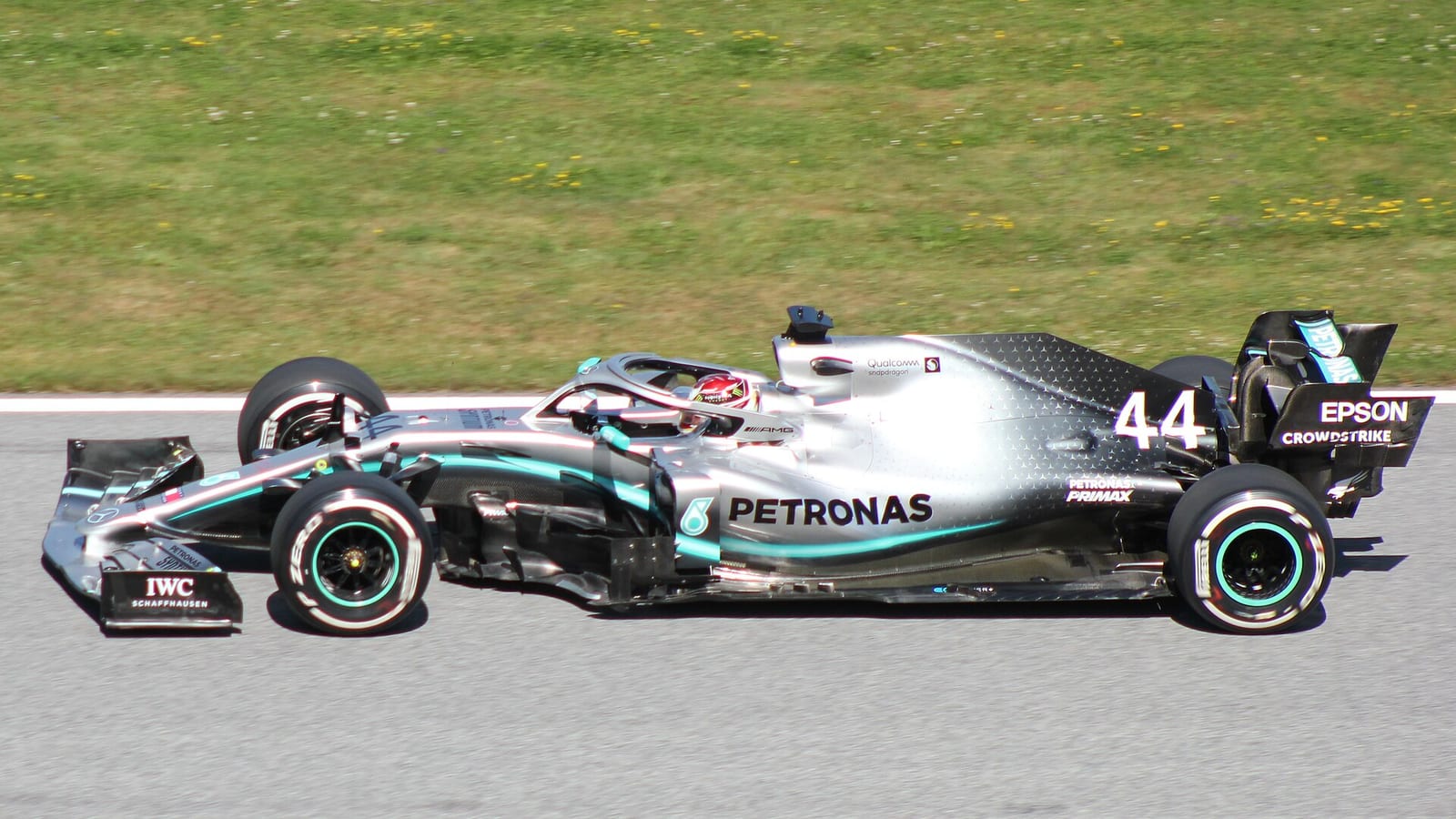
The 2019 Monaco Grand Prix was round 6 of 21, on 26 May, over 78 laps. Niki Lauda had died six days earlier, and Mercedes ran red halos on its cars in his memory.
Lewis Hamilton took pole position in 1:10.166, a new track record, ahead of Valtteri Bottas. Charles Leclerc went out in the first part of qualifying at his home race, after Ferrari chose not to send him out for a second run.
Hamilton led from the start and won. Max Verstappen crossed the line second, but a time penalty for contact with Bottas in the pit lane dropped him to fourth. That put Sebastian Vettel second and Bottas third. Pierre Gasly set the fastest lap, a 1:14.279 on lap 72.
More F1 2019 setups
All the tracks are on the F1 2019 setups page. Monaco is round 6. The round before it is the F1 2019 Spain setup and the next one is the F1 2019 Canada setup.
For the same track in other games, here are my F1 2018 Monaco setup, my F1 2020 Monaco setup and my F1 25 Monaco setup. The values do not carry over from one game to the next.
FAQ
What is the best F1 2019 setup for Monaco?
Front wing 10, rear wing 11, differential 50% on throttle and 62% off, suspension 1 and 2, anti-roll bars 6 and 9, ride height 4 and 5, camber -2.80 and -1.60, brake pressure 88% with 52% front bias, and tyres at 21.0 and 19.5 psi.
What wing levels should I run in Monaco in F1 2019?
10 at the front and 11 at the rear. It is the one track where more wing is always the answer.
Can I use this Monaco setup in a race?
Yes, with small changes. Move the front brake bias to 55%, lower the brake pressure to 84% and raise the rear tyre pressure to about 20.3 psi.
Does this setup work with a controller?
Yes. I would run 56% front bias, brake pressure around 82% and a front anti-roll bar at 4, so the car is calmer on the stick.
Why is the brake bias so far to the rear?
To help the car turn while you are still on the brakes, which you do in almost every corner in Monaco. If the rear locks, go back to 55%.
Where can I overtake in Monaco in F1 2019?
The chicane after the tunnel is the only real place, and it takes a mistake from the car ahead. Sainte Devote is possible with DRS.
How long is the Circuit de Monaco in F1 2019?
3.337 km with 19 corners. The real race is 78 laps, the only one on the calendar shorter than 305 km.