
Monaco is the slowest lap on the F1 2017 calendar and the hardest one to finish. The walls are right there, the car is wide, and a mistake of 20 centimetres ends the lap.
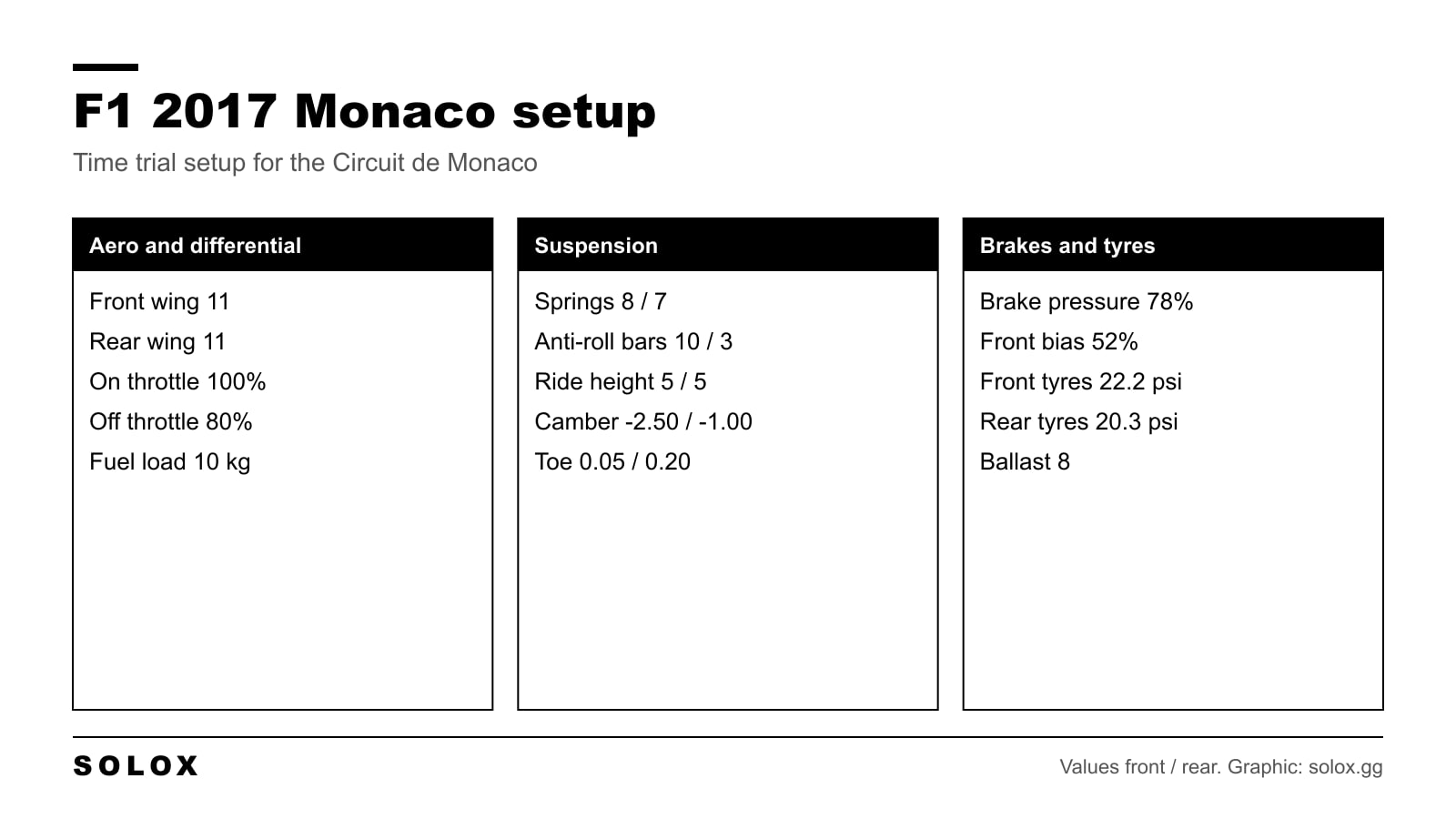
The setup follows from that. Maximum wing, low tyre pressures, a soft rear end. It is a time trial setup, saved with 10 kg of fuel.
F1 2017 Monaco setup
| Setting | Front | Rear |
|---|---|---|
| Wing | 11 | 11 |
| Differential (on / off throttle) | 100% | 80% |
| Camber | -2.50 | -1.00 |
| Toe | 0.05 | 0.20 |
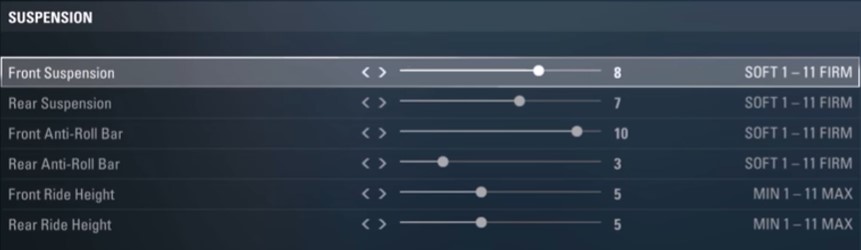
| Suspension | 8 | 7 |
| Anti-roll bar | 10 | 3 |
| Ride height | 5 | 5 |
| Tyre pressure | 22.2 psi | 20.3 psi |
| Setting | Value |
|---|---|
| Fuel load | 10 kg |
| Brake pressure | 78% |
| Front brake bias | 52% |
| Ballast | 8 |
In F1 2017 the wings, suspension, anti-roll bars, ride height and ballast all use a scale from 1 to 11.
This setup was collected for the site in 2022 from a fast time trial lap, like the rest of my F1 2017 setups. Use it as a base and adjust it with the table further down.

Why this setup works in Monaco
The lap is 3.337 km with 19 corners. The longest full throttle part is the tunnel, and even that is a curve.
The wings. 11 and 11, the maximum. There is no straight long enough to make you pay for drag, so you take every bit of downforce. It helps in the faster places: Massenet, Casino, Tabac and the Swimming Pool. It also makes the car calmer on the brakes.
The tyre pressures. 22.2 psi front and 20.3 psi rear. Most of my F1 2017 setups run 23.0 at the front. A lower pressure gives a bigger contact patch, and at these speeds the grip comes from the tyre, not the wing. The lap is too short and slow to overheat them.
The bars. Front 10, rear 3. That is a big split. The stiff front makes the car react quickly when you turn, which you need for the direction changes at the Swimming Pool. The soft rear keeps both rear tyres on the ground when you go back to the throttle.
The springs. 8 and 7. This is the part I would question. It is stiff for a bumpy street track. It makes the car precise, and for one perfect lap that is fast. If you touch the kerbs a lot, it will bite you. See the table below.
Brakes and differential
Brake pressure is 78% with 52% at the front. The bias is further back than in most of my F1 2017 setups. A rearward bias helps the car turn while you are still on the brakes, and in Monaco you trail the brake into almost every corner.
The price is a rear that can step out when you brake hard and downhill. The chicane after the tunnel is the place. If it happens, go to 54%.
The on throttle differential is at 100%, fully locked. For a single lap on fresh tyres it works. I would open it for anything longer, and on a pad I would open it straight away. Off throttle is 80%.
What to change
One change at a time, three laps, then decide.
| Problem | Change | Why |
|---|---|---|
| The car jumps over the kerbs at the Swimming Pool or the chicane | Front suspension 8 to 6, rear 7 to 5 | Softer springs let the car ride the kerb and land without bouncing into the wall |
| Wheelspin out of the hairpin, Portier or Rascasse | On throttle differential 100% to 75% | The corners are so slow that a locked differential just spins both rears |
| The car will not turn at the hairpin | Front anti-roll bar 10 to 8 | A softer front bar gives more front grip at very low speed |
| Rear steps out on the brakes into Sainte Devote or the chicane | Front brake bias 52% to 54% | More front bias keeps the rear in line when you brake downhill out of the tunnel |
| Front tyres lock into Mirabeau | Brake pressure 78% to 75% | You brake downhill there. Less pressure is easier to control |
| Rear feels nervous through Casino and Tabac | Rear anti-roll bar 3 to 2 | The rear rolls more and gives you a warning before it lets go |
For a race
A race in Monaco is about survival and the pit stop. You will not pass many cars on track. Before a 25% or 50% race I would change this:
- On throttle differential 100% to 75%. The rear tyres last longer and the car is easier out of the hairpin with a full tank.
- Springs 8 and 7 to 6 and 5. You will touch kerbs over a race distance. Make sure the car forgives it.
- Front brake bias 52% to 54%. A stable rear matters more than the last bit of rotation when you do 40 laps or more.
- Fuel. The 10 kg is a time trial number. In a race the game sets the load for the distance.
Qualifying is most of the result here. Put your effort into one clean lap on Saturday.
Where the lap time is in Monaco
- Sainte Devote. Brake in a straight line and do not turn in early. The inside wall is closer than it looks. The exit decides your speed all the way up the hill.
- Massenet and Casino. A long left over the crest, then a right. Stay close to the inside barrier at Massenet. If you run wide there you are on the wrong side for Casino.
- Mirabeau. Downhill braking. The inside front goes light and locks. Brake a touch early.
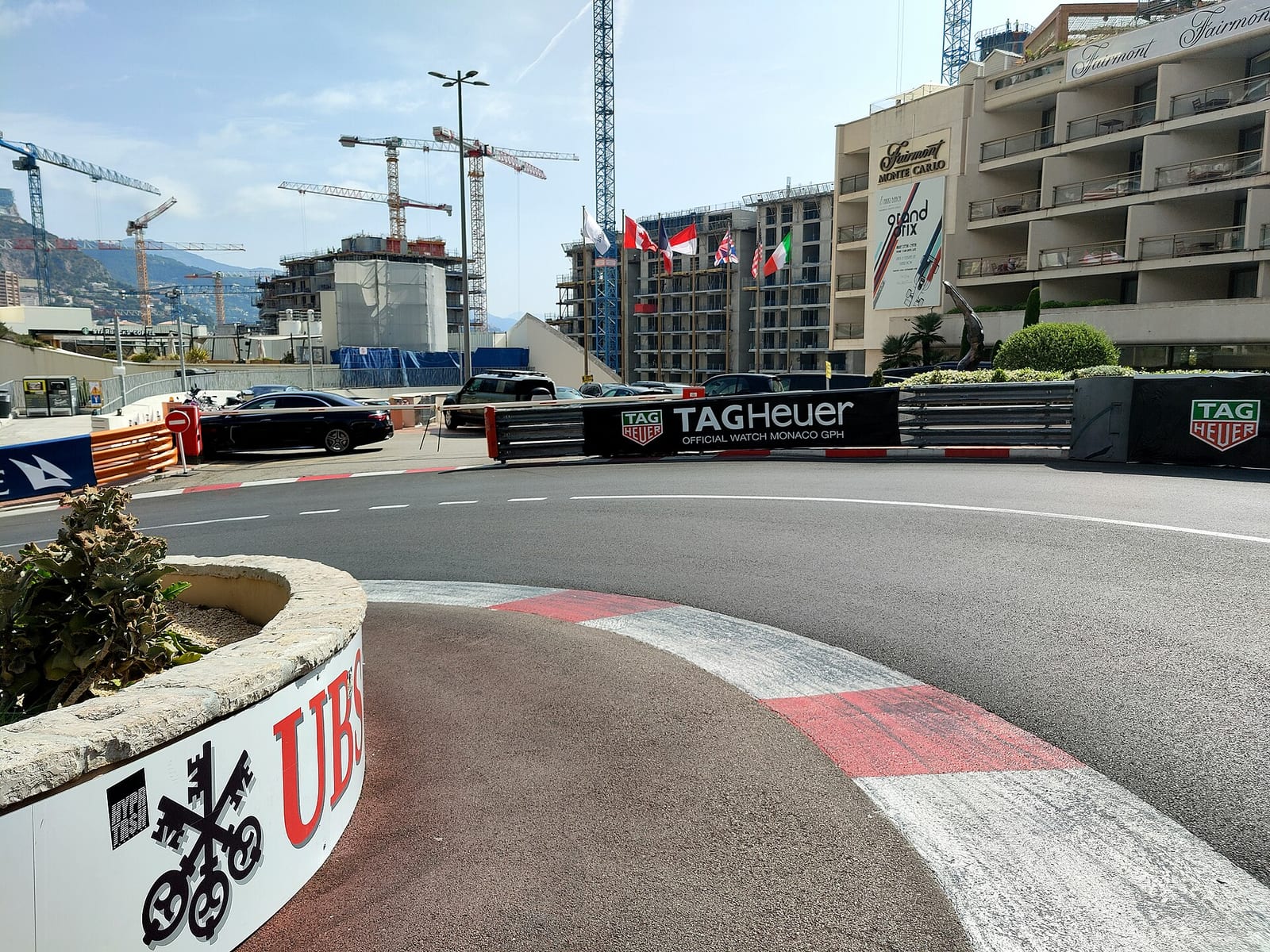
- The hairpin. The slowest corner in Formula 1. Full steering lock, first gear, and wait. Do not touch the throttle until the car points down the hill.
- Portier. The corner before the tunnel. A good exit here is worth more than anything you did in the hairpin.
- The chicane. Hard braking out of the tunnel, downhill, over a bump. It is the one real passing place and the one real place to crash.
- Tabac and the Swimming Pool. The fast part. Tabac is a lift and a turn. The first Swimming Pool chicane is nearly flat. The second one needs a firm brake and a clean line over the kerb.
- Rascasse and the last corner. Slow in. The car wants to understeer into the wall on the outside of Rascasse.
How to learn it: the same way I would tell a young driver to learn any street track. Start well inside the limit and move your braking points later a little on every lap. In Monaco you do not find the limit by going over it.
Monaco in 2017
The real 2017 Monaco Grand Prix was round 6 of 20, on 28 May. Kimi Raikkonen took pole in 1:12.178 for Ferrari. Sebastian Vettel won the race after the pit stops, with Raikkonen second and Daniel Ricciardo third for Red Bull. It was the first Ferrari win in Monaco since 2001.
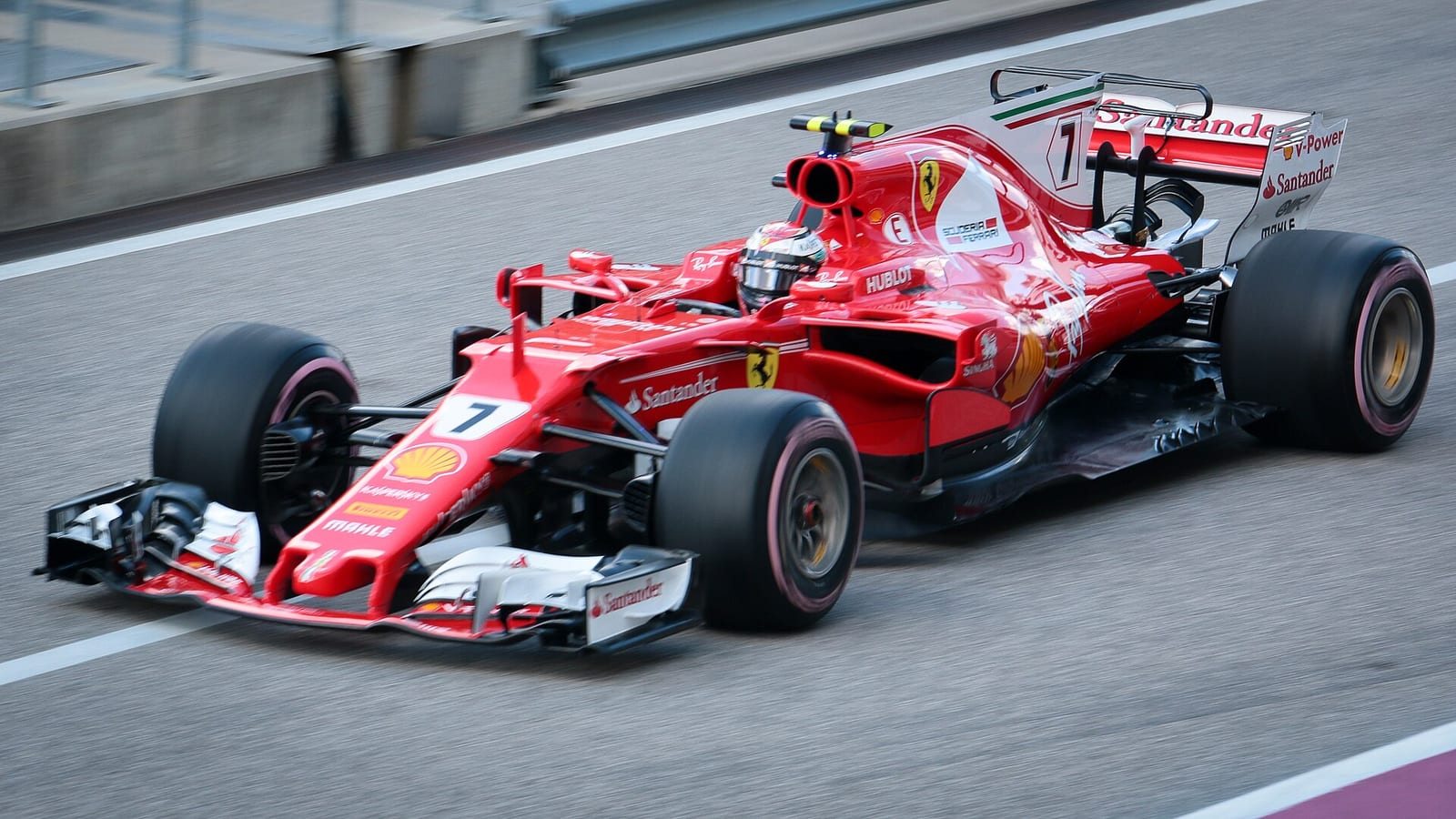
More F1 2017 setups
All 20 tracks are in my F1 2017 setups table. The round before this one is the F1 2017 Spain setup and the next is the F1 2017 Canada setup, which is the opposite kind of track. The only other track with wings at 11 and 11 is in the F1 2017 Hungary setup.
For the same track in other games, here are my F1 2018 Monaco setup and my F1 25 Monaco setup. The values do not carry over from one game to the next.
FAQ
What is the best wing setup for Monaco in F1 2017?
Front wing 11 and rear wing 11. It is the maximum on both ends, and there is no reason to run less.
What tyre pressures should I use in Monaco in F1 2017?
22.2 psi front and 20.3 psi rear. That is lower than at most other tracks, to get more mechanical grip in the slow corners.
What differential should I use in Monaco in F1 2017?
100% on throttle and 80% off throttle for time trial. For a race or on a pad, open the on throttle value to around 75%.
Why does my car bounce off the kerbs in Monaco?
The springs in this setup are stiff at 8 and 7. Go down to 6 and 5 and the car will ride the kerbs at the Swimming Pool and the chicane much better.
Does this setup work with a controller?
Yes, with two changes. On throttle differential down to 75% and brake pressure down to around 75%, so the car is easier on the triggers.
Where can I overtake in Monaco in F1 2017?
The chicane after the tunnel, and Sainte Devote at the start of the lap if the car in front makes a mistake. Everywhere else is too narrow.
How long is the Monaco track in F1 2017?
3.337 km with 19 corners. The real race is 78 laps.