
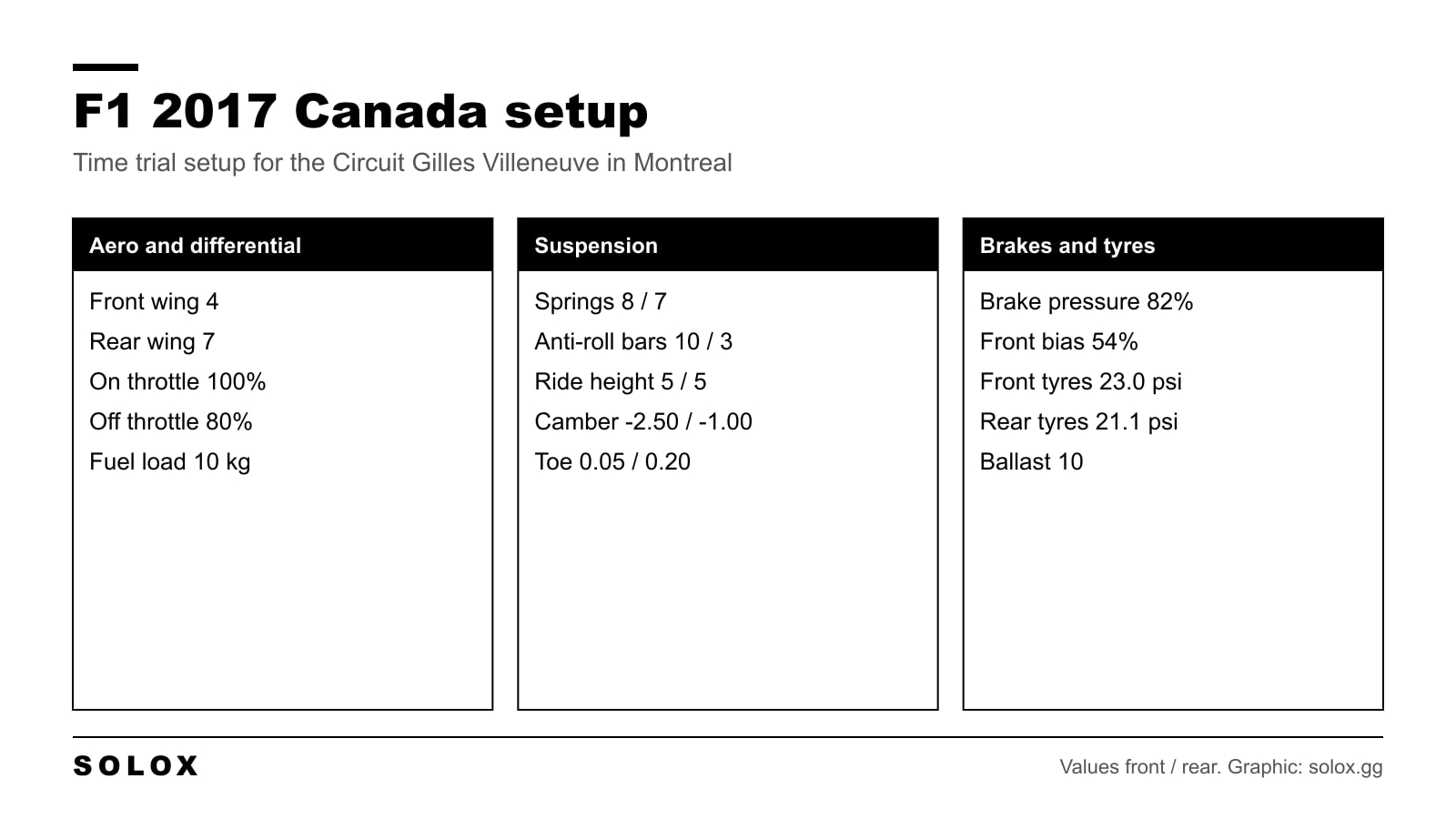
This is the F1 2017 setup for Canada on this site: front wing 4, rear wing 7, the differential fully locked at 100% on throttle, and a front anti-roll bar at 10 against 3 at the rear. It is a time trial setup, saved with 10 kg of fuel. The full menu is in the table below, then I explain why it works in Montreal and what I would change for a race or for a pad.
It was collected in 2022 from a fast time trial lap, like the rest of my F1 2017 setups. Use it as a starting point.
F1 2017 Canada setup
| Setting | Value |
|---|---|
| Fuel load | 10 kg |
| Front wing | 4 |
| Rear wing | 7 |
| Differential on throttle | 100% |
| Differential off throttle | 80% |
| Front camber | -2.50 |
| Rear camber | -1.00 |
| Front toe | 0.05 |
| Rear toe | 0.20 |
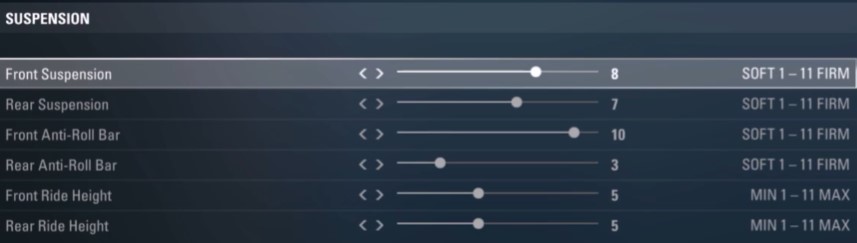
| Front suspension | 8 |
| Rear suspension | 7 |
| Front anti-roll bar | 10 |
| Rear anti-roll bar | 3 |
| Front ride height | 5 |
| Rear ride height | 5 |
| Brake pressure | 82% |
| Front brake bias | 54% |
| Front tyre pressure | 23.0 psi |
| Rear tyre pressure | 21.1 psi |
| Ballast | 10 |

Here is the lap the setup comes from:
Why this setup works in Montreal
The Circuit Gilles Villeneuve is 4.361 km long with 14 corners. On paper it is simple: straights joined by chicanes and one hairpin. There is no long fast corner anywhere on the lap. The time is in the braking zones, the kerbs and the exits.
That is why the wings sit in the middle. Rear wing 7 keeps the car stable when you brake from top speed into the hairpin and the last chicane, and it gives the rear tyres some load on the way out. Any more and you are slow on the back straight, which is the longest full throttle run of the lap. Front wing 4 gives the nose enough bite to change direction in the chicanes.
The differential is the brave part. At 100% on throttle both rear wheels are locked together. Out of the hairpin and out of turn 2 that is the best drive you can get, as long as the car is straight when you go to full throttle. Open the throttle too early with steering lock on and the rear will step out. At 80% off throttle the car stays calm when you lift and brake.
Camber and toe are at the low end of what the game allows, -2.50 and -1.00 with 0.05 and 0.20. That keeps the tyres flat on the road for braking and traction, which is what this track asks for.
Sharp front, soft rear
The front anti-roll bar is at 10 and the rear is at 3. That is a big split.
A stiff front bar makes the car turn the moment you move the wheel. In Montreal you flick the car left and right through four chicanes, so a lazy front end costs you time at every one of them. The soft rear bar does the opposite job. It lets the rear of the car roll and keeps both rear tyres on the ground when you put the power down.
Suspension is 8 at the front and 7 at the rear, on the firm side of the middle. I would not go stiffer. You need to use the kerbs here, and a car that is too stiff jumps off them. Ride height is 5 and 5 for the same reason: enough room to ride the kerbs without the floor hitting.
What to change
One change at a time, three laps, then decide.
| Problem | Change |
|---|---|
| Wheelspin out of the hairpin or turn 2 | On throttle differential from 100% to 85% |
| The car pushes wide in the chicanes | Front wing from 4 to 5 |
| Too slow on the back straight | Rear wing from 7 to 6, and front wing down one click with it |
| Front tyres lock into the hairpin | Brake pressure from 82% to 78% |
| The rear moves under braking for the last chicane | Front brake bias from 54% to 56% |
| The car jumps on the kerbs | Front suspension from 8 to 6 |
| The rear snaps when you change direction | Front anti-roll bar from 10 to 8 |
For a race. A locked differential eats the rear tyres over a stint. Lower it to 80% or 85% first. With race fuel the braking distances are longer as well, so bring the brake pressure down to 78% until you stop locking the fronts. Leave the wings alone. You need the straight line speed to attack and defend into the last chicane.
On a pad. Start with the differential at 75% and the front anti-roll bar at 8. It is hard to feed the throttle in gently with a trigger, and a fully locked rear axle punishes every mistake.
Where the lap time is in Montreal
Turn 1 and turn 2. A fast left kink into a tight right. Brake in a straight line before turn 1, let the car run out to the left, then turn in late for turn 2. The exit of turn 2 matters more than the entry of turn 1.
Turn 3 and turn 4. The first chicane, with a wall on the exit. Take the inside kerb at turn 3 and keep off the big kerb at turn 4. Do not use all the road on the way out until you trust the car.
Turn 6 and turn 7. A slow left and right. Brake a little early, because the exit of turn 7 leads to a flat out run to the next chicane.
Turn 8 and turn 9. The bridge chicane. It is faster than it looks. Brake late, use the first kerb and get back to full throttle before the second apex.
Turn 10. The hairpin. This is the most important exit of the lap, because the back straight comes after it. Brake early, turn late, and wait until the car is straight before you go to full throttle. With the differential at 100% this is where it pays you or bites you.
Turn 13 and turn 14. The last chicane and the Wall of Champions. You arrive at top speed. Brake hard, take a lot of the first kerb and a little of the second. The wall on the exit is close. Leave half a metre until you are doing the same lap every time.
Montreal in 2017
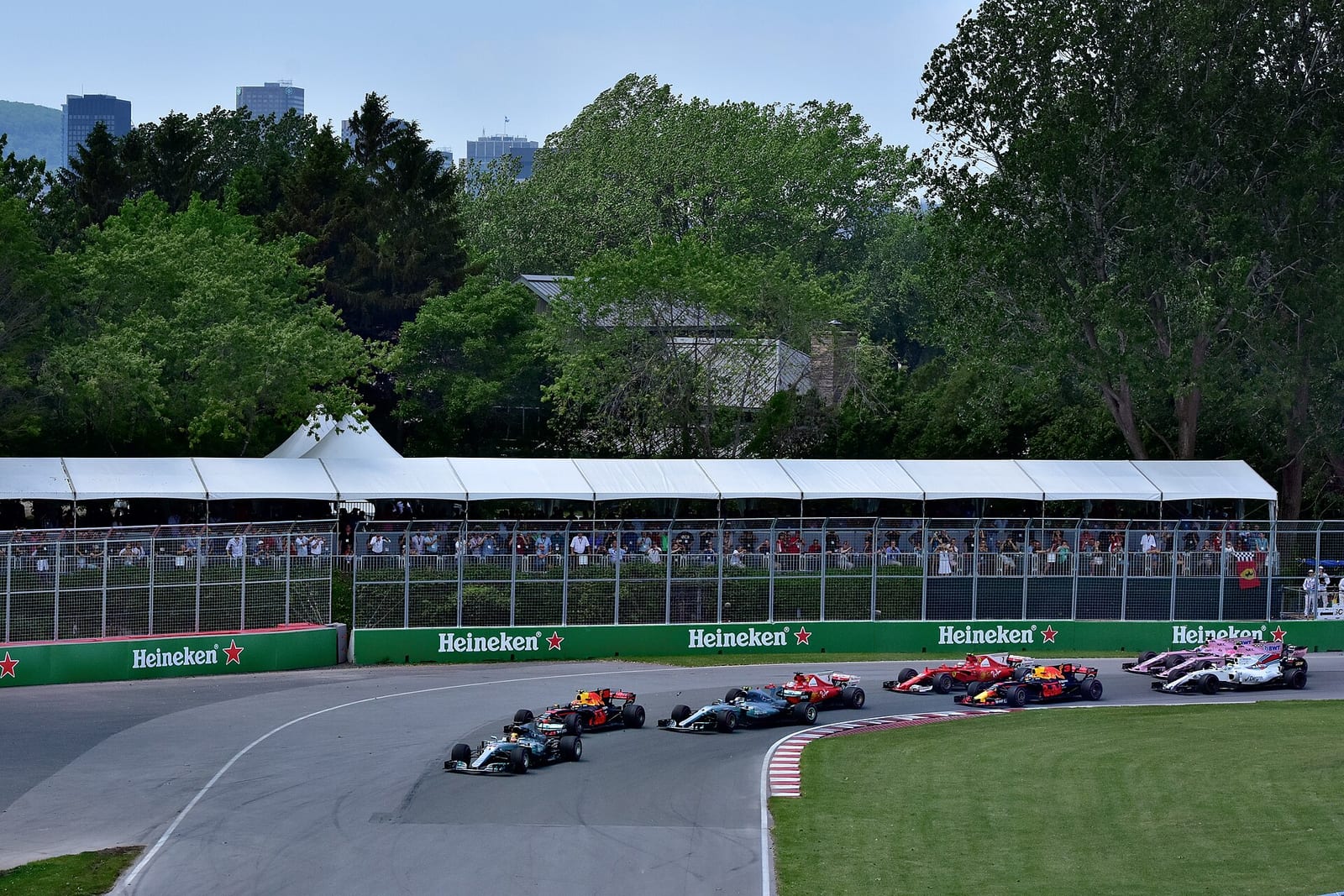
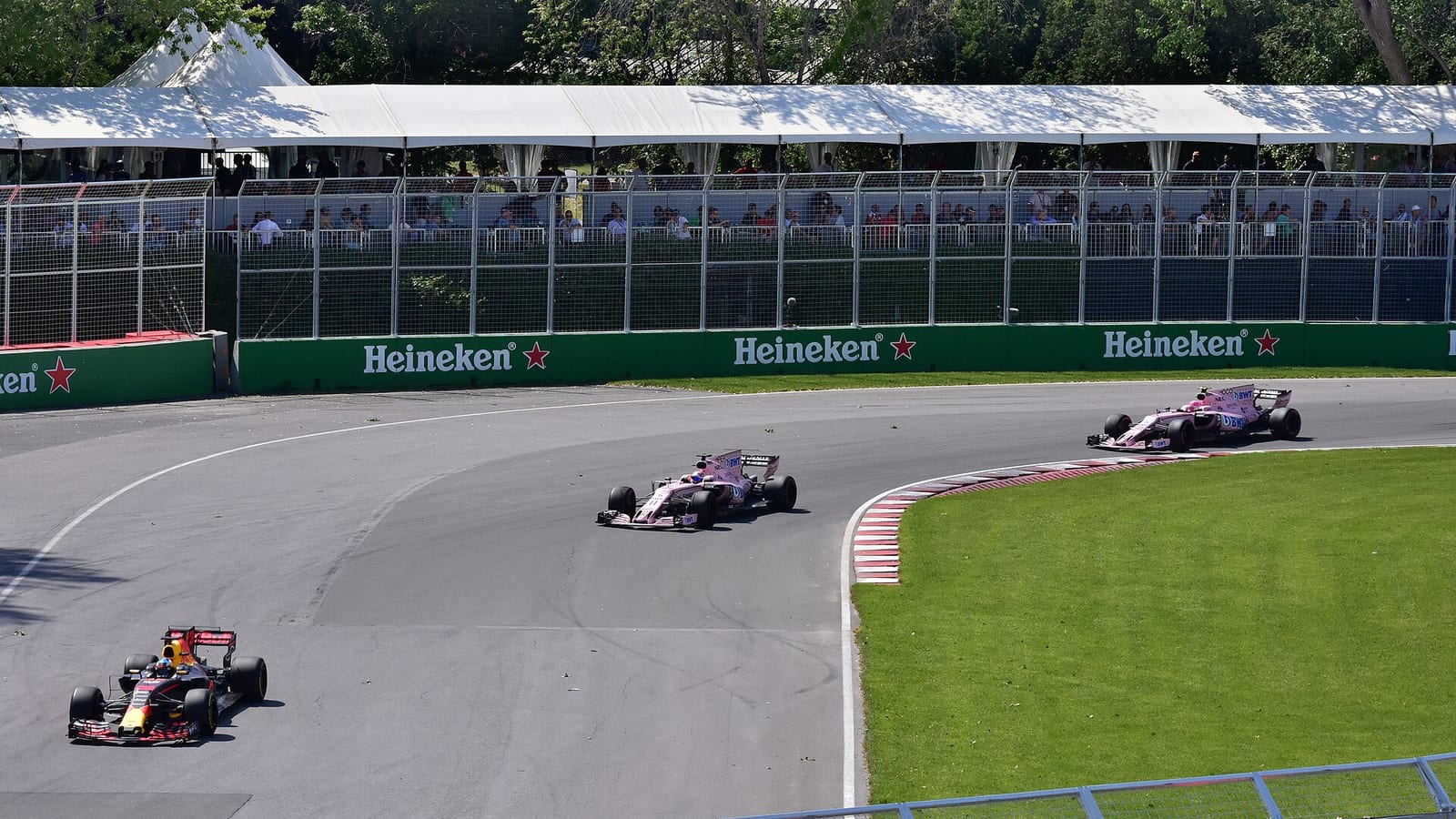
Lewis Hamilton took pole position for the 2017 Canadian Grand Prix with a 1:11.459 and won the race, over 70 laps. Valtteri Bottas made it a Mercedes one two and Daniel Ricciardo finished third for Red Bull. Hamilton also set the fastest lap, a 1:14.551.
More F1 2017 setups
Canada comes between two street tracks on the 2017 calendar. The Monaco setup is the high downforce end of the game, and the Baku setup drops the wings to 2 and 6 for the longest straight of the year. All 20 tracks are in one table on the F1 2017 setups page.
If you play the current game, the track is the same and the car is not: see my F1 25 Canada setup.
FAQ
What is the best F1 2017 setup for Canada?
Front wing 4, rear wing 7, differential 100% on throttle and 80% off, suspension 8 and 7, anti-roll bars 10 and 3, ride height 5 and 5, brake pressure 82% with 54% front bias, and tyres at 23.0 and 21.1 psi.
What wing levels should I run in Montreal in F1 2017?
4 at the front and 7 at the rear. It is a medium downforce level. You can go to 6 at the rear if you want more speed on the back straight, but the car gets harder to stop.
Can I use this Canada setup in a race?
Yes, with two changes. It is saved with 10 kg of fuel. Lower the on throttle differential to 80% or 85% to save the rear tyres, and take the brake pressure down to about 78%.
Does this setup work with a controller?
It does. Lower the on throttle differential to 75% and the front anti-roll bar to 8, so the car is easier on the throttle and calmer in the chicanes.
Why is the differential at 100%?
A locked differential gives the best traction in a straight line, and Montreal is mostly slow corners followed by straights. The price is a rear that slides if you get on the throttle before the car is straight.
Where do I lose the most time in Montreal?
Usually on the exit of the hairpin before the back straight, and by braking too early for the last chicane.