
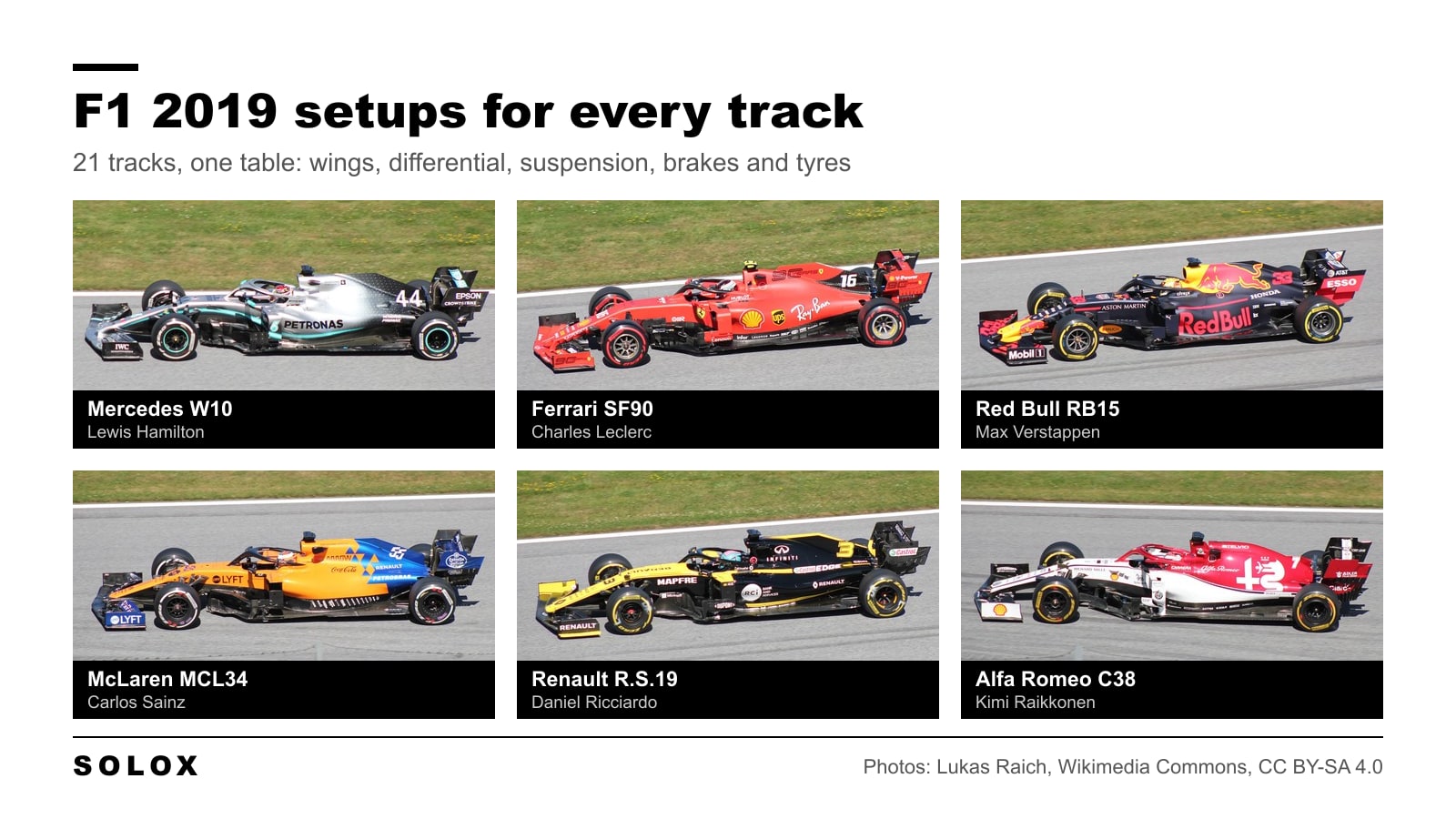
The best F1 2019 setup changes with the track, but the idea behind it is the same almost everywhere: a soft front end, a very stiff rear anti-roll bar, an open differential on throttle and just enough wing for the corners. The table below has the numbers for all 21 tracks in the game, and every track name links to its own page with the full setup menu. 11 of the 21 pages also have an onboard lap.
These setups were collected for this database in 2022 from fast time trial laps. For this update I checked every number in the tables against the setup screenshots on the track pages, and I corrected two pages where the text did not match the screenshot (Monza and Suzuka). I have not driven all 21 of them again since, so use them as a starting point and not as the last word. What I can add is how to read them, which values I would question, and what to change when the car does not suit your hands.
F1 2019 setups for every track
Values are written front / rear. The differential column is on throttle / off throttle. In F1 2019 the wings, suspension, anti-roll bars and ride height all use a scale from 1 to 11.
| Track | Wings | Differential | Suspension | Anti-roll bars | Ride height |
|---|---|---|---|---|---|
| Bahrain (Sakhir) | 4 / 7 | 55% / 60% | 1 / 4 | 3 / 11 | 1 / 3 |
| Australia (Melbourne) | 5 / 5 | 50% / 65% | 2 / 2 | 5 / 11 | 2 / 4 |
| China (Shanghai) | 4 / 7 | 50% / 60% | 4 / 3 | 3 / 11 | 2 / 4 |
| Spain (Barcelona) | 6 / 8 | 50% / 85% | 1 / 1 | 3 / 9 | 4 / 5 |
| Monaco | 10 / 11 | 50% / 62% | 1 / 2 | 6 / 9 | 4 / 5 |
| Azerbaijan (Baku) | 2 / 5 | 60% / 60% | 2 / 2 | 5 / 5 | 4 / 5 |
| Hungary (Budapest) | 8 / 11 | 60% / 65% | 1 / 4 | 6 / 11 | 2 / 4 |
| France (Paul Ricard) | 3 / 6 | 50% / 70% | 3 / 3 | 4 / 9 | 2 / 2 |
| Germany (Hockenheim) | 3 / 7 | 50% / 63% | 1 / 3 | 5 / 11 | 1 / 3 |
| Austria (Red Bull Ring) | 4 / 5 | 70% / 70% | 5 / 4 | 4 / 10 | 4 / 5 |
| Britain (Silverstone) | 3 / 6 | 100% / 61% | 4 / 4 | 3 / 10 | 3 / 4 |
| Belgium (Spa) | 2 / 6 | 50% / 67% | 1 / 3 | 4 / 10 | 4 / 4 |
| Italy (Monza) | 1 / 3 | 65% / 100% | 1 / 1 | 6 / 8 | 2 / 3 |
| Russia (Sochi) | 3 / 6 | 50% / 70% | 1 / 2 | 1 / 11 | 1 / 2 |
| USA (Austin) | 4 / 5 | 55% / 65% | 2 / 2 | 4 / 5 | 3 / 4 |
| Canada (Montreal) | 3 / 5 | 70% / 70% | 1 / 1 | 5 / 11 | 3 / 4 |
| Singapore (Marina Bay) | 8 / 8 | 50% / 60% | 3 / 3 | 6 / 7 | 4 / 5 |
| Japan (Suzuka) | 3 / 7 | 65% / 63% | 2 / 3 | 4 / 10 | 1 / 2 |
| Mexico (Mexico City) | 2 / 6 | 50% / 70% | 2 / 3 | 4 / 11 | 3 / 3 |
| Brazil (Interlagos) | 4 / 5 | 65% / 60% | 3 / 4 | 3 / 11 | 2 / 4 |
| Abu Dhabi (Yas Marina) | 4 / 6 | 50% / 70% | 2 / 2 | 8 / 9 | 2 / 4 |
Brakes, tyres and geometry
Same order as above. F1 2019 has one tyre pressure for the front axle and one for the rear, in psi. Camber and toe are front / rear too.
| Track | Brake pressure | Front brake bias | Tyre pressures | Camber | Toe |
|---|---|---|---|---|---|
| Bahrain (Sakhir) | 87% | 55% | 23.4 / 21.5 | -3.30 / -2.00 | 0.07 / 0.20 |
| Australia (Melbourne) | 87% | 54% | 24.2 / 22.7 | -2.50 / -1.00 | 0.05 / 0.20 |
| China (Shanghai) | 82% | 55% | 23.4 / 21.5 | -2.50 / -1.00 | 0.05 / 0.20 |
| Spain (Barcelona) | 84% | 55% | 21.0 / 19.5 | -2.50 / -1.00 | 0.05 / 0.20 |
| Monaco | 88% | 52% | 21.0 / 19.5 | -2.80 / -1.60 | 0.08 / 0.35 |
| Azerbaijan (Baku) | 87% | 54% | 21.4 / 19.9 | -2.50 / -1.00 | 0.05 / 0.20 |
| Hungary (Budapest) | 85% | 54% | 23.0 / 21.1 | -2.50 / -1.00 | 0.08 / 0.41 |
| France (Paul Ricard) | 80% | 54% | 22.2 / 22.3 | -2.50 / -1.00 | 0.05 / 0.20 |
| Germany (Hockenheim) | 85% | 55% | 23.4 / 21.1 | -2.70 / -1.20 | 0.07 / 0.32 |
| Austria (Red Bull Ring) | 86% | 56% | 23.8 / 21.5 | -2.60 / -1.10 | 0.06 / 0.23 |
| Britain (Silverstone) | 82% | 53% | 23.4 / 21.9 | -2.50 / -1.00 | 0.05 / 0.26 |
| Belgium (Spa) | 75% | 54% | 25.0 / 22.7 | -2.50 / -1.00 | 0.05 / 0.20 |
| Italy (Monza) | 85% | 56% | 21.8 / 20.3 | -2.50 / -1.00 | 0.07 / 0.20 |
| Russia (Sochi) | 85% | 55% | 24.2 / 21.5 | -2.50 / -1.00 | 0.05 / 0.20 |
| USA (Austin) | 80% | 56% | 24.6 / 22.3 | -2.50 / -1.00 | 0.05 / 0.20 |
| Canada (Montreal) | 85% | 54% | 23.8 / 21.9 | -2.50 / -1.00 | 0.05 / 0.20 |
| Singapore (Marina Bay) | 80% | 54% | 23.0 / 20.3 | -2.50 / -1.00 | 0.05 / 0.20 |
| Japan (Suzuka) | 83% | 53% | 23.8 / 21.5 | -2.50 / -1.00 | 0.05 / 0.20 |
| Mexico (Mexico City) | 80% | 56% | 25.0 / 22.7 | -2.50 / -1.00 | 0.05 / 0.26 |
| Brazil (Interlagos) | 80% | 55% | 24.2 / 21.9 | -2.50 / -1.00 | 0.05 / 0.20 |
| Abu Dhabi (Yas Marina) | 87% | 54% | 23.4 / 21.1 | -2.50 / -1.00 | 0.05 / 0.20 |
Fuel load is 10 kg in every one of these setups.
Tracks by downforce level
If you only have time to change one thing before a session, change the wings. This is how the 21 tracks split by rear wing.
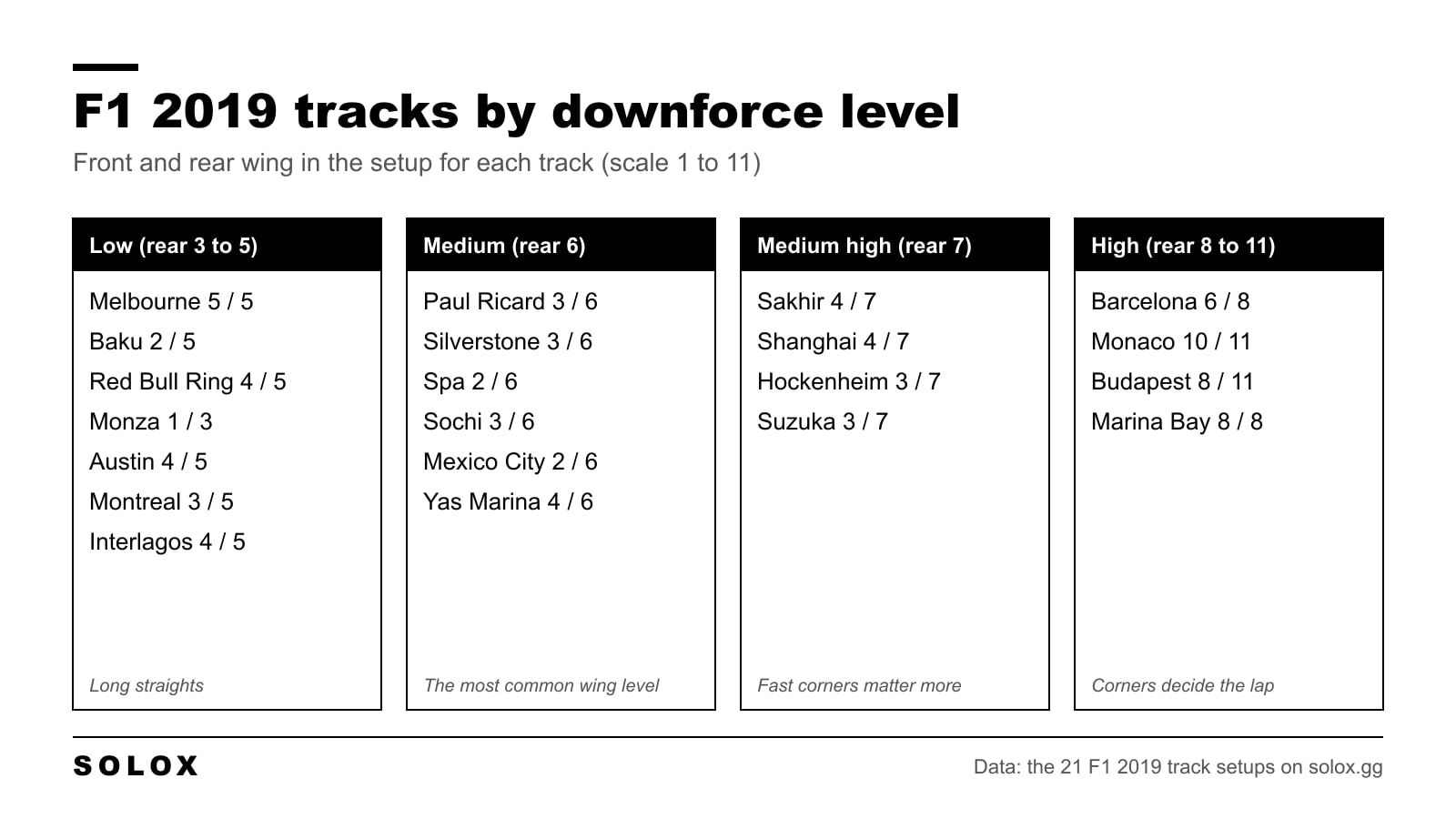
- Low downforce (rear wing 3 to 5): Melbourne, Baku, Red Bull Ring, Monza, Austin, Montreal and Interlagos. Monza is the lowest in the database with 1 at the front and 3 at the rear.
- Medium (rear wing 6): Paul Ricard, Silverstone, Spa, Sochi, Mexico City and Yas Marina.
- Medium high (rear wing 7): Sakhir, Shanghai, Hockenheim and Suzuka.
- High downforce (rear wing 8 to 11): Barcelona, Monaco, Budapest and Marina Bay. Monaco runs 10 and 11, Budapest 8 and 11.
Not one of the 21 setups has more front wing than rear. Melbourne and Marina Bay run the two equal, and everywhere else the rear is between 1 and 4 clicks higher. So the rotation in these setups does not come from the front wing. It comes from the anti-roll bars, and that is the next thing to look at.
What these setups have in common
Read the two tables side by side and a pattern comes out.
- A very stiff rear anti-roll bar. The rear bar is stiffer than the front on 20 of 21 tracks (Baku is the exception with both at 5). It is at 9 or more on 17 tracks and at the maximum of 11 on 9. A stiff rear bar makes the rear slide a little earlier in the middle of the corner, and that turns the car.
- Soft front suspension. 15 of 21 tracks run the front springs at 1 or 2.
- Low ride height with a little rake. The front goes from 1 to 4 and the rear from 2 to 5. The rear is higher than the front on 18 tracks and equal on the other 3 (Paul Ricard, Spa and Mexico City).
- An open differential on throttle. 11 tracks run the minimum of 50%. Without Silverstone, the highest is 70%.
- Brake pressure below the maximum. It goes from 75% (Spa) to 88% (Monaco), and front brake bias from 52% to 56%.
- Camber and toe at the minimum. Front camber is -2.50 on 17 tracks and rear camber -1.00 on 17. Front toe is 0.05 on 15 tracks and rear toe 0.20 on 15. Those are the lowest values the game allows, which keeps the tyres flat on the straights and cool. Sakhir is the outlier with -3.30 at the front and -2.00 at the rear.
- Tyre pressures follow the track. Fronts go from 21.0 psi (Barcelona and Monaco) to 25.0 psi (Spa and Mexico City). Rears go from 19.5 to 22.7 psi.
The values I would question
A database built from other people's laps always has a few numbers that work for one driver and nobody else. These are the ones I would check before I trust them.
- Silverstone, on throttle differential at 100%. Every other track is at 70% or lower. A fully locked differential is stable through the fast corners, but it makes the rear snap when you go on the power out of the slow ones. If you spin there, go down to 70% first.
- Monza, off throttle differential at 100%. The next highest in the database is 85%. Locked off throttle keeps the car straight under braking for the chicanes, but it also pushes the nose wide on turn in. If the car will not rotate into the first chicane, go down to 75 or 80%.
- Sochi, front anti-roll bar at 1 and rear at 11. That is the softest front and the stiffest rear the game allows. It turns, but the rear is on a knife edge. Two clicks more at the front calms it down.
- Paul Ricard, rear tyres at 22.3 psi. It is the only setup where the rear pressure is higher than the front (22.2). It is what the screenshot shows, so it is not a typo, but I would watch the rear tyre temperatures in a longer run.
How to adjust a setup to your driving
A setup from somebody else's fast lap is built around their style. When I worked with engineers in F3 and F2 we never changed five things at once, and the same rule works in the game. One change, three laps, then decide.
- The rear steps out in the middle of the corner. Soften the rear anti-roll bar by two clicks. In these setups it is the first thing to touch, because it is where most of the rotation comes from.
- The rear is loose in fast corners. Add one or two clicks of rear wing.
- The car will not turn in. Add a click of front wing, or soften the front anti-roll bar by one.
- You spin on the exit of slow corners. Check the on throttle differential. If it is already at 50%, the problem is your right foot or the rear bar, not the differential.
- The car is nervous when you lift or brake into a corner. Raise the off throttle differential by 5%. A more locked differential on entry keeps the rear in line.
- You lock the front tyres. Take 3 to 5% off the brake pressure before you touch the bias. If you brake deep into the corner, my trail braking guide explains how to release the pedal.
- The car bottoms out or jumps on the kerbs. Raise the ride height by one click at both ends. Some of these setups run the front at 1, which leaves no margin on a bumpy track.
If you are on a pad, start with points 1 and 6. A stiff rear bar is hard to catch with a thumbstick, and a trigger gives you less travel than a brake pedal.
From time trial setup to race setup
All 21 setups are saved with 10 kg of fuel. In a race you start much heavier and the tyres have to last, so I change three things before a Grand Prix:
- One or two clicks more rear wing. A heavy car slides more at the rear, and a sliding rear tyre overheats.
- Rear anti-roll bar down by two clicks. An 11 at the rear is a qualifying choice. Over a stint it cooks the rear tyres.
- Ride height up by one click where the setup runs 1 or 2 at the front. The car sits lower on full tanks.
Then do five laps on race fuel and look at the tyre wear before you change anything else.
Setups for the other F1 games
A setup does not carry over from one game to the next, because the handling and the setup menu change every year. Each game has its own page:
FAQ
What is the best setup in F1 2019?
There is no single one. The base that works at most tracks is front suspension at 1 or 2, a rear anti-roll bar at 9 or more, front camber -2.50, rear camber -1.00 and the on throttle differential at 50%. Then set the wings for the track from the table above.
Which F1 2019 tracks need the most downforce?
Monaco and Budapest run the rear wing at 11 in this database. Barcelona and Marina Bay follow with a rear wing of 8.
Which F1 2019 tracks need the least downforce?
Monza, with 1 at the front and 3 at the rear. Melbourne, Baku, Red Bull Ring, Austin, Montreal and Interlagos all run a rear wing of 5.
Do these F1 2019 setups work with a controller?
Yes. The setup menu is the same on a pad and on a wheel. On a pad I would soften the rear anti-roll bar by two clicks and take a few percent off the brake pressure, because the car is harder to catch with a thumbstick.
Can I use these setups in a race?
You can, but they are saved with 10 kg of fuel, which is a time trial load. With race fuel the car is heavier and the rear tyres work harder, so add one or two clicks of rear wing, soften the rear anti-roll bar and check your tyre wear after five laps.
Do F1 2019 setups work in F1 2020?
No. The two games look similar in the setup menu, but the handling is not the same and the calendar is different. Use the F1 2020 setups page for that game.
Where do I change the setup in F1 2019?
In the garage, before you leave the pits. Open the car setup screen, pick a preset or build a custom setup, and save it so you can load it again at that track.