
Albert Park is a park road for most of the year. It is bumpy, the walls are close and there is no real straight to rest on. You need a car that changes direction fast and rides the kerbs without jumping.
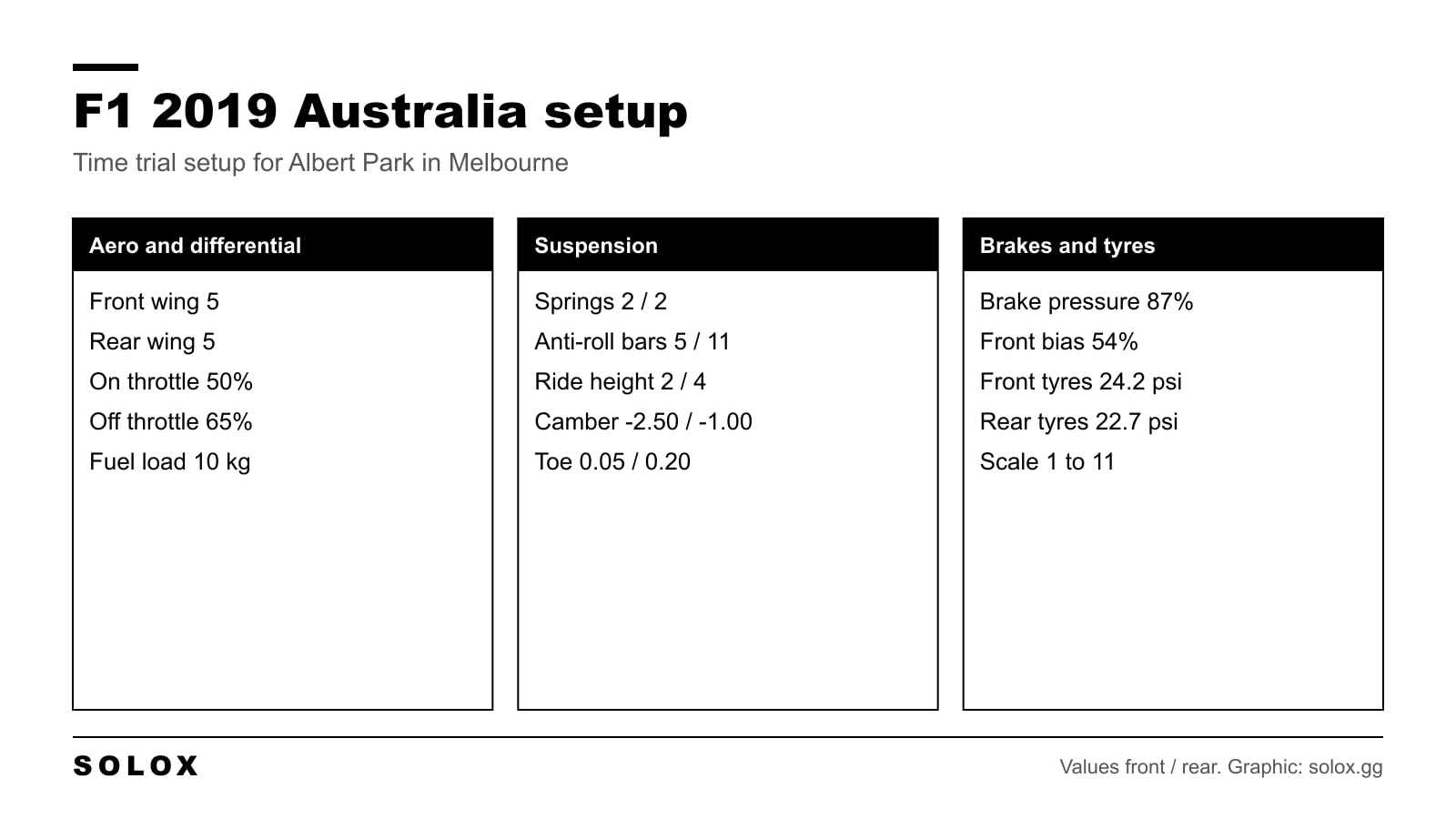
This is the F1 2019 Australia setup on this site: wings 5 and 5, very soft springs, the stiffest rear bar and an open differential. It is a time trial setup, saved with 10 kg of fuel.
F1 2019 Australia setup
| Setting | Front | Rear |
|---|---|---|
| Wing | 5 | 5 |
| Camber | -2.50 | -1.00 |
| Toe | 0.05 | 0.20 |
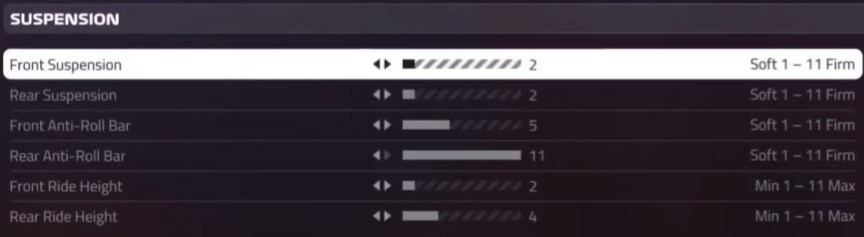
| Suspension | 2 | 2 |
| Anti-roll bar | 5 | 11 |
| Ride height | 2 | 4 |
| Tyre pressure | 24.2 psi | 22.7 psi |
| Setting | Value |
|---|---|
| Fuel load | 10 kg |
| Differential on throttle | 50% |
| Differential off throttle | 65% |
| Brake pressure | 87% |
| Front brake bias | 54% |
In F1 2019 the wings, suspension, anti-roll bars and ride height all use a scale from 1 to 11.
This setup was collected for the site in 2022 from a fast time trial lap, like the rest of my F1 2019 setups. Use it as a base and adjust it with the table further down.

The lap on board
Why this setup works in Melbourne
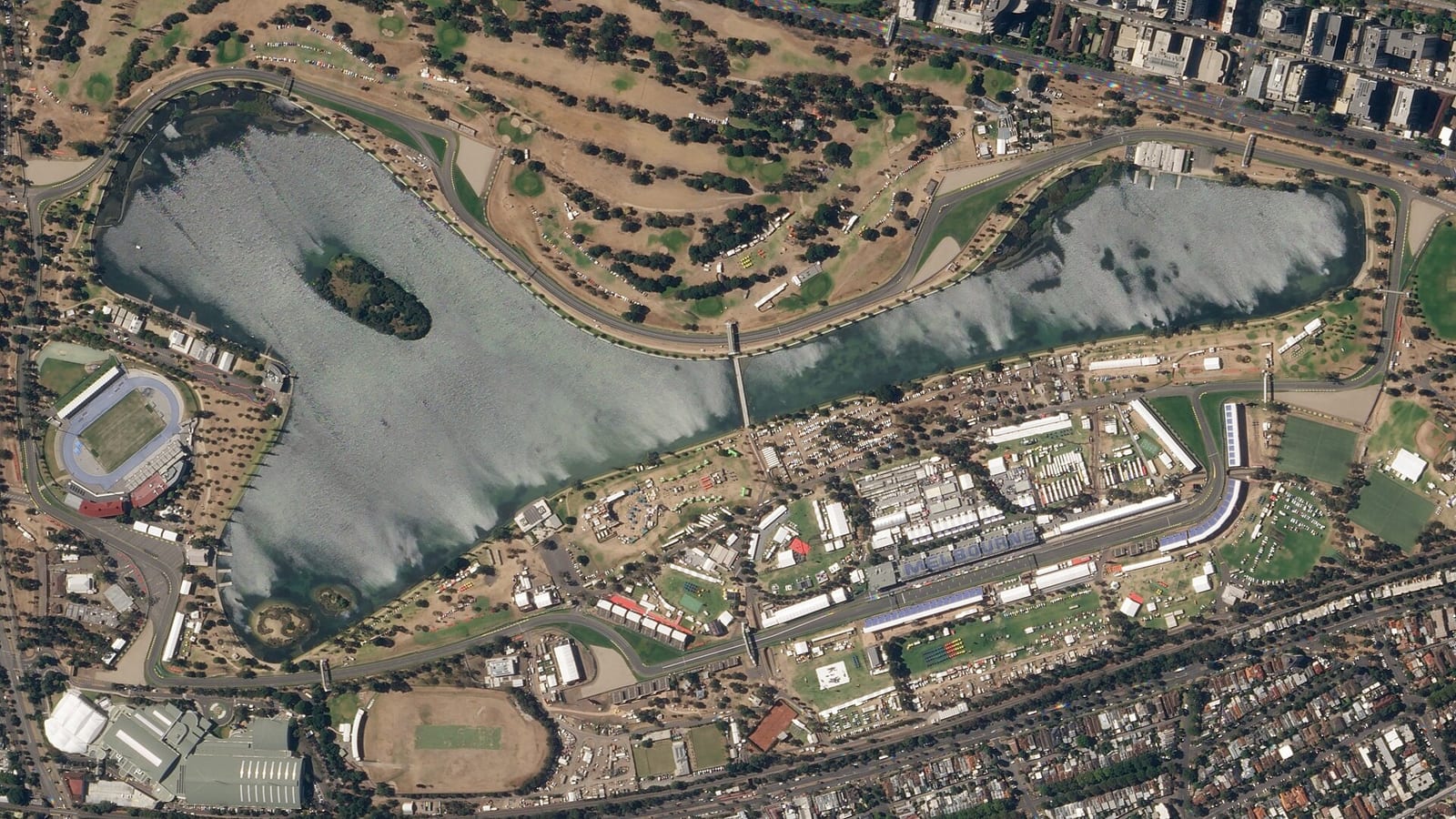
Albert Park in F1 2019 is the old layout: 5.303 km and 16 corners around the lake. Most of the corners are medium speed, they come in pairs, and the longest flat out section is a curve, not a straight.
The wings. 5 and 5 is the middle of the menu with no gap between front and rear. My China setup, for comparison, runs 4 and 7. Here the front has as much wing as the rear, so the nose bites on the way in to turn 1, turn 6 and the fast chicane at turn 11 and turn 12.
The differential. 50% on throttle is as open as it goes. Out of turn 3, turn 10 and turn 15 the inside rear wheel is free to spin a little slower than the outside one, and the car puts its power down without snapping. 65% off throttle is on the open side too, so the car turns when you lift.
The geometry. Camber -2.50 and -1.00, toe 0.05 and 0.20. The least angle the menu allows. The tyres run flatter on the road, which helps braking and traction, and Melbourne is mostly braking and traction.
Soft springs, stiff rear bar
The springs are at 2 and 2, one click from the softest. On a bumpy track that is the right call. A soft car keeps its tyres on the ground over the bumps in the braking zones and lets you take the kerbs at turn 2, turn 10 and turn 12.
The anti-roll bars do the opposite job. The front is at 5 and the rear is at 11, the maximum. A stiff rear bar takes grip from the rear in a change of direction, and the car rotates. In the turn 11 and turn 12 chicane you feel it at once: the car follows the steering on the second part with no delay.
It has a price. With level wings and the rear bar at 11, the rear is light in fast corners. If you are rough with the steering in turn 11, it will step out. In time trial on new tyres you can live with it. In a race I would not.
Ride height is 2 at the front and 4 at the rear. The lower nose puts more load on the front tyres.
What to change
One change at a time, three laps, then decide.
| Problem | Change | Why |
|---|---|---|
| The rear steps out in turn 11 and turn 12 | Rear anti-roll bar 11 to 8 | A softer rear bar gives the rear tyres more grip in a change of direction |
| Still nervous in the fast corners | Rear wing 5 to 7 | More rear downforce than front makes the car stable |
| The rear moves when you brake into turn 3 or turn 13 | Off throttle differential 65% to 75% | More lock off the throttle keeps the rear in line |
| Front tyres lock into turn 1 or turn 3 | Brake pressure 87% to 83% | Less peak pressure, easier to hold at the limit |
| Understeer in the slow corners | Front anti-roll bar 5 to 3 | A softer front bar gives the front tyres more grip |
| The car feels lazy on the kerbs | Suspension 2 and 2 to 3 and 3 | A little more support, still soft enough for the bumps |
| Wheelspin out of turn 15 | Rear tyre pressure 22.7 to 22.3 psi | A slightly softer rear tyre has a bigger footprint under traction |
For a race
With fuel in the car and tyres that have to last, a loose rear costs you twice: you lose time and you overheat the rear tyres. Before a 25% or 50% race I would change this:
- Rear anti-roll bar 11 to 8. The first change. The car is calmer and you can lean on it for a whole stint.
- Rear wing 5 to 6. One click more at the rear than at the front, for stability in turn 11 and under braking.
- Off throttle differential 65% to 70%. More stability on the brakes with a heavy car.
- Brake pressure 87% to 84%. A flat spot stays with you until the stop.
- Fuel. The 10 kg is a time trial number. In a race the game sets the load for the distance.
On a pad, I would take the rear bar down to 7 and the brake pressure down to around 82%. A nervous rear is harder to catch with a thumb than with a wheel.
F1 2019 has manual ERS modes. In Melbourne I would spend the battery on the pit straight and on the run from turn 10 to turn 11, and save it in the slow part from turn 13 to turn 16.
Where the lap time is in Melbourne
- Turn 1 and turn 2. A fast right and left at the end of the pit straight. Brake late and short, turn in once and let the car run to the exit kerb of turn 2. The wall on the outside is close.
- Turn 3. The biggest braking zone of the lap and the best place to overtake. Brake in a straight line. The exit matters more than the entry, because turn 4 comes at once.
- Turn 6. A quick right between the walls. A short brake and a lot of trust. With level wings the front bites well here, so do not turn in too early.
- Turn 9 and turn 10. A slow right and left. Easy to overdrive. Go in slow, use the kerbs and get on the throttle early, because the fastest part of the track comes next.
- Turn 11 and turn 12. The fast left and right. This is where the lap is won or lost, and where this setup asks the most from you. One smooth steering input for each corner. If the rear moves, you turned too hard.
- Turn 13. A hard stop after the fast section. The track is bumpy on the brakes and the soft springs help.
- Turn 15 and turn 16. A slow left and then the right onto the pit straight. Be patient in turn 15. A clean exit from turn 16 is worth more than anything you gain on entry.
A chicane like turn 11 and turn 12 follows the same rule in a kart and in an F1 car: the first corner is only there to set up the second. Give away a little on the way in and you carry the speed all the way to turn 13.
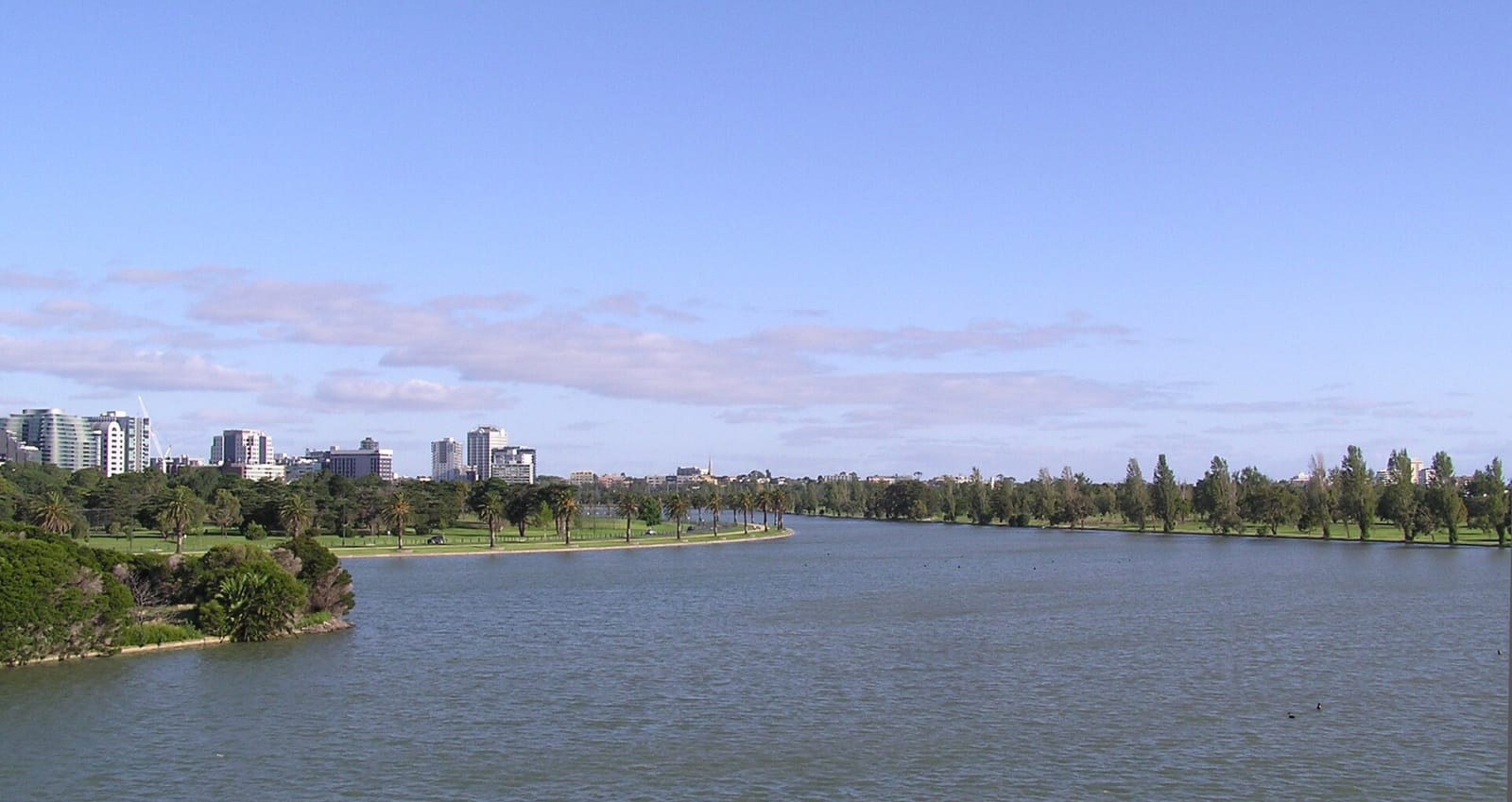
Melbourne in 2019
The 2019 Australian Grand Prix was round 1 of 21, on 17 March, over 58 laps. Lewis Hamilton took pole position in 1:20.486. Valtteri Bottas started second, led into turn 1 and won, with Hamilton second and Max Verstappen third for Red Bull.
It was the first race with a bonus point for the fastest lap, and Bottas took that too, with a 1:25.580 on lap 57. Lando Norris, George Russell and Alexander Albon all made their Formula 1 debut that weekend.
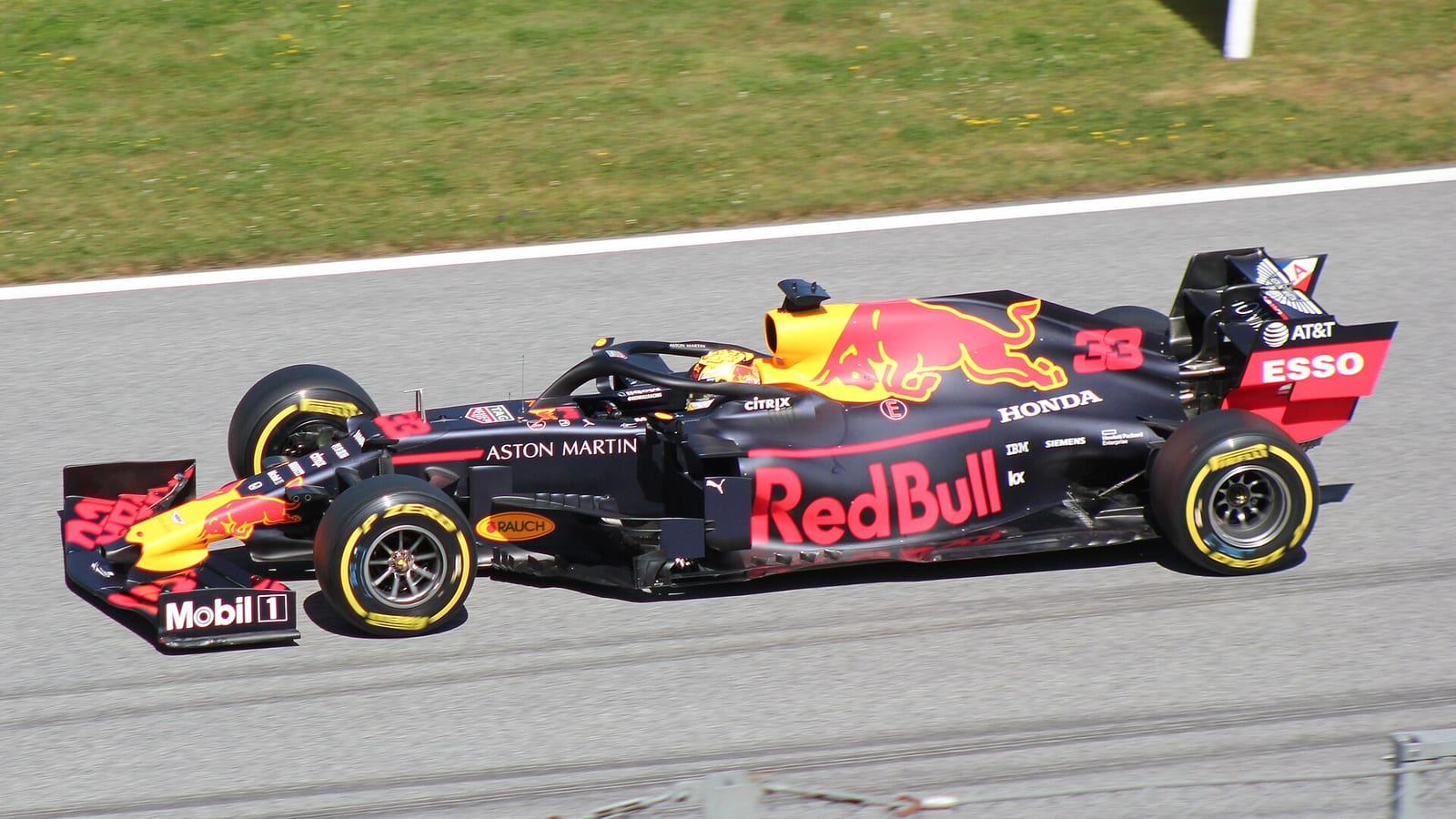
More F1 2019 setups
All the tracks are on the F1 2019 setups page. Australia is the first round. Next comes the F1 2019 Bahrain setup and then the F1 2019 China setup.
For the same track in other games, here are my F1 2018 Australia setup, my F1 2020 Australia setup and my F1 25 Australia setup. The values do not carry over from one game to the next, and in F1 25 the track itself is different: the slow chicane at turn 9 and turn 10 is gone.
FAQ
What is the best F1 2019 setup for Australia?
Front wing 5, rear wing 5, differential 50% on throttle and 65% off, suspension 2 and 2, anti-roll bars 5 and 11, ride height 2 and 4, brake pressure 87% with 54% front bias, and tyres at 24.2 and 22.7 psi.
What wing levels should I run in Australia in F1 2019?
5 at the front and 5 at the rear for time trial. For a race I would go to 6 at the rear to make the car more stable.
Can I use this Australia setup in a race?
Yes, with a few changes. Soften the rear anti-roll bar from 11 to 8, add a click of rear wing and lower the brake pressure to 84%.
Does this setup work with a controller?
Yes, but the rear is lively. I would lower the rear anti-roll bar to 7 and the brake pressure to around 82%.
Why are the springs so soft in this setup?
Because Albert Park is a bumpy road track and you use the kerbs in nearly every corner. Soft springs keep the tyres on the ground.
Where can I overtake in Melbourne in F1 2019?
Into turn 3 with DRS is the best place. Turn 1 and turn 13 work too if you get a good exit before them.
How long is Albert Park in F1 2019?
5.303 km with 16 corners. The real race is 58 laps.