
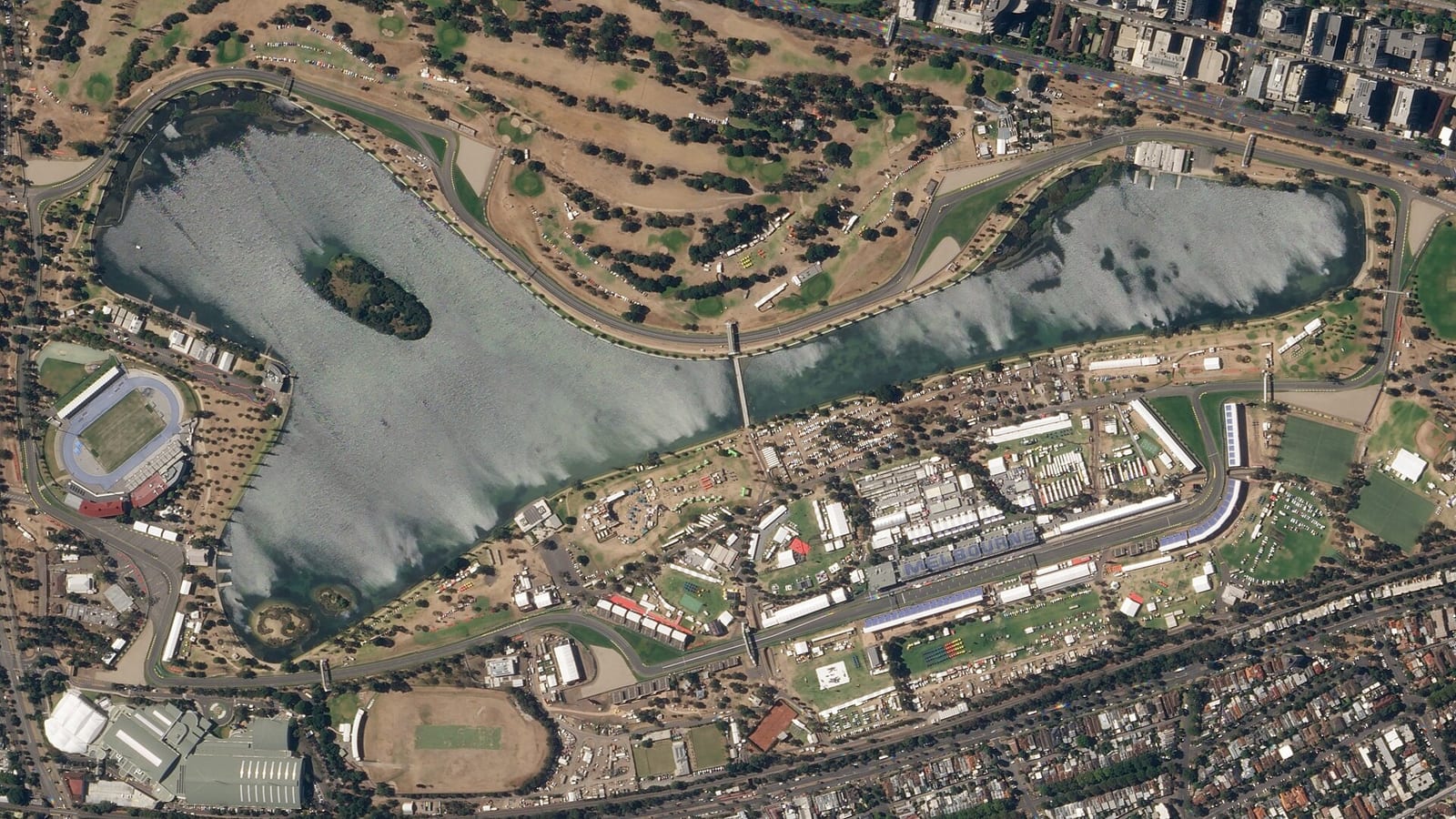
Albert Park is a park road around a lake. It is quick, it is bumpy for a Formula 1 track, and the walls are close in the places where you want to push.
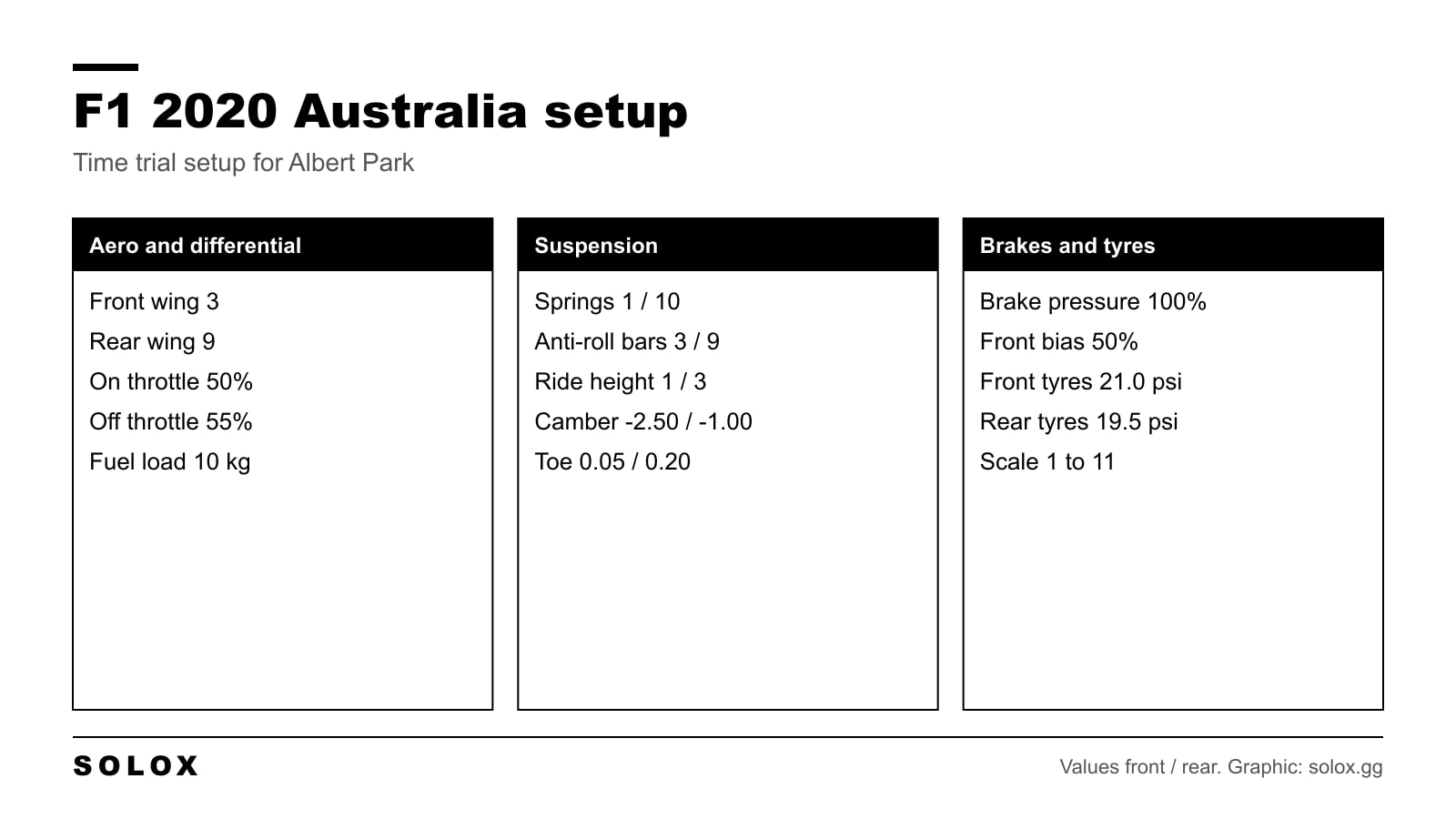
This F1 2020 Australia setup puts a big wing on the rear and takes the grip at the front from the suspension. Wings are 3 and 9, the front is as soft as it goes and the rear is stiff. It is a time trial setup, saved with 10 kg of fuel.
F1 2020 Australia setup
| Setting | Front | Rear |
|---|---|---|
| Wing | 3 | 9 |
| Camber | -2.50 | -1.00 |
| Toe | 0.05 | 0.20 |
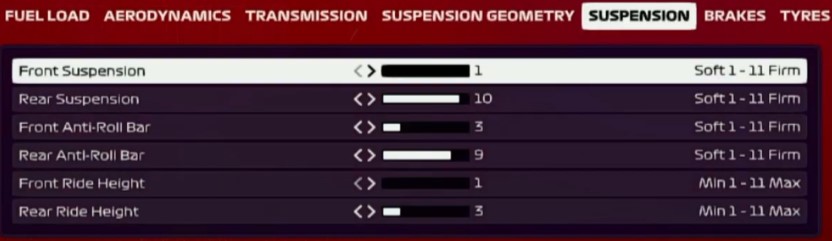
| Suspension | 1 | 10 |
| Anti-roll bar | 3 | 9 |
| Ride height | 1 | 3 |
| Tyre pressure | 21.0 psi | 19.5 psi |
| Setting | Value |
|---|---|
| Fuel load | 10 kg |
| Differential on throttle | 50% |
| Differential off throttle | 55% |
| Brake pressure | 100% |
| Front brake bias | 50% |
In F1 2020 the wings, suspension, anti-roll bars and ride height all use a scale from 1 to 11. The differential goes from 50%, fully open, to 100%, locked.
This setup was collected for the site in 2022 from a fast time trial lap, like the rest of my F1 2020 setups. Use it as a base and adjust it with the table further down.

The lap on board
Why this setup works in Melbourne
The lap in F1 2020 is 5.303 km with 16 corners. It is the old layout, the one the real race used until the track was rebuilt for 2021.
The wings. 3 and 9. Six clicks more at the rear than at the front. Melbourne has no really long straight, so a rear wing at 9 does not cost you much. What it gives you is a rear that stays planted in the fast chicane at turns 11 and 12 and a car that stays straight when you hit the brakes.
The differential. 50% on throttle, fully open. Most of the exits here are from third gear or lower, and an open differential lets the inside rear tyre turn without lighting up both. 55% off throttle is close to open too, so the car turns when you lift.
The tyre pressures. 21.0 psi front and 19.5 psi rear, the lowest the menu allows. A softer tyre has a bigger footprint. On a bumpy road that is grip you can use.
The camber. Front -2.50 and rear -1.00, with toe at 0.05 and 0.20. The rear camber is the flattest in my F1 2020 list. Only Austria, Singapore and Abu Dhabi share it. A flat rear tyre has more rubber on the road when you go on the throttle.
Soft front, stiff rear
This is how the car turns with a front wing at 3.
The front suspension is at 1 and the front anti-roll bar is at 3. Soft. A soft front end gives the front tyres grip and lets the car bite when you turn in.
The rear suspension is at 10 and the rear anti-roll bar is at 9. Stiff. A stiff rear has less grip in a change of direction, so it follows the front around the corner.
Then the rear wing at 9 does its job. In the fast corners the downforce holds the rear down, and the stiff springs keep the floor stable under that load. In the slow corners there is less downforce, and the stiff rear lets the car rotate. You get both.
The price is the kerbs and the bumps. A rear at 10 does not absorb much. Over the kerbs at turns 1 and 2 and through the chicane the rear can jump.
Ride height is 1 and 3. The front is at the minimum. If the car hits the ground or bounces off a kerb, this is the first thing to raise.
The brakes
Brake pressure 100%, front bias 50%. Every setup in my F1 2020 database runs 100% pressure, so that is normal for this game. The 50% bias is far back. It uses the rear tyres to help stop the car and it helps the car rotate on the way in to the corner.
It works if you brake in a straight line. If you are still hard on the brakes when you turn, the rear will come around. Turn 3 and turn 13 are the two places where that happens here. If you trail the brakes deep into corners, move the bias forward before you do anything else.
What to change
One change at a time, three laps, then decide.
| Problem | Change | Why |
|---|---|---|
| The rear steps out when you brake and turn | Front brake bias 50% to 54% | Less braking at the rear keeps it behind you |
| Front tyres lock into turn 3 | Brake pressure 100% to 95% | Less peak pressure, easier to hold at the limit |
| The rear jumps on the kerbs | Rear suspension 10 to 7 | A softer rear rides the kerbs instead of bouncing off them |
| The rear snaps in turns 11 and 12 | Rear anti-roll bar 9 to 7 | A softer rear bar gives grip in a change of direction |
| The car hits the ground | Ride height 1 and 3 to 2 and 4 | More room under the floor |
| Understeer in the fast corners | Front wing 3 to 4 | More front downforce |
| Too slow on the straights | Rear wing 9 to 8 | Less drag. Less stability in the chicane |
For a race
With a heavy car and tyres that have to last, a stiff rear costs you grip and overheats the rear tyres. Before a 25% or 50% race I would change this:
- Rear suspension 10 to 7. The first change. Better traction and a car that rides the kerbs.
- Rear anti-roll bar 9 to 7. A calmer rear when the tyres are worn.
- Front brake bias 50% to 54%. With cars around you there is no room for a snap on the brakes.
- Brake pressure 100% to 95%. A flat spot stays with you until the stop.
- Fuel. The 10 kg is a time trial number. In a race the game sets the load for the distance.
I would leave the wings alone. The rear at 9 is already kind to the tyres.
On a pad, I would make the same changes and take the brake pressure down to around 90%.
F1 2020 manages the ERS for you and gives you an overtake button. In Melbourne, press it on the main straight and on the run from turn 2 to turn 3. Those are the two places where you can pass.
Where the lap time is in Melbourne
- Turn 1 and turn 2. A right and then a left, taken as one corner. Brake late for the first part and use the kerbs. The exit of turn 2 leads onto a straight, so that is the part to get right.
- Turn 3. The hardest stop of the lap and the best place to pass. Brake in a straight line, and with the bias at 50% I mean it. Release the brake before you turn.
- Turn 5. A fast right. With this rear wing it is flat. Keep the steering small.
- Turn 6. A quick right with a wall on the exit. Lift, turn, back on the throttle. Do not use all the road until you know the car.
- Turn 9 and turn 10. The slow chicane by the lake. Give up the entry and be early on the throttle out of the second part.
- Turn 11 and turn 12. The fast left and right. This is where the rear wing pays for itself. A small lift for the left, then flat through the right.
- Turn 13. A hard stop into a right. Easy to lock the inside front. Brake a little early.
- Turn 15 and turn 16. A slow left and then the right onto the main straight. Be patient in the left. The exit of turn 16 is the start of your next lap.
If you take one thing from this page: commit in turns 11 and 12. The setup is built for that part of the lap.
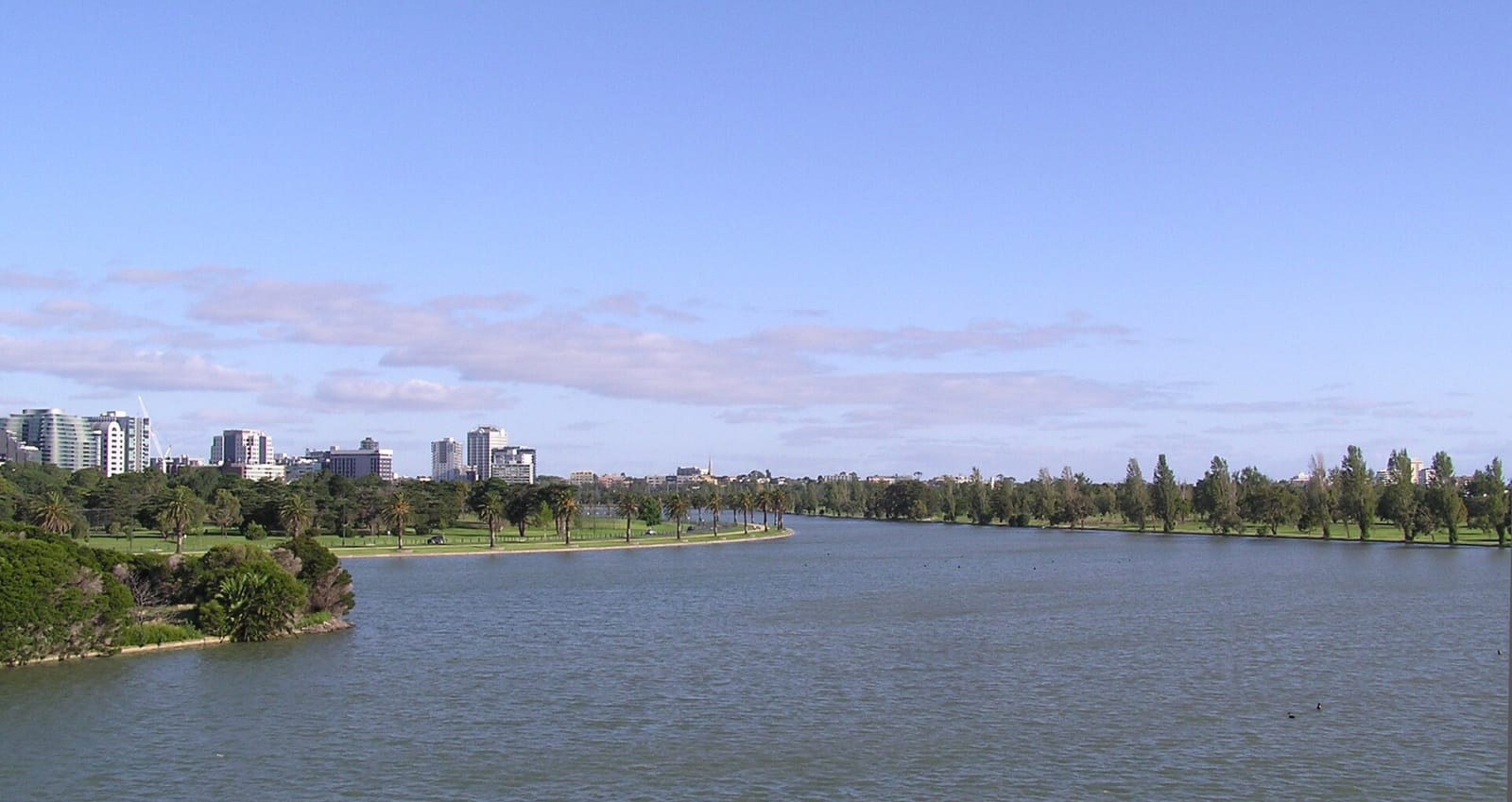
Melbourne in 2020
There was no real race to compare with. The 2020 Australian Grand Prix was planned for 15 March as the first round of the season. The teams and drivers were all in Melbourne. McLaren withdrew after a team member tested positive for the virus, and the event was cancelled hours before the first practice session.
The season started in July in Austria. The game was built around the calendar planned before all of that, so Albert Park is round 1 in F1 2020, as it was meant to be.
The last race before it was in 2019, when Valtteri Bottas won for Mercedes. Formula 1 came back to Melbourne in 2022, on a rebuilt and faster track with 14 corners. So F1 2020 is one of the last games with the old 16 corner lap.
More F1 2020 setups
All 22 tracks are on the F1 2020 setups page. Melbourne is the first track in the game's calendar. The next one is Sakhir, with my F1 2020 Bahrain setup, and after that Hanoi, with my F1 2020 Vietnam setup.
For the same track in other games, here are my F1 2019 Australia setup, my F1 2021 Melbourne setup and my F1 25 Australia setup. The values do not carry over from one game to the next, and F1 25 has the newer layout.
FAQ
What is the best F1 2020 setup for Australia?
Front wing 3, rear wing 9, differential 50% on throttle and 55% off, suspension 1 and 10, anti-roll bars 3 and 9, ride height 1 and 3, brake pressure 100% with 50% front bias, and tyres at 21.0 and 19.5 psi.
What wing levels should I run in Melbourne in F1 2020?
3 at the front and 9 at the rear. I would keep them for a race too.
Can I use this Australia setup in a race?
Yes, after you calm the rear down. Rear suspension to 7, rear anti-roll bar to 7, brake bias to 54% and brake pressure to 95%.
Does this setup work with a controller?
With the race changes, yes. As it is, the stiff rear and the 50% brake bias are hard to control with a thumb stick.
Why is the rear so stiff in this setup?
To make the car rotate with a low front wing. A stiff rear follows the front around the corner, and the big rear wing holds it down in the fast corners.
Why is the brake bias at 50%?
It shortens the stops and helps the car turn in. It only works if you finish your braking before you turn.
Was there a 2020 Australian Grand Prix?
No. It was cancelled hours before the first practice session because of the pandemic. Albert Park is still in the game, as round 1.