
Bahrain is four straights and four big stops. Every lap you brake hard, turn a slow corner and ask the rear tyres to push a Formula 1 car out of it. Then you do it again.
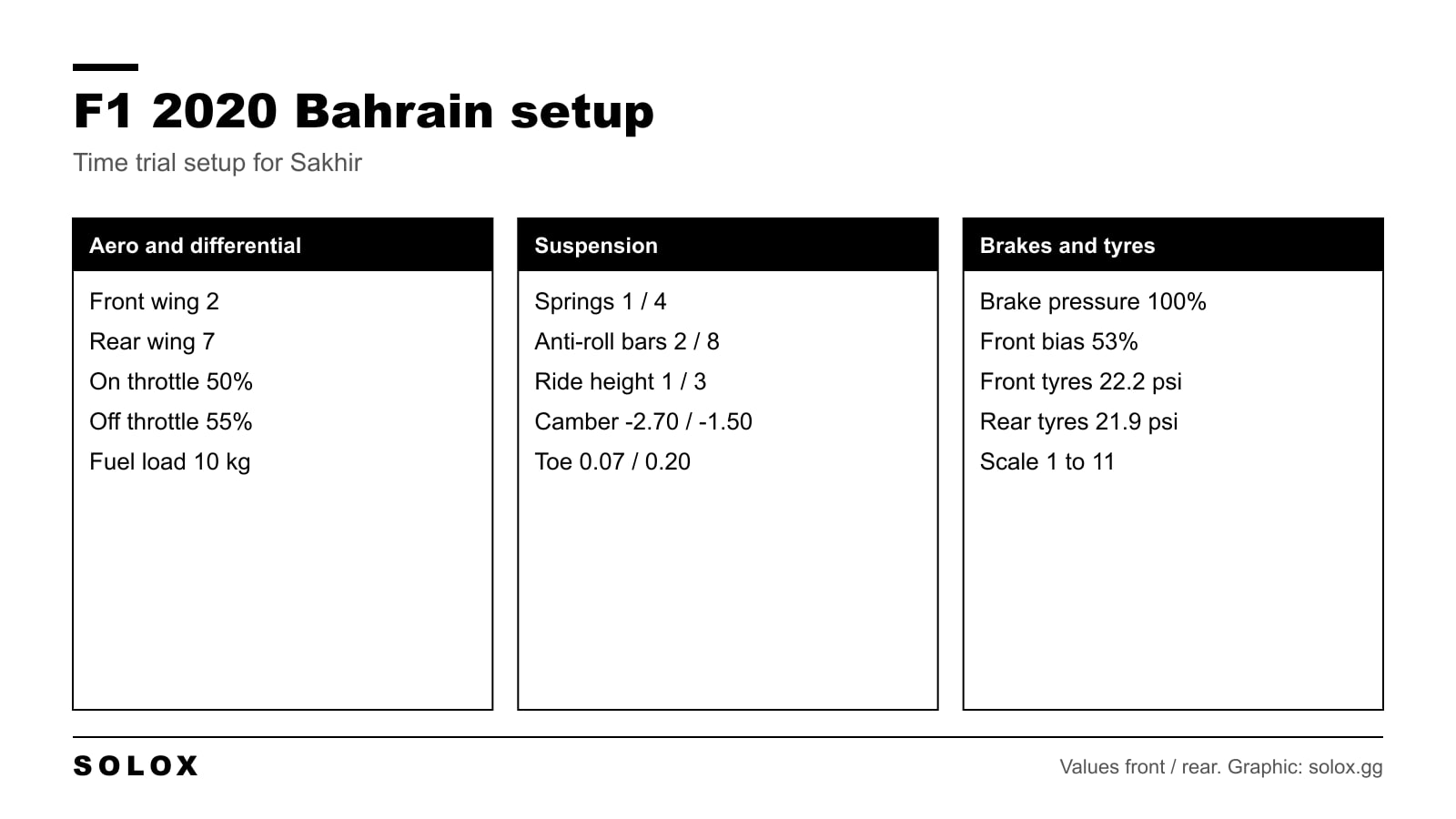
So this F1 2020 Bahrain setup is about traction. Wings are 2 and 7, the rear springs are soft and the differential is open. It is a time trial setup, saved with 10 kg of fuel.
F1 2020 Bahrain setup
| Setting | Front | Rear |
|---|---|---|
| Wing | 2 | 7 |
| Camber | -2.70 | -1.50 |
| Toe | 0.07 | 0.20 |
| Suspension | 1 | 4 |
| Anti-roll bar | 2 | 8 |
| Ride height | 1 | 3 |
| Tyre pressure | 22.2 psi | 21.9 psi |
| Setting | Value |
|---|---|
| Fuel load | 10 kg |
| Differential on throttle | 50% |
| Differential off throttle | 55% |
| Brake pressure | 100% |
| Front brake bias | 53% |
In F1 2020 the wings, suspension, anti-roll bars and ride height all use a scale from 1 to 11. The differential goes from 50%, fully open, to 100%, locked.
This setup was collected for the site in 2022 from a fast time trial lap, like the rest of my F1 2020 setups. Use it as a base and adjust it with the table further down.

The lap on board
Why this setup works in Bahrain
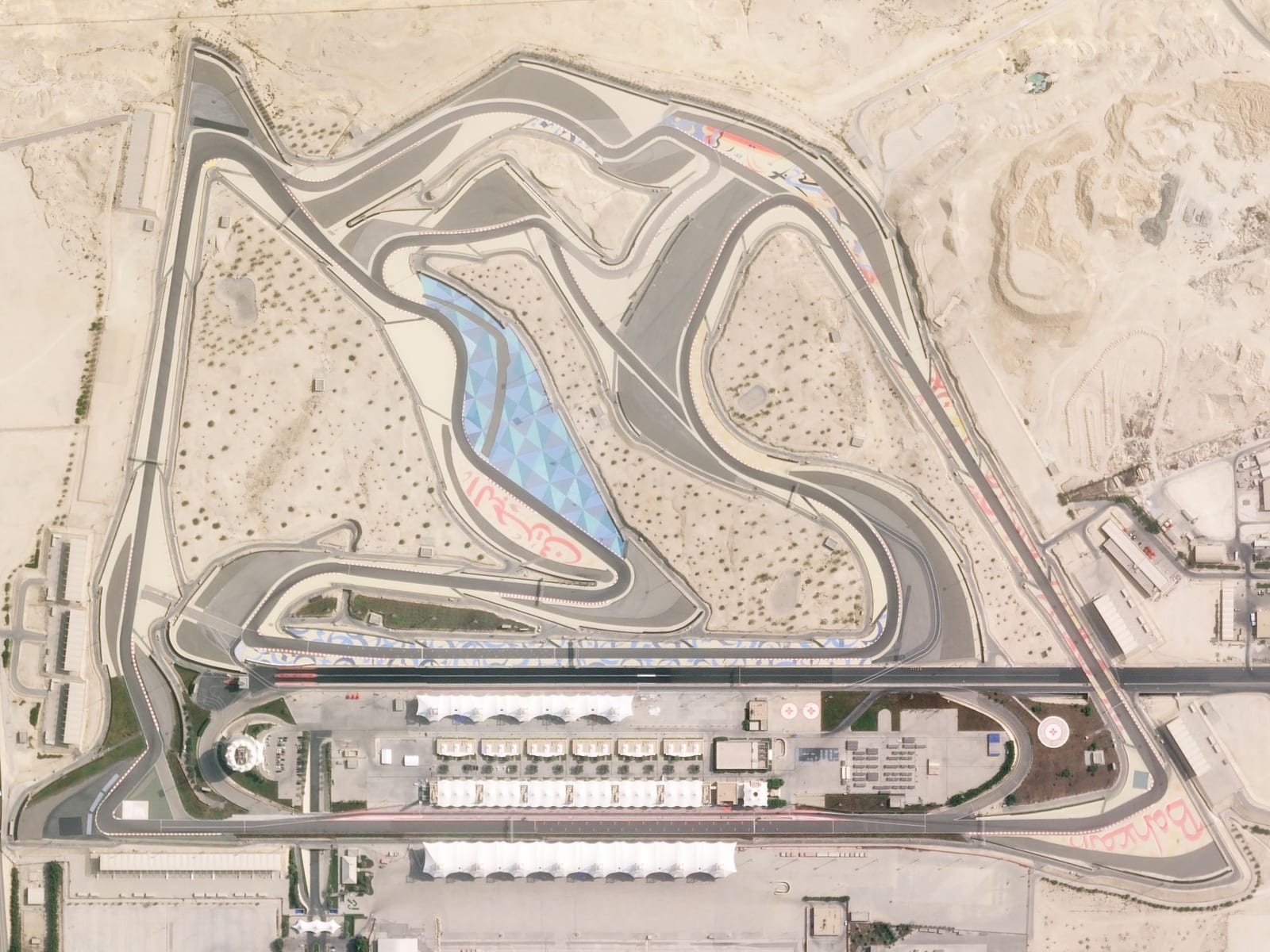
The Bahrain International Circuit is 5.412 km with 15 corners. Most of them are slow. The only fast part is the run of esses from turn 5 to turn 7.
The wings. 2 and 7. The front is one click from the minimum, because there are four straights to pay for. The rear sits five clicks higher. That gap is for the exits. Rear downforce is traction, and a car with more wing at the rear than at the front stays straight when you hit the brakes at top speed.
The differential. 50% on throttle, fully open. Out of turn 1, turn 8 and turn 10 the inside rear wheel can turn slower than the outside one, so the car puts the power down without snapping. 55% off throttle is close to open too, and the car turns when you lift.
The tyre pressures. 22.2 psi front and 21.9 psi rear. This is unusual for my F1 2020 list. Eighteen of the 22 setups run the lowest pressures the menu allows, 21.0 and 19.5. Bahrain is one of the four that do not. The rear is more than 2 psi above the minimum. A harder tyre moves less under the long acceleration zones, and the car is more precise on the brakes.
The camber and toe. Front camber is -2.70 and rear is -1.50. Front toe is 0.07. All a little more than the minimum. Turn 11 and turn 12 are long corners where the outside front tyre carries the load, and that is where the extra camber helps.
A soft rear for traction
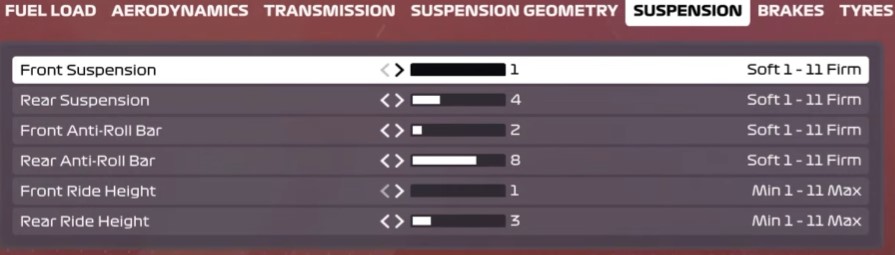
Most of my F1 2020 setups run the rear springs between 8 and 11. Here they are at 4. Only Zandvoort is softer, and Monaco is the same.
A soft rear lets the car squat when you go on the throttle. The weight moves back, the rear tyres push into the road and you get traction. In Bahrain you need that six or seven times a lap.
The front suspension is at 1 and the front anti-roll bar is at 2. As soft as the rear, or softer. So the front has grip to turn in to the slow corners.
The rear anti-roll bar is at 8. That is what makes the car rotate. A stiff rear bar takes grip away from the rear in a change of direction, so the car points into the corner and through the esses.
So the springs give you traction in a straight line and the bar gives you rotation in the corner. It is a good combination for this track.
Ride height is 1 and 3. The front is at the minimum. Bahrain is smooth and the kerbs are flat, so you can run it.
The brakes
Brake pressure 100%, front bias 53%. Every setup in my F1 2020 database runs 100% pressure, so that is normal for this game.
The bias is the interesting one. 53% is the furthest forward in my whole F1 2020 list. Almost every other track is at 50%.
The reason is turn 10. You brake downhill while the car is still turning left out of turn 9. With the bias at 50% the rear would come around there. Three points forward keeps it behind you. The price is the inside front tyre, which has no weight on it and locks easily. Come off the pedal as you turn.
What to change
One change at a time, three laps, then decide.
| Problem | Change | Why |
|---|---|---|
| Inside front locks into turn 10 | Brake pressure 100% to 95% | Less peak pressure, easier to hold at the limit |
| The rear moves when you brake for turn 1 | Front brake bias 53% to 55% | Less braking at the rear keeps it behind you |
| Wheelspin out of the slow corners | Rear wing 7 to 8 | More rear downforce helps traction |
| The rear steps out in the esses | Rear anti-roll bar 8 to 6 | A softer rear bar gives grip in a change of direction |
| Understeer in turn 11 and turn 12 | Front wing 2 to 3 | More front downforce in the long corners |
| The rear tyres overheat | Rear tyre pressure 21.9 to 21.1 psi | A softer tyre runs cooler on the surface |
| Too slow on the straights | Rear wing 7 to 6 | Less drag. Less traction on the exits |
For a race
Bahrain is hard on the rear tyres. Every exit is a traction zone. Before a 25% or 50% race I would change this:
- Rear wing 7 to 8. Less wheelspin, and the rear tyres last longer.
- Rear anti-roll bar 8 to 6. A calmer rear when the tyres are worn.
- Brake pressure 100% to 95%. A heavy car locks its fronts more easily, and a flat spot stays with you until the stop.
- Fuel. The 10 kg is a time trial number. In a race the game sets the load for the distance.
On a pad, I would make the same changes and take the brake pressure down to around 90%.
F1 2020 manages the ERS for you and gives you an overtake button. In Bahrain, press it on the main straight and on the run from turn 3 to turn 4. Those are the two best places to pass. The back straight to turn 14 is the third.
Where the lap time is in Bahrain
- Turn 1. The biggest stop of the lap. Brake in a straight line and take a late apex. Turn 2 and turn 3 follow at once, and the exit of that sequence leads onto a long straight.
- Turn 4. A wide right at the top of the hill. It invites you to go in too fast. Get the car turned early and use all of the exit kerb.
- Turn 5 to turn 7. The fast esses. One smooth line and a small lift for turn 6. With front wing 2 the car wants to run wide, so do not throw it in.
- Turn 8. A hairpin. Slow in, straight out. Nothing to gain on entry.
- Turn 9 and turn 10. The hardest corner on the track. Downhill, turning left, on the brakes. Brake a little earlier than you think.
- Turn 11. A long uphill left. Be patient with the throttle until you see the exit.
- Turn 13. The exit leads onto the back straight. A late apex is worth more than a brave entry.
- Turn 14 and turn 15. The last corner. Brake early, turn once, and be on the throttle before the apex of turn 15. That speed stays with you all the way to turn 1.
If you take one thing from this page: Bahrain is won on exits, not on entries. Give up a metre on the way in and get the throttle down early.
Bahrain in 2020
In the game, Bahrain is round 2, because that was the plan. The real race was due on 22 March 2020. It was postponed nine days before, and for months nobody knew if it would happen.
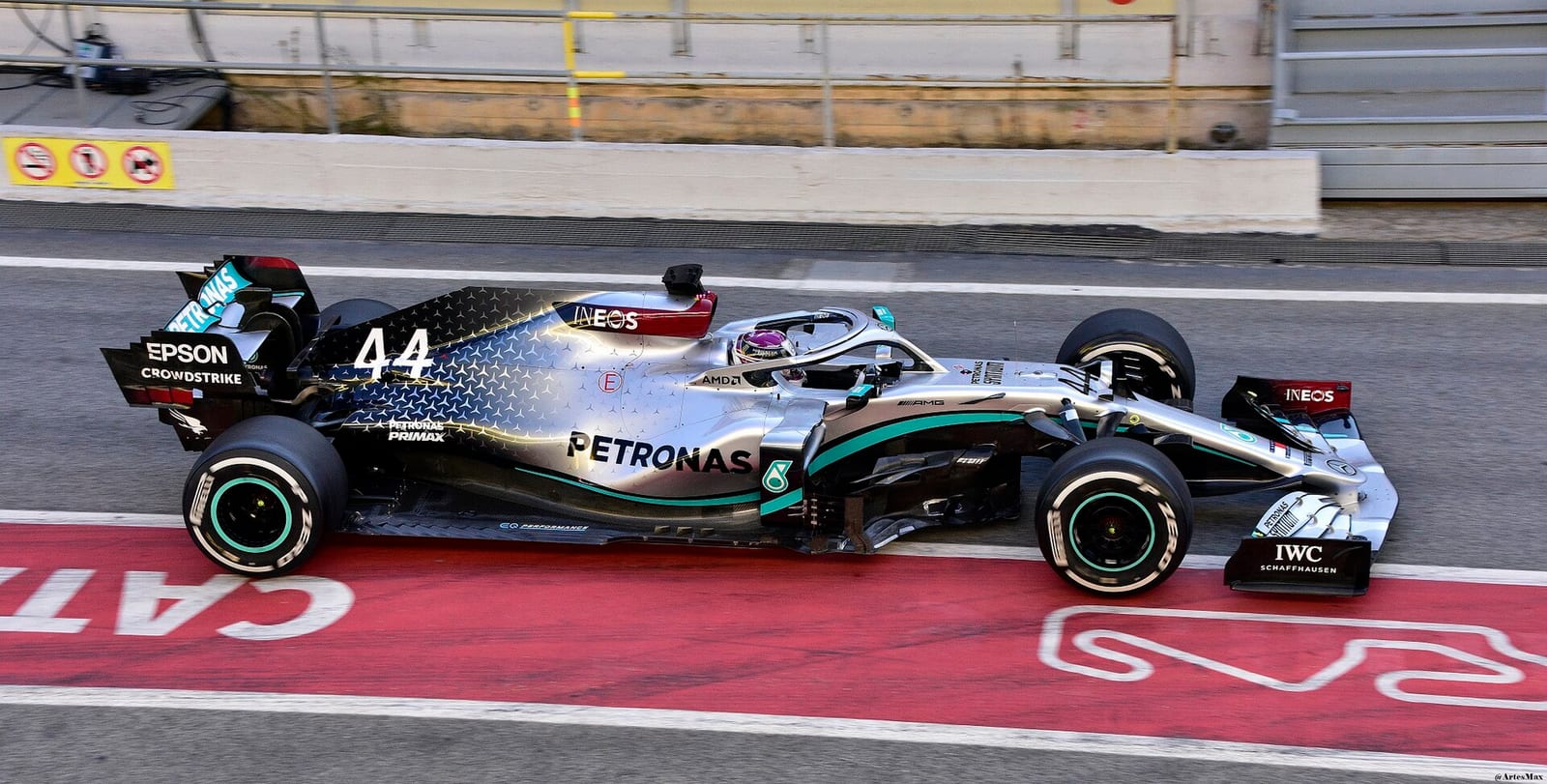
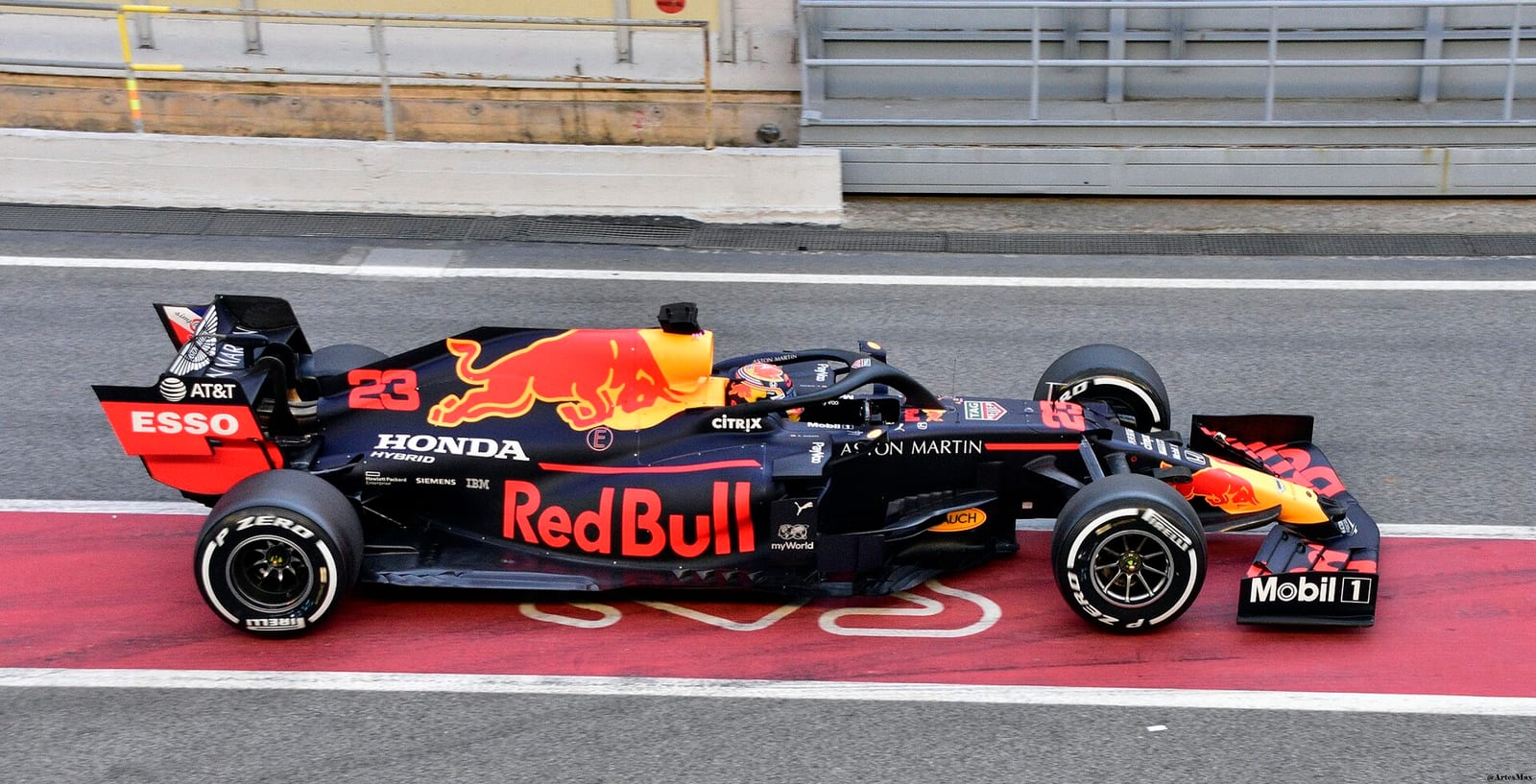
It did, on 29 November, as round 15 of 17. It was 57 laps, behind closed doors. Lewis Hamilton took pole position in 1:27.264 and won the race. Max Verstappen was second with the fastest lap, a 1:32.014, and Alexander Albon was third in the other Red Bull.
Most people remember that race for something else. On the first lap Romain Grosjean had a very big accident. His Haas split in two and caught fire, and he got out with burns on his hands. The race was stopped for eighty minutes.
A week later Formula 1 raced at the same venue again, on a different layout, for the Sakhir Grand Prix. That layout is not in F1 2020.
More F1 2020 setups
All 22 tracks are on the F1 2020 setups page. The track before Bahrain in the game's calendar is Melbourne, with my F1 2020 Australia setup, and the next one is Hanoi, with my F1 2020 Vietnam setup.
For the same track in other games, here are my F1 2019 Bahrain setup, my F1 2021 Bahrain setup and my F1 25 Bahrain setup. The values do not carry over from one game to the next.
FAQ
What is the best F1 2020 setup for Bahrain?
Front wing 2, rear wing 7, differential 50% on throttle and 55% off, suspension 1 and 4, anti-roll bars 2 and 8, ride height 1 and 3, brake pressure 100% with 53% front bias, and tyres at 22.2 and 21.9 psi.
What wing levels should I run in Bahrain in F1 2020?
2 at the front and 7 at the rear for time trial. For a race I would run 8 at the rear for traction and tyre life.
Can I use this Bahrain setup in a race?
Yes, with small changes. Rear wing to 8, rear anti-roll bar to 6 and brake pressure to 95%.
Does this setup work with a controller?
Yes. The soft rear makes it one of the easier setups in my list. I would lower the brake pressure to around 90%.
Why is the brake bias at 53% and not 50%?
For turn 10, where you brake and turn at the same time. A little more front bias keeps the rear stable there.
Why are the tyre pressures higher than in the other setups?
For stability under acceleration and braking. If the rear tyres overheat in a long run, lower the rear towards 21.0 psi.
Was there a 2020 Bahrain Grand Prix?
Yes, but not in March. It was postponed and run on 29 November 2020. Lewis Hamilton won from pole.