
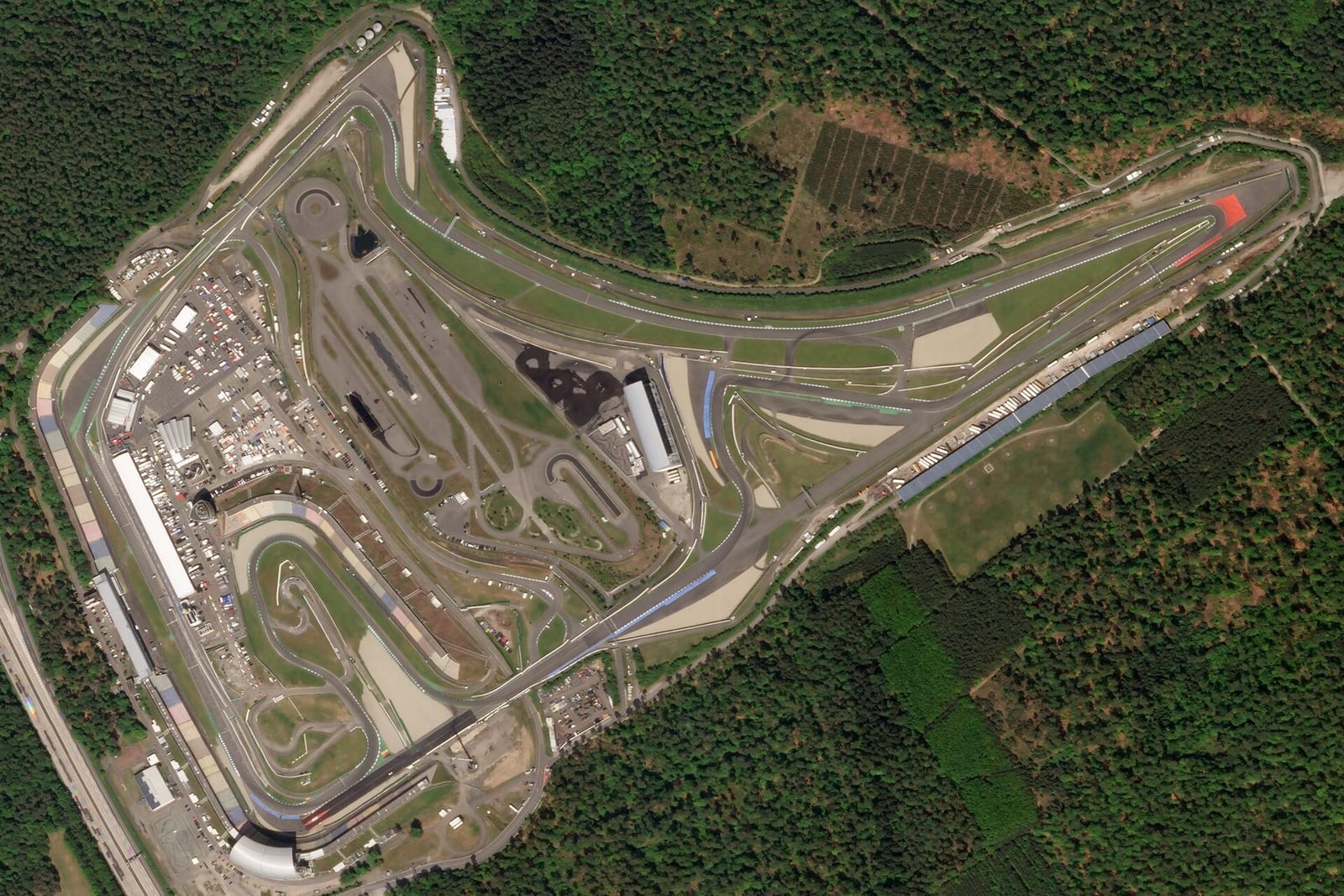
Hockenheim is two tracks in one lap. A fast first half with the long Parabolika, then the slow, technical stadium at the end.
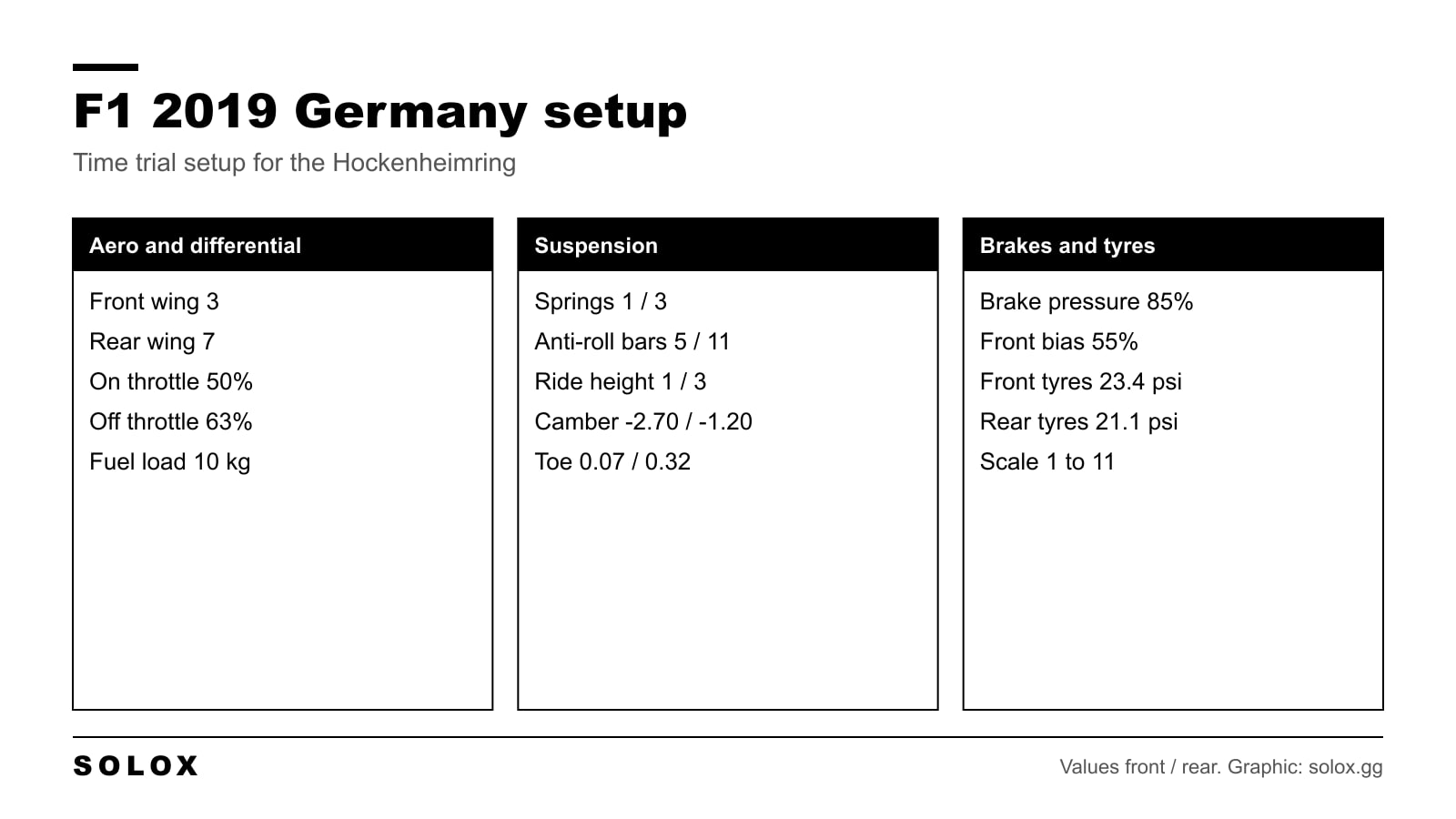
This setup leans towards the stadium. Wings 3 and 7, an open differential and a very soft front. It is a time trial setup, saved with 10 kg of fuel.
F1 2019 Germany setup
| Setting | Front | Rear |
|---|---|---|
| Wing | 3 | 7 |
| Camber | -2.70 | -1.20 |
| Toe | 0.07 | 0.32 |
| Suspension | 1 | 3 |
| Anti-roll bar | 5 | 11 |
| Ride height | 1 | 3 |
| Tyre pressure | 23.4 psi | 21.1 psi |
| Setting | Value |
|---|---|
| Fuel load | 10 kg |
| Differential on throttle | 50% |
| Differential off throttle | 63% |
| Brake pressure | 85% |
| Front brake bias | 55% |
In F1 2019 the wings, suspension, anti-roll bars and ride height all use a scale from 1 to 11.
This setup was collected for the site in 2022 from a fast time trial lap, like the rest of my F1 2019 setups. Use it as a base and adjust it with the table further down.

Why this setup works at Hockenheim
The lap is 4.574 km with 17 corners. Turn 1 is fast. Then a slow exit onto the Parabolika, the longest flat out part of the lap, and the hardest stop of the lap at the hairpin. After that it is the Mercedes Arena and the stadium, where the corners are slow and close together.
The wings. 3 and 7. The same pair as my Japan setup. Four clicks between front and rear is a lot. It gives a rear that stays put when you get on the throttle out of turn 2, the hairpin and the Sachs Kurve. Those three exits are worth more than top speed on the Parabolika. The front at 3 keeps some of the drag away.
The differential. 50% on throttle, which is fully open. The inside rear wheel is free to turn at its own speed, so it does not light up on the way out of the slow corners. Off throttle it is 63%. That keeps the rear in line when you brake and turn into the hairpin from top speed.
The brakes. 85% pressure and 55% front bias. Normal numbers. The hairpin is the only very big stop. Everywhere else you brake with some steering already on, and a bias further forward would lock the inside front.
The geometry and tyres. Camber -2.70 and -1.20, two steps away from the least angle the menu allows. Front toe is 0.07. Rear toe is 0.32, well above the 0.20 minimum, and it is there for the same reason as the rear wing: a calm rear on the throttle. Pressures are 23.4 and 21.1 psi.
A soft, low front and a stiff rear bar
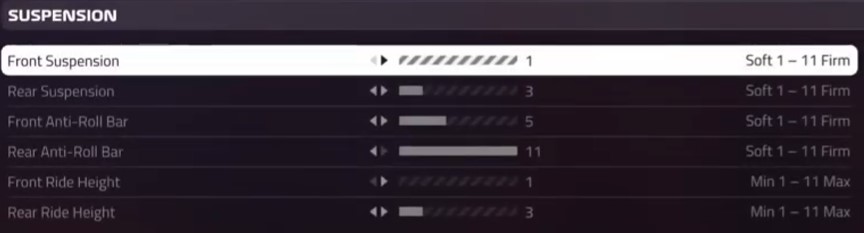
Front springs at 1 and front ride height at 1. Both are the minimum. The rear is at 3 for both. My Bahrain setup runs the same ride heights.
A soft front bites on turn in. That is what you want in the stadium, where you turn the car again and again at low speed. A low front also puts the car at an angle, nose down, and that helps the front wing do more with only 3 clicks.
The anti-roll bars are 5 at the front and 11 at the rear. 11 is the maximum. With a rear wing at 7, a lot of rear toe and an open differential, the rear of this car has a lot of grip. The stiff rear bar is what stops it from pushing. It makes the car rotate in the middle of the corner.
The price is the kerbs. At ride height 1 the front will touch if you use too much of them, mostly at the exit of turn 1 and in the Mercedes Arena.
What to change
One change at a time, three laps, then decide.
| Problem | Change | Why |
|---|---|---|
| The rear snaps in the Mercedes Arena | Rear anti-roll bar 11 to 9 | A softer rear bar gives the rear more grip |
| The car bottoms out on the kerbs | Front ride height 1 to 2 | More room under the floor |
| Too slow on the Parabolika | Rear wing 7 to 6 | Less drag. The exits get a little harder |
| Understeer in the Sachs Kurve | Front wing 3 to 4 | More front load in the long corner |
| Front tyres lock into the hairpin | Brake pressure 85% to 82% | Less peak pressure, easier to hold at the limit |
| The rear moves when you brake for the hairpin | Off throttle differential 63% to 70% | More lock off the throttle keeps the rear in line |
| Lazy change of direction after turn 2 | Front suspension 1 to 2 | A stiffer front answers the steering faster |
For a race
The stadium works the rear tyres hard, lap after lap. Before a 25% or 50% race I would change this:
- Rear anti-roll bar 11 to 9. The car is calmer on worn tyres and the rears last longer.
- Front ride height 1 to 2. With fuel on board the car sits lower and hits the kerbs sooner.
- Front wing 3 to 4. Less sliding at the front in the stadium.
- Fuel. The 10 kg is a time trial number. In a race the game sets the load for the distance.
On a pad, I would go to brake pressure around 80%, the rear anti-roll bar at 9 and the front ride height at 2.
F1 2019 has manual ERS modes. Spend the battery out of turn 2 and all the way down the Parabolika. Save in the stadium, where you are limited by grip. You pass into the hairpin.
Where the lap time is at Hockenheim
- Turn 1, the Nordkurve. A fast right. A short brake or a lift, turn in early and let the car run to the exit kerb, and no further.
- Turn 2. The most important exit of the lap. Brake in a straight line, turn late and get the car straight early, because the Parabolika comes after it.
- The hairpin. The hardest stop of the lap, from top speed. Brake a little earlier than you think, take a late apex and wait for the car to point down the road before full throttle.
- Mercedes Arena. A slow left and then a long way round. Be patient. If you go in too fast you wait for the front for the whole corner.
- Turn 12 into the stadium. A fast right. Lift, turn in, and trust the rear wing.
- Sachs Kurve. A banked left hairpin. The banking holds the car, so you can carry more speed in than it looks. Stay low and open the steering on the exit.
- Südkurve. The last two rights. Treat them as one corner. The second apex is the one that counts, because the start line comes right after it.
If you take one thing from this page: brake for the hairpin at the same point every lap. It is the one place where a metre too late costs the whole lap.
Germany in 2019
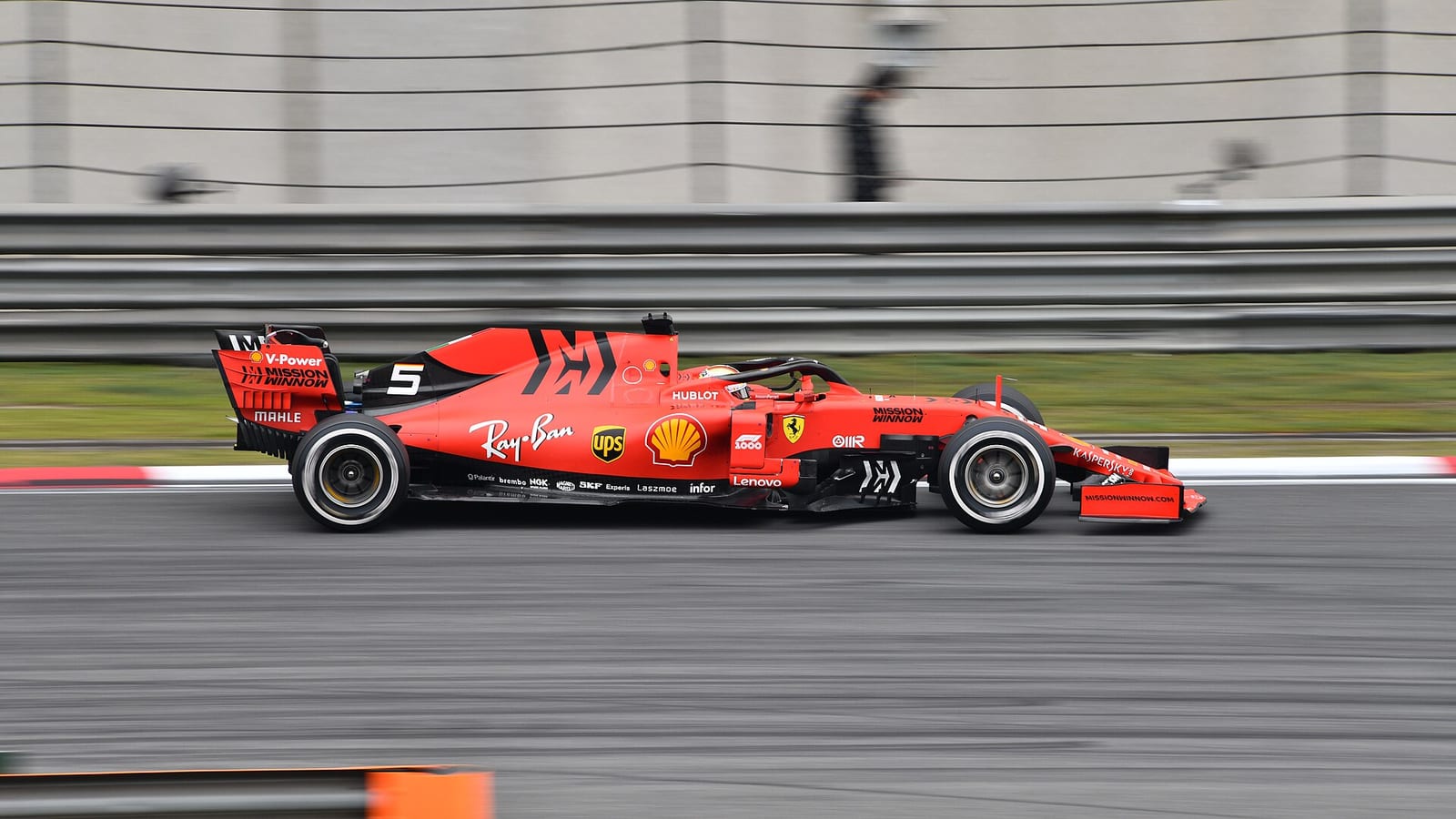
The 2019 German Grand Prix was round 11 of 21, on 28 July. Lewis Hamilton took pole position in 1:11.767.
The race started on a wet track. The formation laps behind the safety car were taken off the distance, so the race ran over 64 laps instead of 67. Hamilton led until lap 29. Then he went off, lost his front wing and got a penalty for the way he came into the pit lane.
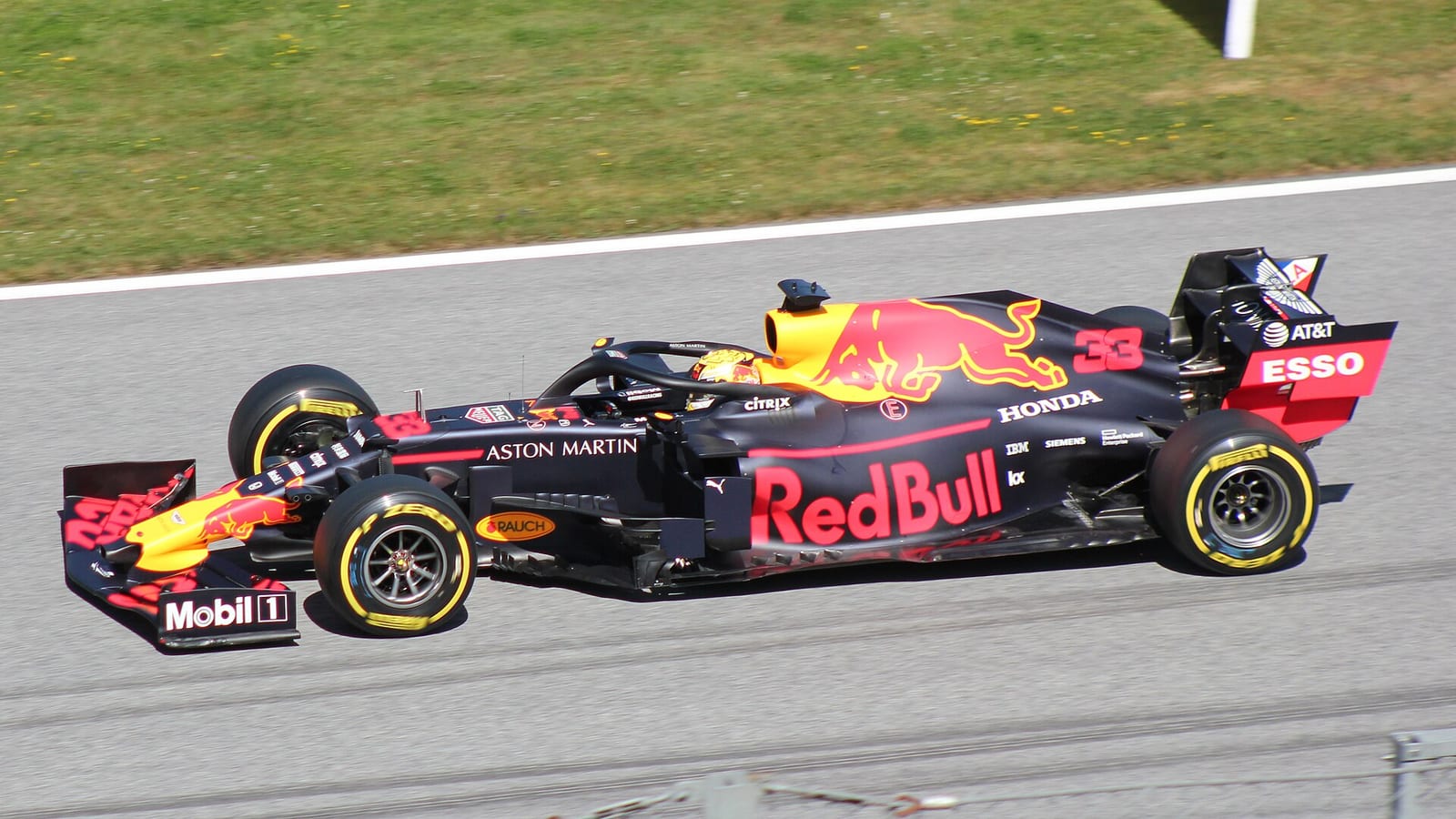
Max Verstappen started second, made a slow start and still won. Sebastian Vettel finished second. Daniil Kvyat was third for Toro Rosso after an early switch to dry tyres behind the last safety car. Robert Kubica finished tenth and scored the only point Williams got in 2019. Verstappen set the fastest lap, a 1:16.645 on lap 61. It is still the last German Grand Prix to be held.
More F1 2019 setups
All the tracks are on the F1 2019 setups page. Germany is round 11. The round before it is the F1 2019 Silverstone setup and the next one is the F1 2019 Hungary setup.
Hockenheim is also in the game before this one, and here is my F1 2018 Germany setup. The values do not carry over from one game to the next.
FAQ
What is the best F1 2019 setup for Germany?
Front wing 3, rear wing 7, differential 50% on throttle and 63% off, suspension 1 and 3, anti-roll bars 5 and 11, ride height 1 and 3, brake pressure 85% with 55% front bias, and tyres at 23.4 and 21.1 psi.
What wing levels should I run at Hockenheim in F1 2019?
3 at the front and 7 at the rear for time trial. For a race I would run 4 at the front to help the front tyres in the stadium.
Can I use this Germany setup in a race?
Yes, with small changes. Soften the rear anti-roll bar to 9, raise the front ride height to 2 and add one click of front wing.
Does this setup work with a controller?
Yes. I would lower the brake pressure to around 80%, soften the rear anti-roll bar to 9 and raise the front ride height to 2.
Why is the rear anti-roll bar at the maximum?
To make the car rotate. The rear has a lot of grip from the wing, the toe and the open differential. The stiff rear bar balances it.
Where can I overtake at Hockenheim in F1 2019?
Into the hairpin at the end of the Parabolika, with DRS. Turn 2 is the second option.
How long is the Hockenheimring in F1 2019?
4.574 km with 17 corners. The real race is 67 laps. In 2019 it ran over 64.