
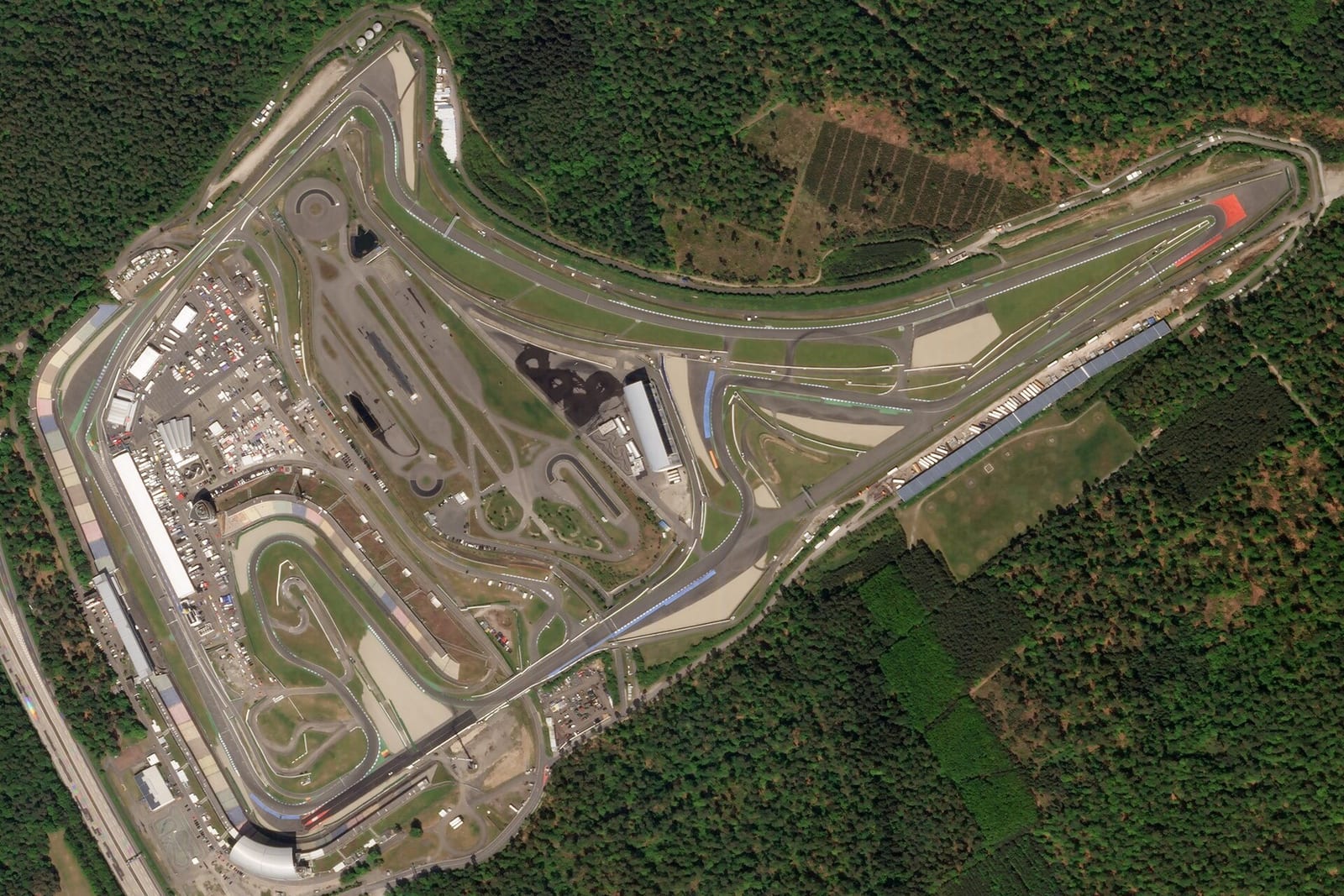
Hockenheim is two tracks in one lap. The first half is a drag race: Turn 2, then the long Parabolika, flat all the way to the hairpin. The second half is the stadium, slow and technical, where you need the car to turn and to put the power down.
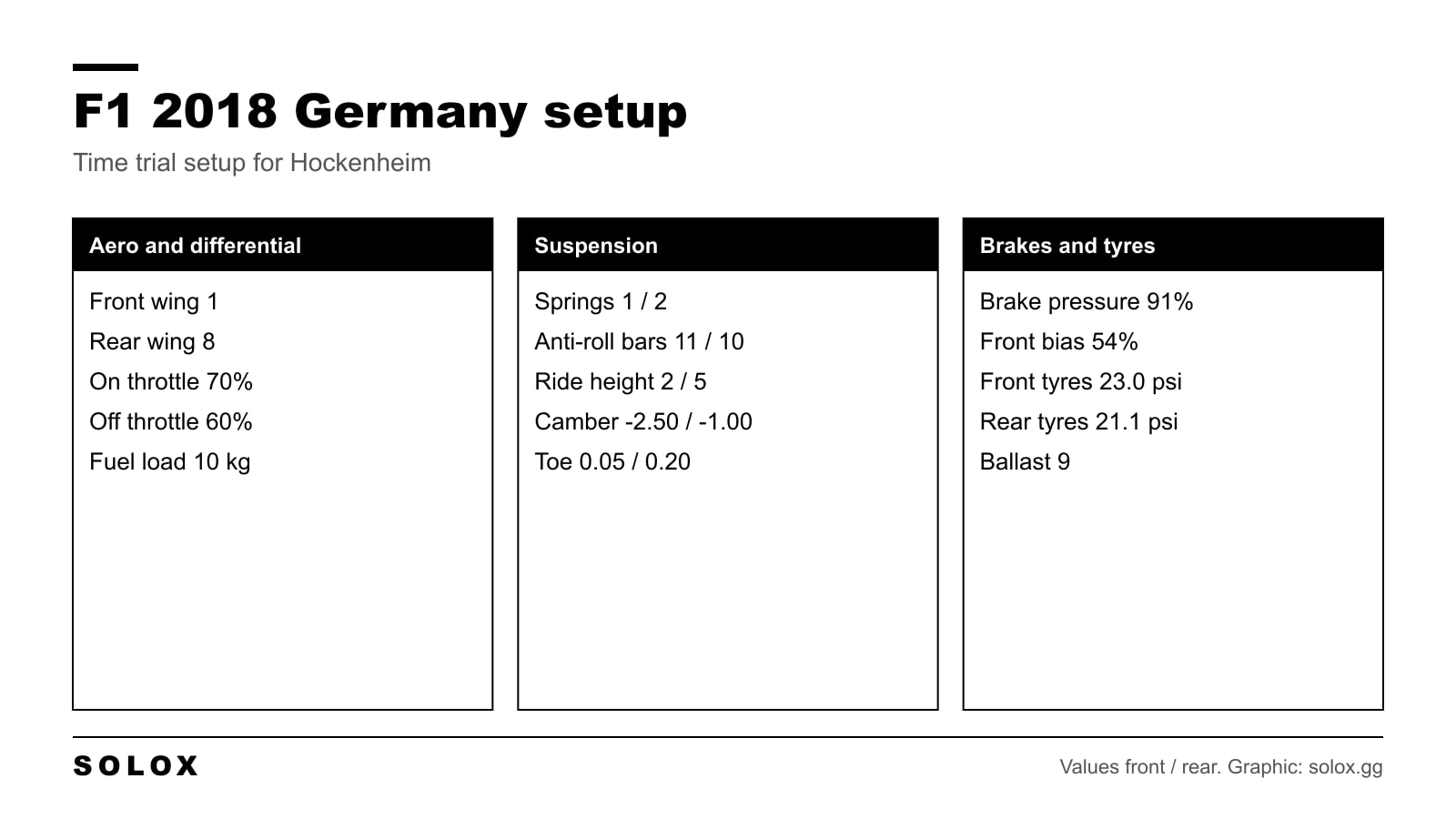
This F1 2018 Germany setup solves it in an unusual way. Almost no front wing, a big rear wing, and a very soft car with a lot of rake to give the front its grip back. It is a time trial setup, saved with 10 kg of fuel.
F1 2018 Germany setup
| Setting | Front | Rear |
|---|---|---|
| Wing | 1 | 8 |
| Camber | -2.50 | -1.00 |
| Toe | 0.05 | 0.20 |
| Suspension | 1 | 2 |
| Anti-roll bar | 11 | 10 |
| Ride height | 2 | 5 |
| Tyre pressure | 23.0 psi | 21.1 psi |
| Setting | Value |
|---|---|
| Fuel load | 10 kg |
| Differential on throttle | 70% |
| Differential off throttle | 60% |
| Brake pressure | 91% |
| Front brake bias | 54% |
| Ballast | 9 |

Why this setup works at Hockenheim
The lap is 4.574 km with 17 corners. Most of them are slow or medium speed. There is very little time to find in fast corners, so the setup is built around traction and straight line speed.
The wings. Front 1, rear 8. Seven clicks of difference is a lot. The front wing at the minimum cuts drag for the Parabolika. The rear wing at 8 is there for the exits: Turn 2, the hairpin, the Mercedes Arena, the Sachs Kurve. Every one of those is a slow corner that leads onto a straight, and a rear that holds lets you go to full throttle early.
On paper this is an understeering car. The suspension is what fixes it.
The differential. 70% on throttle, 60% off. The off throttle side is quite open, which helps the car rotate when you lift into the hairpin and the Sachs Kurve. With a front wing at 1 you need that help. On throttle, 70% gives good drive in a straight line without making the rear snap.
The geometry. Camber -2.50 and -1.00, toe 0.05 and 0.20. The least angle the menu allows. Good for braking and traction, which is what this lap is about.
Soft springs, stiff bars, a lot of rake
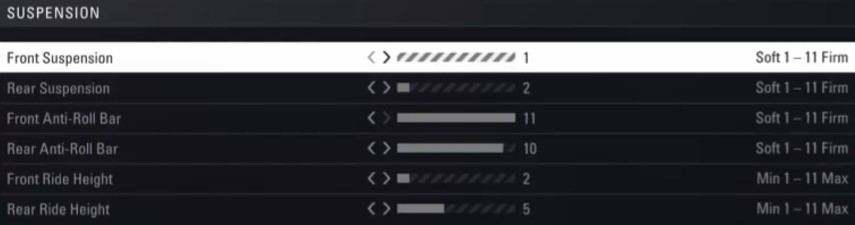
The springs are at 1 at the front and 2 at the rear. That is the softest front the game has. A soft spring lets the tyre follow the road and gives mechanical grip in slow corners, and it lets you use the kerbs in the stadium.
A car this soft would roll a lot, so the anti-roll bars do the opposite job: 11 at the front, the maximum, and 10 at the rear. The car is soft over bumps and kerbs but stays flat when you turn. That keeps it quick to respond in the Mercedes Arena and through the last two corners.
Ride height is 2 at the front and 5 at the rear. Three clicks of rake is a lot. A nose that low moves the aero balance forward and makes the front bite, and that is how this setup gets away with a front wing at 1.
Compare it with my F1 2018 Silverstone setup, where the springs are at 6 and 6. Fast track, stiff car. Slow track, soft car.
Brakes
Brake pressure is 91% with 54% at the front. The big stop is the hairpin at the end of the Parabolika, from top speed down to first or second gear. It is the best place to gain time and the easiest place to lock a front wheel.
If you lock the fronts there, lower the pressure before you touch the bias. 87% is still plenty.
What to change
One change at a time, three laps, then decide.
| Problem | Change | Why |
|---|---|---|
| The car pushes wide in the stadium | Front wing 1 to 3 | More front downforce in the medium speed corners |
| The car is slow at the end of the Parabolika | Rear wing 8 to 6 | Less drag on the longest full throttle part of the lap |
| The rear snaps on the exit of the hairpin | On throttle differential 70% to 60% | The inside wheel can slip without turning the car |
| The rear moves when you lift and turn in | Off throttle differential 60% to 70% | A more locked differential calms the entry |
| The car hits the kerbs hard and jumps | Front ride height 2 to 3 | More room under the nose |
| Front tyres lock into the hairpin | Brake pressure 91% to 87% | Less peak pressure, easier to hold at the limit |
| The rear moves under braking | Front brake bias 54% to 56% | More of the braking goes to the front |
For a race
With fuel the car is heavier and lower, and a front that slides for 67 laps kills the front tyres. Before a 25% or 50% race I would change this:
- Front wing 1 to 3. Less understeer, less front tyre wear.
- Rear wing 8 to 7. You need top speed to pass or defend into the hairpin.
- Front ride height 2 to 3. The heavy car touches the ground and the kerbs otherwise.
- On throttle differential 70% to 60%. Easier on the rear tyres out of the slow corners.
- Fuel. The 10 kg is a time trial number. In a race the game sets the load for the distance.
On a pad, I would also go to 60% on throttle. The exits of the hairpin and the Sachs Kurve are where a stick on full throttle spins the wheels.
In F1 2018 you manage the ERS yourself. Spend the battery out of Turn 2 and along the Parabolika, where the pass into the hairpin is made, and recover it in the stadium.
Where the lap time is at Hockenheim
- Turn 1, the Nordkurve. A fast right. Brake lightly, turn in early and use the exit kerb. A lot of people brake too much here.
- Turn 2. Slow right, then a quick left on the way out. Everything here is about the exit, because the Parabolika comes next and it is flat. A bad exit costs you all the way to the hairpin.
- The hairpin. The hardest stop of the lap. Brake in a straight line, release the pedal slowly as you turn, and wait for the car to rotate before you go to the power.
- The Mercedes Arena. A fast kink to the right, then left and right. Do not attack the first part. Give up the entry to be straight and early on the throttle at the exit.
- Turn 12, into the stadium. A fast right at the end of a short straight. A small brake, and the car has to turn at once. This is where the stiff front bar helps.
- The Sachs Kurve. A long banked left hairpin. The banking gives you more grip than you expect, so carry speed in and stay low.
- The last two corners, the Südkurve. Two rights. Treat them as one corner with a late apex in the second, because the exit decides your speed across the line.
Hockenheim in 2018
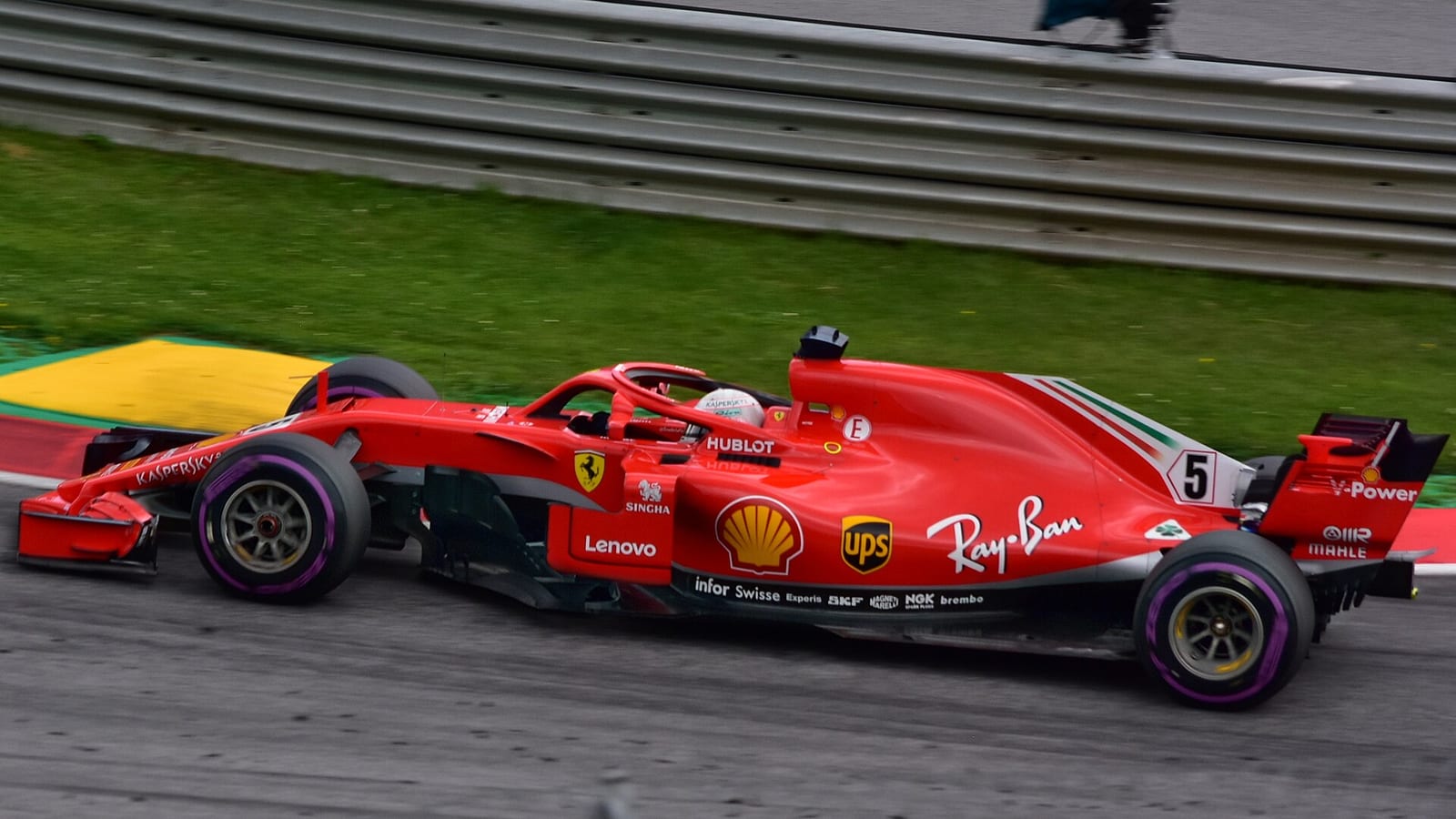
The 2018 German Grand Prix was round 11 of 21, on 22 July. It was the first German Grand Prix since 2016. Sebastian Vettel took pole position for Ferrari in 1:11.212 and led the race until he crashed out when light rain arrived. Lewis Hamilton won for Mercedes from 14th on the grid, ahead of Valtteri Bottas and Kimi Räikkönen. Hamilton also set the fastest lap, a 1:15.545 on lap 66 of 67.
More F1 2018 setups
All the tracks are on the F1 2018 setups page. The round before Germany is the F1 2018 Silverstone setup and the round after it is the F1 2018 Hungary setup.
For the same track one game later, here is my F1 2019 Germany setup. The values do not carry over from one game to the next.
FAQ
What is the best F1 2018 setup for Germany?
For time trial: front wing 1, rear wing 8, differential 70% on throttle and 60% off, suspension 1 and 2, anti-roll bars 11 and 10, ride height 2 and 5, brake pressure 91% with 54% front bias, tyres at 23.0 and 21.1 psi, ballast 9.
What wing levels should I run at Hockenheim in F1 2018?
1 at the front and 8 at the rear for one lap. For a race, 3 and 7 give a better balance and are kinder to the front tyres.
Can I use this Germany setup in a race?
Yes, with changes. Front wing to 3, rear wing to 7, front ride height to 3 and the on throttle differential to 60%.
Does this setup work with a controller?
It does. Lower the on throttle differential to 60% so the rear stays calm out of the hairpin and the Sachs Kurve.
Why is the front wing so low?
To cut drag on the Parabolika. The front grip comes from the soft front springs and the low front ride height instead. If the car still pushes for you, go to front wing 3.
How long is Hockenheim in F1 2018?
4.574 km with 17 corners. Pole position in the real 2018 race was a 1:11.212.