
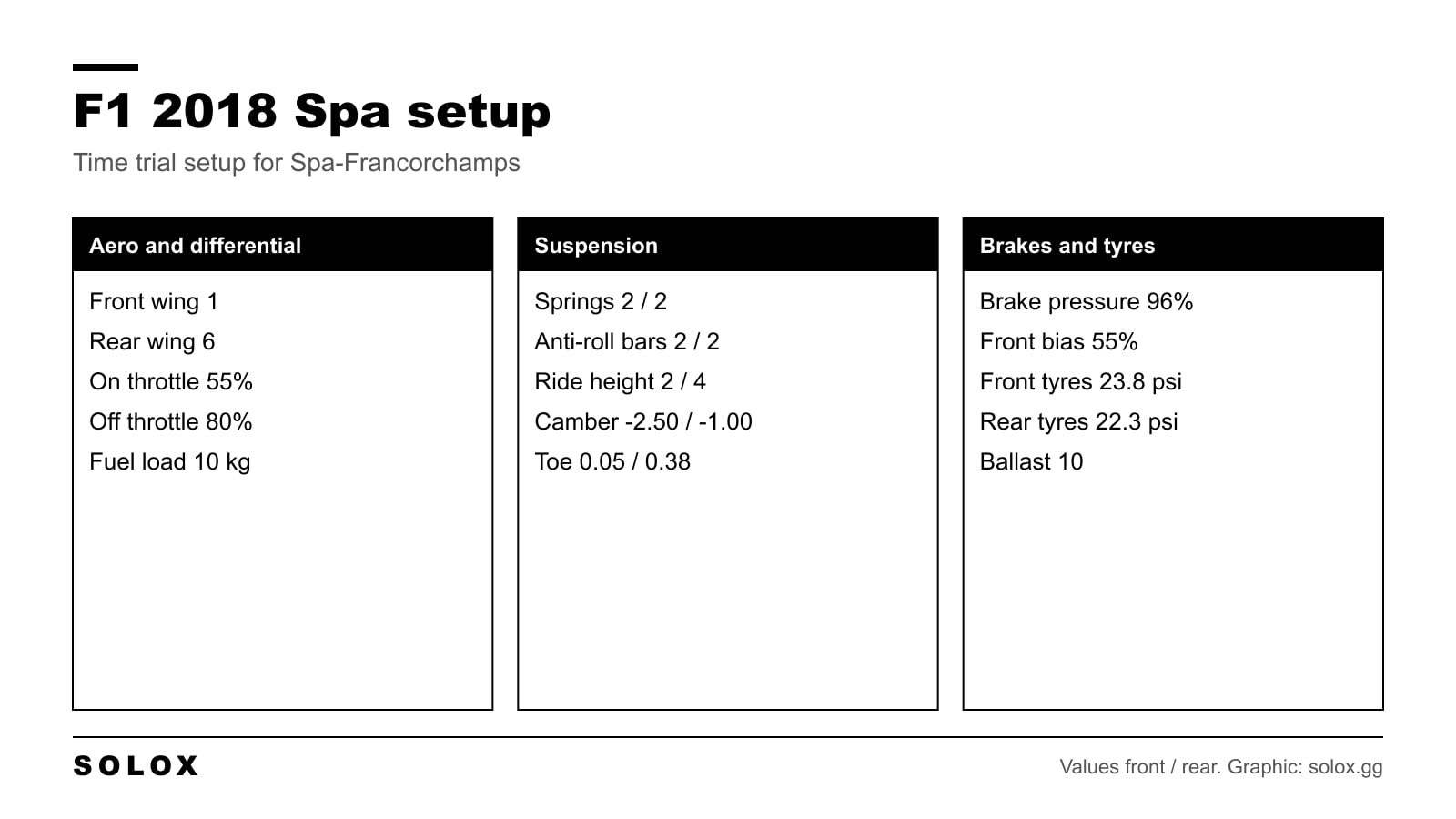
Spa is the track where the setup is always a compromise. Sectors one and three are full throttle for a very long time. Sector two is all corners, most of them fast. You can not be perfect in both, so you pick where you want to lose the least.
This F1 2018 Spa setup picks the straights, then gets grip back in the middle sector with a very soft car. Front wing 1, rear wing 6. It is a time trial setup, saved with 10 kg of fuel.
F1 2018 Spa setup
| Setting | Front | Rear |
|---|---|---|
| Wing | 1 | 6 |
| Camber | -2.50 | -1.00 |
| Toe | 0.05 | 0.38 |
| Suspension | 2 | 2 |
| Anti-roll bar | 2 | 2 |
| Ride height | 2 | 4 |
| Tyre pressure | 23.8 psi | 22.3 psi |
| Setting | Value |
|---|---|
| Fuel load | 10 kg |
| Differential on throttle | 55% |
| Differential off throttle | 80% |
| Brake pressure | 96% |
| Front brake bias | 55% |
| Ballast | 10 |

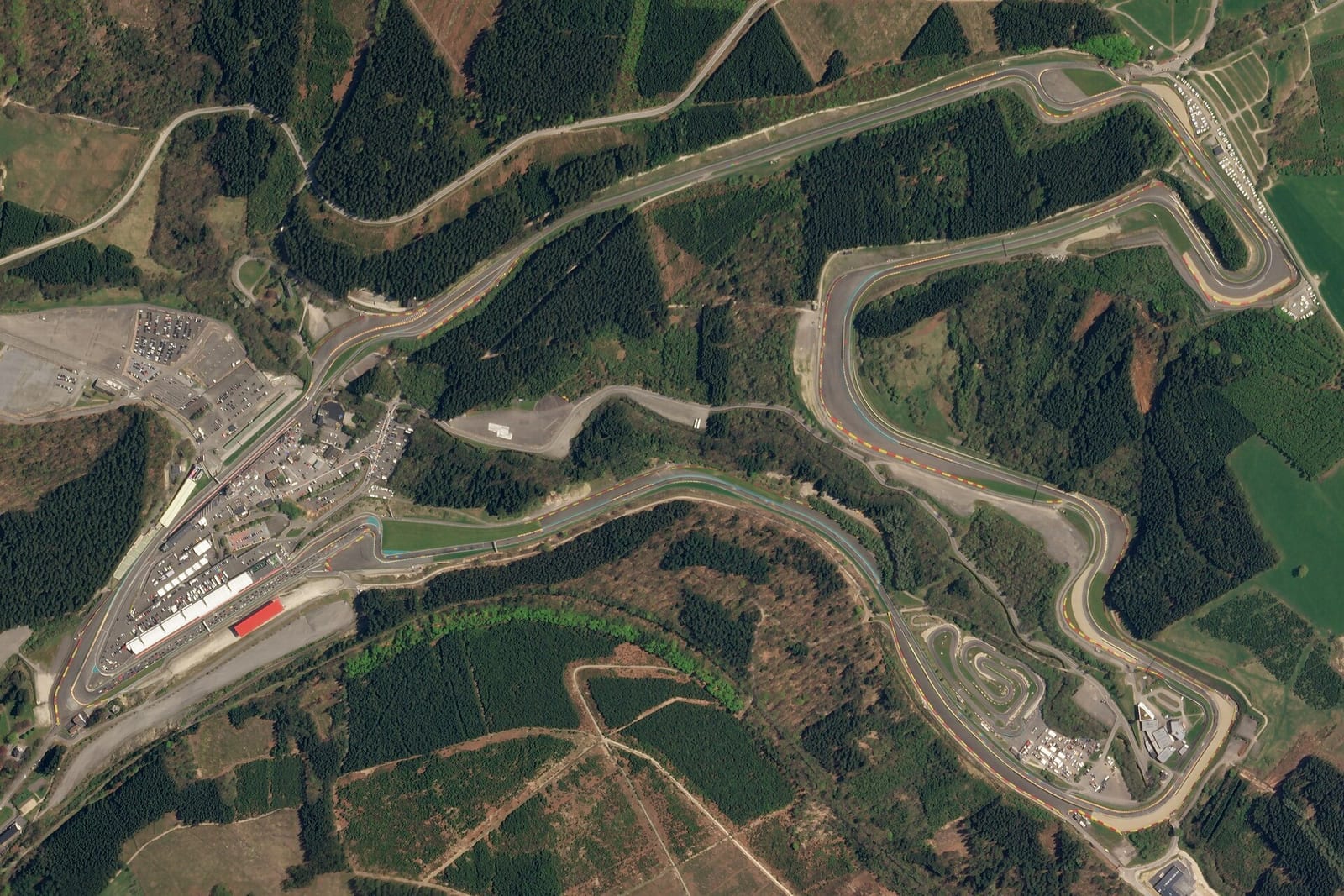
Here is the lap the setup comes from:
Why this setup works at Spa
The lap is 7.004 km, the longest of the season, with 19 corners. From the exit of La Source you are flat through Eau Rouge and Raidillon and all the way up the Kemmel straight. From Stavelot you are flat again through Blanchimont to the Bus Stop. Drag costs you for a very long time here.
The wings. Front 1, rear 6. The front is at the minimum. The rear at 6 is the part that makes the car driveable: it holds the rear in Pouhon and Blanchimont, and through Eau Rouge with a light car. Five clicks between front and rear means the balance is on the safe side, towards understeer. At 300 km/h that is the side you want.
The differential. 55% on throttle, 80% off. The on throttle side is close to open. That helps in two places, the exit of La Source and the exit of the Bus Stop, both slow corners followed by a very long straight where wheelspin costs you for many seconds. Off throttle, 80% keeps the car steady when you lift for Pouhon or brake into Les Combes.
The rear toe. 0.38, against 0.20 on almost every other track on this site. More rear toe makes the rear more stable in fast corners and on the power. It costs a little straight line speed and some tyre life. With the front wing at 1 and a soft rear end, the setup uses the toe to keep the rear calm. The rest of the geometry is at the least angle: camber -2.50 and -1.00, front toe 0.05.
A very soft car
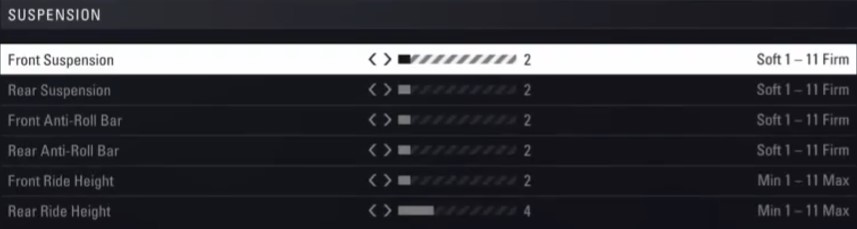
Springs at 2 and 2. Anti-roll bars at 2 and 2. Almost everything is near the soft end of the range.
A soft car gives mechanical grip, and that is how this setup pays for the low wings. In Les Combes, Bruxelles and the Bus Stop the tyres do the work the wings are not doing. A soft car also takes kerbs well, and at Spa the fast line uses them at Les Combes, at the exit of Pouhon and in the Bus Stop.
The price is response. With bars at 2 the car rolls and takes a moment to settle when you change direction. You feel it in the left and right of Les Combes and in Fagnes. Turn in a little earlier than you think and be smooth. If you want a sharper car, the front bar is the first thing to raise.
Ride height is 2 at the front and 4 at the rear. The low nose gives the front some bite back and cuts drag. Compare it with my F1 2018 Hungary setup, which does everything the other way around: wings at 7 and 11 and front springs at 9.
Brakes and tyres
Brake pressure is 96% with 55% at the front. There are two big stops from very high speed, Les Combes and the Bus Stop, and both are in a straight line. High pressure gives you the shortest braking distance there.
The risk is La Source and Bruxelles, where you brake at lower speed with less downforce on the car. That is where a front wheel locks with 96%. Come off the pedal earlier there, or drop to 92%.
The tyres are at 23.8 and 22.3 psi, higher than on most of my F1 2018 setups. Higher pressure makes the tyre respond faster, which gives back some of the sharpness the soft bars take away. It also makes the tyres run hotter, which is fine for one lap.
What to change
One change at a time, three laps, then decide.
| Problem | Change | Why |
|---|---|---|
| The car pushes wide in Pouhon | Front wing 1 to 3 | More front downforce in the fast corners |
| The rear moves in Eau Rouge or Blanchimont | Rear wing 6 to 7 | More rear downforce at high speed |
| The car is lazy in Les Combes and Fagnes | Front anti-roll bar 2 to 5 | A stiffer front bar makes the car answer faster |
| Too slow on the Kemmel straight | Rear wing 6 to 5 | Less drag, with a looser rear in sector two |
| Front tyres lock into La Source | Brake pressure 96% to 92% | Less peak pressure, easier to hold at the limit |
| The car bottoms out in Eau Rouge | Front ride height 2 to 3 | More room under the nose in the compression |
| The car does not rotate in the Bus Stop | Off throttle differential 80% to 70% | An open differential lets the car turn when you lift |
For a race
With fuel the car is heavy in Eau Rouge and Pouhon, and it sits lower in the compression. Before a 25% or 50% race I would change this:
- Front wing 1 to 3. The heavy car needs the front grip in sector two.
- Front ride height 2 to 3. So the floor does not touch at the bottom of Eau Rouge.
- Brake pressure 96% to 90%. A flat spot at Spa stays with you for seven kilometres a lap.
- Rear toe 0.38 to 0.29. Easier on the rear tyres over a stint.
- Tyre pressures down a few clicks. They run cooler and last longer.
- Fuel. The 10 kg is a time trial number. In a race the game sets the load for the distance.
On a pad, I would add one click of rear wing and go to 90% on the brakes. The differential at 55% is already friendly.
In F1 2018 you manage the ERS yourself. Use the battery from La Source to Les Combes. That is where almost every pass at Spa happens. Recover in sector two, then use what is left from Stavelot to the Bus Stop.
Where the lap time is at Spa
- La Source. The most important exit of the lap. Brake early, turn in late, get the car straight and go to full throttle once. You carry that speed for more than twenty seconds.
- Eau Rouge and Raidillon. Flat with low fuel in F1 2018. Left at the bottom, right up the hill, left over the top. Use as little steering as you can, because every degree of steering is speed lost on the Kemmel straight.
- Les Combes. Hard braking, then right, left, right. Take the kerb on the first two. Give up the first corner to be on line for the third, which leads down to Bruxelles.
- Bruxelles. A long downhill right hairpin. The front pushes because the road falls away. Be patient and wait for the apex in the second half.
- Pouhon. A double left, downhill on the way in. A lift or a short brake, one gear down, then back on the throttle early and hold the car through the second part. This is where the rear wing at 6 earns its place.
- Fagnes and Stavelot. Right and left at Fagnes, then two rights. The exit of the second right is the start of the next flat out section, so that is the one to get right.
- Blanchimont. Flat. Just place the car and do not move the wheel more than you need.
- The Bus Stop. Brake very late in a straight line, right then left. Use the kerbs and get the car straight early for the run to the line.
Spa in 2018
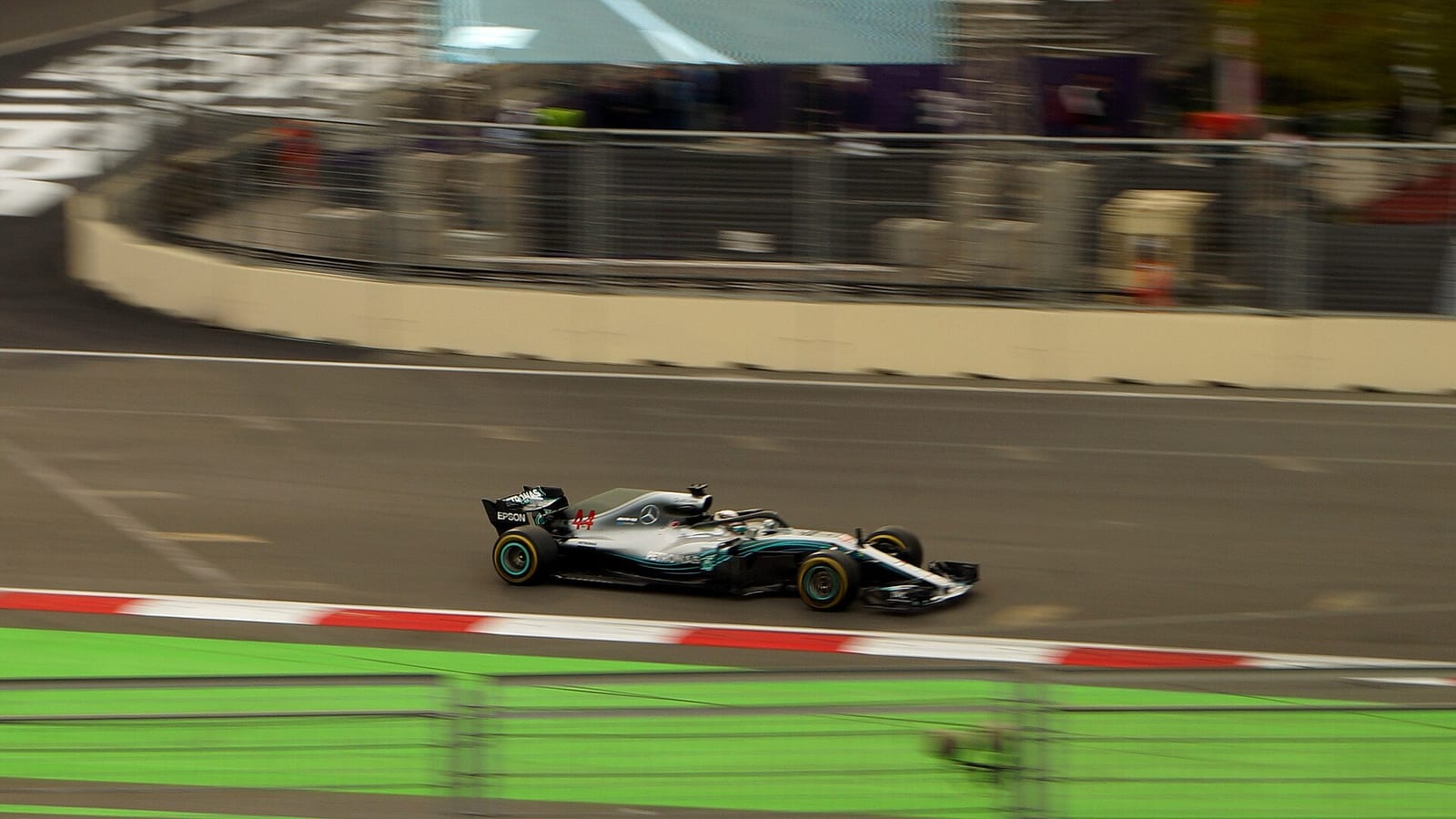
The 2018 Belgian Grand Prix was round 13 of 21, on 26 August, the first race after the summer break. Lewis Hamilton took pole position for Mercedes with a 1:58.179. Sebastian Vettel won for Ferrari over 44 laps, ahead of Hamilton and Max Verstappen. Valtteri Bottas set the fastest lap, a 1:46.286 on lap 32.
More F1 2018 setups
All the tracks are on the F1 2018 setups page. The round before Spa is the F1 2018 Hungary setup and the round after it is the F1 2018 Monza setup.
For the same track in other games, here are my F1 2017 Spa setup, my F1 2019 Spa setup and my F1 25 Spa setup. The values do not carry over from one game to the next.
FAQ
What is the best F1 2018 setup for Spa?
For time trial: front wing 1, rear wing 6, differential 55% on throttle and 80% off, rear toe 0.38, suspension 2 and 2, anti-roll bars 2 and 2, ride height 2 and 4, brake pressure 96% with 55% front bias, tyres at 23.8 and 22.3 psi, ballast 10.
What wing levels should I run at Spa in F1 2018?
1 at the front and 6 at the rear for one lap. For a race, 3 and 6 give the heavy car more front grip in Pouhon and the middle sector.
Is Eau Rouge flat in F1 2018?
With low fuel and this setup, yes. With race fuel you may need a small lift on the first laps, and a higher front ride height so the car does not touch the ground.
Can I use this Spa setup in a race?
Yes, with changes. Front wing to 3, front ride height to 3, brake pressure to 90% and rear toe down to 0.29.
Does this setup work with a controller?
It does. Add one click of rear wing and lower the brake pressure to 90% so the fronts do not lock into La Source.
How long is Spa in F1 2018?
7.004 km with 19 corners, the longest lap in the game. The real 2018 race was 44 laps.