
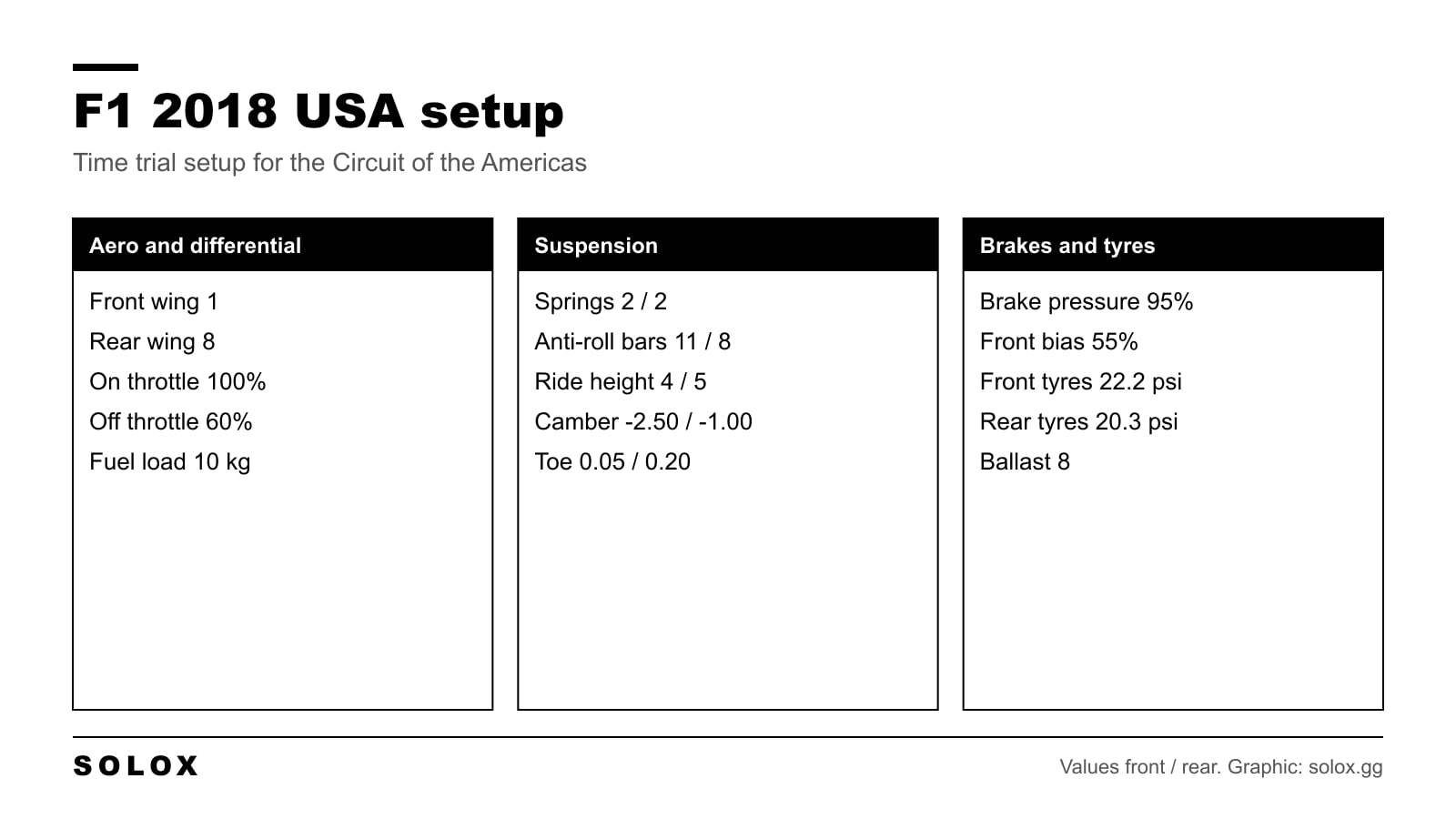
The Circuit of the Americas asks for two different cars. The first sector is a run of fast sweepers where you want downforce and a quick change of direction. Then comes a 1 km straight, and a last sector of slow corners where traction decides everything.
This F1 2018 USA setup splits it like this: a front wing at 1, a rear wing at 8, soft springs, stiff bars and a locked differential. It is a time trial setup, saved with 10 kg of fuel.
F1 2018 USA setup
| Setting | Front | Rear |
|---|---|---|
| Wing | 1 | 8 |
| Camber | -2.50 | -1.00 |
| Toe | 0.05 | 0.20 |
| Suspension | 2 | 2 |
| Anti-roll bar | 11 | 8 |
| Ride height | 4 | 5 |
| Tyre pressure | 22.2 psi | 20.3 psi |
| Setting | Value |
|---|---|
| Fuel load | 10 kg |
| Differential on throttle | 100% |
| Differential off throttle | 60% |
| Brake pressure | 95% |
| Front brake bias | 55% |
| Ballast | 8 |

Here is the lap the setup comes from:
Why this setup works at COTA
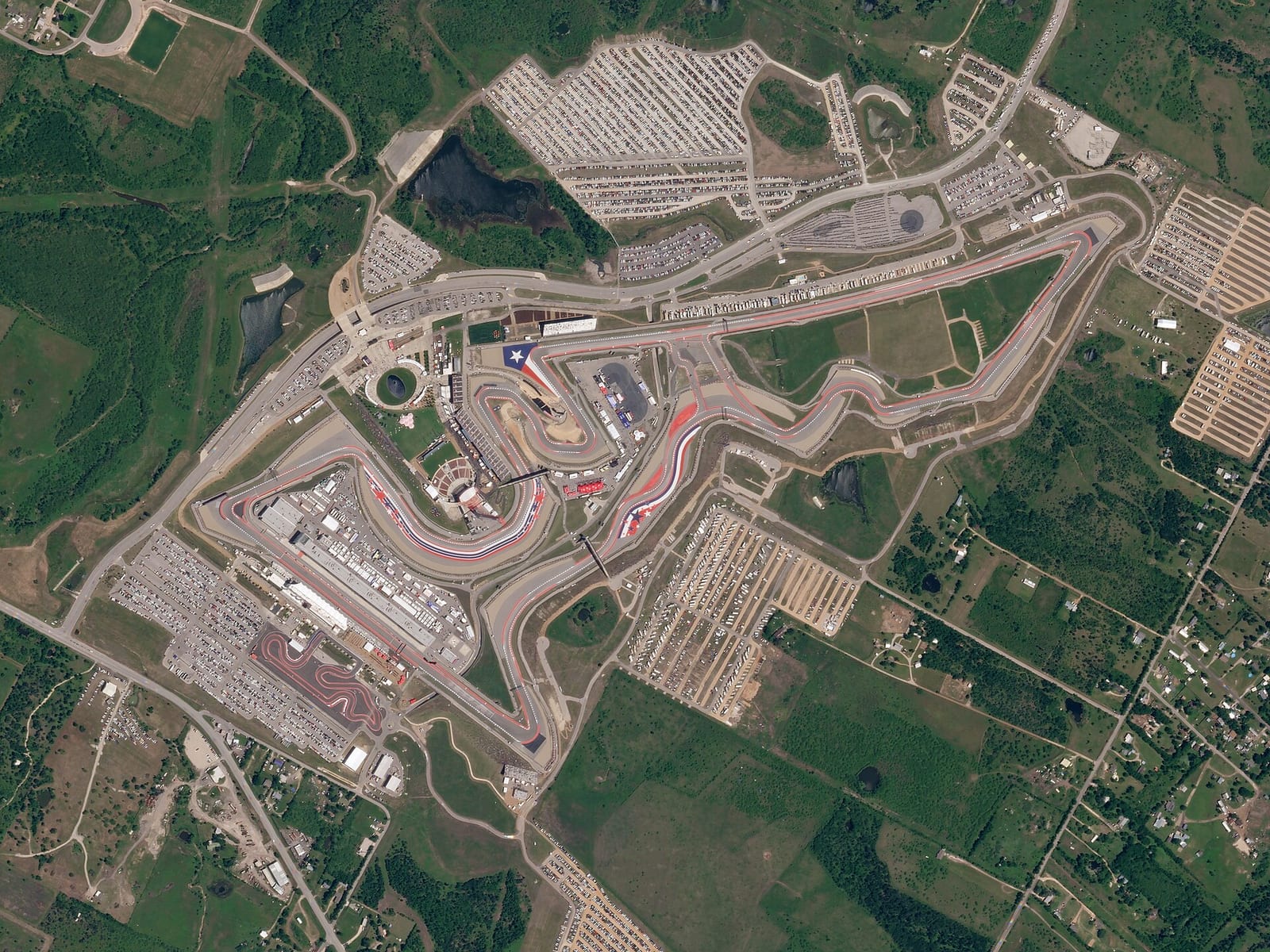
The lap is 5.513 km with 20 corners. It starts with a steep climb to Turn 1, drops into a set of fast sweepers from Turn 3 to Turn 6 that tighten through Turns 7 to 9, and then runs out to the hairpin at Turn 11. After the back straight there is a slow stadium style section and a long multi apex right hander before the last two lefts.
The wings. Front 1, rear 8. Seven clicks apart. The front wing at the minimum keeps the drag down for the back straight. The rear at 8 holds the car through the sweepers and gives traction out of Turn 11 and through the last sector. On wings alone this car would understeer a lot. The bars are there to fix that.
The differential. 100% on throttle, the maximum. A locked differential drives both rear wheels together, so on a clean exit the car goes forward with no wasted wheelspin on the inside tyre. Out of Turn 11, Turn 12 and Turn 20, that is free speed. The price: if you ask for power with a lot of steering on, the rear lets go at once. Off throttle it is 60%, which is open, so the car still turns in.
The geometry. Camber -2.50 and -1.00, toe 0.05 and 0.20. The least angle the menu allows.
Soft springs, stiff bars
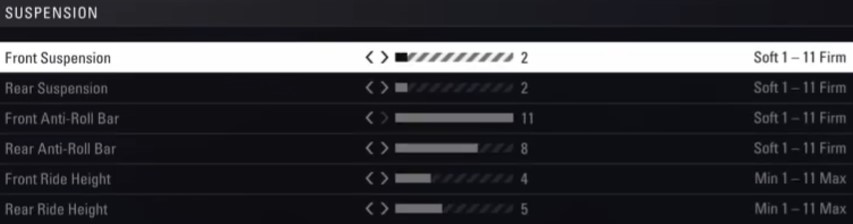
Springs are at 2 and 2, close to the softest. Anti-roll bars are at 11 and 8, with the front at the maximum.
It looks like a contradiction and it is not. The springs control how the car moves up and down: over kerbs, under braking, over the bumps. Soft springs let the car ride the kerbs in the sweepers and in the stadium section. The bars control roll only. Stiff bars keep the car flat when you go from left to right, so it changes direction quickly. You get a car that is soft over a kerb and sharp in the Esses.
The front bar at 11 is also where the front end comes from with a wing at 1. If the car feels too sharp for you on turn in, that is the first thing to lower.
Ride height is 4 and 5. It is higher than on most of my F1 2018 setups, because soft springs let the car sink at speed and it needs the room.
Tyres are at 22.2 psi front and 20.3 rear. The low rear pressure is for traction, and with a locked differential you need it.
My F1 2018 Japan setup is for a similar kind of first sector and goes the other way: middle springs, soft bars and an open differential.
Brakes
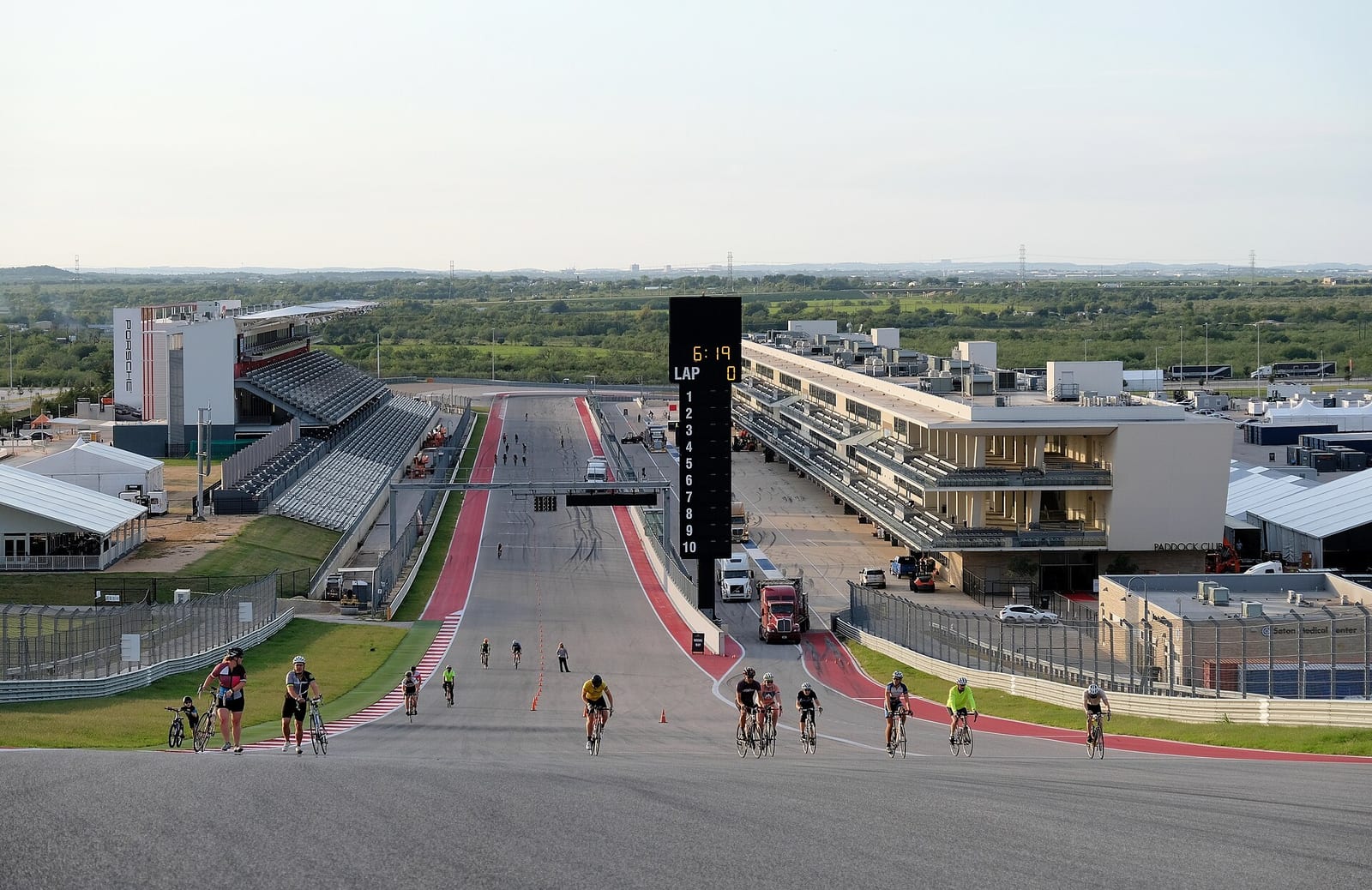
Brake pressure is 95% with 55% at the front. There are three big stops in a straight line: Turn 1, Turn 11 and Turn 12 at the end of the back straight. High pressure is worth it for those.
Turn 1 is uphill, so the car stops better than you expect. Turn 12 is flat and comes from top speed, and that is where the fronts lock. If it happens more than once in a few laps, go to 90%.
What to change
One change at a time, three laps, then decide.
| Problem | Change | Why |
|---|---|---|
| The rear snaps on corner exit | On throttle differential 100% to 75% | An open differential forgives early throttle |
| The car pushes wide in the sweepers | Front wing 1 to 3 | More front downforce at high speed |
| The car is too sharp on turn in | Front anti-roll bar 11 to 8 | A softer front bar calms the front |
| The rear is loose in Turns 16 to 18 | Rear anti-roll bar 8 to 6 | A softer rear bar gives the rear more grip |
| Front tyres lock into Turn 12 | Brake pressure 95% to 90% | Less peak pressure, easier to hold at the limit |
| The car bottoms out on the kerbs | Springs 2 to 4, front and rear | Stiffer springs hold the car up |
| Too slow on the back straight | Rear wing 8 to 7 | Less drag, with less grip in the first sector |
For a race
With fuel and worn rear tyres, a locked differential is hard work. Before a 25% or 50% race I would change this:
- On throttle differential 100% to 70%. The big one. The rear tyres last longer and the car is easier out of slow corners.
- Front wing 1 to 3. Less understeer through the sweepers saves the front left.
- Brake pressure 95% to 90%. One flat spot costs you the stint.
- Front anti-roll bar 11 to 9. Easier on the front tyres.
- Fuel. The 10 kg is a time trial number. In a race the game sets the load for the distance.
On a pad, I would run the differential at 60% on throttle and the front bar at 8. With a trigger for a throttle, 100% is too much.
In F1 2018 you manage the ERS yourself. Use the battery out of Turn 11 for the whole back straight, which is the main passing place, and again from Turn 20 up the hill to Turn 1. Recover in the sweepers.
Where the lap time is at COTA
- Turn 1. A steep climb to a hairpin with the apex on the crest. You cannot see it until late. The road is very wide, so there are many lines. Brake late, because the hill helps, and take a late apex for the run down to Turn 2.
- Turns 3 to 6. The fast sweepers. Flat or close to it at the start, with small lifts as it goes on. Keep the car in the middle of the road between corners and never use all of the exit, or you are out of position for the next one.
- Turns 7 to 9. The same rhythm, but it tightens and slows down. This is where you go from lifting to braking. If you carry too much speed from Turn 6, you lose it all here.
- Turn 10. Blind and downhill. Trust the line and let the car run out.
- Turn 11. The hairpin before the back straight. Brake in a straight line, late apex, car straight, then full throttle. With the differential locked, wait for the car to be straight.
- Turn 12. The biggest stop of the lap. Brake at the limit and turn in late.
- Turns 13 to 15. Slow and technical. Turn 15 tightens on you, so you brake and turn at the same time. Be patient.
- Turns 16 to 18. One long right with several apexes. Hold a steady throttle and a steady steering angle. Corrections here cost a lot.
- Turns 19 and 20. Two lefts. Turn 19 is fast and easy to overdo. Turn 20 decides your speed up the hill.
Austin in 2018
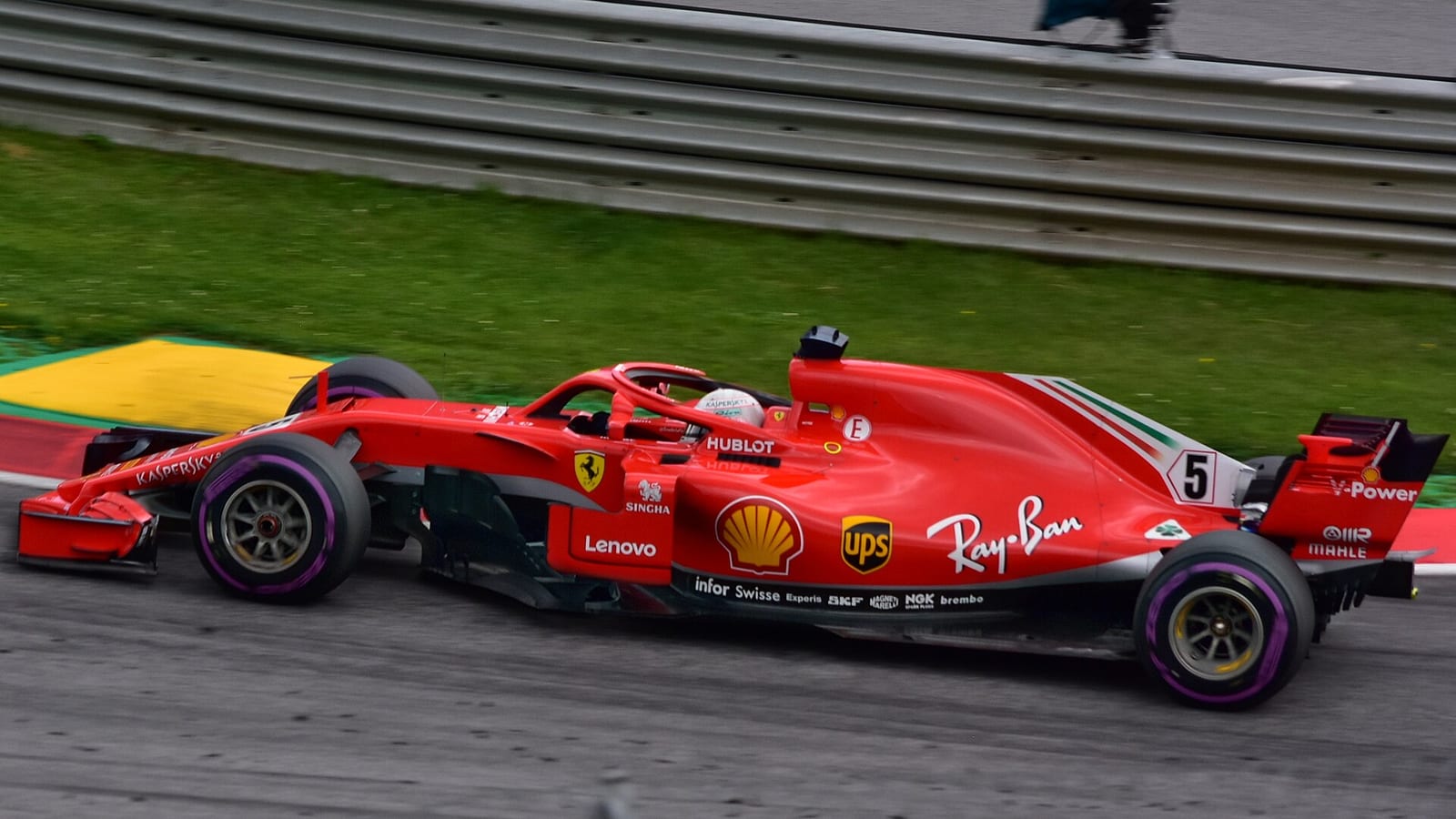
The 2018 United States Grand Prix was round 18 of 21, on 21 October. Lewis Hamilton took pole position for Mercedes with a 1:32.237. Kimi Raikkonen won the race for Ferrari over 56 laps, his first win since the 2013 Australian Grand Prix and the last of his F1 career. Max Verstappen was second for Red Bull and Hamilton third. Hamilton also set the fastest lap, a 1:37.392 on lap 40.
The track opened in 2012 and was the first in the United States built for Formula One.
More F1 2018 setups
All the tracks are on the F1 2018 setups page. The round before the USA is the F1 2018 Japan setup and the round after it is the F1 2018 Mexico setup.
For the same track in other games, here are my F1 2017 USA setup, my F1 2020 USA setup and my F1 25 USA setup. The values do not carry over from one game to the next.
FAQ
What is the best F1 2018 setup for the USA?
For time trial: front wing 1, rear wing 8, differential 100% on throttle and 60% off, suspension 2 and 2, anti-roll bars 11 and 8, ride height 4 and 5, brake pressure 95% with 55% front bias, tyres at 22.2 and 20.3 psi, ballast 8.
What wing levels should I run at COTA in F1 2018?
1 at the front and 8 at the rear for one lap. For a race, 3 and 8 take away understeer in the sweepers and save the front left tyre.
Can I use this COTA setup in a race?
Yes, with changes. On throttle differential down to 70%, front wing to 3, brake pressure to 90% and front anti-roll bar to 9.
Does this setup work with a controller?
It does, with a more open differential. Set it to 60% on throttle and lower the front anti-roll bar to 8.
Why is the differential at 100% on throttle?
For drive out of the slow corners. Both rear wheels push together, which is fast when the car is straight. If the rear snaps on you, 75% is the better choice.
How long is COTA in F1 2018?
5.513 km with 20 corners. The real 2018 race was 56 laps, and the pole lap was a 1:32.237.