
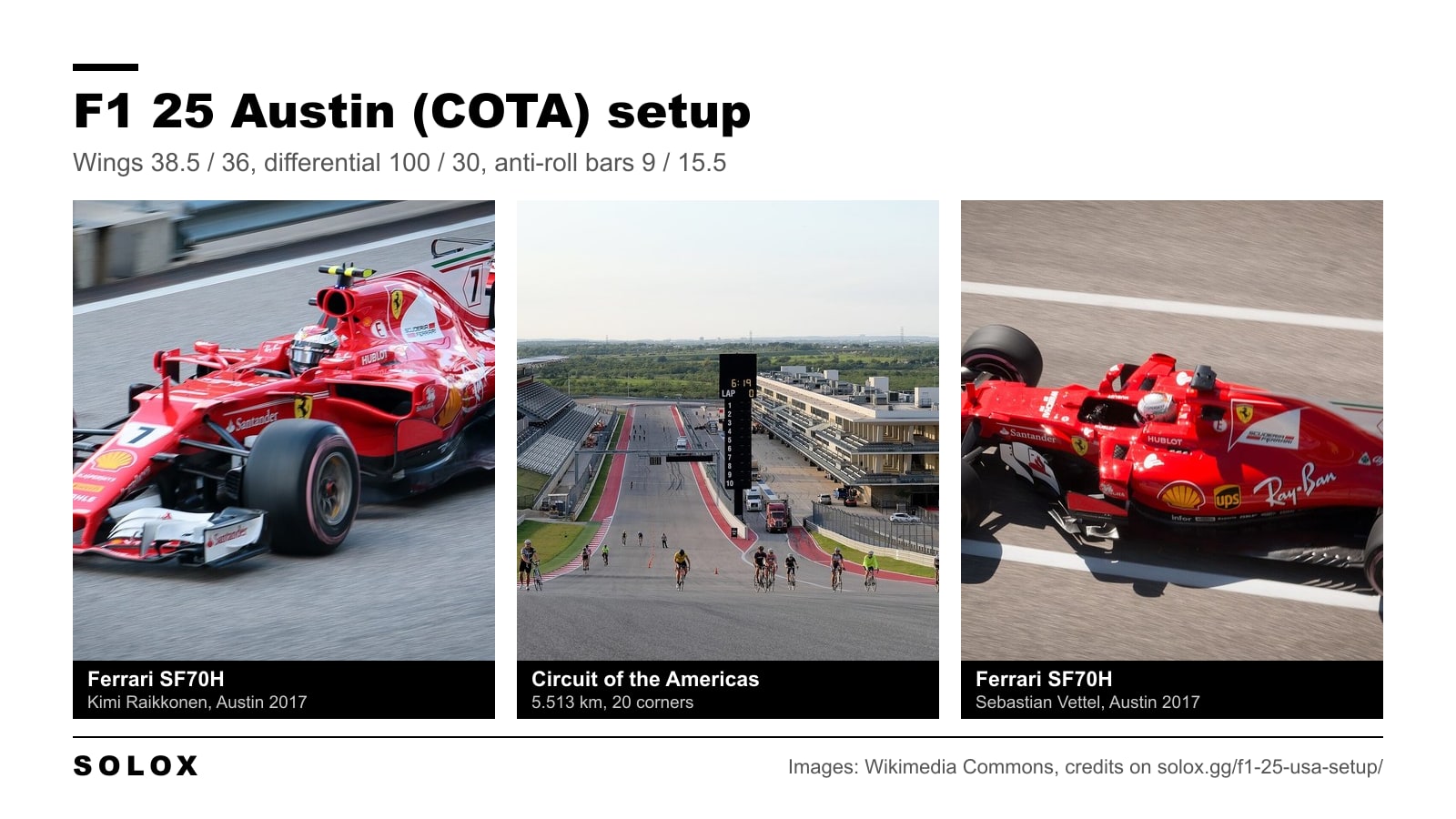
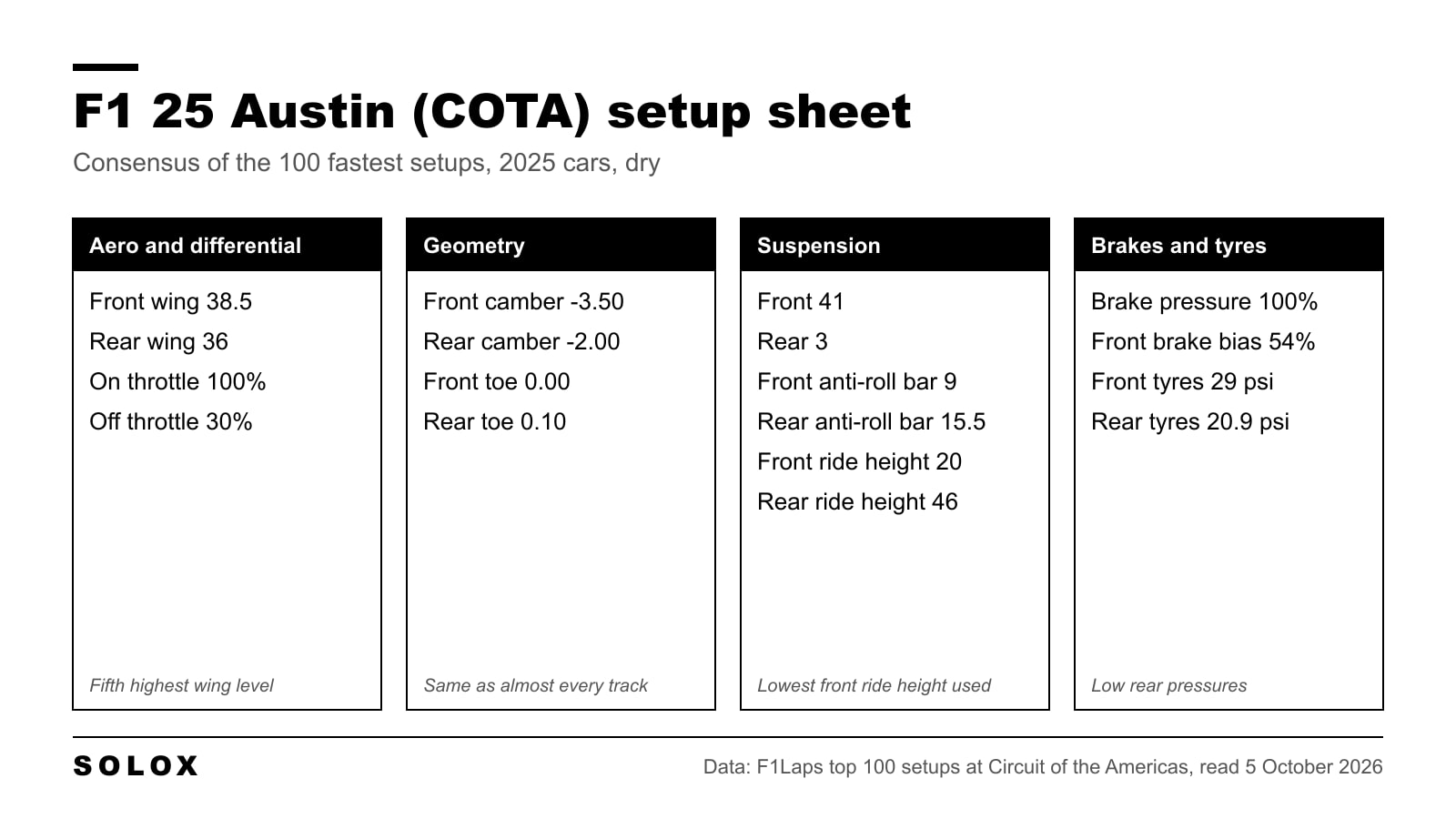
The best F1 25 USA setup for Circuit of the Americas runs wings at 38.5 and 36, the differential at 100% on throttle and 30% off, suspension at 41 and 3, anti-roll bars at 9 and 15.5, ride height at 20 and 46 and front brake bias at 54%. It is a high downforce setup. Only Monaco, Hungary, Singapore and Zandvoort run more wing.
The numbers come from F1Laps, which reports what the 100 fastest setups at this track have in common. I read them on 5 October 2026. I have not tested this exact setup in the game, so take it as community data. The reading of it is mine.
F1 25 USA setup: dry and wet
These values are for the 2025 cars in the base game.
| Setting | Dry | Wet |
|---|---|---|
| Front wing | 38.5 | 39.5 |
| Rear wing | 36 | 36 |
| Differential on throttle | 100% | 80% |
| Differential off throttle | 30% | 30% |
| Front camber | -3.50 | -3.50 |
| Rear camber | -2.00 | -2.00 |
| Front toe | 0.00 | 0.00 |
| Rear toe | 0.10 | 0.10 |
| Front suspension | 41 | 41 |
| Rear suspension | 3 | 8 |
| Front anti-roll bar | 9 | 9 |
| Rear anti-roll bar | 15.5 | 15 |
| Front ride height | 20 | 21 |
| Rear ride height | 46 | 48 |
| Brake pressure | 100% | 100% |
| Front brake bias | 54% | 54% |
| Front tyre pressures | 29 psi | 28.75 psi |
| Rear tyre pressures | 20.9 psi | 20.9 psi |
Why this setup works at Austin
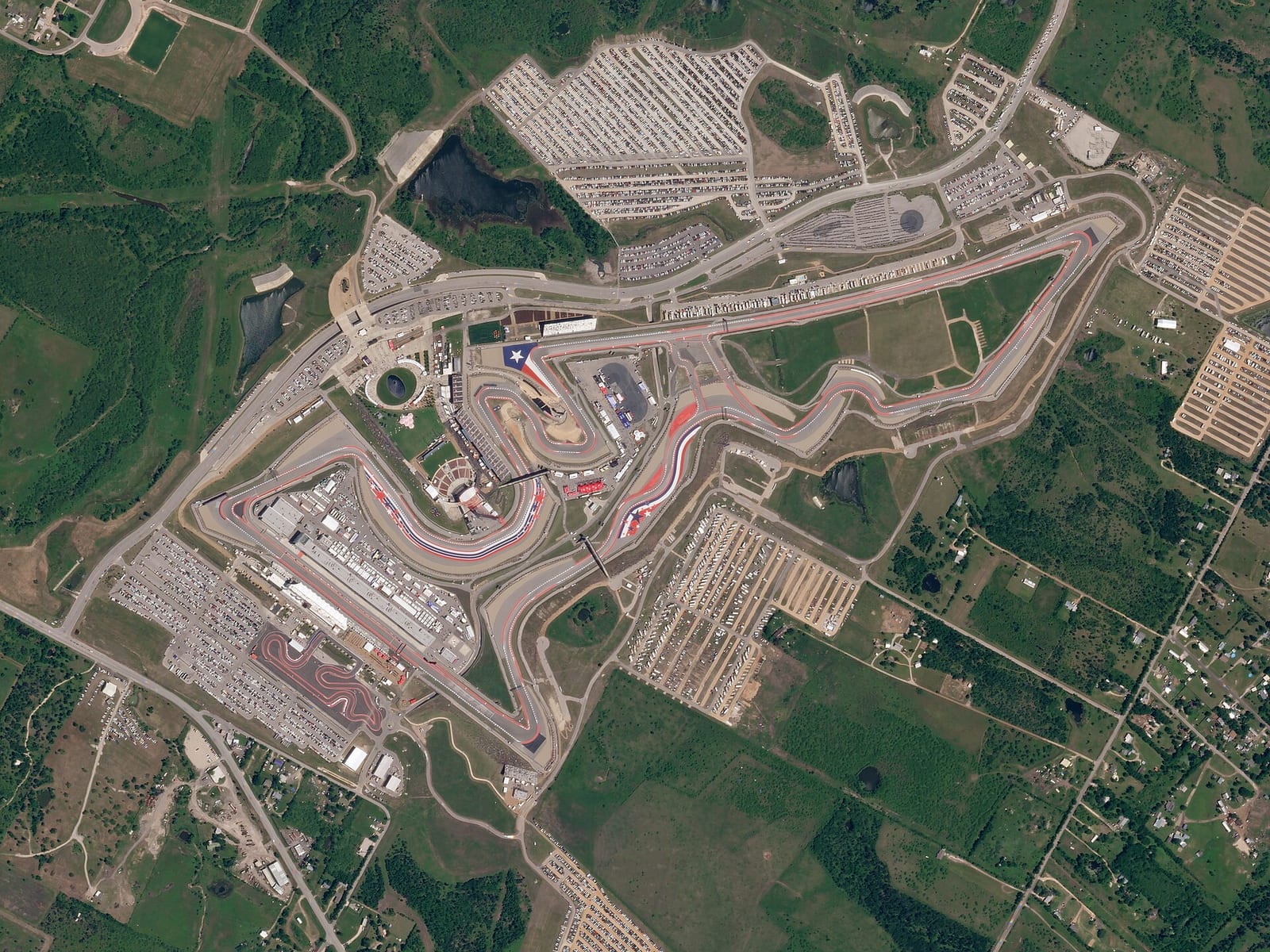
Circuit of the Americas is 5.513 km long and has 20 corners. The lap runs anticlockwise and it has a bit of everything: a steep climb to a blind hairpin, a fast run of esses, a long back straight and a slow stadium section before a long multi apex right hander.
The setup has to serve two masters. The first sector wants downforce and a car that changes direction. The back straight wants low drag. The community has settled on the downforce side, and I agree with it. The esses and the long right hander are worth more time than the straight.
Wings at 38.5 and 36. No other track uses these exact values. Nineteen run less at both ends, and only Monaco, Hungary, Singapore and Zandvoort run more. You can compare it with every other track in my F1 25 setups for every track.
Differential at 100% and 30%. Fully locked on throttle, like 19 of the 24 tracks, for traction out of Turn 1, Turn 11 and the stadium section. Off throttle, 30% is in the upper half. Eleven tracks run less, nine run the same and only Melbourne, Montreal, Imola and Miami run more. That keeps the rear settled when you lift through the esses.
Camber and toe. Camber is -3.50 and -2.00 and toe is 0.00 and 0.10, the values almost every track uses.
Suspension at 41 and 3. The stiffest front any track runs, shared by fourteen of them. The rear at 3 is soft, the same as Interlagos, Imola and Silverstone. Seven tracks run less and thirteen run more.
Anti-roll bars at 9 and 15.5. The front bar matches Bahrain and Hungary. Fourteen tracks run less and seven run more. The rear at 15.5 is unique and sits in the middle, with twelve tracks below and eleven above. It is a balanced car, a little stiffer at the front than most.
Ride height at 20 and 46. The front at 20 is the lowest any track uses, shared with Barcelona, Mexico City, Jeddah and Abu Dhabi. The rear is in the middle, the same as Bahrain, Miami and Abu Dhabi, with eleven tracks lower and nine higher. A low front gives the floor more to work with in the fast corners.
Brake bias at 54%. The value seventeen of the 24 tracks use. Brake pressure is 100%.
Tyres at 29 and 20.9 psi. Only Miami runs the same front pressure. Twelve tracks run less and ten run more. The rears are low. Only Monaco runs less, and Mexico City, Zandvoort, Singapore and Barcelona run the same.
How to drive it
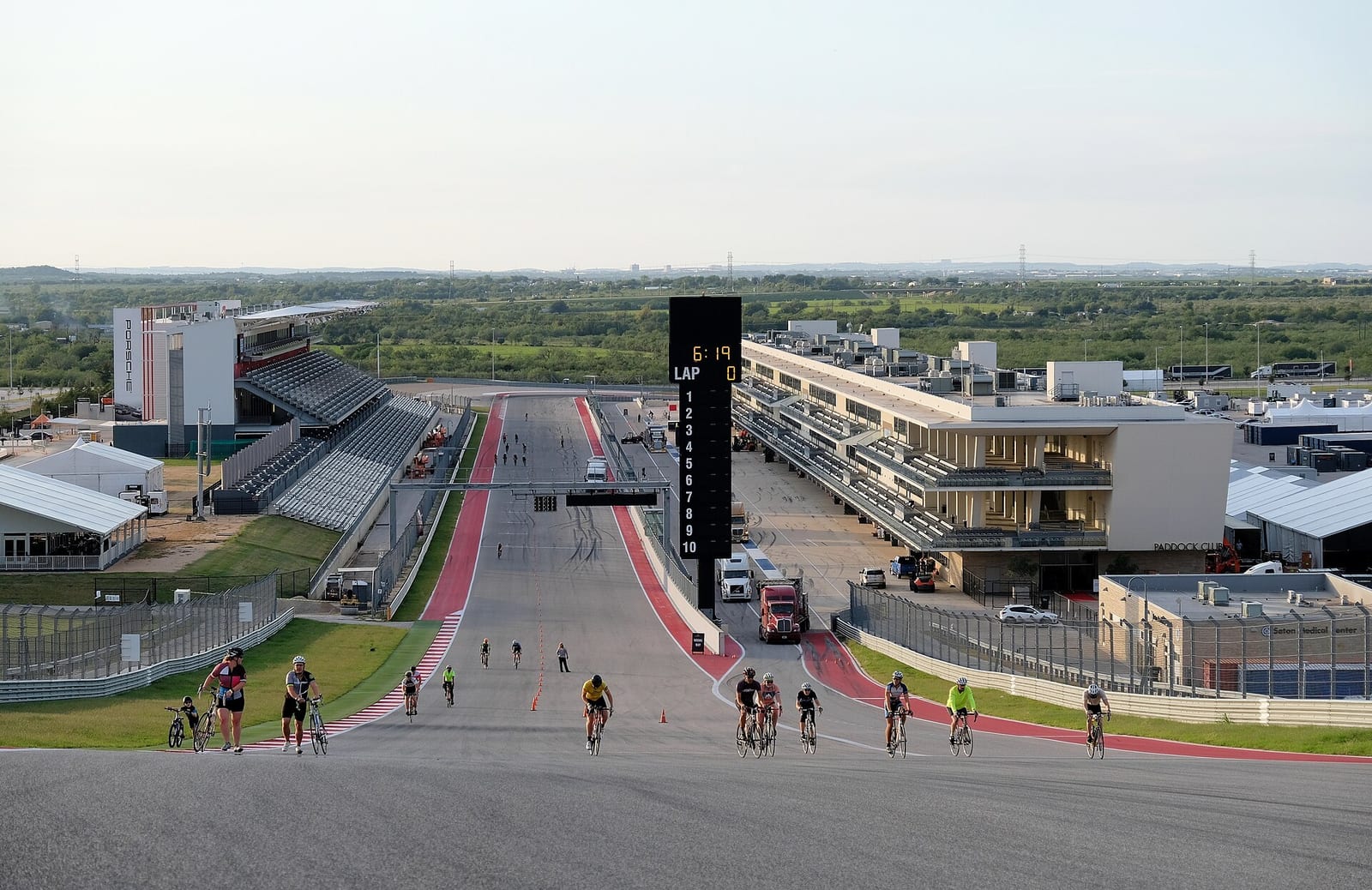
Brake later than you think for Turn 1. The hill slows the car for you. The track is very wide on entry, so several lines work. I would brake on the outside, turn in late and aim for a late apex, because the exit runs downhill into Turn 2 and you want to be straight early.
Find a rhythm in the esses. Turns 3 to 6 are fast and flow into each other. Each corner sets up the next, so a mistake in Turn 3 costs you all the way to Turn 9. Lift a little rather than brake, keep the steering smooth, and give up some speed at the start to be on line at the end.
Turn 11 decides the back straight. It is a slow hairpin left at the far end of the track. Brake in a straight line, take a late apex and get the car straight before you go to full throttle. With the differential locked, wheelspin here costs speed for the whole straight.
Turn 12 is the best place to pass. It comes at the end of the back straight with a big braking zone. Brake at 54% bias is stable here. Do not carry too much speed in, because the stadium section that follows is slow and punishes a wide exit.
Hold a constant arc through Turns 16 to 18. It is one long right hander with more than one apex. Turn in once, hold the throttle steady and let the car run. Adding steering in the middle only scrubs the front tyres.
Watch the track limits at the end. Turns 19 and 20 are both lefts with a tempting amount of run off on exit. The game is strict here. Keep two wheels inside the white line.
How to adjust it to your driving
Change one thing at a time and drive three clean laps before you judge it.
- The rear slides on corner exit. Lower the on throttle differential from 100% to 90%.
- The car is nervous in the esses. Soften the rear anti-roll bar from 15.5 to 13.
- The car understeers in the long right hander. Soften the front anti-roll bar from 9 to 7.
- The floor hits the ground or the car bounces. Raise the front ride height from 20 to 21 and the rear from 46 to 48, the values the wet set uses.
- You lose too much on the back straight in a race. Take one click off both wings, to 37.5 and 35. Do not go further.
- The fronts lock into Turn 12. Lower the brake pressure from 100% to 97%.
- You are on a controller. Start with the on throttle differential at 85% and the rear anti-roll bar at 12. My F1 25 controller settings cover the calibration side.
Wet setup for Austin
The wet setup stays close to the dry one. Compared with the dry setup:
- The front wing goes up from 38.5 to 39.5. The rear stays at 36.
- The on throttle differential drops from 100% to 80%.
- The rear suspension stiffens from 3 to 8.
- The rear anti-roll bar comes down from 15.5 to 15.
- Ride height goes up from 20 and 46 to 21 and 48.
- The front tyres drop from 29 to 28.75 psi.
Off throttle differential, camber, toe, front suspension, front anti-roll bar, brake pressure, brake bias and rear tyre pressures all stay the same.
The change that matters is the differential. At 80% the car puts its power down out of Turn 1, Turn 11 and the stadium section without both rear tyres spinning at once. The extra ride height keeps the floor away from standing water.
Austin setup for the 2026 Season Pack car
The 2026 cars arrived in F1 25 with the 2026 Season Pack. They have their own setups, and a 2025 setup does not carry over. F1Laps files these cars under F1 26. These are the sets for Austin as I read them on 5 October 2026.
| Setting | 2026 car, dry | 2026 car, wet |
|---|---|---|
| Front wing | 48 | 42 |
| Rear wing | 37.5 | 37 |
| Differential on throttle | 100% | 70% |
| Differential off throttle | 40% | 40% |
| Engine braking | 50% | 50% |
| Front camber | -3.50 | -3.50 |
| Rear camber | -2.00 | -2.00 |
| Front toe | 0.00 | 0.00 |
| Rear toe | 0.10 | 0.10 |
| Front suspension | 38 | 37 |
| Rear suspension | 11 | 11 |
| Front anti-roll bar | 6 | 12 |
| Rear anti-roll bar | 8 | 11 |
| Front ride height | 20 | 21 |
| Rear ride height | 46 | 48 |
| Brake pressure | 100% | 100% |
| Front brake bias | 56% | 56% |
| Front tyre pressures | 28 psi | 28 psi |
| Rear tyre pressures | 21.5 psi | 20.9 psi |
The 2026 car runs much more front wing, 48, with the rear at 37.5. The differential is 100% on throttle and 40% off. The front suspension softens to 38 and the rear stiffens to 11. The anti-roll bars come down to 6 and 8. Ride height stays at 20 and 46, brake bias is 56%, and the tyres run 28 and 21.5 psi.
The 2026 data on F1Laps still moves from one day to the next. Treat it as a starting point and check the source before a league race.
Other tracks and older games
For the other track in the United States with the same front tyre pressure, see my F1 25 Miami setup. For the track whose fast esses inspired the first sector here, see my F1 25 Japan setup. For another setup with the front ride height at 20, see my F1 25 Spain setup. If you are on an older game, I have a COTA setup for F1 23.
FAQ
What is the best setup for COTA in F1 25?
Wings 38.5 and 36, differential 100% on throttle and 30% off, camber -3.50 and -2.00, toe 0.00 and 0.10, suspension 41 and 3, anti-roll bars 9 and 15.5, ride height 20 and 46, brake pressure 100%, front brake bias 54%, front tyres 29 psi and rear tyres 20.9 psi.
What wing level should I run at Austin in F1 25?
38.5 at the front and 36 at the rear in the dry. In the wet, the consensus is 39.5 and 36. For a race you can take one click off both for the back straight.
Is COTA a high downforce track in F1 25?
Yes. It runs the fifth highest wing level in the game. Only Monaco, Hungary, Singapore and Zandvoort run more.
What is the best wet setup for Austin in F1 25?
Wings 39.5 and 36, differential 80% and 30%, suspension 41 and 8, anti-roll bars 9 and 15, ride height 21 and 48 and brake bias 54%. Front tyres run 28.75 psi and rear tyres 20.9.
Does the F1 25 USA setup work on the 2026 cars?
No. The 2026 Season Pack car runs wings at 48 and 37.5, the differential at 100% and 40%, suspension at 38 and 11, anti-roll bars at 6 and 8 and brake bias at 56%. Use the 2026 table on this page.
Where does this setup come from?
From F1Laps, which analyses the 100 fastest setups its users have driven at Circuit of the Americas. I read the numbers on 5 October 2026. They can move when the game is patched.