
Suzuka is a driver's track. The first sector is one corner flowing into the next for almost half a minute, and if you miss the first apex of the Esses you are still paying for it at Dunlop. The setup has to give you a car you trust at high speed.
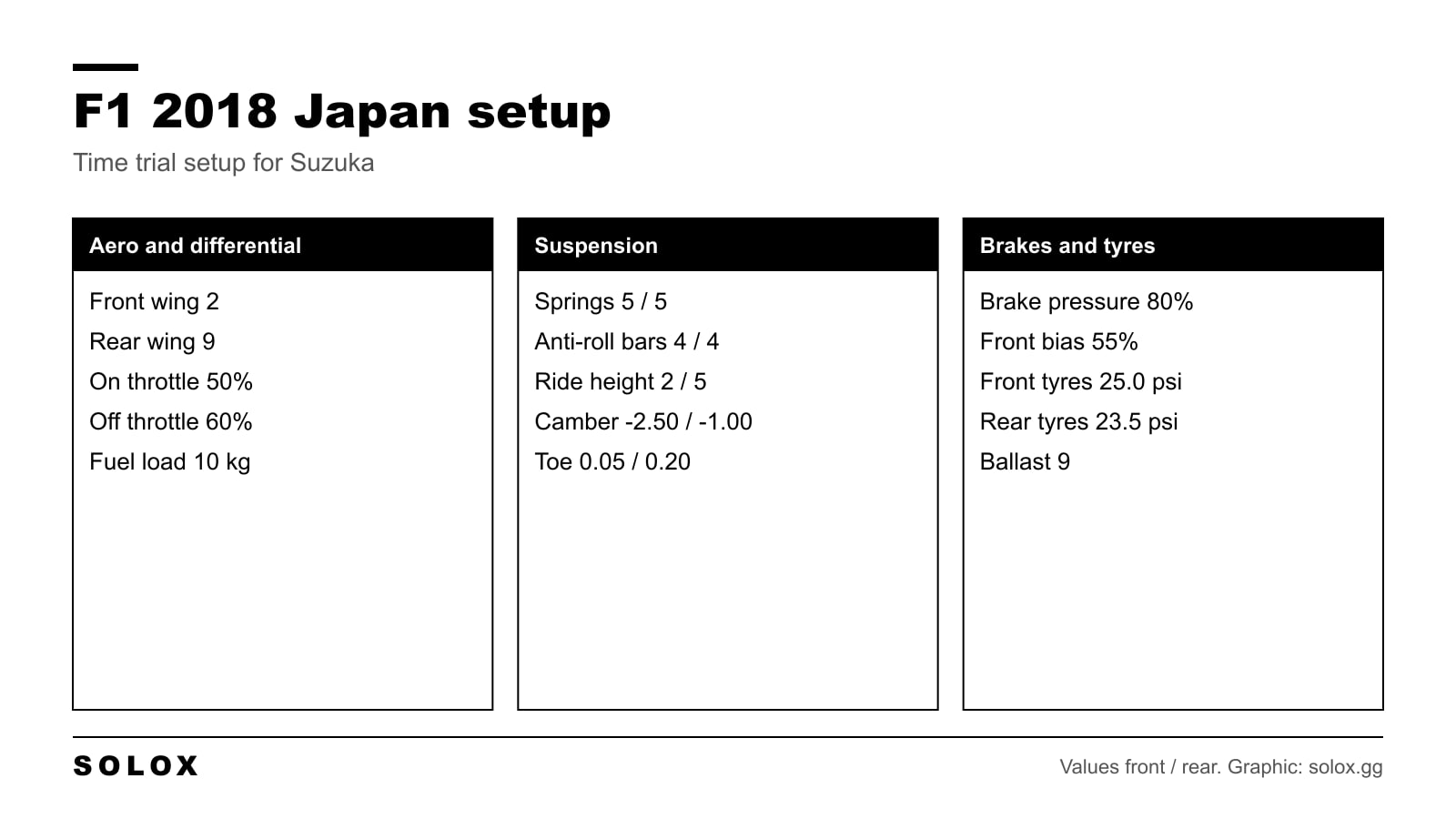
This F1 2018 Japan setup does it with a rear wing at 9, a front wing at 2 and a lot of rake. It is a time trial setup, saved with 10 kg of fuel.
F1 2018 Japan setup
| Setting | Front | Rear |
|---|---|---|
| Wing | 2 | 9 |
| Camber | -2.50 | -1.00 |
| Toe | 0.05 | 0.20 |
| Suspension | 5 | 5 |
| Anti-roll bar | 4 | 4 |
| Ride height | 2 | 5 |
| Tyre pressure | 25.0 psi | 23.5 psi |
| Setting | Value |
|---|---|
| Fuel load | 10 kg |
| Differential on throttle | 50% |
| Differential off throttle | 60% |
| Brake pressure | 80% |
| Front brake bias | 55% |
| Ballast | 9 |

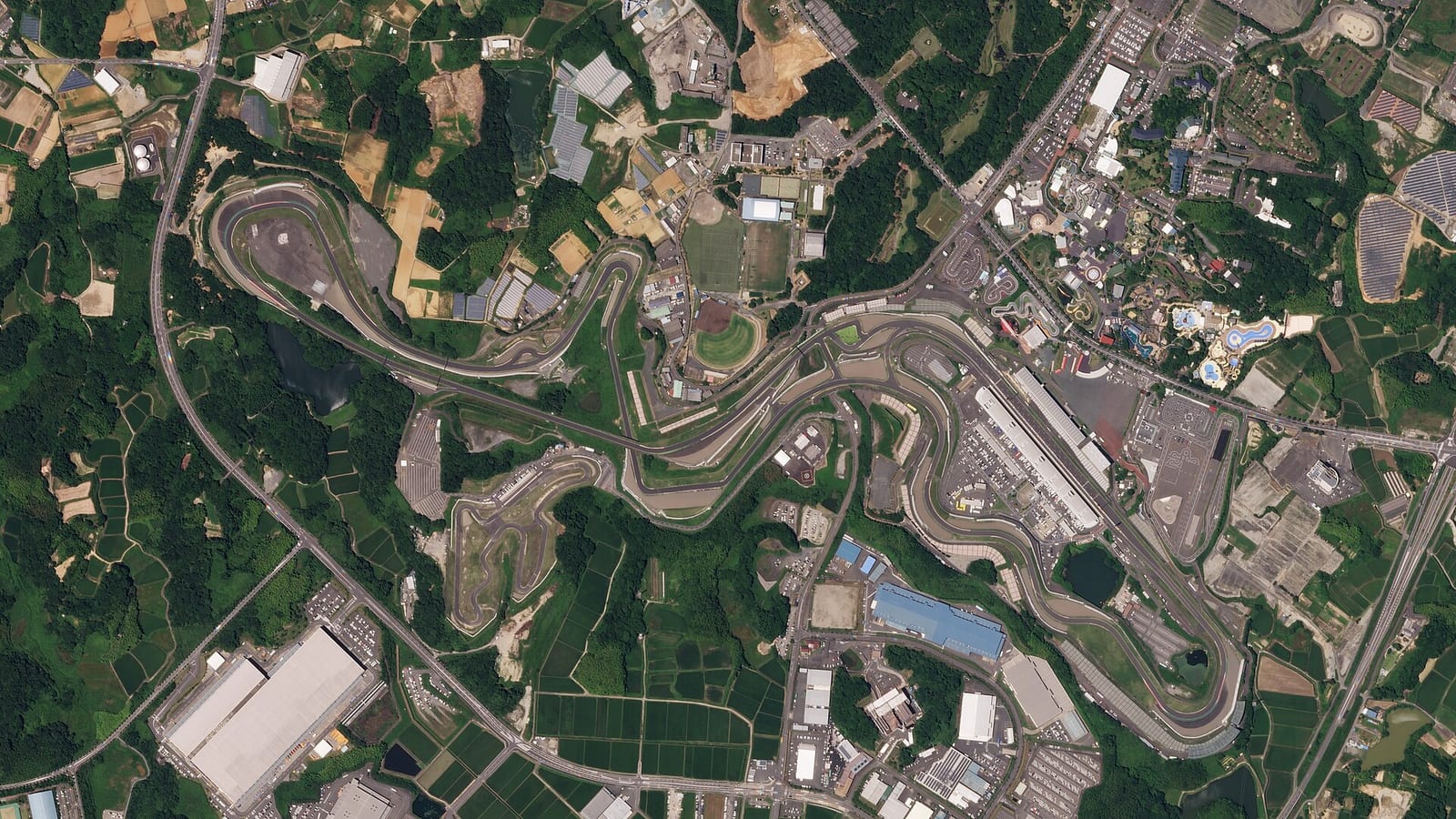
Here is the lap the setup comes from:
Why this setup works at Suzuka
The lap is 5.807 km with 18 corners, in a figure of eight: the back straight crosses over the first part of the lap on a bridge. There are two places where drag matters, the back straight and the pit straight. Everywhere else you are turning, mostly fast.
The wings. Front 2, rear 9. Seven clicks apart. The rear wing at 9 is what lets you commit in the Esses, through Dunlop and in 130R. A rear end that moves at those speeds costs you confidence first and lap time right after. The front at 2 keeps the drag down, and on its own it would leave the car with a lot of understeer.
The rake. That is where the ride height comes in: 2 at the front, 5 at the rear. A nose down car puts more load on the front axle, so you get turn in back without paying for it in drag the way a front wing does.
The differential. 50% on throttle, the minimum, and 60% off. Open at both ends. In the Esses you are never fully on or fully off the throttle, you are always somewhere in between, and an open differential lets the car turn in both phases. It also helps at the hairpin and out of the chicane.
The geometry. Camber -2.50 and -1.00, toe 0.05 and 0.20. The least angle the menu allows.
Middle springs, soft bars, hard tyres
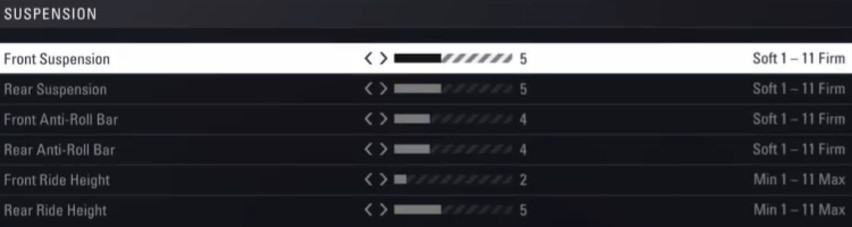
Springs are at 5 and 5. Anti-roll bars are at 4 and 4. Nothing extreme, and the same front and rear, so the mechanical balance is neutral and the wings and the rake decide how the car behaves.
The bars at 4 are on the soft side. That gives grip in the long corners, Dunlop and Spoon, where the car is loaded for a long time. A soft bar also makes the car slower to change direction, which is not what you want in the Esses.
The tyres fix that. The fronts are at 25.0 psi, the maximum, and the rears at 23.5. A hard tyre answers faster, so the car still flicks from left to right. It is a one lap choice. Over a stint, pressures this high cook the tyres.
Compare it with my F1 2018 Russia setup, which also runs the fronts at 25.0 psi but gets its response from a front bar at 11.
Brakes
Brake pressure is 80% with 55% at the front. 80% is low, and Suzuka is the reason.
There are few big stops in a straight line here. Into Turn 2, into Degner 2 and into Spoon you are braking with steering on, and that is when an unloaded inside front locks. Lower pressure gives you more of the pedal to work with.
The two straight line stops are the hairpin and the chicane. If you feel you are giving away metres there, try 85%.
What to change
One change at a time, three laps, then decide.
| Problem | Change | Why |
|---|---|---|
| The car pushes wide in the Esses | Front wing 2 to 4 | More front downforce in fast changes of direction |
| The rear moves in 130R or Dunlop | Rear ride height 5 to 4 | Less rake puts the balance back towards the rear |
| The car is slow to change direction | Front anti-roll bar 4 to 6 | A stiffer front bar makes the car answer faster |
| The rear steps out when you lift | Off throttle differential 60% to 70% | More locking keeps the rear in line off the power |
| Wheelspin out of the hairpin | Rear tyre pressure 23.5 to 22.3 psi | A softer rear tyre has more traction |
| The front bottoms out through the Esses | Front ride height 2 to 3 | More room under the nose over the kerbs |
| Too slow on the back straight | Rear wing 9 to 8 | Less drag, with a looser rear in the first sector |
For a race
With fuel, the first sector is hard on the front left tyre and the high pressures stop working after a few laps. Before a 25% or 50% race I would change this:
- Tyre pressures down. Fronts from 25.0 to 23.8 psi, rears from 23.5 to 22.3. This is the big one.
- Front wing 2 to 4. Less understeer means less sliding on the fronts in the Esses.
- Front ride height 2 to 3. The heavy car sits lower and touches the kerbs.
- Off throttle differential 60% to 70%. A calmer rear when the tyres are worn.
- Fuel. The 10 kg is a time trial number. In a race the game sets the load for the distance.
On a pad, I would run 70% off throttle and a rear ride height of 4. The car turns a bit less and forgives a lot more in the fast corners.
In F1 2018 you manage the ERS yourself. Use the battery out of Spoon and down the back straight to 130R, and again on the pit straight. Recover in the Esses, where more power does not help you.
Where the lap time is at Suzuka
- Turns 1 and 2. Turn 1 is fast, with a lift or a light brake. Turn 2 is tighter and you brake for it while still turning. Give up a little in Turn 1 so you are on the right line out of Turn 2. The whole first sector starts here.
- The Esses. Left, right, left, right, uphill. Do not attack the first one. Every apex should be a little late so the car is already pointing at the next corner. If you are correcting the steering, you went in too fast.
- Dunlop. The long uphill left. Be patient and keep a steady throttle. It opens at the end.
- Degner 1 and 2. The first is fast and narrow, and the kerb on the inside can throw the car. The second is slower and tighter than it looks. Brake in the short gap between the two.
- The hairpin. Brake in a straight line after the flat right kink, late apex, and let the open differential turn the car on the way out.
- Spoon. A double left. Carry speed into the first part, let the car drift to the middle of the road, then tighten for the second apex. The exit is the start of the back straight, so the second half matters more than the first.
- 130R. Flat with this setup and low fuel. Turn in once and keep your hands still.
- The chicane. The last big stop. Brake late in a straight line, right then left, and take some of the first kerb. Get on the throttle early for the last corner and the pit straight.
Suzuka in 2018
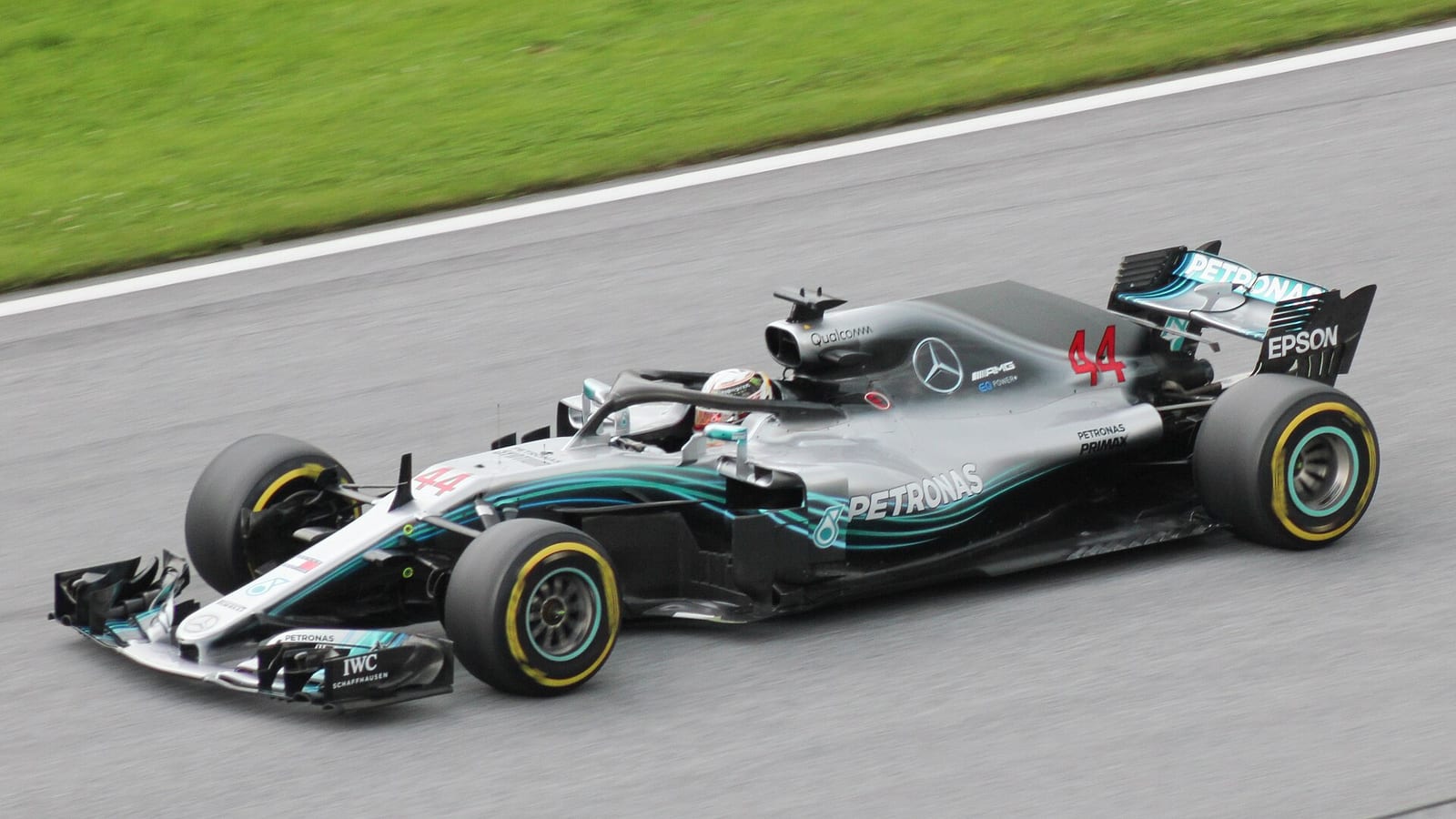
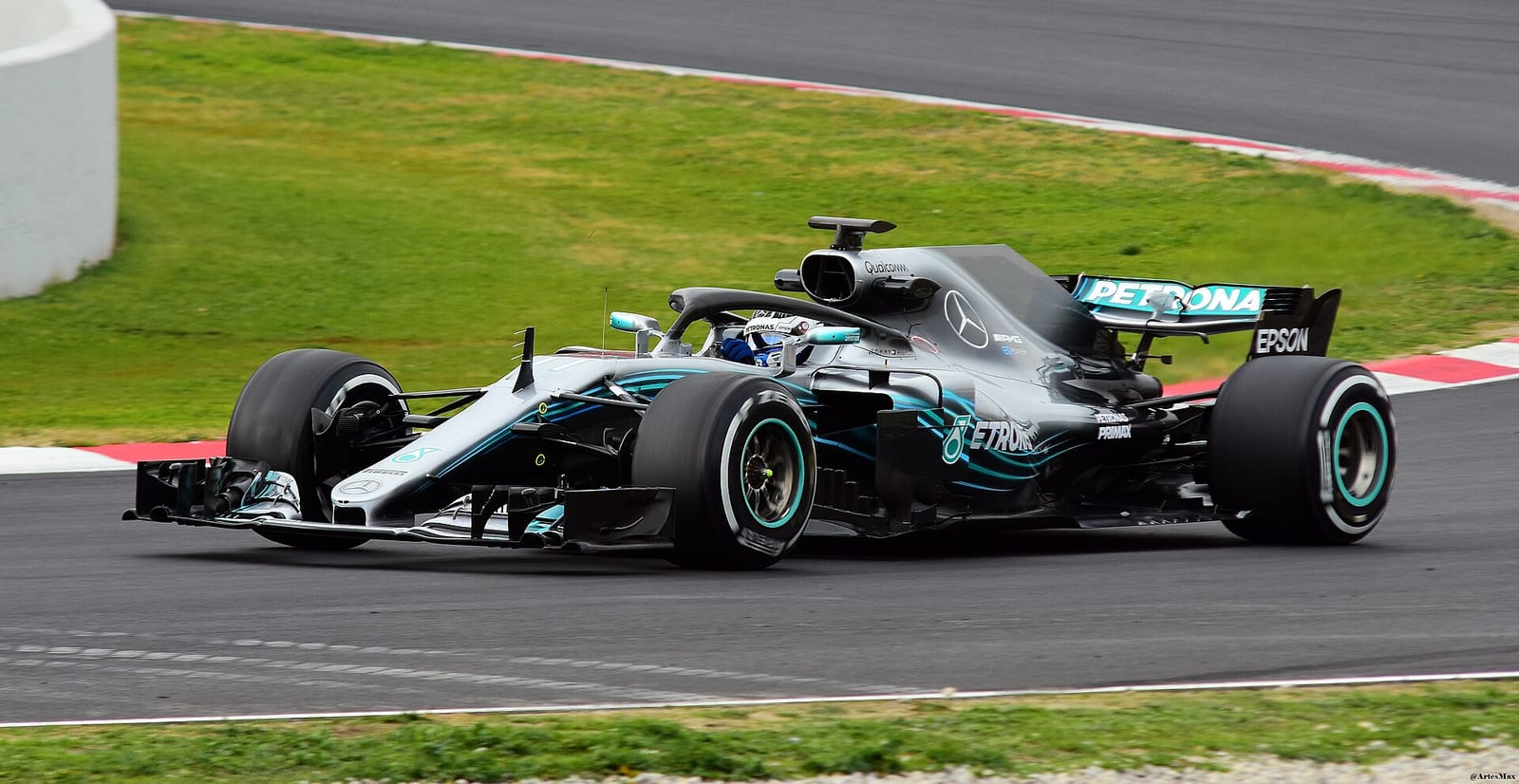
The 2018 Japanese Grand Prix was round 17 of 21, on 7 October, one week after Russia. Lewis Hamilton took pole position for Mercedes with a 1:27.760 and won the race over 53 laps. Valtteri Bottas was second and Max Verstappen third for Red Bull. Sebastian Vettel set the fastest lap for Ferrari, a 1:32.318 on the last lap.
Suzuka opened in 1962 as a Honda test track and held its first F1 Grand Prix in 1987.
More F1 2018 setups
All the tracks are on the F1 2018 setups page. The round before Japan is the F1 2018 Russia setup and the round after it is the F1 2018 USA setup.
For the same track in other games, here are my F1 2017 Suzuka setup, my F1 2019 Suzuka setup and my F1 25 Japan setup. The values do not carry over from one game to the next.
FAQ
What is the best F1 2018 setup for Japan?
For time trial: front wing 2, rear wing 9, differential 50% on throttle and 60% off, suspension 5 and 5, anti-roll bars 4 and 4, ride height 2 and 5, brake pressure 80% with 55% front bias, tyres at 25.0 and 23.5 psi, ballast 9.
What wing levels should I run at Suzuka in F1 2018?
2 at the front and 9 at the rear for one lap. For a race, 4 and 9 take away understeer in the Esses and save the front tyres.
Can I use this Suzuka setup in a race?
Yes, with changes. Tyre pressures down to 23.8 and 22.3 psi, front wing to 4, front ride height to 3 and off throttle differential to 70%.
Does this setup work with a controller?
It does. Raise the off throttle differential to 70% and lower the rear ride height to 4 so the rear is calmer in the fast corners.
Is 130R flat in F1 2018?
With this setup and low fuel, yes. On race fuel and worn tyres you may need a small lift on the way in.
How long is Suzuka in F1 2018?
5.807 km with 18 corners, in a figure of eight layout. The real 2018 race was 53 laps, and the pole lap was a 1:27.760.