
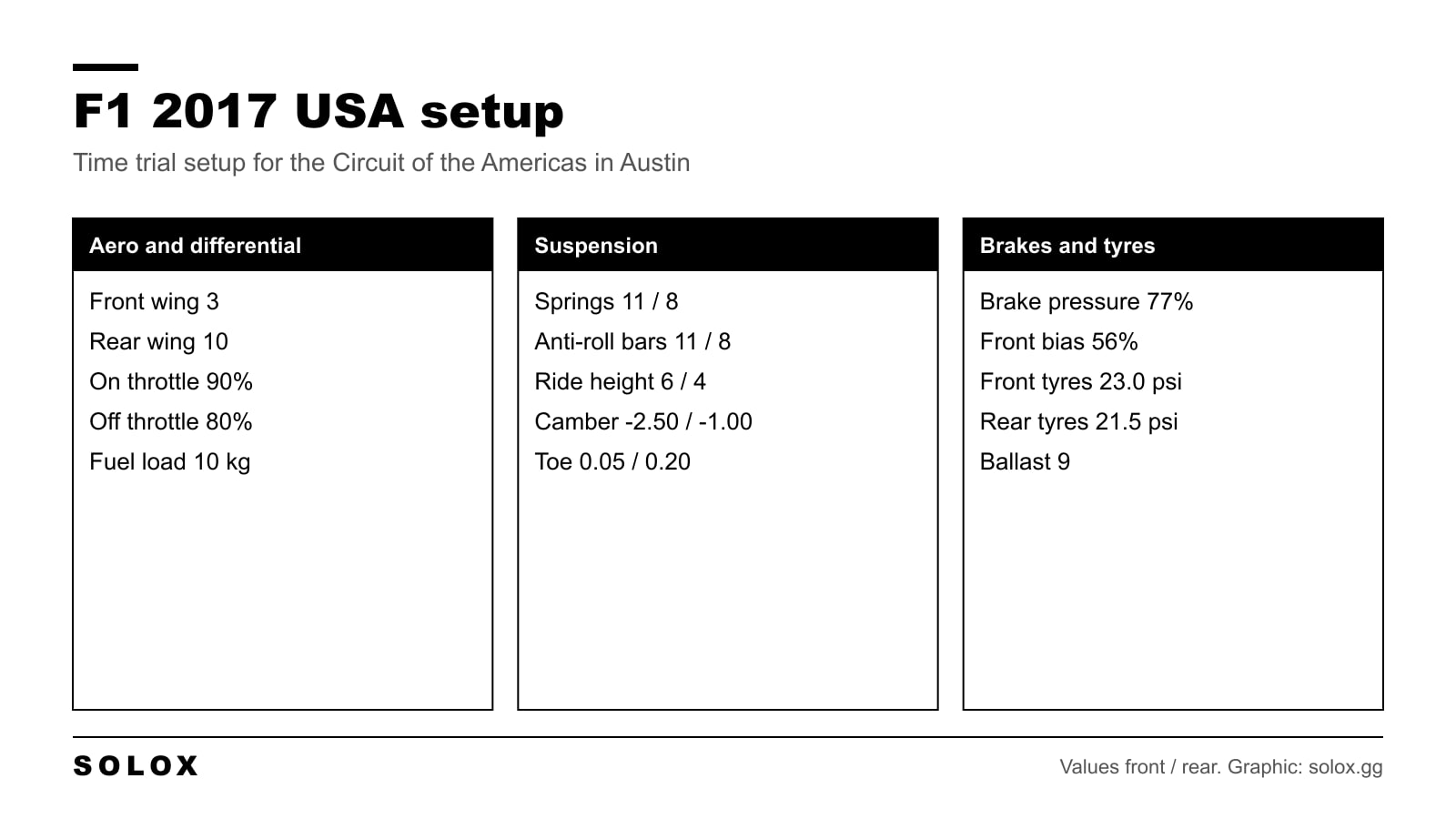
This is the F1 2017 setup for the USA on this site: front wing 3, rear wing 10, a stiff front end at 11 and 11, and a softer rear at 8 and 8. It is a time trial setup, saved with 10 kg of fuel. The full menu is in the table below, then I explain why it works in Austin and what I would change for a race or for a pad.
It was collected in 2022 from a fast time trial lap, like the rest of my F1 2017 setups. Use it as a starting point.
F1 2017 USA setup
| Setting | Value |
|---|---|
| Fuel load | 10 kg |
| Front wing | 3 |
| Rear wing | 10 |
| Differential on throttle | 90% |
| Differential off throttle | 80% |
| Front camber | -2.50 |
| Rear camber | -1.00 |
| Front toe | 0.05 |
| Rear toe | 0.20 |
| Front suspension | 11 |
| Rear suspension | 8 |
| Front anti-roll bar | 11 |
| Rear anti-roll bar | 8 |
| Front ride height | 6 |
| Rear ride height | 4 |
| Brake pressure | 77% |
| Front brake bias | 56% |
| Front tyre pressure | 23.0 psi |
| Rear tyre pressure | 21.5 psi |
| Ballast | 9 |

Why this setup works at COTA
The Circuit of the Americas is 5.513 km long with 20 corners. It is three tracks in one lap. Sector 1 is a steep climb to a blind hairpin and then a run of fast esses. Sector 2 is a hairpin and a back straight of more than a kilometre. Sector 3 is slow and technical, with a long multi apex right hander near the end.
You cannot set the car up for all three. This setup picks the esses.
Rear wing 10 out of 11 is a lot. It keeps the rear planted from turn 3 to turn 9, where you change direction six times at high speed and any slide costs you the next three corners. It also helps in the long right at turns 16 to 18. You pay for it on the back straight, and in time trial that is a trade worth making. The front wing stays at 3, so the balance is on the safe side: a touch of understeer in fast corners, and a rear you can trust.
The differential follows the same logic. At 90% on throttle the rear axle is nearly locked, which gives good drive out of the slow corners if you are clean with your right foot. At 80% off throttle the car stays stable when you lift in the esses.
Stiff front, softer rear
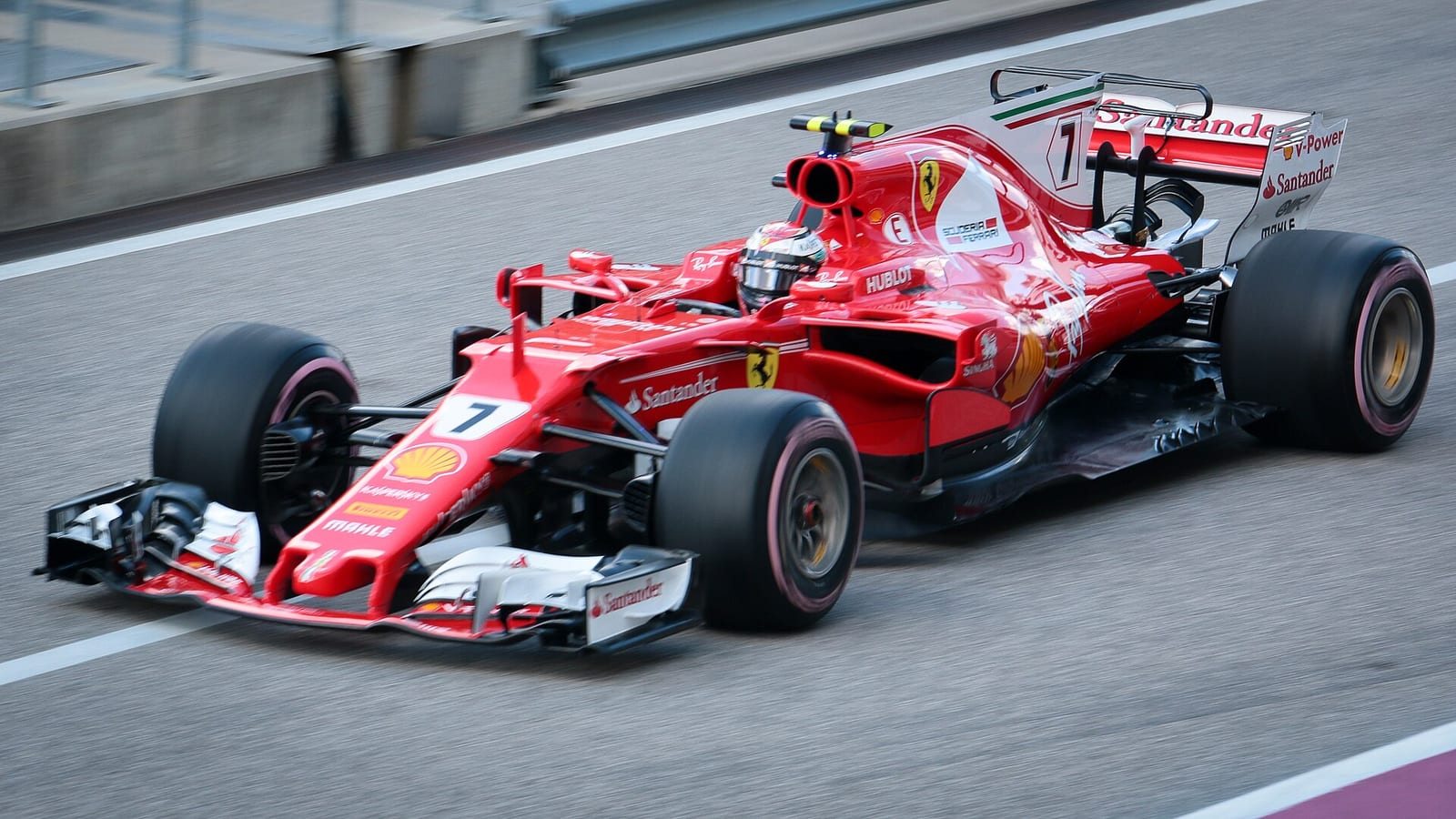
The front suspension and the front anti-roll bar are both at 11, the firmest setting in the game. The rear is at 8 and 8.
A stiff front makes the car answer at once when you turn the wheel, and in the esses that is what you want. Left, right, left, with no delay between your hands and the nose. The softer rear lets the rear tyres bite on the way out of turn 1, turn 11 and turn 12, where you are on the throttle from very low speed.
The ride height is the odd part: 6 at the front and 4 at the rear. Most setups in this game run the rear higher than the front. Here it is the other way round, and it works with the stiff front. The nose has room to move over the kerbs in the esses and does not hit the ground under braking for turn 12. I would not copy this to other tracks without testing it.
What to change
One change at a time, three laps, then decide.
| Problem | Change |
|---|---|
| The car pushes wide in the esses | Front wing from 3 to 4 or 5 |
| Still understeer in the slow corners | Front anti-roll bar from 11 to 9 |
| Too slow on the back straight | Rear wing from 10 to 8, and front wing down one click with it |
| Wheelspin out of turn 1, turn 11 or turn 12 | On throttle differential from 90% to 80% |
| The rear moves under braking for turn 12 | Front brake bias from 56% to 58% |
| Front tyres lock into turn 1 or turn 11 | Brake pressure from 77% to 74% |
| The car jumps on the kerbs | Front suspension from 11 to 9 |
For a race. With race fuel the car is heavier and it sits lower, so the stiff front becomes hard work over a full stint. Soften the front suspension to 9 and lower the on throttle differential to 80% to save the rear tyres. If you are racing the AI or other players, take rear wing down to 8 as well. With 10 you will be passed on the back straight, even with DRS.
On a pad. Start with the differential at 80% and the front anti-roll bar at 9. The esses need small, smooth steering inputs, and a very stiff front is nervous on a stick.
Where the lap time is at COTA
Turn 1. A steep climb to a blind left hairpin. The hill slows the car for you, so you can brake later than it looks. The track is very wide on entry. Use that width, take a late apex, and get the car straight for the run down the hill.
Turn 3 to turn 6. The esses. The first one sets up all the others. Lift a little for turn 3, be precise, and then it flows. If you go in too fast, you miss every apex after it and you lose more each time.
Turn 7 to turn 9. The esses get slower and tighter here. Brake a touch for turn 7 and be patient to turn 9, because its exit leads onto a short straight.
Turn 11. The hairpin before the back straight. This is the most important exit of the lap. Brake early, turn late, and be on the throttle with the car straight. One km/h more here is worth it all the way to turn 12.
Turn 12. The big braking zone at the end of the back straight, and the best place to overtake. The car is light at the rear at that speed, so brake in a straight line.
Turn 16 to turn 18. One long right hander with three apexes. Keep a steady throttle and a steady steering angle. With the rear wing at 10 the car is very stable here, and you can carry more speed than you think.
Austin in 2017
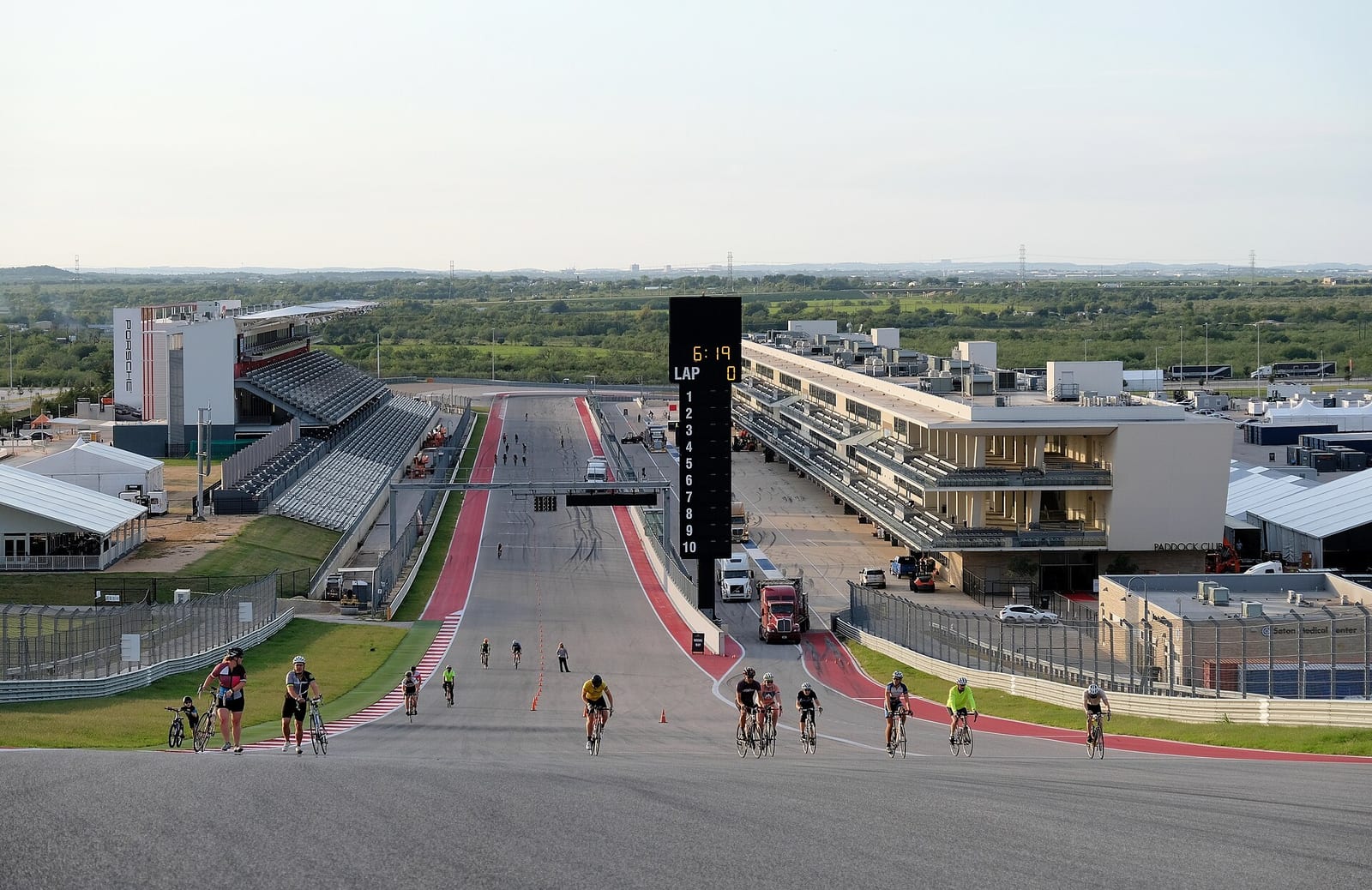
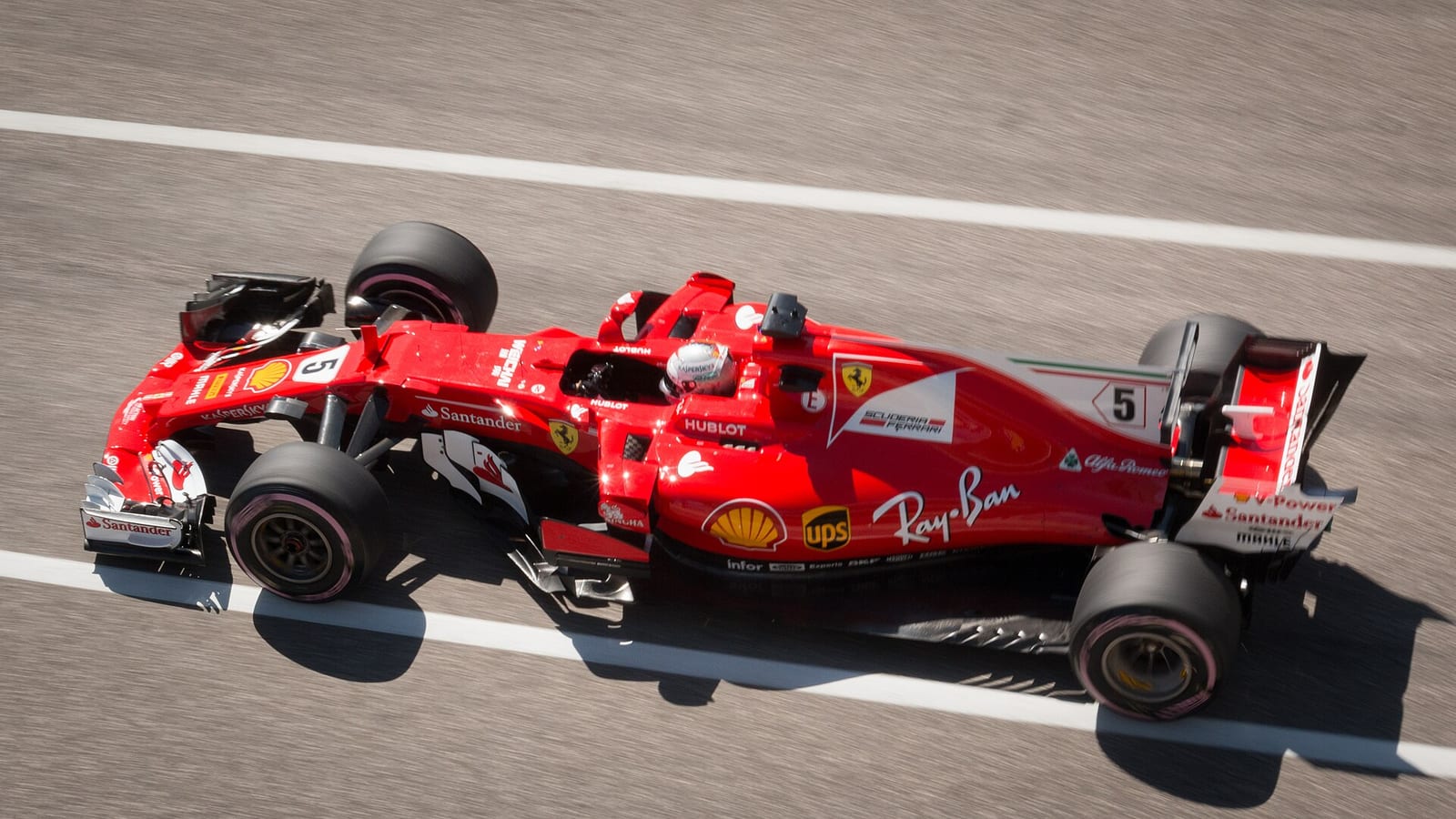
Lewis Hamilton took pole position for the 2017 United States Grand Prix with a 1:33.108 and won the race, over 56 laps. Sebastian Vettel finished second for Ferrari.
More F1 2017 setups
Austin comes between two very different tracks on the 2017 calendar. The Suzuka setup runs less wing at 2 and 8 with an even car at 6 and 6, and the Mexico setup drops the wings to 2 and 7 for the long straight. All 20 tracks are in one table on the F1 2017 setups page.
If you play the current game, the track is the same and the car is not: see my F1 25 USA setup.
FAQ
What is the best F1 2017 setup for the USA?
Front wing 3, rear wing 10, differential 90% on throttle and 80% off, suspension 11 and 8, anti-roll bars 11 and 8, ride height 6 and 4, brake pressure 77% with 56% front bias, and tyres at 23.0 and 21.5 psi.
What wing levels should I run at COTA in F1 2017?
3 at the front and 10 at the rear for time trial. For a race I would go down to 8 at the rear, so you can defend and attack on the back straight.
Can I use this USA setup in a race?
Yes, with a few changes. It is saved with 10 kg of fuel. Soften the front suspension to 9, lower the on throttle differential to 80% and take two clicks of rear wing off.
Does this setup work with a controller?
It does. Lower the on throttle differential to 80% and the front anti-roll bar to 9, so the car is calmer in the esses and easier on the throttle.
Why is the front ride height higher than the rear?
It gives the stiff front end room over the kerbs in the esses and under heavy braking. It is unusual, so test it before you copy it to another track.
Where do I lose the most time at COTA?
Usually in the esses from turn 3 to turn 9, by going into the first one too fast, and on the exit of turn 11 before the back straight.