
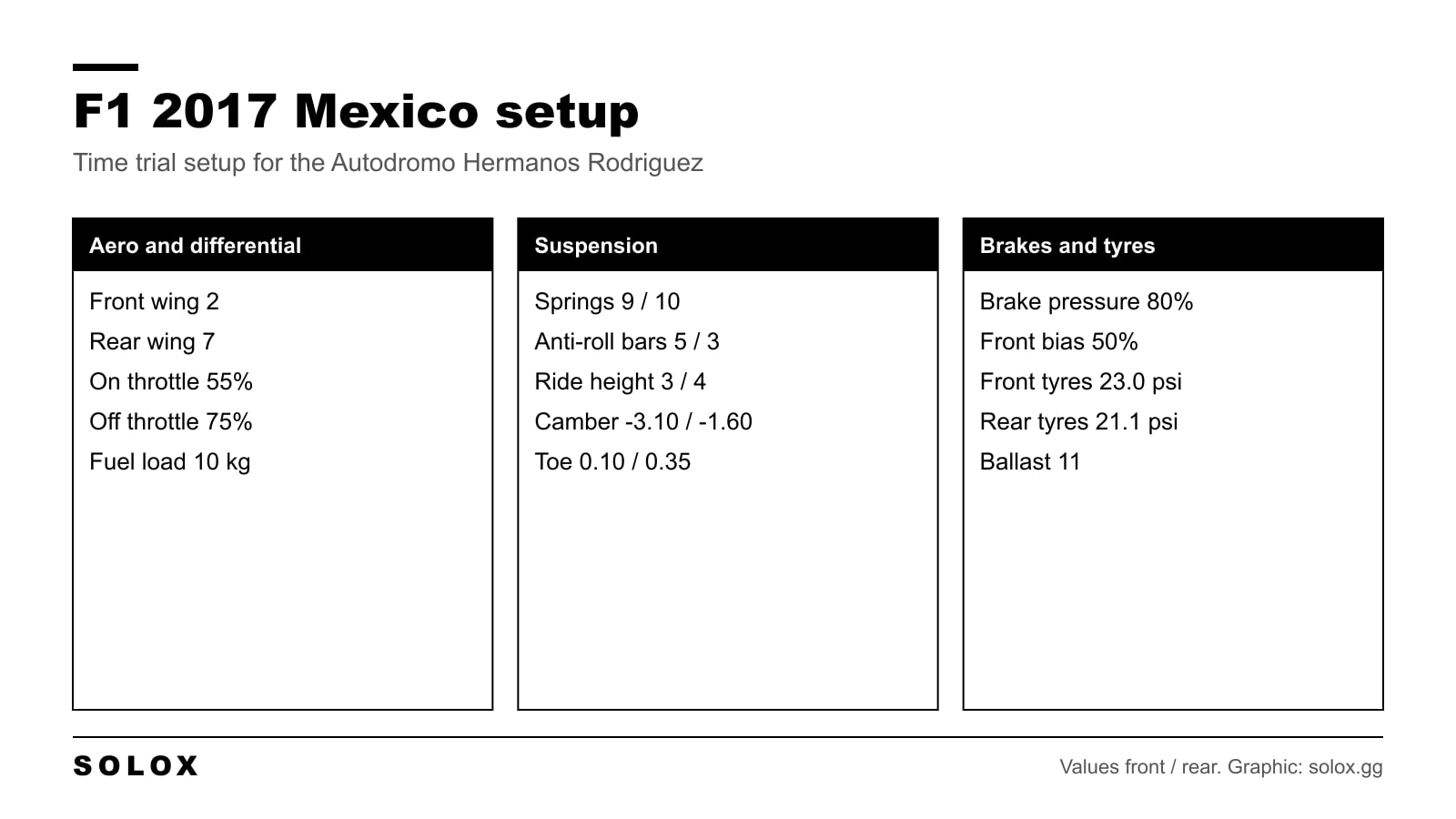
This is the F1 2017 setup for Mexico on this site: front wing 2, rear wing 7, the differential open at 55% on throttle, and the brake bias far back at 50%. It is a time trial setup, saved with 10 kg of fuel. The full menu is in the table below, then I explain why it works in Mexico City and what I would change for a race or for a pad.
It was collected in 2022 from a fast time trial lap, like the rest of my F1 2017 setups. Use it as a starting point.
F1 2017 Mexico setup
| Setting | Value |
|---|---|
| Fuel load | 10 kg |
| Front wing | 2 |
| Rear wing | 7 |
| Differential on throttle | 55% |
| Differential off throttle | 75% |
| Front camber | -3.10 |
| Rear camber | -1.60 |
| Front toe | 0.10 |
| Rear toe | 0.35 |
| Front suspension | 9 |
| Rear suspension | 10 |
| Front anti-roll bar | 5 |
| Rear anti-roll bar | 3 |
| Front ride height | 3 |
| Rear ride height | 4 |
| Brake pressure | 80% |
| Front brake bias | 50% |
| Front tyre pressure | 23.0 psi |
| Rear tyre pressure | 21.1 psi |
| Ballast | 11 |

Why this setup works in Mexico City
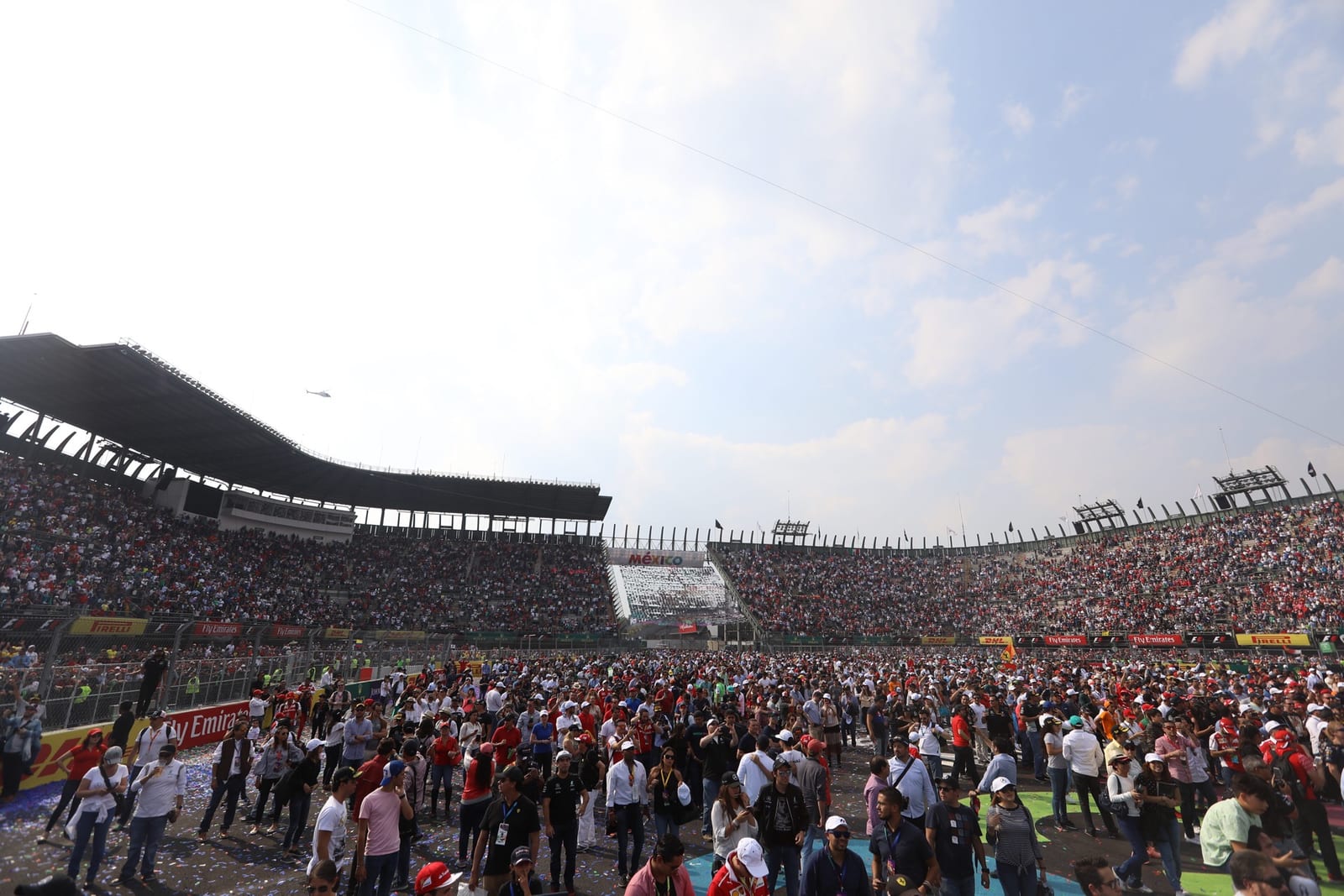
The Autodromo Hermanos Rodriguez is 4.304 km long with 17 corners. The lap has three parts. First a very long main straight into a slow right, left, right. Then a middle sector of medium speed esses. Then the stadium, which is slow and tight, and the banked last corner that brings you back onto the straight.
This setup is different from most of my other F1 2017 setups. Many of them share the same base. This one changes almost every line of the menu.
The wings are 2 and 7. The low front wing is for the main straight. The rear stays at 7 because you need the back of the car to hold in the esses from turn 7 to turn 11, where you change direction at speed and a slide costs you three corners.
The differential is 55% on throttle. The lowest the game allows is 50%, so this is nearly fully open. An open differential lets the inside rear wheel turn at its own speed, which makes the car rotate on the throttle and cuts wheelspin out of slow corners. Mexico has a lot of those: turn 1 to turn 3, turn 4 and turn 5, and the whole stadium. At 75% off throttle the car also turns in more freely when you lift.
The geometry is more aggressive too. Camber is -3.10 and -1.60, and toe is 0.10 and 0.35. More camber gives the outside tyres more grip in the long esses. More rear toe keeps the rear straight under power. You pay for both with tyre wear, which does not matter in time trial.
Stiff springs, soft bars and a rear brake bias
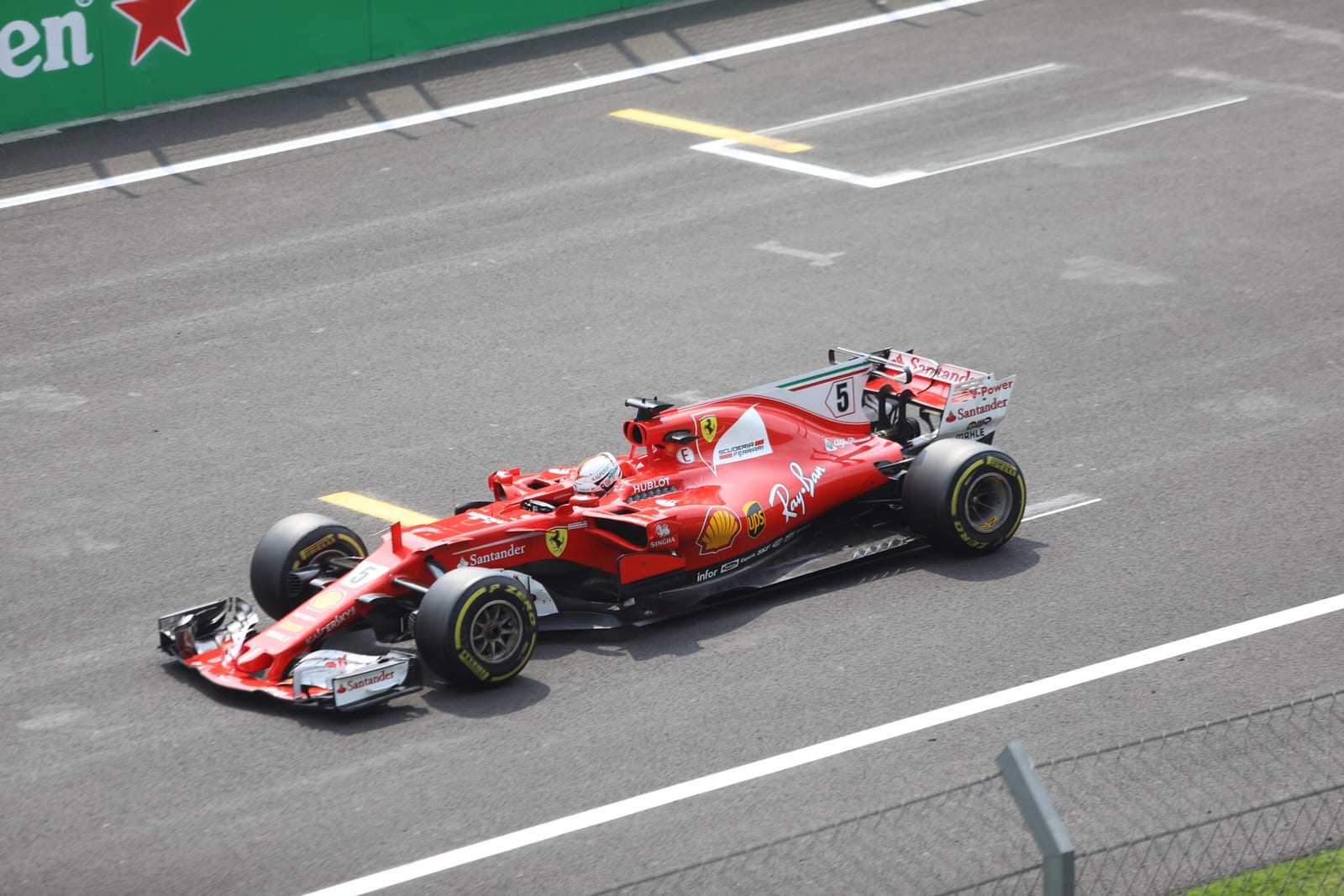
The suspension is 9 at the front and 10 at the rear. Both anti-roll bars are soft, at 5 and 3. That is the opposite of setups like Canada and Silverstone, where the front bar is at 10.
Stiff springs hold the car steady when it pitches under braking and acceleration, and they let you run it low. Ride height is 3 at the front and 4 at the rear, the lowest front ride height of my 20 setups for this game. Soft bars let the car roll in the corners, so each tyre keeps its grip in the slow stuff and over the kerbs in the esses. A rear spring that is stiffer than the front also helps the car rotate.
Then the brakes. Front bias is 50%. Most of my setups for this game run 54%, and only Malaysia is as far back as this. With more braking at the rear, the car turns into slow corners more easily and the front tyres lock less at the end of the main straight. The risk is clear: brake while you are turning and the rear will come round. Brake in a straight line and release the pedal before you ask for a lot of steering.
Put together, this is a car that rotates. Open differential, rear brake bias, stiff rear springs. It is fast if you are tidy and a handful if you are not.
What to change
One change at a time, three laps, then decide.
| Problem | Change |
|---|---|
| The rear steps out under braking for turn 1 or turn 4 | Front brake bias from 50% to 54% |
| The rear is loose in the esses | Rear suspension from 10 to 8 |
| The car spins on the way out of the stadium | Rear wing from 7 to 8 |
| The car pushes wide in turn 1 to turn 3 | Front wing from 2 to 3 |
| Front tyres lock at the end of the main straight | Brake pressure from 80% to 76% |
| The floor hits the ground on the straight or the kerbs | Ride height from 3 and 4 to 4 and 5 |
| The car feels lazy on the throttle out of slow corners | On throttle differential from 55% to 65% |
For a race. This much camber and toe will overheat the tyres over a stint. Go back toward -2.80 and -1.30 on camber and 0.30 on rear toe. Move the brake bias forward to 53% or 54%, because a rear lock up with a heavy car is hard to catch. Keep the wings. The main straight is where every overtake happens.
On a pad. Start with the brake bias at 54% and the rear suspension at 8. The open differential is already kind to a trigger, so leave it where it is.
Where the lap time is in Mexico City
Turn 1 to turn 3. The biggest stop of the lap, after the main straight. Brake in a straight line, with the bias this far back you have no other choice. Turn 1 is a right, turn 2 a left, turn 3 a right that opens onto a straight. Give up turn 1 and turn 2 to get a clean exit from turn 3.
Turn 4 and turn 5. A slow left and right. Use the kerb on the inside of turn 4, then be patient in turn 5. It is easy to go to the throttle early here and run wide.
Turn 6. A tight right hairpin. Late apex, and keep the car to the right on the exit to line up the esses.
Turn 7 to turn 11. The esses. This is where the setup earns its place. The rhythm is everything: a small lift for the first one, then keep the throttle steady and let the car flow from kerb to kerb. If you miss the first apex, you miss them all.
Turn 12. The entry to the stadium, a medium speed right after a short straight. Brake a touch early. A good line in turn 12 sets up the whole stadium section.
Turn 13 to turn 16. The stadium. Slow, tight and narrow. The open differential helps you get the power down from one corner to the next. Do not attack the kerbs. A tidy line is faster than a brave one here.
Turn 17. The last corner, part of the old Peraltada. It is banked and it opens onto the main straight. Be on full throttle as early as you can, because that speed stays with you for the longest straight of the lap.
Mexico City in 2017
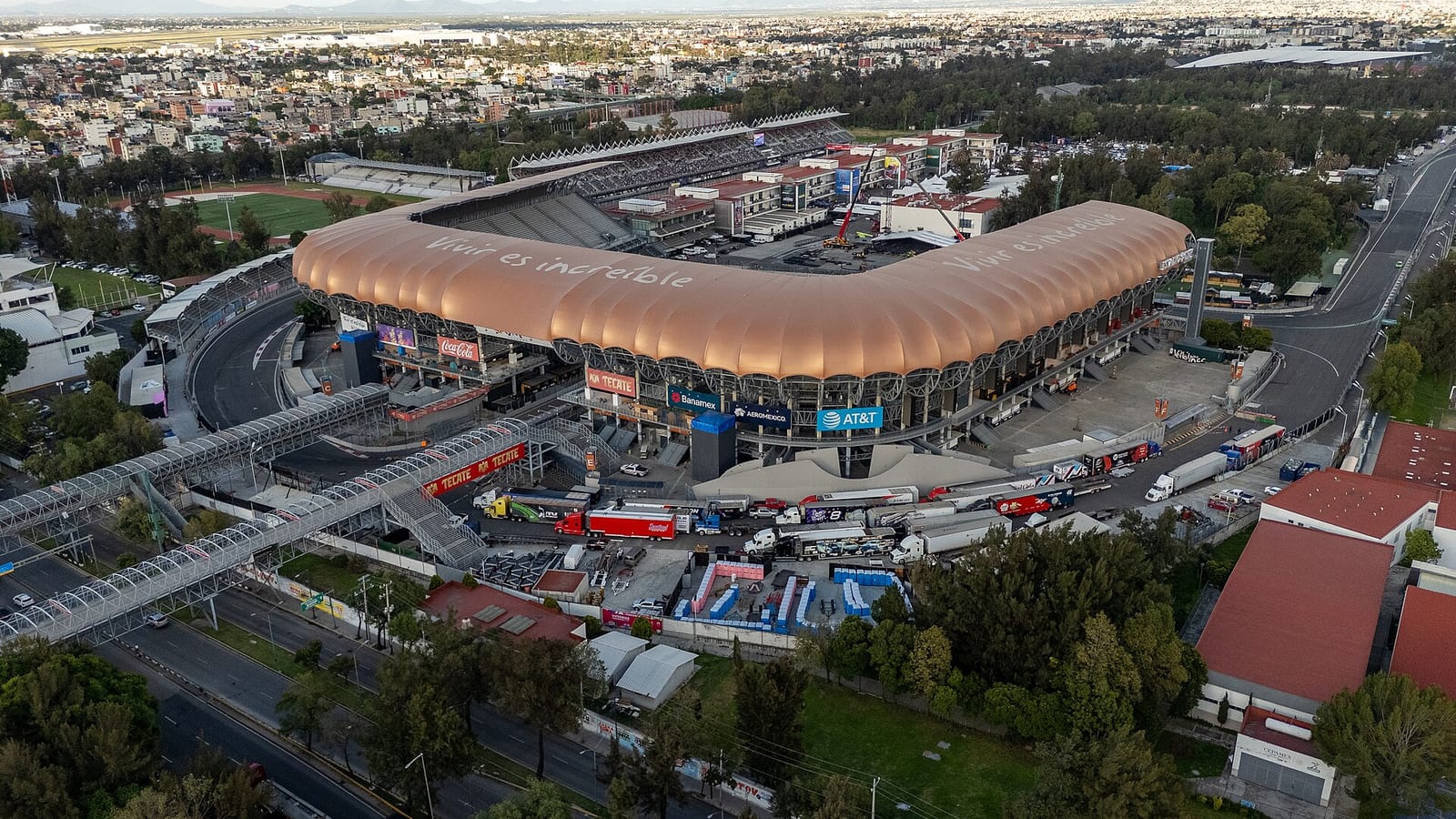
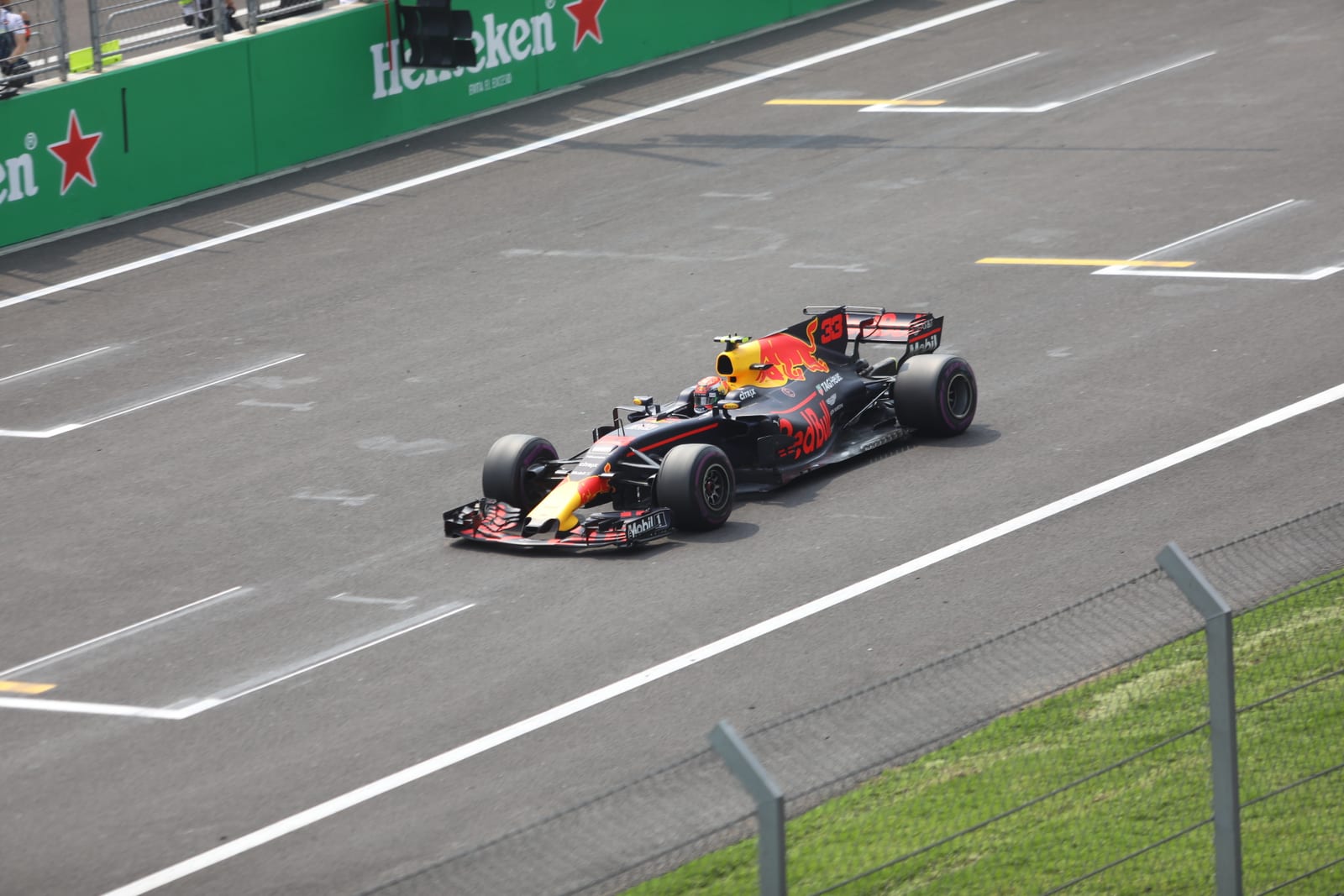
Sebastian Vettel took pole position for the 2017 Mexican Grand Prix with a 1:16.488. Max Verstappen won the race for Red Bull, over 71 laps. Valtteri Bottas finished second for Mercedes and Kimi Raikkonen was third for Ferrari. Vettel set the fastest lap, a 1:18.785. Lewis Hamilton finished ninth, and that was enough to make him world champion for the fourth time.
More F1 2017 setups
Mexico comes late in the 2017 calendar. The USA setup before it runs 3 and 10 with a very stiff front, and the Brazil setup after it goes up to 7 and 11 on the wings. All 20 tracks are in one table on the F1 2017 setups page.
If you play the current game, the track is the same and the car is not: see my F1 25 Mexico setup.
FAQ
What is the best F1 2017 setup for Mexico?
Front wing 2, rear wing 7, differential 55% on throttle and 75% off, suspension 9 and 10, anti-roll bars 5 and 3, ride height 3 and 4, brake pressure 80% with 50% front bias, and tyres at 23.0 and 21.1 psi.
What wing levels should I run in Mexico in F1 2017?
2 at the front and 7 at the rear. If the rear is loose in the esses or out of the stadium, go to 8 at the rear before you change anything else.
Can I use this Mexico setup in a race?
Yes, with a few changes. It is saved with 10 kg of fuel. Move the front brake bias to 53% or 54% and take some camber and rear toe off to keep the tyres alive.
Does this setup work with a controller?
It does. Raise the front brake bias to 54% and soften the rear suspension to 8, so the rear is calmer under braking and in the esses.
Why is the brake bias at 50%?
With more braking at the rear the car turns into slow corners more easily and the fronts lock less. It only works if you brake in a straight line. Raise it if the rear steps out.
Where do I lose the most time in Mexico?
Usually in the esses from turn 7 to turn 11, by going into the first one too fast, and on the exit of turn 3 and of the last corner, which both lead onto straights.