
Mexico City has one of the longest straights of the year and one of the slowest sections, and they are a few corners apart. You brake from top speed into Turn 1, you thread the esses in the middle of the lap, and you crawl through the stadium before the last corner.
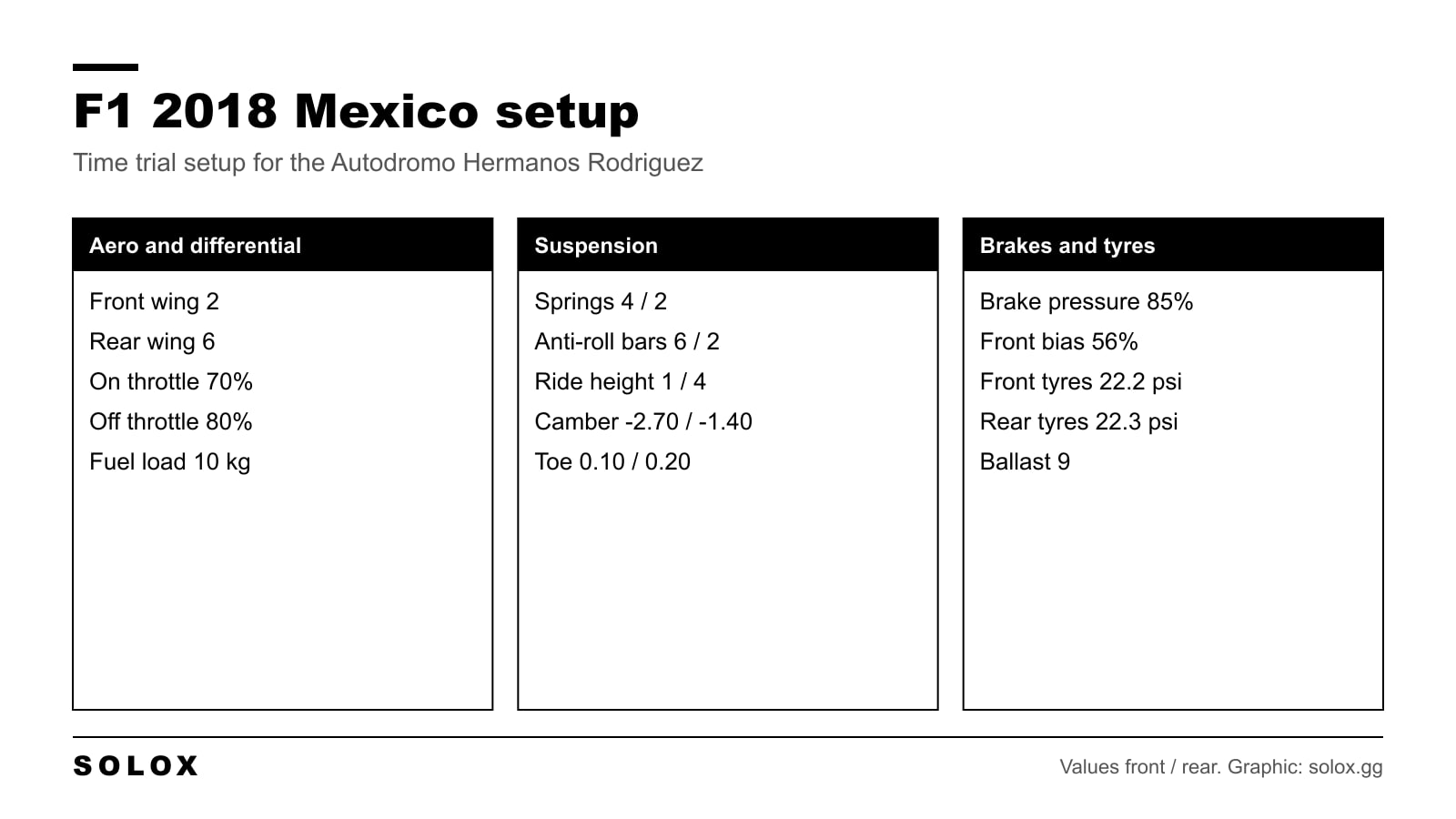
This F1 2018 Mexico setup runs wings at 2 and 6, a very low front, a soft rear and a little more camber than usual. It is a time trial setup, saved with 10 kg of fuel.
F1 2018 Mexico setup
| Setting | Front | Rear |
|---|---|---|
| Wing | 2 | 6 |
| Camber | -2.70 | -1.40 |
| Toe | 0.10 | 0.20 |
| Suspension | 4 | 2 |
| Anti-roll bar | 6 | 2 |
| Ride height | 1 | 4 |
| Tyre pressure | 22.2 psi | 22.3 psi |
| Setting | Value |
|---|---|
| Fuel load | 10 kg |
| Differential on throttle | 70% |
| Differential off throttle | 80% |
| Brake pressure | 85% |
| Front brake bias | 56% |
| Ballast | 9 |

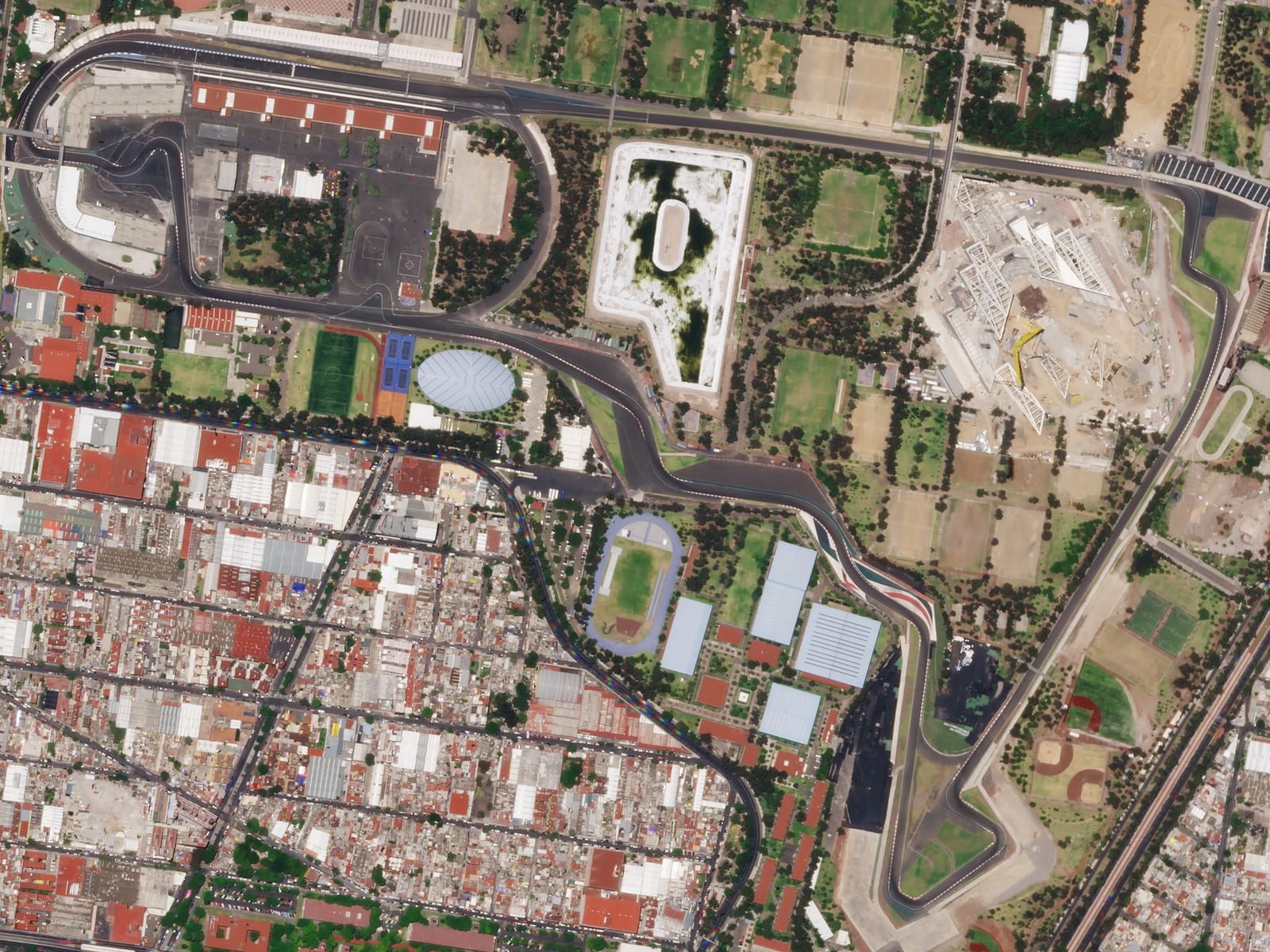
Here is the lap the setup comes from:
Why this setup works in Mexico
The lap is 4.304 km with 17 corners. The front straight is about 1.2 km long. After it you have the Turn 1 to 3 chicane, a second straight, two slow corners and a hairpin, the esses, and then the stadium section that leads onto the second half of the Peraltada.
The wings. Front 2, rear 6. A middle choice. With less rear wing the car is quicker on the two straights and you lose the rear in the esses and on every exit in the stadium. With more, you are a sitting target on the main straight.
The rake. Ride height is 1 at the front, the minimum, and 4 at the rear. This is where the front end comes from. A nose down car loads the front axle without the drag of a bigger front wing.
The differential. 70% on throttle, 80% off. A middle setting on the power: enough locking for drive out of Turn 3 and the hairpin, open enough that the car does not snap in the stadium. The 80% off throttle keeps the rear steady in the big stops into Turn 1 and Turn 4.
The geometry. Camber -2.70 and -1.40, front toe 0.10. Most of my F1 2018 setups run the least angle the menu allows. This one runs a little more. More negative camber gives the outside tyre more grip when the car is leaned on it for a long time, and the esses are exactly that. The extra front toe helps the car turn in. The cost is a bit of braking grip and a bit of tyre life.
A firm front and a soft rear
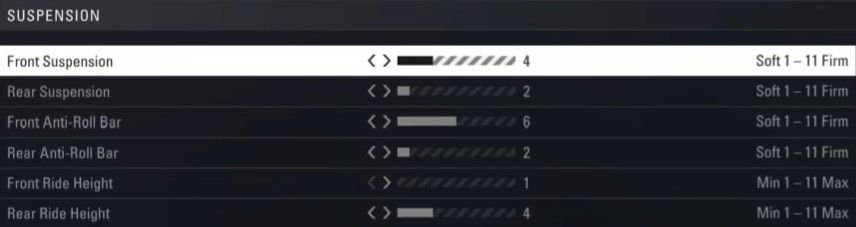
Springs are at 4 front and 2 rear. Anti-roll bars are at 6 front and 2 rear.
The idea is simple. The front is firmer, so it answers the steering in the esses and holds the nose up with a ride height of 1. The rear is soft on both the spring and the bar, so the rear tyres stay on the ground and grip when you go to the throttle. In Mexico you leave a slow corner seven or eight times a lap, and a soft rear pays every time.
A soft rear also means the car leans on the rear in fast changes of direction. If it feels lazy in the esses, the rear bar is the one to raise.
Tyres are at 22.2 psi front and 22.3 rear. The fronts are low for grip under braking and on turn in. The rears are in the middle of the range.
For the opposite approach, look at my F1 2018 USA setup: soft springs at both ends, stiff bars and a locked differential.
Brakes
Brake pressure is 85% with 56% at the front. Turn 1 is one of the biggest stops of the season, and you would expect more pressure for it.
The reason for 85% is the rest of the lap. With a front wing at 2 and extra front camber, the front tyres lock easily in the slower stops: Turn 4, the hairpin and the entry to the stadium. A bit less pressure makes those easier to judge, and you give away very little into Turn 1.
What to change
One change at a time, three laps, then decide.
| Problem | Change | Why |
|---|---|---|
| The front hits the kerbs or bottoms out | Front ride height 1 to 2 | More room under the nose |
| The car pushes wide in the esses | Front wing 2 to 4 | More front downforce in the medium speed corners |
| The car is lazy in changes of direction | Rear anti-roll bar 2 to 4 | A stiffer rear bar helps the car rotate |
| The rear steps out on exit in the stadium | On throttle differential 70% to 60% | A more open differential forgives early throttle |
| Front tyres lock into Turn 1 | Front brake bias 56% to 54% | Moves braking work to the rear |
| The front tyres wear on the inside edge | Front camber -2.70 to -2.50 | Less angle, flatter tyre |
| Too slow on the main straight | Rear wing 6 to 5 | Less drag, with a looser rear in the esses |
For a race
With fuel the car sits lower and the tyres have to last. Before a 25% or 50% race I would change this:
- Front ride height 1 to 2. With a full tank the minimum is too low over the kerbs.
- Camber to -2.50 and -1.00. Less angle is kinder to the tyres over a stint.
- Front wing 2 to 3. Less sliding on the fronts in the esses.
- On throttle differential 70% to 60%. Easier on the rear tyres out of the slow corners.
- Fuel. The 10 kg is a time trial number. In a race the game sets the load for the distance.
On a pad, I would run the differential at 60% on throttle and the front toe back at 0.05, so the car is less nervous on the straight and on turn in.
In F1 2018 you manage the ERS yourself. Use the battery out of the last corner for the main straight, where the passing happens, and out of Turn 3. Recover through the esses and the stadium.
Where the lap time is in Mexico
- Turn 1. A huge stop from top speed into a right hander. Brake in a straight line and do not turn in early. Turns 1, 2 and 3 are one sequence, and the exit of Turn 3 is the only part that counts, because a straight follows.
- Turns 4 and 5. Left then right, both slow. Brake hard for Turn 4 and stay tight for Turn 5.
- Turn 6. A slow right hairpin. Late apex and get the car straight early.
- The esses. A run of medium speed corners, left and right. This is the part where a good lap is made. Be smooth, use the kerbs without jumping on them, and do not let the car run wide on any exit, because each exit is the next entry.
- The stadium. The slowest part of the lap, through an old baseball stadium. Tight, with walls close by. Slow in, then early and gentle on the throttle. The soft rear helps you here.
- The last corner. You come out of the stadium onto the second half of the Peraltada, a fast, slightly banked right. Full throttle as early as you can. Everything you gain here you keep for 1.2 km.
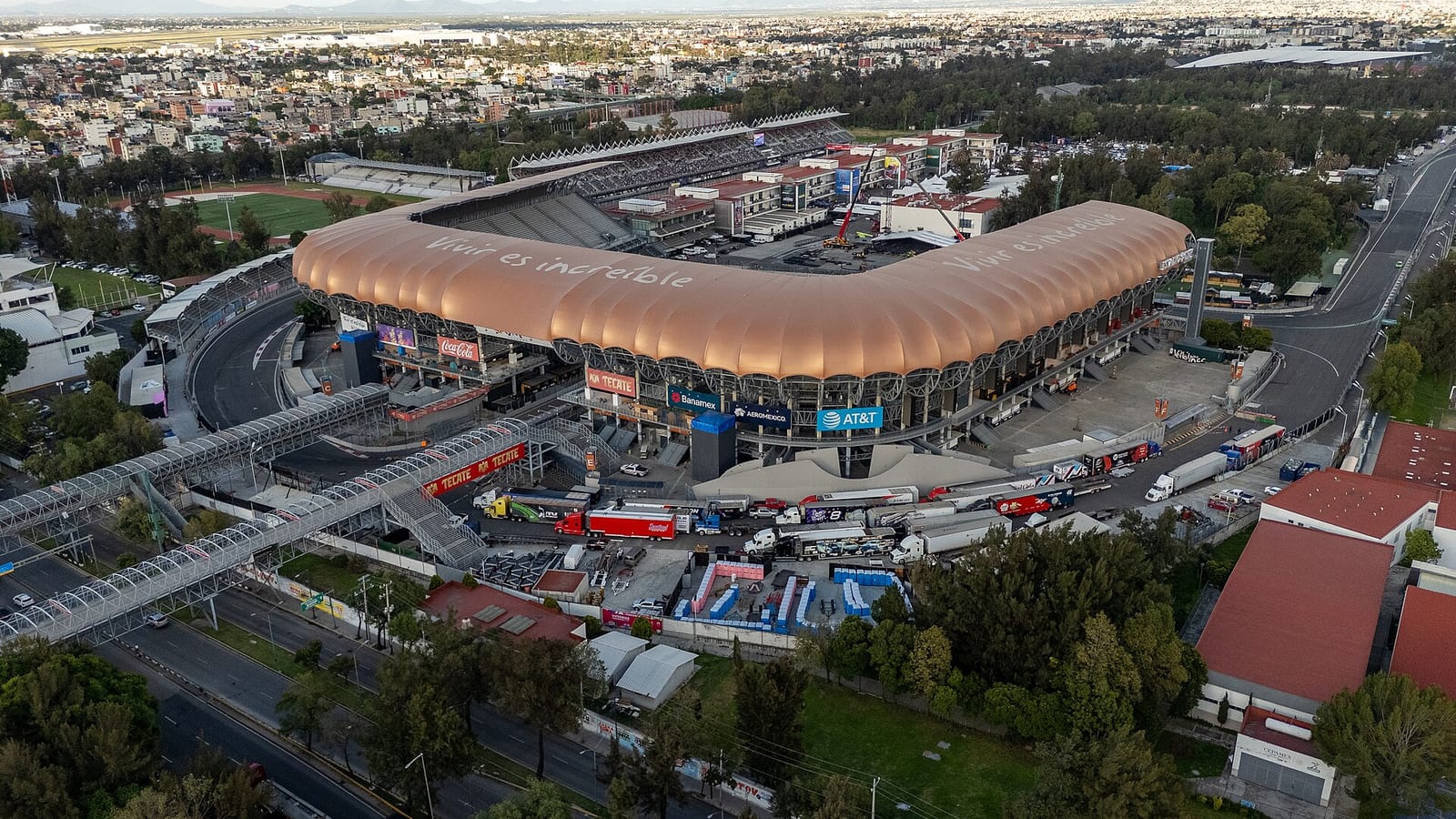
Mexico City in 2018
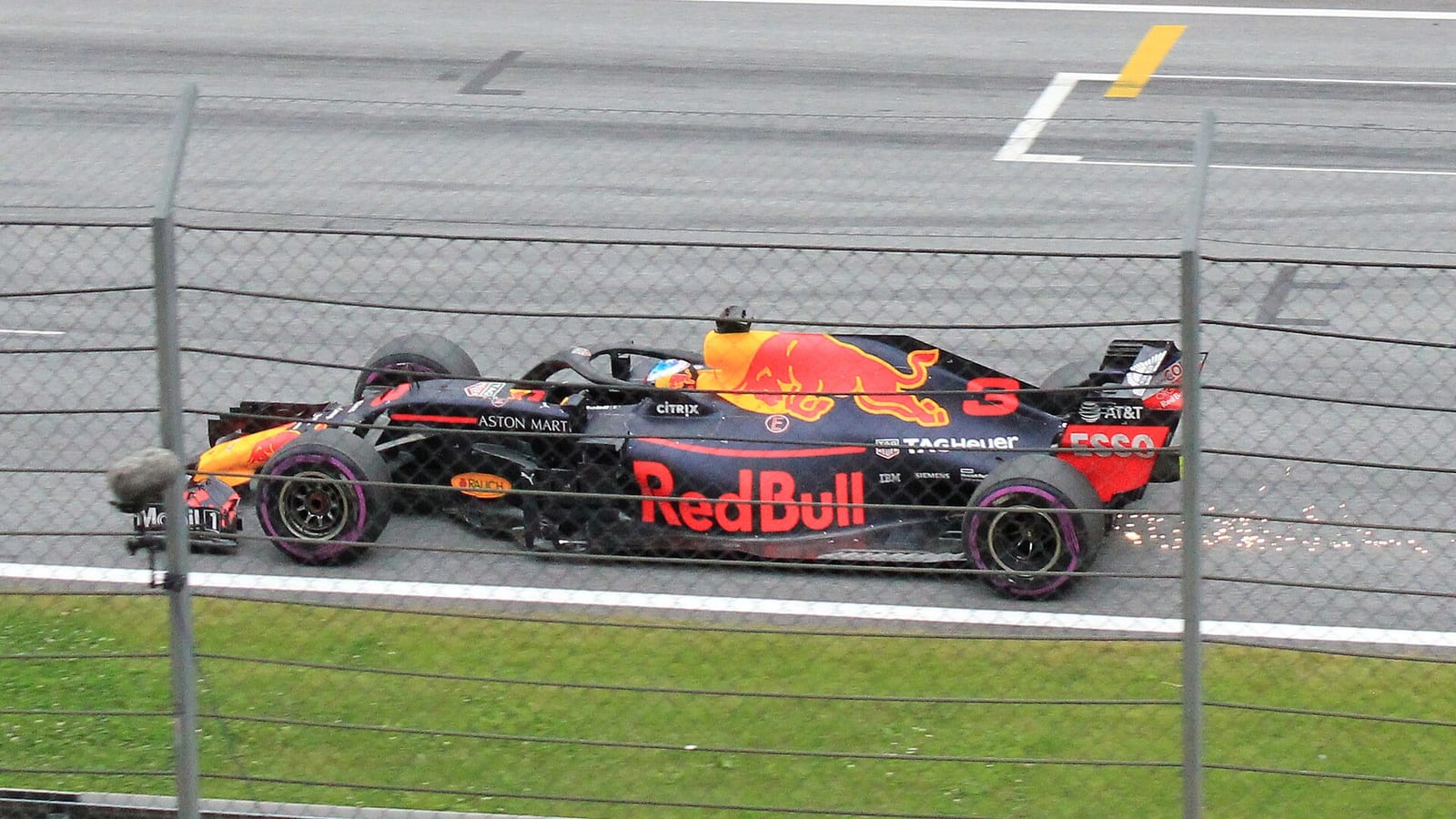
The 2018 Mexican Grand Prix was round 19 of 21, on 28 October. Daniel Ricciardo took pole position for Red Bull with a 1:14.759. His team mate Max Verstappen won the race over 71 laps, with Sebastian Vettel second and Kimi Raikkonen third, both for Ferrari. Valtteri Bottas set the fastest lap, a 1:18.741 on lap 65. Lewis Hamilton finished fourth, and that was enough to win his fifth world title.
The track is 2,238 m above sea level. In real life the thin air cuts drag, so teams can run more wing there with less of a penalty on the straight.
More F1 2018 setups
All the tracks are on the F1 2018 setups page. The round before Mexico is the F1 2018 USA setup and the round after it is the F1 2018 Brazil setup.
For the same track in other games, here are my F1 2017 Mexico setup, my F1 2019 Mexico setup and my F1 25 Mexico setup. The values do not carry over from one game to the next.
FAQ
What is the best F1 2018 setup for Mexico?
For time trial: front wing 2, rear wing 6, differential 70% on throttle and 80% off, camber -2.70 and -1.40, suspension 4 and 2, anti-roll bars 6 and 2, ride height 1 and 4, brake pressure 85% with 56% front bias, tyres at 22.2 and 22.3 psi, ballast 9.
What wing levels should I run in Mexico in F1 2018?
2 at the front and 6 at the rear for one lap. For a race, 3 and 6 take away some understeer in the esses and save the front tyres.
Can I use this Mexico setup in a race?
Yes, with changes. Front ride height to 2, camber back to -2.50 and -1.00, front wing to 3 and on throttle differential to 60%.
Does this setup work with a controller?
It does. Lower the on throttle differential to 60% and set the front toe to 0.05 so the car is calmer on turn in.
Why is the front ride height at 1?
To get front grip without adding front wing. The low nose loads the front axle. If the car bottoms out on the kerbs, go to 2.
How long is the Mexico track in F1 2018?
4.304 km with 17 corners. The real 2018 race was 71 laps, and the pole lap was a 1:14.759.