
The Red Bull Ring is the shortest lap of the F1 2018 calendar by time: just over a minute. Ten corners, three straights, three big braking zones. A tenth is a lot here, and most of it comes from the wing level and from traction.
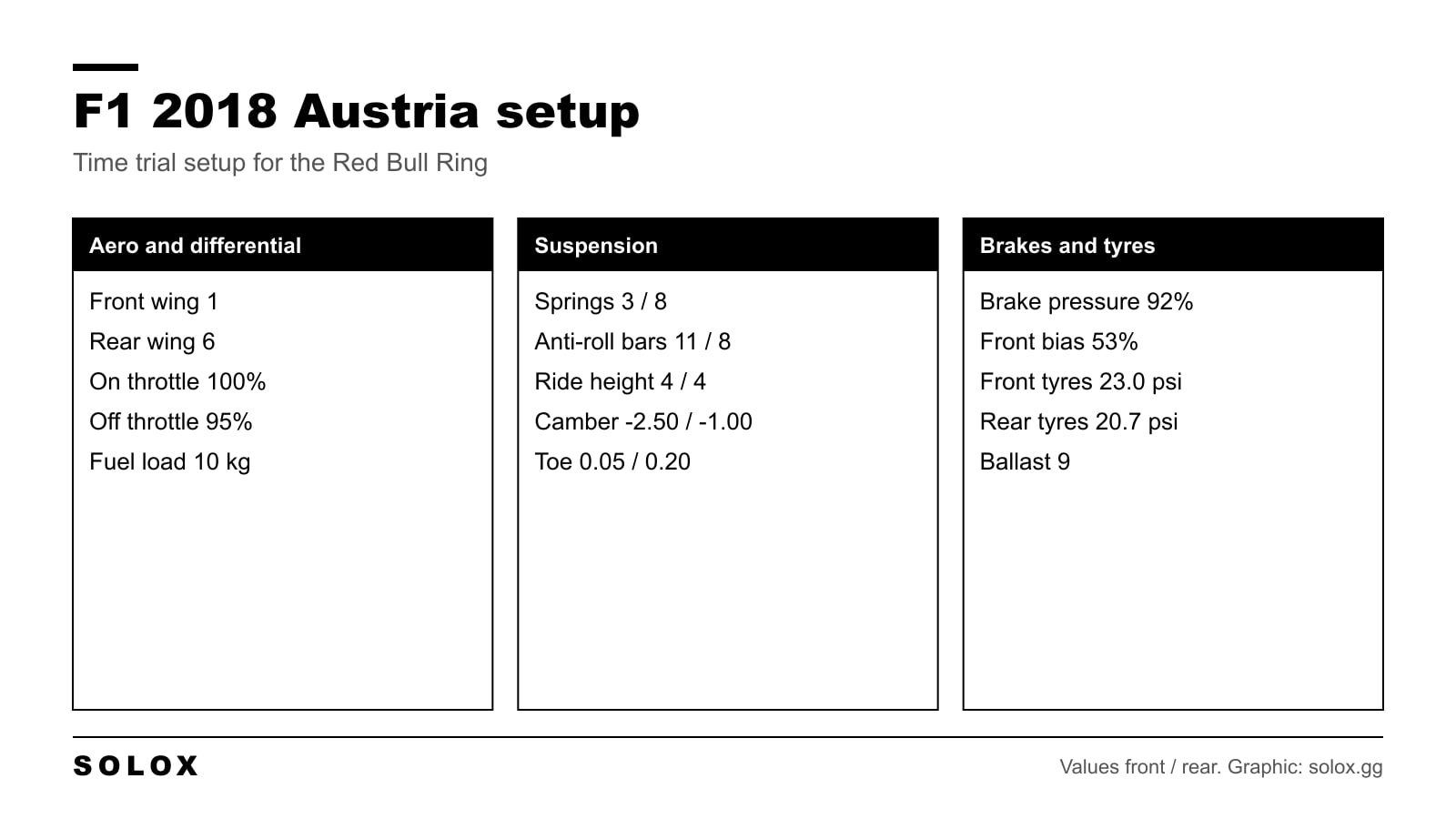
This is the F1 2018 Austria setup on this site: front wing 1, rear wing 6, a locked differential and strong brakes. It is a time trial setup, saved with 10 kg of fuel.
F1 2018 Austria setup
| Setting | Front | Rear |
|---|---|---|
| Wing | 1 | 6 |
| Camber | -2.50 | -1.00 |
| Toe | 0.05 | 0.20 |
| Suspension | 3 | 8 |
| Anti-roll bar | 11 | 8 |
| Ride height | 4 | 4 |
| Tyre pressure | 23.0 psi | 20.7 psi |
| Setting | Value |
|---|---|
| Fuel load | 10 kg |
| Differential on throttle | 100% |
| Differential off throttle | 95% |
| Brake pressure | 92% |
| Front brake bias | 53% |
| Ballast | 9 |

Here is the lap the setup comes from:
Why this setup works at the Red Bull Ring
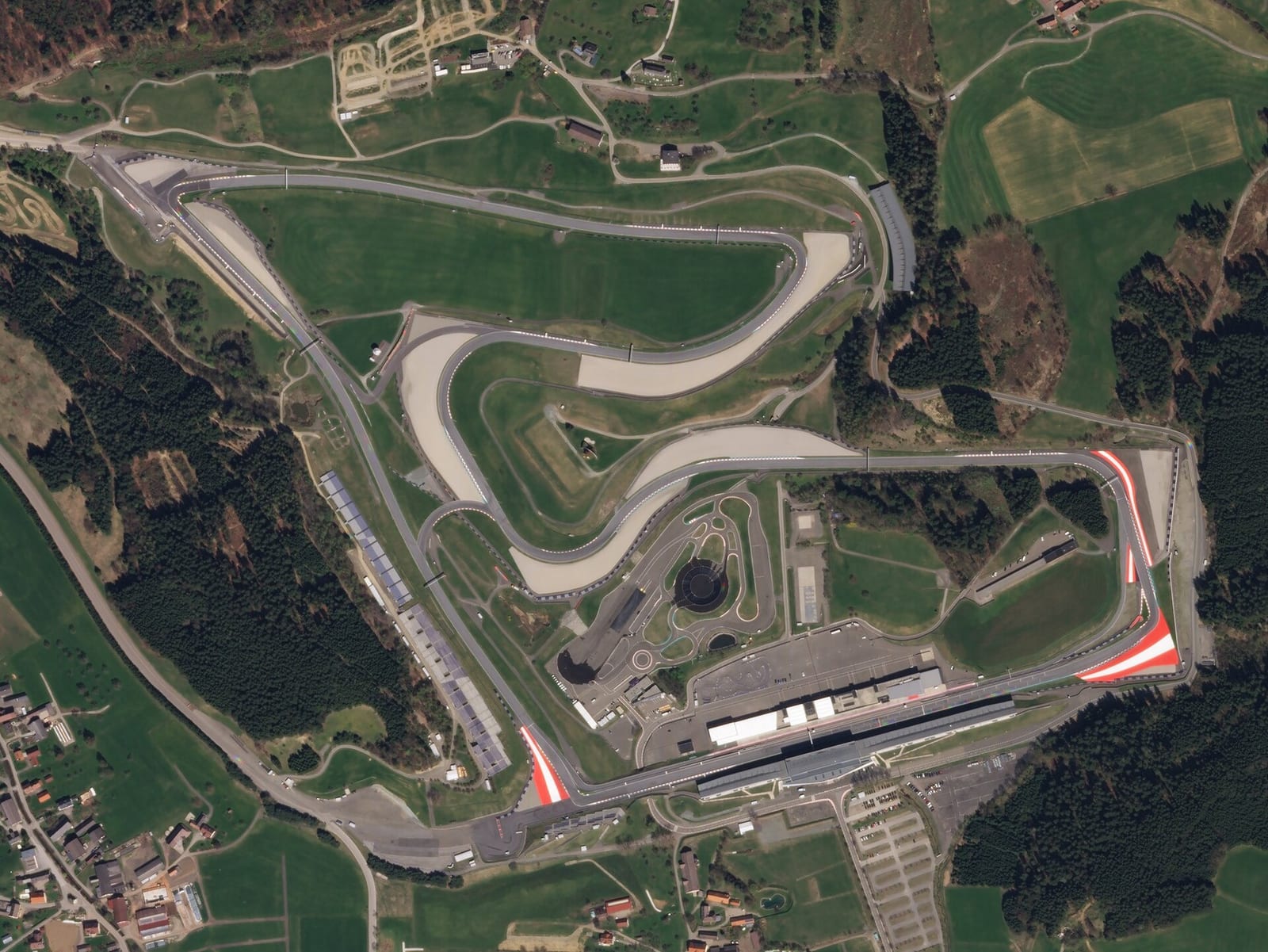
The lap is 4.318 km with 10 corners. It has two halves. From the start line to Turn 4 it is straight, brake, slow corner, three times, and uphill for most of it. From Turn 5 to the end it is fast and downhill, with corners that flow into each other.
The wings. Front 1 is the minimum, rear 6 is in the middle. The first half is all about top speed and the car spends a long time flat out, so the drag has to be low. The rear wing at 6 is for the second half: Turn 6, Turn 7 and the last two corners are fast, and the rear has to stay behind you there. The price is the same as on my France setup, which runs the same 1 and 6: the nose pushes in the long corners.
The differential. 100% on throttle and 95% off. Turn 1, Turn 3 and Turn 4 are slow corners followed by a straight, and Turn 3 is uphill on the exit. A locked differential gives the most drive once the car is straight. It also adds understeer on the way in and makes the rear snap if you are greedy with the throttle. In time trial that is a fair trade. In a race it is not, and I come back to it below.
The geometry. Camber -2.50 and -1.00, toe 0.05 and 0.20. The least angle the menu allows. The tyres sit flat for the braking zones and for traction.
Soft front springs, stiff bars
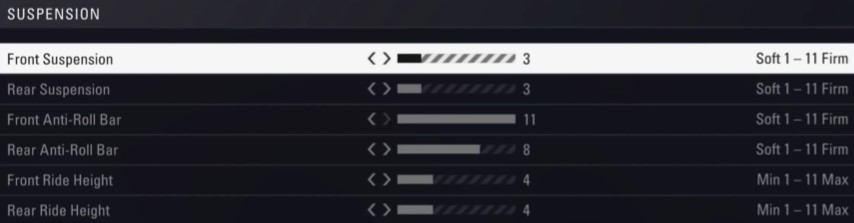
The springs are at 3 at the front and 8 at the rear. The anti-roll bars are at 11 and 8.
The soft front is for the kerbs. At the Red Bull Ring you use the inside kerb in almost every corner, and a soft front spring lets the car ride over it without jumping. It also helps the front tyres bite under braking.
The stiff rear spring at 8 holds the back of the car up when you go to the throttle, so the car does not squat on the uphill exits.
The front anti-roll bar at 11 is the maximum. It keeps the car flat and sharp when you change direction in the second half of the lap. Be aware that a stiff front bar also adds understeer in slow corners. If the car does not turn in Turn 3, this is the first thing I would soften.
Ride height is 4 and 4. Not very low. The kerbs here are aggressive and you need the room.
Brakes
Brake pressure is 92% with 53% at the front. That is a lot of pressure. The three stops in the first half are from high speed and in a straight line, so you can use it.
The risk is Turn 3. The road goes uphill and then flattens at the corner, and the inside front locks easily. Without ABS, if you lock there more than once in five laps, go down to 88%.
The bias at 53% is far back. It helps the car rotate into the slow corners, which it needs with the front wing at 1.
What to change
One change at a time, three laps, then decide.
| Problem | Change | Why |
|---|---|---|
| The car does not turn in Turn 1, Turn 3 or Turn 4 | Front anti-roll bar 11 to 9 | A softer front bar lets the front tyres bite on turn in |
| The car pushes wide in Turn 6 and Turn 7 | Front wing 1 to 2 or 3 | More front downforce in the fast left handers |
| The rear snaps on the exit of Turn 3 | On throttle differential 100% to 80% | An open differential lets the inside wheel slip without turning the car |
| The rear moves when you lift into Turn 9 | Rear wing 6 to 7 | More rear downforce in the fast downhill corners |
| Front tyres lock into Turn 3 or Turn 4 | Brake pressure 92% to 88% | Less peak pressure, easier to hold at the limit |
| The rear moves under braking | Front brake bias 53% to 55% | More of the braking goes to the front |
| The car jumps on the kerbs in the last two corners | Rear suspension 8 to 6 | A softer rear takes the kerb without unsettling the car |
For a race
In a race you carry fuel and the rear tyres have to last. This lap is hard on them: three full throttle exits from low speed, 71 times at full distance. Before a 25% or 50% race I would change this:
- On throttle differential 100% to 75%. The biggest one. Less wheelspin, less heat in the rear tyres.
- Off throttle differential 95% to 80%. The car turns in better with fuel on board.
- Front wing 1 to 3. Less sliding at the front in the second half of the lap.
- Brake pressure 92% to 88%. With a heavy car and worn tyres the fronts lock sooner.
- Fuel. The 10 kg is a time trial number. In a race the game sets the load for the distance.
On a pad, I would go further on the differential, to 65% on throttle, and take the brake pressure down to around 85%.
The Red Bull Ring had three DRS zones in 2018 and overtaking is easy here. In a race I would save the battery in the second half of the lap and spend it on the run from Turn 1 up to Turn 3, then again down to Turn 4.
Where the lap time is at the Red Bull Ring
- Turn 1. A fast uphill right at the end of the pit straight. Brake later than you think, use the inside kerb and let the car run out to the exit kerb. Track limits are strict on the outside.
- Turn 3. The slowest corner, a tight right at the top of the hill. Brake in a straight line, turn in late and get the car pointed down the next straight before you go to full throttle. With a locked differential you cannot be early on the power here.
- Turn 4. A downhill braking zone into a right hander. The car is light on entry. Brake a little earlier than feels right and take a late apex, because the exit leads onto the short run to the fast part.
- Turn 6 and Turn 7. Two fast left handers. This is where the low front wing costs you. Turn in early, be patient in the middle and do not ask for more steering than the front can give.
- Turn 8. A fast right. It should be flat or close to it.
- Turn 9 and Turn 10. Two fast downhill rights. You do not see much of Turn 9 before you turn in. Small lift, turn in, and use the exit kerb but nothing beyond it. Turn 10 decides your speed on the pit straight, so give up a bit of entry speed for a clean exit.
The last two corners follow the oldest rule in racing: the lap time is in the exit, not in the entry. If you go into Turn 9 too fast, you are off line for Turn 10 and slow all the way to Turn 1.
The Red Bull Ring in 2018
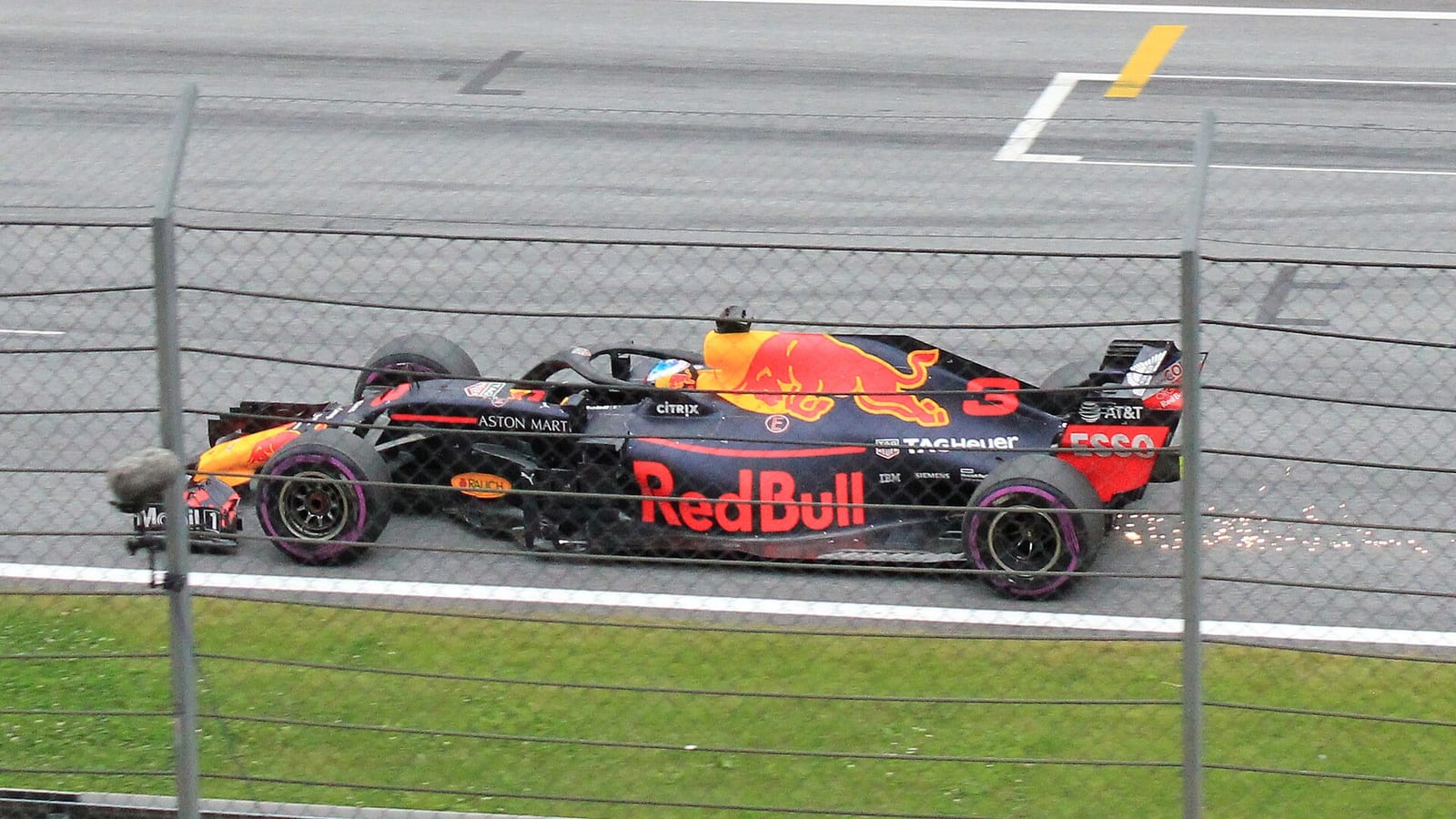
The 2018 Austrian Grand Prix was round 9 of 21, on 1 July. Valtteri Bottas took pole position for Mercedes in 1:03.130. Max Verstappen won the race for Red Bull over 71 laps, the first win for the team at its home track. Kimi Räikkönen was second and Sebastian Vettel third for Ferrari. Räikkönen set the fastest lap, a 1:06.957 on the last lap.
More F1 2018 setups
All the tracks are on the F1 2018 setups page. The round before Austria is the F1 2018 France setup, with the same wings, and the round after it is the F1 2018 Silverstone setup.
For the same track in other games, here are my F1 2017 Austria setup, my F1 2019 Austria setup and my F1 25 Austria setup. The values do not carry over from one game to the next.
FAQ
What is the best F1 2018 setup for Austria?
For time trial: front wing 1, rear wing 6, differential 100% on throttle and 95% off, suspension 3 and 8, anti-roll bars 11 and 8, ride height 4 and 4, brake pressure 92% with 53% front bias, tyres at 23.0 and 20.7 psi, ballast 9.
What wing levels should I run at the Red Bull Ring in F1 2018?
1 at the front and 6 at the rear for one lap. For a race, 3 at the front makes the car kinder on the front tyres.
Can I use this Austria setup in a race?
Yes, with changes. Open the differential to 75% on throttle and 80% off, add front wing and lower the brake pressure to 88%.
Does this setup work with a controller?
It does if you open the differential to around 65% on throttle and lower the brake pressure to about 85%. A locked differential is hard to manage with a trigger.
Why does the car understeer in Turn 3?
Low front wing, a locked differential and the stiffest front anti-roll bar all push the same way. Soften the front bar from 11 to 9 first.
How long is a lap of the Red Bull Ring in F1 2018?
The track is 4.318 km with 10 corners. Pole position in the real 2018 race was a 1:03.130.