
Paul Ricard came back to the calendar in 2018 and F1 2018 was the first game of the series with it. It is a strange track to set up. Two long straights ask for no wing, and Signes and Beausset ask for a lot of it.
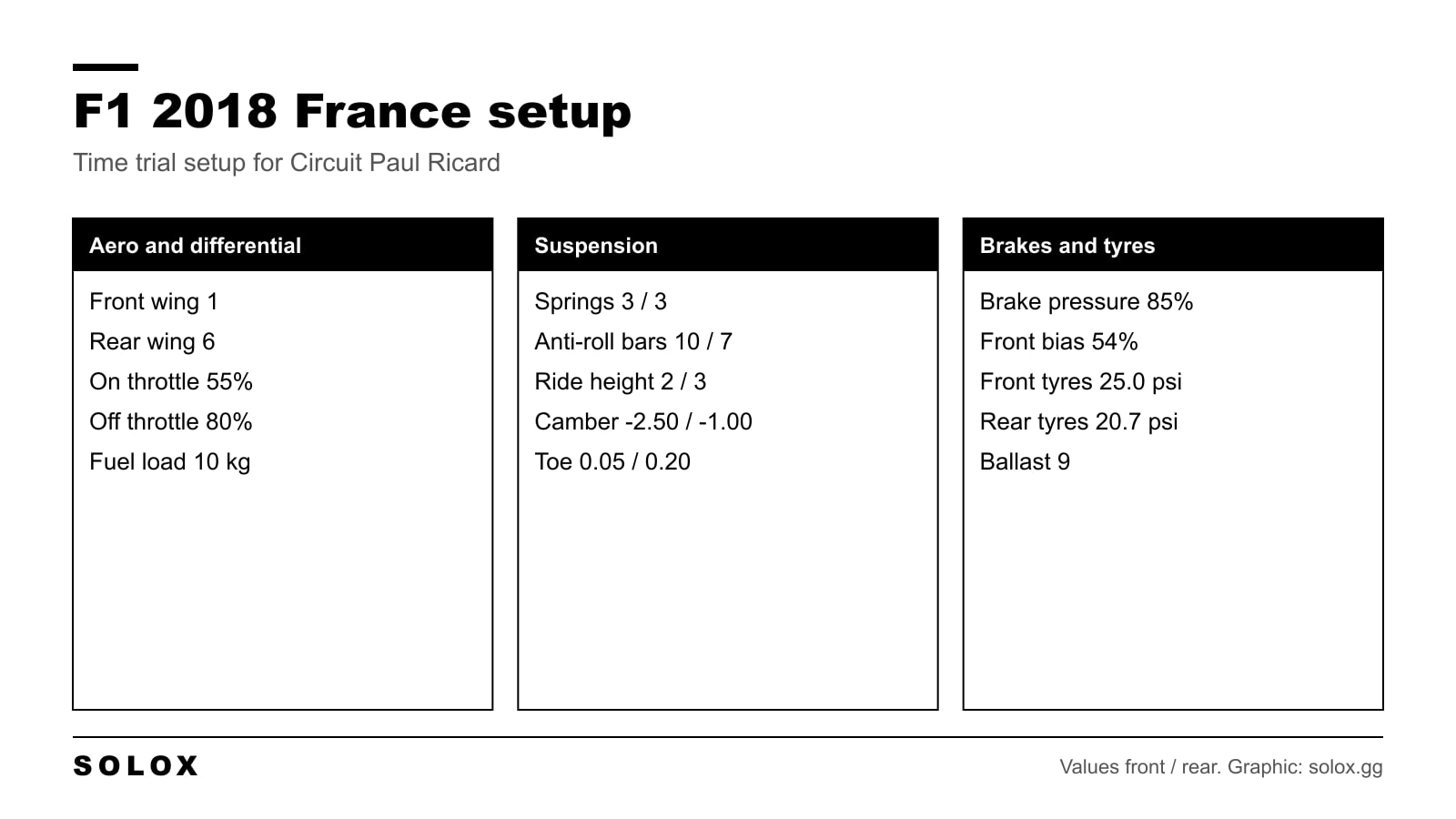
This is the F1 2018 France setup on this site: front wing 1, rear wing 6, an almost open differential and soft springs. It is a time trial setup, saved with 10 kg of fuel.
F1 2018 France setup
| Setting | Front | Rear |
|---|---|---|
| Wing | 1 | 6 |
| Camber | -2.50 | -1.00 |
| Toe | 0.05 | 0.20 |
| Suspension | 3 | 3 |
| Anti-roll bar | 10 | 7 |
| Ride height | 2 | 3 |
| Tyre pressure | 25.0 psi | 20.7 psi |
| Setting | Value |
|---|---|
| Fuel load | 10 kg |
| Differential on throttle | 55% |
| Differential off throttle | 80% |
| Brake pressure | 85% |
| Front brake bias | 54% |
| Ballast | 9 |
In F1 2018 the wings, suspension, anti-roll bars, ride height and ballast all use a scale from 1 to 11.
This setup was collected for the site in 2022 from a fast time trial lap, like the rest of my F1 2018 setups. Use it as a base and adjust it with the table further down.

An onboard lap of Paul Ricard in F1 2018
Watch how much track is used on the exits. Paul Ricard has no gravel and no walls close to the line, so the lap is about track limits more than about fear.
Why this setup works at Paul Ricard
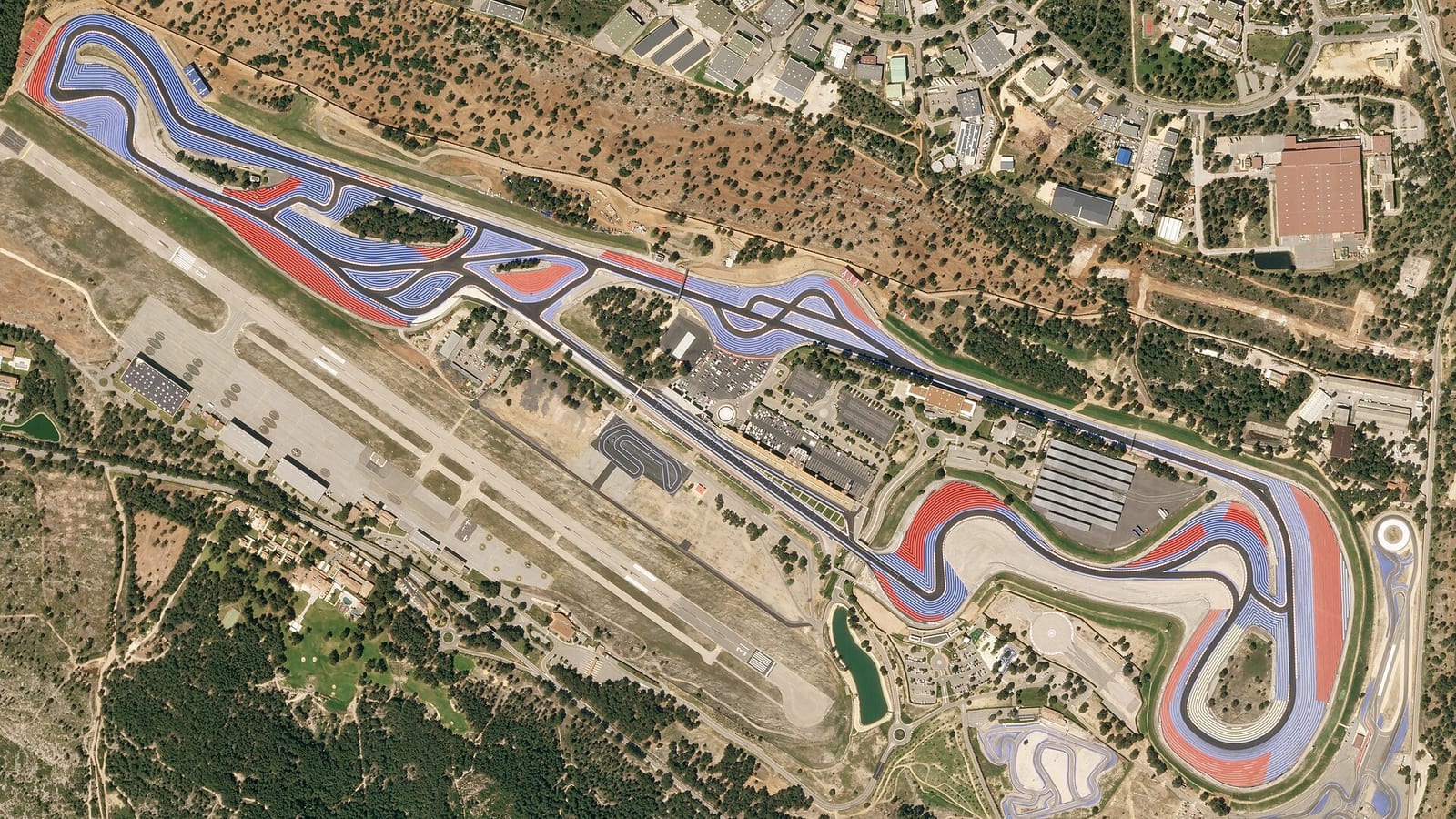
The lap is 5.842 km with 15 corners. The first sector is slow and technical. Then comes the Mistral straight, cut in two by a chicane. Then Signes, one of the fastest corners of the season, and the long double right of Beausset. The lap ends with a few slow corners.
The wings. Front 1 is the minimum. Rear 6 is in the middle. The idea is simple: the straights are long and there are three of them, so the car has to be slippery. The rear wing at 6 is what keeps the car stable through Signes, where you do not want the rear to move at all. The price is understeer. With the front wing at 1 the nose will push in Beausset, and you have to be patient there.
The differential. 55% on throttle is close to fully open. Paul Ricard has long corners where you are on the throttle with steering lock on, the first chicane, Beausset and the last corner. An open differential lets the car rotate while you feed the power in. That takes away part of the understeer the low front wing gives you.
The geometry. Camber -2.50 and -1.00, toe 0.05 and 0.20. These are the values with the least angle in the menu. The tyres sit flat, which helps in the straight line braking zones and keeps tyre temperature under control on the straights.
Soft springs, stiff bars
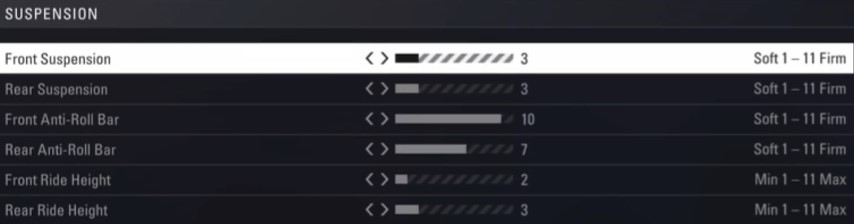
The suspension is at 3 and 3. The anti-roll bars are at 10 and 7. Soft springs and stiff bars look like a contradiction. They are not.
The springs control how the car moves up and down. Soft springs let it ride the kerbs in the first chicane and in the Mistral chicane without jumping. The anti-roll bars control how much the car leans. Stiff bars keep it flat when you change direction, and Paul Ricard is full of quick left and right sequences.
The front bar at 10 is stiffer than the rear at 7. That makes the front a bit lazy and the rear planted. Together with the wings it gives a car that is safe in the fast corners and needs help in the slow ones. The open differential is that help.
Ride height is 2 and 3. Very low, for the straights. The track is smooth, so the only place you pay for it is on the kerbs.
What to change
One change at a time, three laps, then decide.
| Problem | Change | Why |
|---|---|---|
| The car pushes wide in Signes and Beausset | Front wing 1 to 2 or 3 | More front downforce in the two long, fast right handers |
| Understeer in the slow corners of the first sector | Front anti-roll bar 10 to 8 | A softer front bar lets the front tyres bite on turn in |
| The rear steps out when you lift into Signes | Off throttle differential 80% to 90% | A more locked differential off throttle keeps the rear in line |
| Front tyres lock into the Mistral chicane | Brake pressure 85% to 80% | Less peak pressure, easier to hold at the limit without ABS |
| Slow off the chicane and out of the last corner | On throttle differential 55% to 65% | More lock gives more drive once the car is straight |
| The car bottoms or bounces on the chicane kerbs | Front ride height 2 to 3 | More room under the floor over the kerbs |
| The rear feels loose in fast changes of direction | Rear wing 6 to 7 | More rear downforce, at the cost of top speed on the Mistral |
For a race
In a race you carry fuel, the tyres have to last, and understeer costs you more every lap because it wears the front tyres. Before a 25% or 50% race I would change this:
- Front wing 1 to 3. The front left does a lot of work in Signes and Beausset. More front wing means less sliding, and less sliding means less wear.
- Rear wing 6 to 7. To keep the balance with the extra front wing.
- Front tyre pressure 25.0 to 24.2 psi. 25.0 is the maximum. It is fast for one lap and it runs hot over a stint.
- Fuel. The 10 kg is a time trial number. In a race the game sets the load for the distance.
On a pad, I would take the brake pressure down to around 80%. The differential is already open, so the throttle side is easy on the triggers.
F1 2018 was the first game of the series with manual ERS modes. At Paul Ricard I would save the battery in the first sector and spend it on the two halves of the Mistral and on the pit straight.
Where the lap time is at Paul Ricard
- Turn 1 and turn 2. A fast left and a tighter right. The entry is quicker than it looks. Brake late for turn 1 and give up a little in turn 2 so the car is straight for the run to the next chicane.
- Turn 3, 4 and 5. A slow chicane and then a right hander. Use the kerb on the inside of the chicane, not the big one behind it. The soft springs are there for this.
- Turn 6. A long right that opens onto the Mistral. This exit matters more than anything in the first sector. Late apex, full throttle early.
- The Mistral chicane, turn 8 and 9. The best place to pass, with DRS on the way in. Brake in a straight line and do not cut too much. The game is strict on track limits here.
- Signes, turn 10. A very fast right at the end of the Mistral. With the rear wing at 6 it should be flat in time trial. Turn in once and keep the wheel still.
- Beausset, turn 11. A long double apex right. This is where the low front wing hurts. Go in slower than you want, hold the car on the inside and wait for the second apex before you go to full throttle.
- Turn 12 to turn 15. Slow and narrow by the standards of this track. The last corner leads onto the pit straight, so again the exit is what counts.
The rule I give drivers in karting applies in Beausset more than anywhere: the corner is not over at the first apex. If you go to the throttle too early there, you run wide and lift again, and that lift is where the time goes.
Paul Ricard in 2018
The 2018 French Grand Prix was round 8 of 21, on 24 June. It was the first French Grand Prix in ten years and the first at Paul Ricard since 1990. Lewis Hamilton took pole position in 1:30.029 and won the race for Mercedes over 53 laps. Max Verstappen was second for Red Bull and Kimi Raikkonen third for Ferrari.
At the first corner Sebastian Vettel ran into the back of Valtteri Bottas. Both had to pit for repairs. Vettel got a penalty and came back to fifth.
More F1 2018 setups
All the tracks are on the F1 2018 setups page. The round before France is the F1 2018 Canada setup, another low wing track, and the round after it is the F1 2018 Austria setup.
For the same track in later games, here are my F1 2019 France setup and my F1 2021 Paul Ricard setup. The values do not carry over from one game to the next. If you race GT cars here, I also have a Paul Ricard track guide for ACC.
FAQ
What is the best F1 2018 setup for France?
Front wing 1, rear wing 6, differential 55% on throttle and 80% off, suspension 3 and 3, anti-roll bars 10 and 7, ride height 2 and 3, brake pressure 85% with 54% front bias, and tyres at 25.0 and 20.7 psi.
What wing levels should I run at Paul Ricard in F1 2018?
1 at the front and 6 at the rear for time trial. For a race I would go to 3 and 7 so the front tyres last.
Can I use this France setup in a race?
Yes, with a few changes. It is saved with 10 kg of fuel. Add two clicks of front wing, one of rear wing, and lower the front tyre pressure a little.
Does this setup work with a controller?
Yes. The on throttle differential is already low, which is what you want on a trigger. I would lower the brake pressure to around 80%.
Why does the car understeer in Beausset?
Because the front wing is at the minimum and the front anti-roll bar is at 10. Add front wing one click at a time, or soften the front bar to 8.
Where can I overtake at Paul Ricard in F1 2018?
Into the Mistral chicane with DRS, and into turn 1 at the end of the pit straight.
How long is Paul Ricard in F1 2018?
5.842 km with 15 corners, with the chicane on the Mistral straight. The real race was 53 laps.