
Silverstone is a lap you drive with the steering wheel, not with the brake pedal. Copse, Maggotts, Becketts, Stowe: almost all of the lap time is in corners taken above 200 km/h. The setup has one job, to keep the car flat and precise when you change direction at speed.
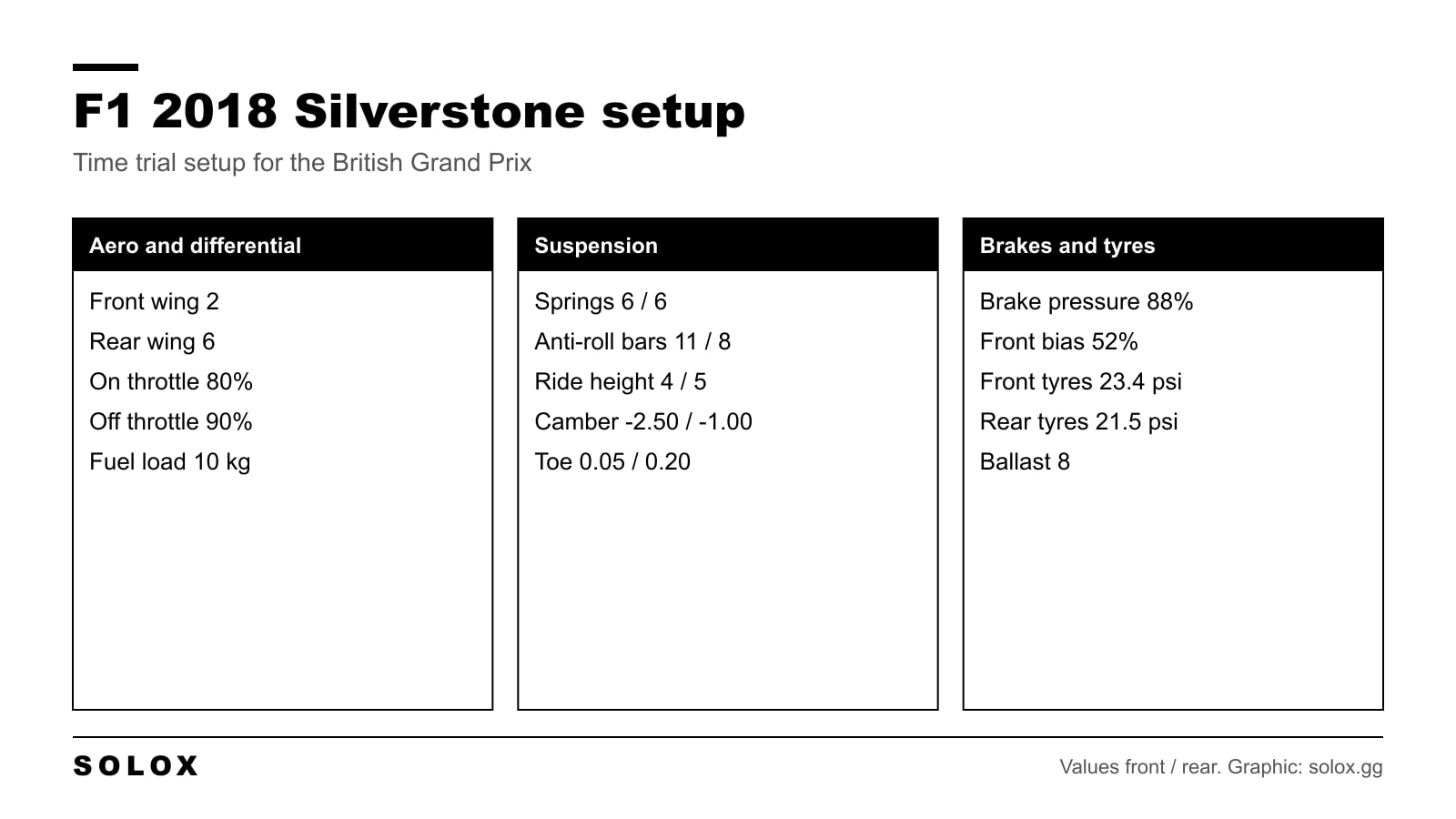
This is the F1 2018 Silverstone setup on this site: front wing 2, rear wing 6, springs at 6 and a front anti-roll bar at the maximum. It is a time trial setup, saved with 10 kg of fuel.
F1 2018 Silverstone setup
| Setting | Front | Rear |
|---|---|---|
| Wing | 2 | 6 |
| Camber | -2.50 | -1.00 |
| Toe | 0.05 | 0.20 |
| Suspension | 6 | 6 |
| Anti-roll bar | 11 | 8 |
| Ride height | 4 | 5 |
| Tyre pressure | 23.4 psi | 21.5 psi |
| Setting | Value |
|---|---|
| Fuel load | 10 kg |
| Differential on throttle | 80% |
| Differential off throttle | 90% |
| Brake pressure | 88% |
| Front brake bias | 52% |
| Ballast | 8 |

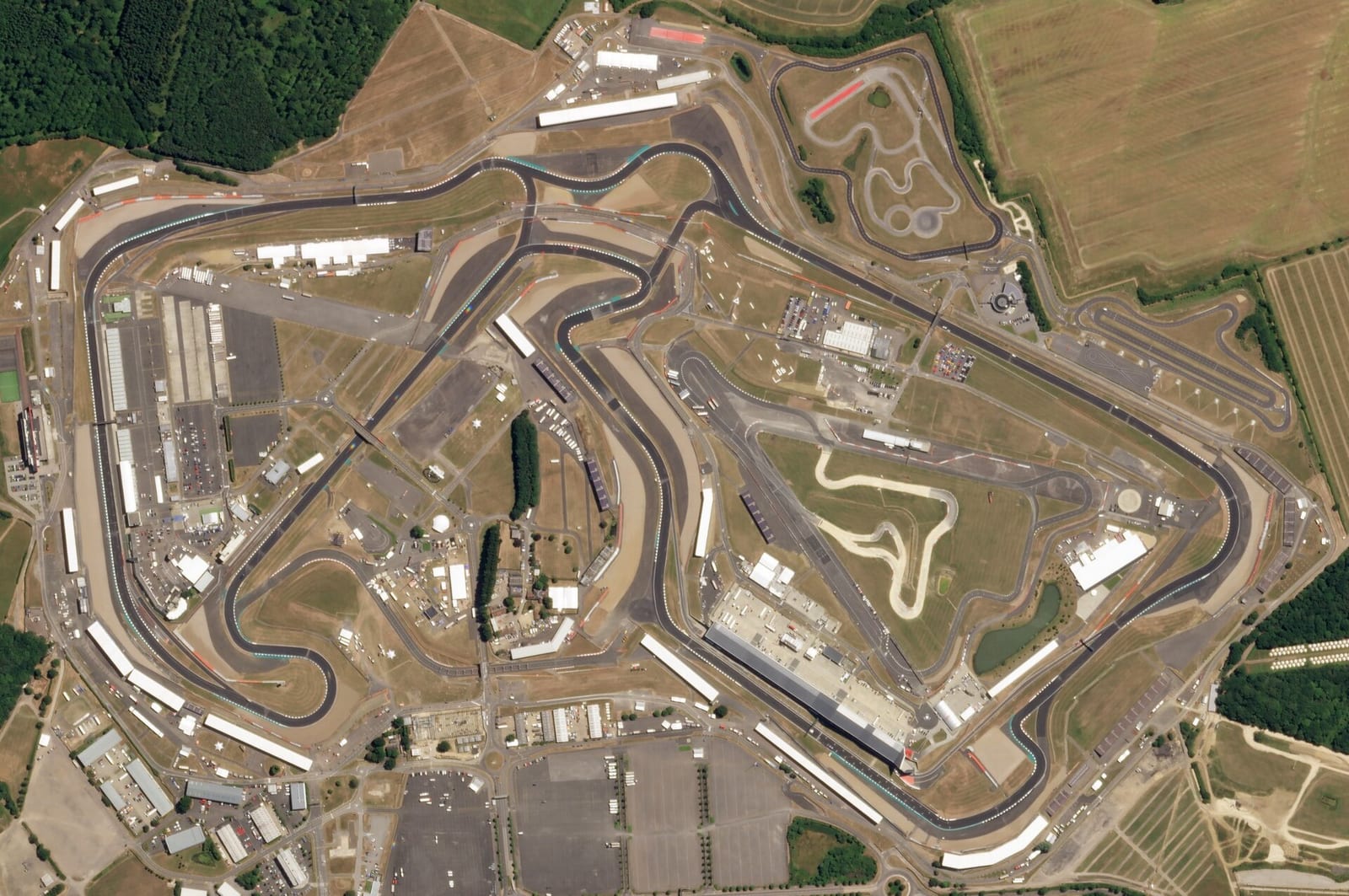
Here is the lap the setup comes from:
Why this setup works at Silverstone
The lap is 5.891 km with 18 corners, and it is flat. No hills, few kerbs you need to attack, and long straights between the fast sections: Wellington, the run to Copse, Hangar.
The wings. Front 2, rear 6. For a track with this many fast corners that looks low. It works because on one lap with low fuel, many of the fast corners are flat anyway. Abbey, Farm and Copse do not need more wing, they need a stable car. What more wing would give you in Maggotts and Becketts, you would give back on the three straights. The rear at 6 against the front at 2 keeps the rear behind you when you turn in at high speed, which is the thing that matters most here.
The differential. 80% on throttle, 90% off. A differential that is nearly locked off throttle makes the car stable when you lift and turn at speed, like on the way into Becketts or Stowe. The price is in the slow corners. In Village, The Loop and Luffield the car resists turning, and you have to be patient before you go to the power.
The geometry. Camber -2.50 and -1.00, toe 0.05 and 0.20. The least angle the menu allows. Less drag on the straights and an even tyre under braking.
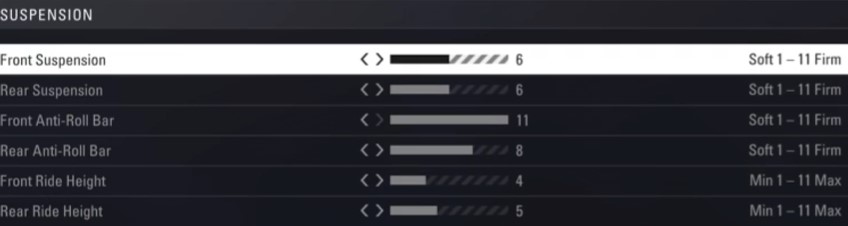
Springs at 6, front bar at 11
The springs are in the middle of the range, 6 and 6. On a track with no bumps and few kerbs you can run the car stiffer than at a place like Austria, where the front is at 3. A stiffer car moves less, so the floor stays at the same height from the road and the downforce stays constant.
The front anti-roll bar is at 11, the maximum, with the rear at 8. This is for Maggotts and Becketts. Left, right, left, right, at very high speed. A stiff front bar makes the car answer the steering at once, with no delay while the body rolls from one side to the other.
Ride height is 4 at the front and 5 at the rear. A little rake to help the front turn, which the low front wing needs.
Brakes
Brake pressure is 88% with 52% at the front. You only brake hard three times: Village, Brooklands and Vale. Everywhere else it is a lift or a short touch of the pedal.
The bias at 52% is far back. It helps the car rotate on the way into the slow corners, where the locked differential works against you. It also makes the rear light when you brake and turn into Brooklands. If the rear moves there, go to 54%.
What to change
One change at a time, three laps, then decide.
| Problem | Change | Why |
|---|---|---|
| The car pushes wide in Maggotts and Becketts | Front wing 2 to 4 | More front downforce in the fast direction changes |
| The rear moves when you turn into Copse or Stowe | Rear wing 6 to 7 | More rear downforce on high speed entry |
| The car does not turn in Village, The Loop or Luffield | Off throttle differential 90% to 75% | An open differential lets the car rotate when you lift |
| The rear snaps on the exit of Luffield or Club | On throttle differential 80% to 65% | The inside wheel can slip without turning the car |
| Understeer in the middle of slow corners | Front anti-roll bar 11 to 9 | A softer front bar gives the front tyres more grip |
| The rear moves under braking into Brooklands | Front brake bias 52% to 54% | More of the braking goes to the front |
| Front tyres lock into Village or Vale | Brake pressure 88% to 84% | Less peak pressure, easier to hold at the limit |
For a race
With fuel on board the fast corners are not flat any more, and the front left tyre takes a beating through Copse, Maggotts, Becketts and Stowe. Before a 25% or 50% race I would change this:
- Front wing 2 to 4. The heavy car needs the front grip, and less sliding saves the front left.
- Rear wing 6 to 7. Keeps the balance and helps the rear tyres on the exits.
- On throttle differential 80% to 65%. Less wheelspin out of Luffield and Club.
- Off throttle differential 90% to 75%. The car turns better in the slow part.
- Fuel. The 10 kg is a time trial number. In a race the game sets the load for the distance.
On a pad, I would go to 60% on throttle and add one more click of rear wing. Fast corners with a stick are easier with a calm rear.
In F1 2018 you manage the ERS yourself. Use the battery on the Wellington and Hangar straights, where the DRS zones are and where you can pass, and save it through the fast middle part of the lap.
Where the lap time is at Silverstone
- Abbey and Farm. Flat on a time trial lap. Turn in smoothly and let the car run out. Any correction on the steering costs speed all the way to Village.
- Village and The Loop. The first real braking zone, then the slowest corner of the lap. Give up the exit of Village to be on the right side for The Loop, because The Loop leads onto the Wellington straight.
- Brooklands and Luffield. Brake while you turn into Brooklands, then stay patient in Luffield. It is long and the car wants to push. Wait, wait, then full throttle once you can see the exit.
- Copse. A lift or a quick touch of the brake, turn in early and trust the car. It has more grip than you think.
- Maggotts and Becketts. The first two are flat. Then each corner is a little slower than the one before. Lift, then one downshift, then another. Stay tight on each apex so you are well placed for the next one. Your exit from Chapel decides your speed for the whole Hangar straight.
- Stowe. A fast right at the end of the straight. Brake very little, turn in early and use all the road on the exit.
- Vale and Club. Heavy braking into the left at Vale, then the long right of Club. Get on the throttle early and open the steering as the corner opens.
Silverstone in 2018
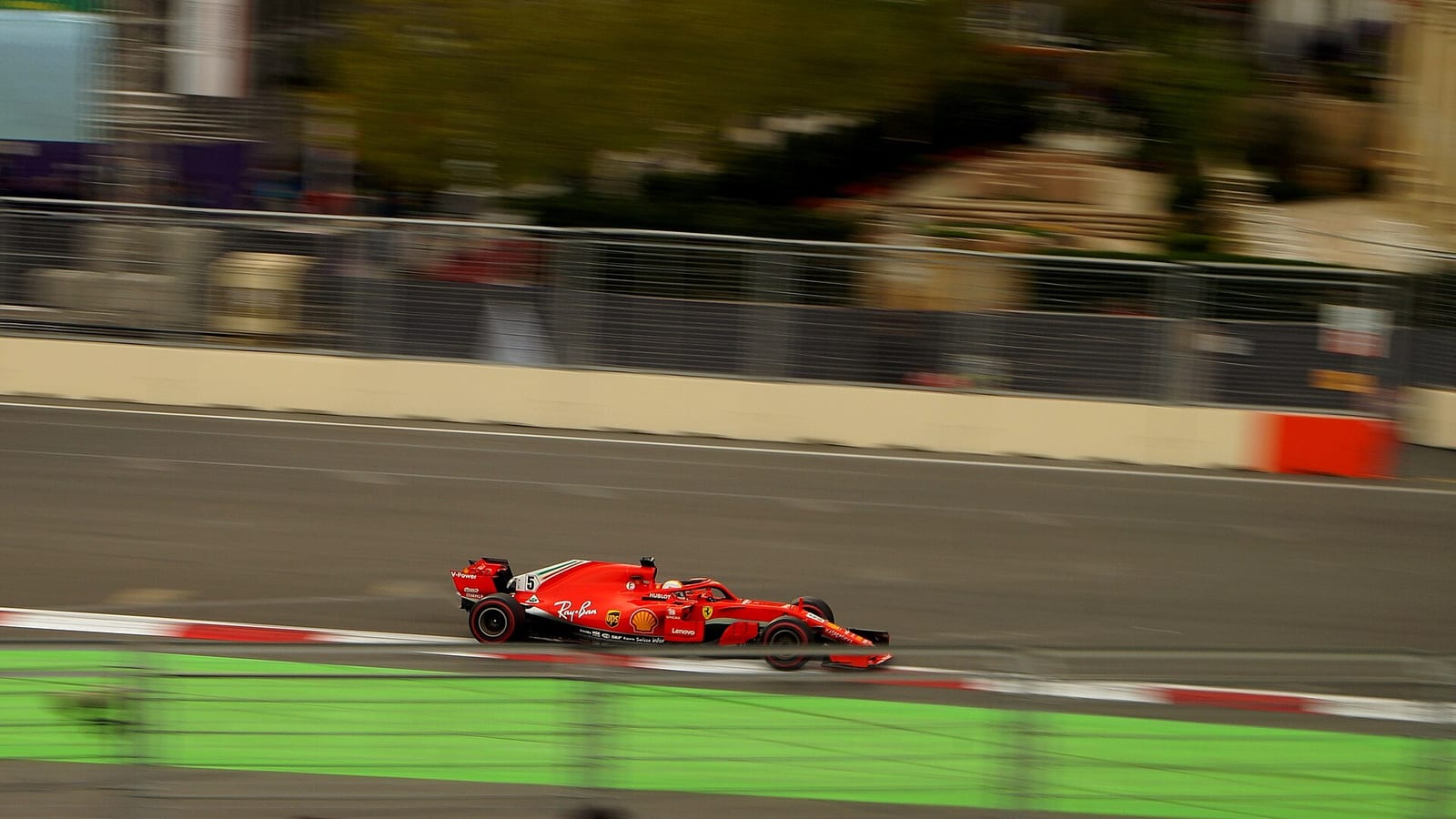
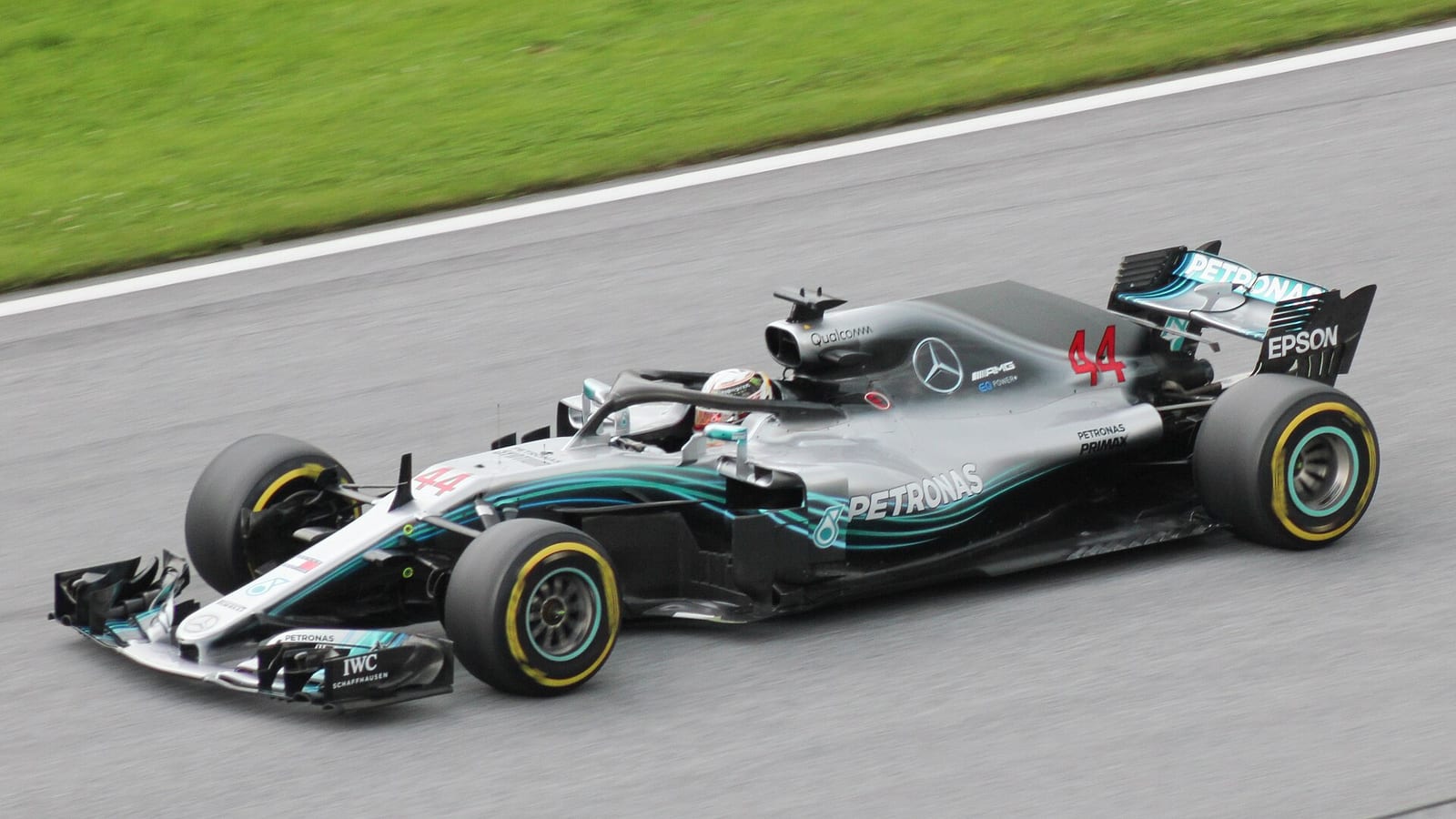
The 2018 British Grand Prix was round 10 of 21, on 8 July, one week after Austria. Lewis Hamilton took pole position for Mercedes in 1:25.892. Sebastian Vettel won for Ferrari over 52 laps, his first win at Silverstone since 2009. Hamilton was hit on the first lap, dropped to the back and came back to finish second. Kimi Räikkönen was third. Vettel also set the fastest lap, a 1:30.696 on lap 47.
It was the first race with three DRS zones at Silverstone. The new one was on the pit straight, and drivers could keep the DRS open through Abbey and Farm.
More F1 2018 setups
All the tracks are on the F1 2018 setups page. The round before Silverstone is the F1 2018 Austria setup and the round after it is the F1 2018 Germany setup.
For the same track in other games, here are my F1 2017 Silverstone setup, my F1 2019 Silverstone setup and my F1 25 Silverstone setup. The values do not carry over from one game to the next.
FAQ
What is the best F1 2018 setup for Silverstone?
For time trial: front wing 2, rear wing 6, differential 80% on throttle and 90% off, suspension 6 and 6, anti-roll bars 11 and 8, ride height 4 and 5, brake pressure 88% with 52% front bias, tyres at 23.4 and 21.5 psi, ballast 8.
What wing levels should I run at Silverstone in F1 2018?
2 at the front and 6 at the rear for one lap. For a race, 4 and 7 make the car easier on the front left tyre.
Can I use this Silverstone setup in a race?
Yes, with changes. Add wing to 4 and 7 and open the differential to 65% on throttle and 75% off.
Does this setup work with a controller?
It does. Lower the on throttle differential to 60% and add a click of rear wing so the car is calmer in the fast corners.
Are Abbey and Copse flat in F1 2018?
Abbey is flat on a time trial lap with this setup. Copse needs a lift or a light touch of the brake. With race fuel, expect to lift for both.
How long is Silverstone in F1 2018?
5.891 km with 18 corners. Pole position in the real 2018 race was a 1:25.892.