
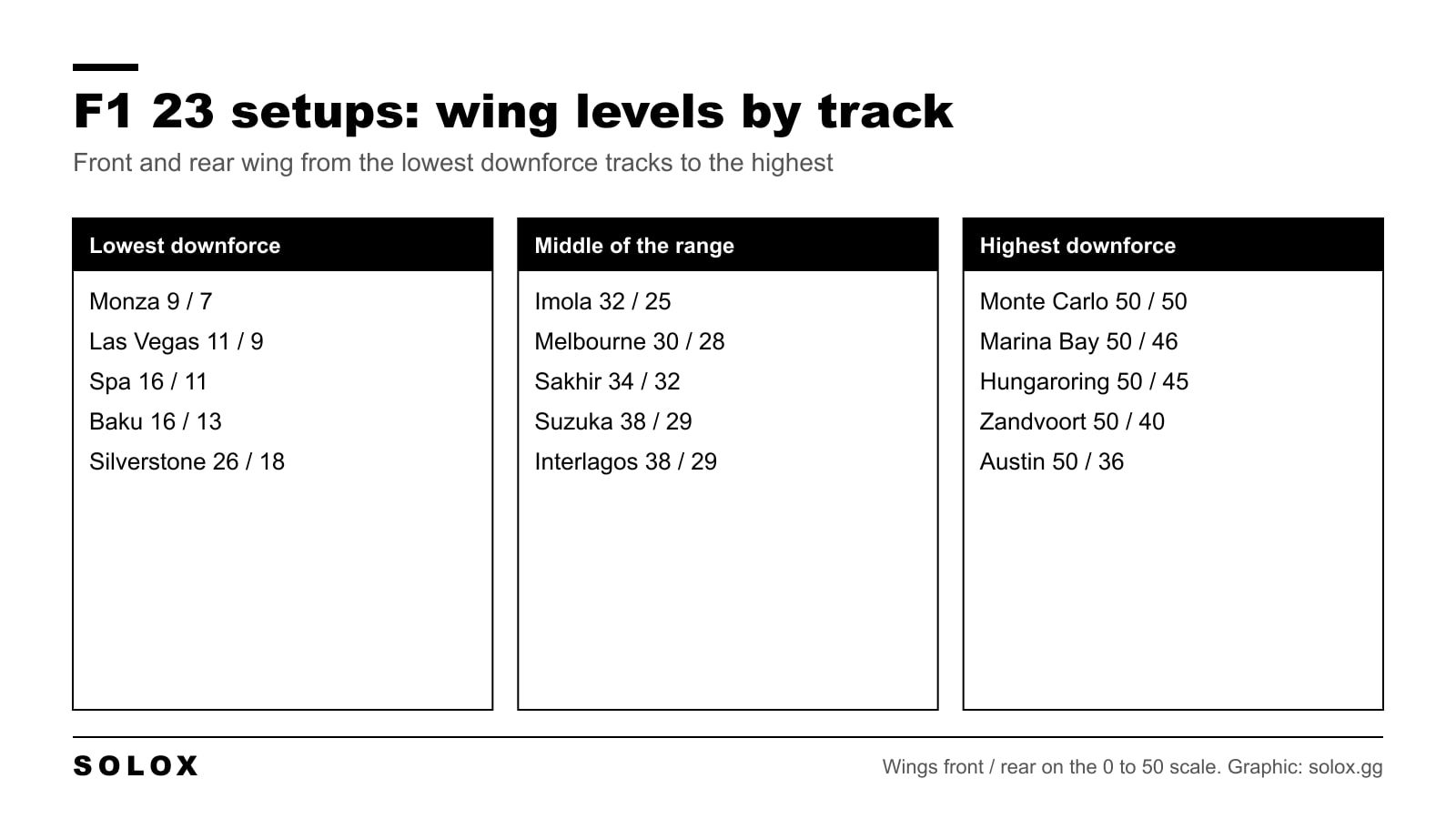
Here are the F1 23 setups for every track on the calendar, in one place. Find your circuit in the table, copy the values, and open the page for the full setup with tyre pressures and camber.
After the tables I explain what the numbers tell you, because the patterns are the same at every track and once you see them you can fix a setup yourself.
F1 23 setups for all 23 tracks
| Grand Prix | Circuit | Wings F / R | Diff on / off | Brake bias | Setup page |
|---|---|---|---|---|---|
| Bahrain | Sakhir | 34 / 32 | 55% / 50% | 55% | Sakhir setup |
| Saudi Arabia | Jeddah | 28 / 24 | 50% / 51% | 54% | Jeddah setup |
| Australia | Melbourne | 30 / 28 | 50% / 50% | 53% | Melbourne setup |
| Azerbaijan | Baku | 16 / 13 | 57% / 51% | 56% | Baku setup |
| Miami | Miami | 28 / 20 | 56% / 50% | 56% | Miami setup |
| Emilia Romagna | Imola | 32 / 25 | 55% / 53% | 53% | Imola setup |
| Monaco | Monte Carlo | 50 / 50 | 55% / 55% | 53% | Monte Carlo setup |
| Spain | Barcelona | 46 / 39 | 50% / 50% | 54% | Barcelona setup |
| Canada | Montreal | 36 / 35 | 55% / 50% | 52% | Montreal setup |
| Austria | Red Bull Ring | 28 / 20 | 55% / 52% | 55% | Red Bull Ring setup |
| Great Britain | Silverstone | 26 / 18 | 50% / 51% | 55% | Silverstone setup |
| Hungary | Hungaroring | 50 / 45 | 50% / 50% | 54% | Hungaroring setup |
| Belgium | Spa | 16 / 11 | 50% / 51% | 55% | Spa setup |
| Netherlands | Zandvoort | 50 / 40 | 55% / 50% | 52% | Zandvoort setup |
| Italy | Monza | 9 / 7 | 55% / 50% | 55% | Monza setup |
| Singapore | Marina Bay | 50 / 46 | 50% / 51% | 54% | Marina Bay setup |
| Japan | Suzuka | 38 / 29 | 50% / 50% | 55% | Suzuka setup |
| Qatar | Lusail | 50 / 36 | 55% / 51% | 55% | Lusail setup |
| United States | Austin | 50 / 36 | 55% / 51% | 55% | Austin setup |
| Mexico | Mexico City | 32 / 24 | 55% / 50% | 56% | Mexico City setup |
| Brazil | Interlagos | 38 / 29 | 53% / 52% | 54% | Interlagos setup |
| Las Vegas | Las Vegas | 11 / 9 | 51% / 51% | 55% | Las Vegas setup |
| Abu Dhabi | Yas Marina | 38 / 33 | 55% / 50% | 54% | Yas Marina setup |
Wings in F1 23 go from 0 to 50. The differential is shown as on throttle and off throttle.
Suspension, ride height and brakes
| Circuit | Suspension F / R | Anti-roll bars F / R | Ride height F / R | Brake pressure |
|---|---|---|---|---|
| Sakhir | 28 / 8 | 6 / 1 | 33 / 36 | 100% |
| Jeddah | 30 / 6 | 13 / 1 | 35 / 39 | 100% |
| Melbourne | 28 / 8 | 6 / 1 | 33 / 36 | 100% |
| Baku | 25 / 16 | 1 / 6 | 30 / 30 | 96% |
| Miami | 24 / 6 | 6 / 1 | 31 / 32 | 100% |
| Imola | 25 / 6 | 7 / 1 | 33 / 34 | 98% |
| Monte Carlo | 41 / 11 | 7 / 5 | 35 / 42 | 100% |
| Barcelona | 41 / 11 | 10 / 5 | 33 / 37 | 100% |
| Montreal | 30 / 8 | 6 / 3 | 34 / 35 | 100% |
| Red Bull Ring | 35 / 6 | 8 / 4 | 33 / 39 | 100% |
| Silverstone | 41 / 15 | 8 / 1 | 32 / 34 | 100% |
| Hungaroring | 30 / 11 | 1 / 1 | 33 / 35 | 100% |
| Spa | 41 / 9 | 3 / 1 | 33 / 38 | 100% |
| Zandvoort | 41 / 12 | 15 / 2 | 24 / 38 | 100% |
| Monza | 41 / 12 | 12 / 1 | 32 / 34 | 100% |
| Marina Bay | 41 / 8 | 1 / 1 | 32 / 36 | 100% |
| Suzuka | 30 / 7 | 9 / 1 | 36 / 37 | 100% |
| Lusail | 41 / 12 | 12 / 1 | 34 / 37 | 100% |
| Austin | 41 / 12 | 12 / 1 | 34 / 37 | 100% |
| Mexico City | 20 / 8 | 8 / 2 | 33 / 36 | 100% |
| Interlagos | 32 / 12 | 6 / 1 | 32 / 35 | 100% |
| Las Vegas | 28 / 7 | 14 / 13 | 32 / 36 | 100% |
| Yas Marina | 28 / 8 | 6 / 1 | 33 / 36 | 100% |
All of these come from fast time trial laps, on the dry, with 10 kg of fuel. Lusail and Austin share the same values. They are a starting point. Your driving style, your wheel or pad and the game version all move the ideal setup a little.
What the numbers tell you
Look down the columns and four things stand out.
The wings decide the character of the setup. Monza runs 9 and 7, Las Vegas 11 and 9, Spa and Baku 16 at the front. At the other end, Monaco is 50 and 50 and Singapore, the Hungaroring and Zandvoort have the front at 50. Everything else sits in between. If you only change one thing between tracks, change this.
The front wing is never lower than the rear. Only Monaco has them equal. The F1 23 car understeers by nature, and a bigger front wing is the cleanest way to get the nose to turn.
The differential is nearly open on throttle. 50% to 57% at every circuit. That lets the rear wheels turn at different speeds out of a corner, so the car puts the power down without snapping. There is no reason to go higher unless you want more rotation on exit and you have the throttle control for it.
Stiff front, soft rear. Front suspension between 20 and 41, rear between 6 and 16. Front anti-roll bars are mostly higher than the rear ones, which sit at 1 at most tracks. A soft rear gives traction. A stiff front keeps the aero platform stable and the steering sharp.
It is the same logic an engineer uses on a real single seater. You set the aero level for the track first, then you use the mechanical side to balance the car at low speed, where the wings do little.
How to adjust a setup to your driving
Do not change five things at once. One change, three laps, then decide.
| Problem | First change | Second change |
|---|---|---|
| Understeer in slow corners | Front wing up 2 or 3 | Off throttle differential down |
| Understeer in fast corners | Front wing up 2 or 3 | Front anti-roll bar softer |
| Rear steps out on the throttle | On throttle differential down towards 50% | Rear wing up 2 |
| Rear is loose on corner entry | Front brake bias up 1 or 2% | Off throttle differential up |
| Slow on the straights | Both wings down by the same amount | Ride height down 1, if the car does not touch |
| Car bottoms out or spins on kerbs | Rear ride height up 1 or 2 | Suspension softer |
| Front tyres lock | Brake pressure down to 95% | Front brake bias down 1% |
| Rear tyres overheat in a race | On throttle differential at 50% | Rear wing up 1 or 2 |
From time trial to race
A time trial setup is built for one lap on new tyres with no fuel. In a race the car is heavy and the tyres have to last. What I would change:
- Add 2 or 3 clicks of wing at both ends on tracks where the tyres suffer, like Barcelona, Silverstone, Suzuka and Lusail. A car that slides less wears its tyres less.
- Take the on throttle differential to 50%. It protects the rears out of slow corners on a full tank.
- Brake pressure 100% is for a wheel with a load cell pedal. On a pad, or without ABS and with a soft pedal, 95% is easier to control.
- Raise the ride height by 1 or 2 if the car touches the ground on the straights with race fuel.
In the wet, add a lot more wing than you think, around 5 to 8 clicks, raise the ride height and soften the car.
Wheel or controller?
The setups work on both. On a controller the car feels more nervous on turn in, so I would go one or two clicks softer on the front anti-roll bar and keep the differential at 50% on throttle.
If you are not sure your wheel works with the game, check the F1 23 compatible wheels and controllers list. And if the AI is too fast or too slow for a fair race, my F1 23 AI difficulty settings show how to find your level.
Setups for the other F1 games
Setup values do not carry over from one game to the next. The scales and the handling change every year. If you play the current game, use my F1 25 setups. For the older ones, there is a full table for F1 2017.
FAQ
What is the best setup in F1 23?
There is no single one. The wing level depends on the track: 9 and 7 at Monza, 50 and 50 at Monaco. Use the table above and pick your circuit.
What is the scale for wings in F1 23?
0 to 50 for both the front and the rear wing.
What differential should I use in F1 23?
On throttle between 50% and 55% at nearly every track. Off throttle around 50% to 53%.
Do F1 23 setups work in F1 24 or F1 25?
No. The handling model and some of the setup scales changed. Use setups made for the game you play.
Can I use time trial setups in a race?
As a base, yes. Add a couple of clicks of wing, lower the on throttle differential to 50% and check the ride height with race fuel.
Do these setups work on a controller?
Yes. Soften the front anti-roll bar by one or two clicks and lower the brake pressure to around 95% to make the car calmer.
How many tracks are in F1 23?
The 2023 calendar in the game has 23 Grands Prix. Las Vegas and Lusail in Qatar were the new circuits that year.