
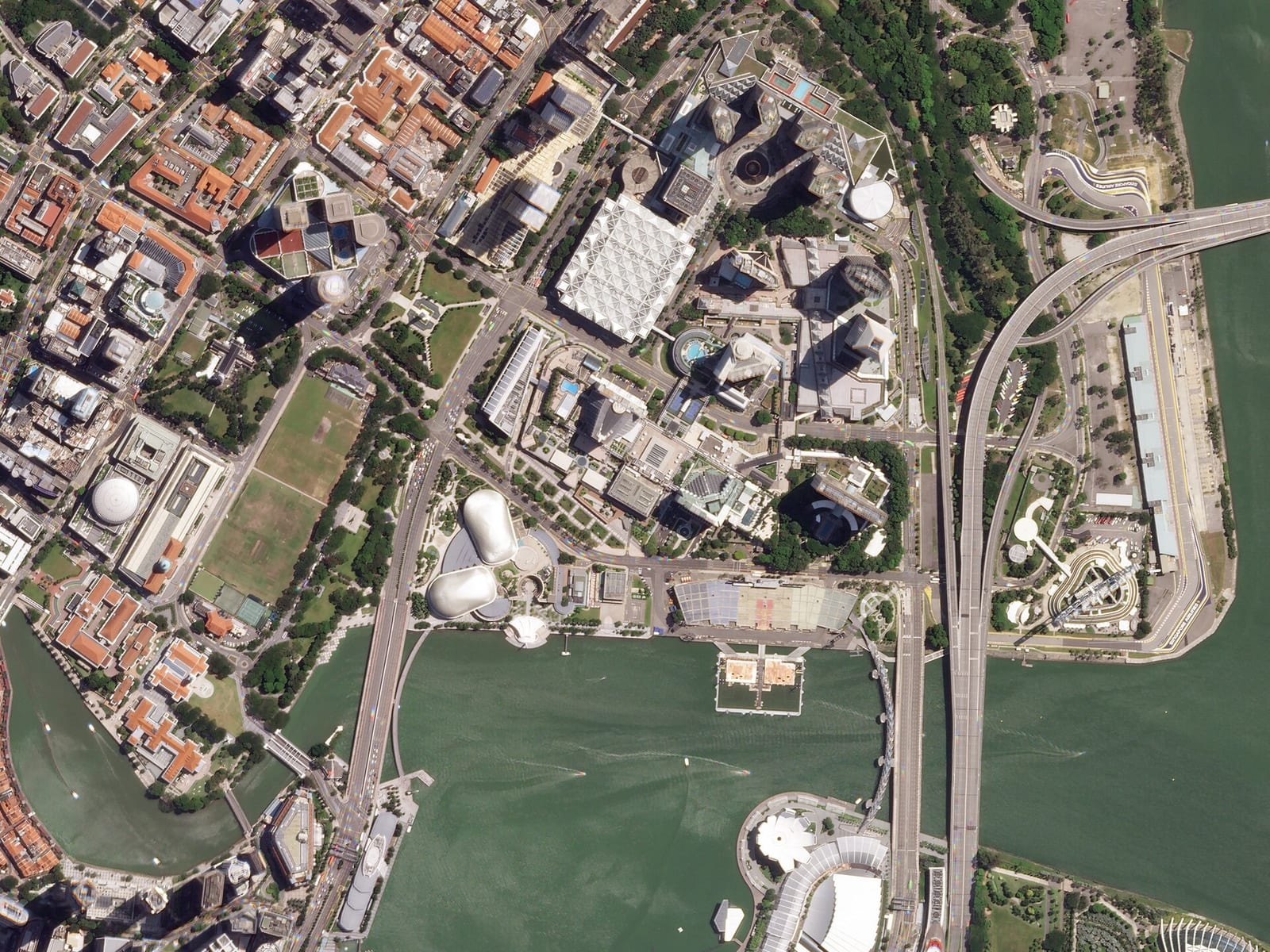
Marina Bay has 23 corners, more than any other track in the game. Most of them are slow, a lot of them are 90 degrees, and there is a wall on the outside of nearly every one. The longest flat out run is short.
So this F1 2020 Singapore setup has all the wing the game gives you, and anti-roll bars that are much stiffer than you would guess. It is a time trial setup, saved with 10 kg of fuel.
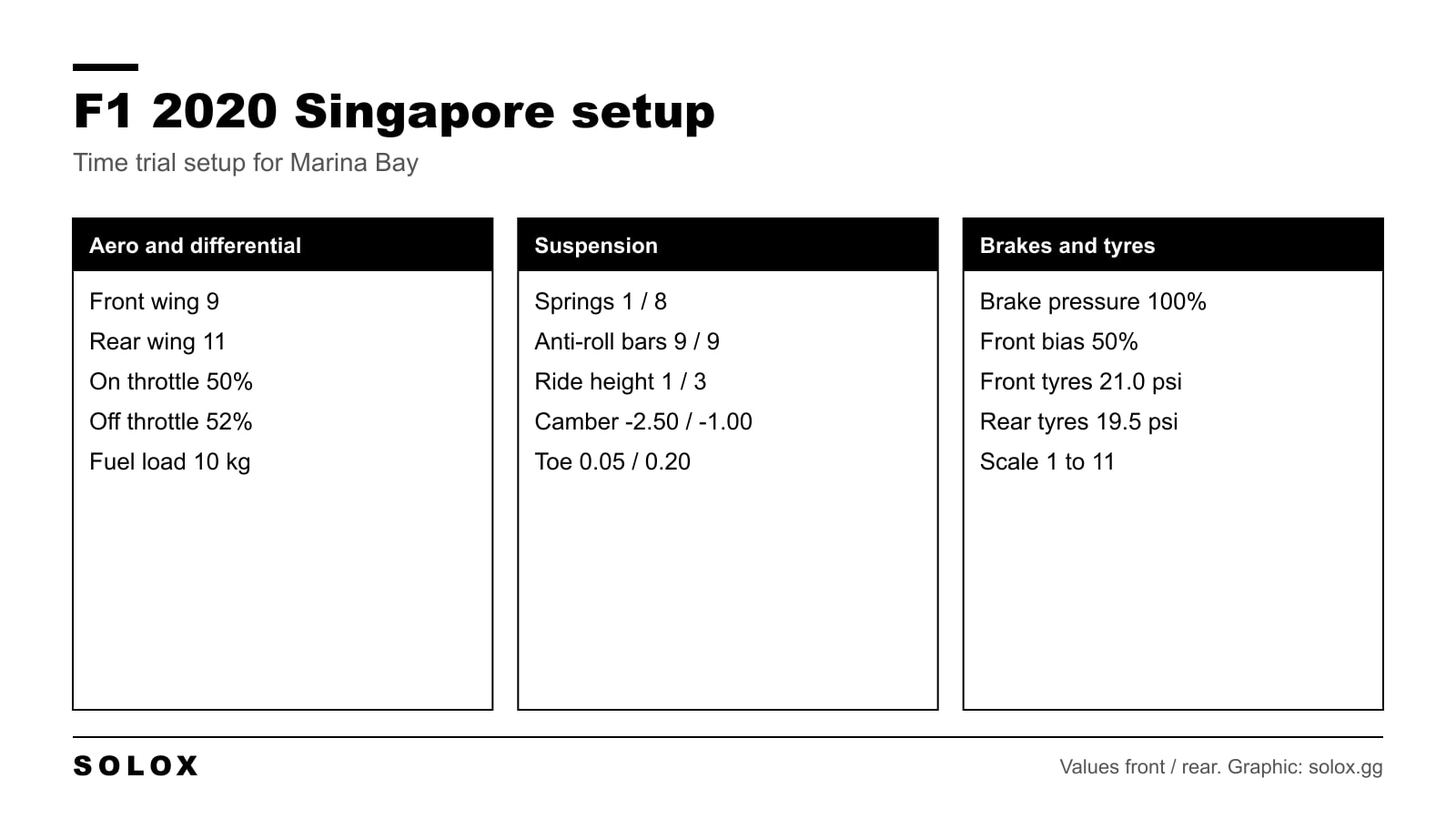
F1 2020 Singapore setup
| Setting | Front | Rear |
|---|---|---|
| Wing | 9 | 11 |
| Camber | -2.50 | -1.00 |
| Toe | 0.05 | 0.20 |
| Suspension | 1 | 8 |
| Anti-roll bar | 9 | 9 |
| Ride height | 1 | 3 |
| Tyre pressure | 21.0 psi | 19.5 psi |
| Setting | Value |
|---|---|
| Fuel load | 10 kg |
| Differential on throttle | 50% |
| Differential off throttle | 52% |
| Brake pressure | 100% |
| Front brake bias | 50% |
In F1 2020 the wings, suspension, anti-roll bars and ride height all use a scale from 1 to 11. The differential goes from 50%, fully open, to 100%, locked.
This setup was collected for the site in 2022 from a fast time trial lap, like the rest of my F1 2020 setups. Use it as a base and adjust it with the table further down.

The lap on board
Why this setup works at Marina Bay
The wings. 9 and 11. The same numbers as my F1 2020 Monaco setup, and more than the other 20 tracks in the list. The rear is at the maximum. There is no straight here long enough to make you pay for it, and there are 23 corners where it helps.
The differential. 50% on throttle, 52% off. Open on the power. That sounds wrong for a track with so many slow exits, but an open differential lets the car turn while you go back on the throttle, and in a 90 degree corner between walls that is what you need. If you get wheelspin, the table further down has the fix.
The camber. -2.50 front and -1.00 rear. Both are the least the game allows. Only four of my 22 setups go this far at the rear. With so little camber the rear tyres sit flat on the road, and that is good for traction and for braking in a straight line. Marina Bay has no long fast corner that would ask for more.
The tyre pressures. 21.0 psi front and 19.5 psi rear, the lowest the menu allows.
Monaco wings, a much stiffer car
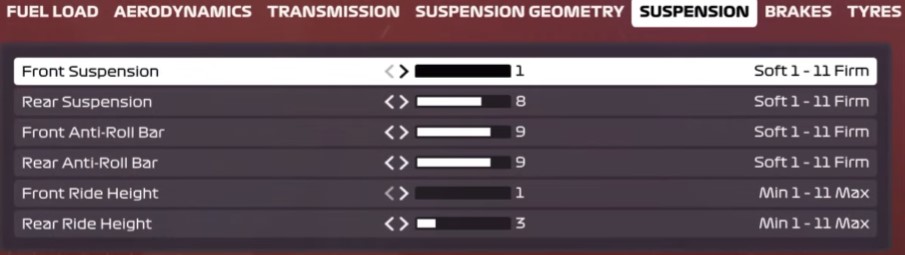
This is where Singapore and Monaco go different ways. The Monaco setup runs anti-roll bars at 1 and 7. This one runs 9 and 9. Only Russia has a stiffer front bar in my list.
A stiff bar makes the car answer fast when you turn the wheel. At Marina Bay you change direction all the time: turns 1 to 3, the section under the grandstand, the corners around the Anderson Bridge. A car that leans and waits costs you a little in every one. The price is that a stiff car is less forgiving on the kerbs and on the throttle.
The springs are 1 at the front and 8 at the rear. Softer at the rear than the 11 that nine of my setups use, which gives some traction back.
Ride height is 1 and 3. That is low for a street circuit. In time trial it works. If the car jumps when you use the kerbs in the last sector, go up one click at each end.
The brakes
Brake pressure 100%, front bias 50%. Every setup in my F1 2020 database runs 100% pressure.
You brake a lot at Marina Bay, but only two stops are really hard: turn 7 and turn 14. The others are short stops from medium speed. With this much wing the car is stable. The risk is the inside front in the slow corners of the last sector, where there is no downforce left to help. If it locks, go to 95%.
What to change
One change at a time, three laps, then decide.
| Problem | Change | Why |
|---|---|---|
| Wheelspin out of turn 13 and the last sector | On throttle differential 50% to 60% | A little lock makes both rear wheels push |
| The car snaps when you touch a kerb | Anti-roll bars 9 and 9 to 6 and 7 | A softer car takes the kerbs better |
| The car jumps over the kerbs | Ride height 1 and 3 to 2 and 4 | More room over the kerbs |
| Understeer in the 90 degree corners | Front anti-roll bar 9 to 7 | A softer front bar gives the front tyres more grip |
| The rear moves on the way into turn 7 | Off throttle differential 52% to 56% | More lock steadies the rear on entry |
| The rear slides in turn 5 and the last two corners | Rear camber -1.00 to -1.30 | A little more camber helps the rear in the faster corners |
| Front tyres lock in the last sector | Brake pressure 100% to 95% | Less peak pressure, easier to hold at the limit |
For a race
With 23 corners and walls everywhere, Singapore is an easy race to throw away. Before a 25% or 50% race I would change this:
- On throttle differential 50% to 60%. 23 corners a lap is a lot of exits. The rear tyres need the help.
- Anti-roll bars 9 and 9 to 7 and 8. A slightly softer car is easier to keep off the wall when you are tired and the tyres are old.
- Brake pressure 100% to 95%. A heavy car locks more easily in the slow corners.
- Fuel. The 10 kg is a time trial number. In a race the game sets the load for the distance.
On a pad, I would go to 60% on throttle, soften the bars in the same way and take the brake pressure down to around 90%.
F1 2020 manages the ERS for you and gives you an overtake button. Use it on Raffles Boulevard after turn 5, and out of turn 13 if you want to try a move into turn 14.
Where the lap time is at Marina Bay
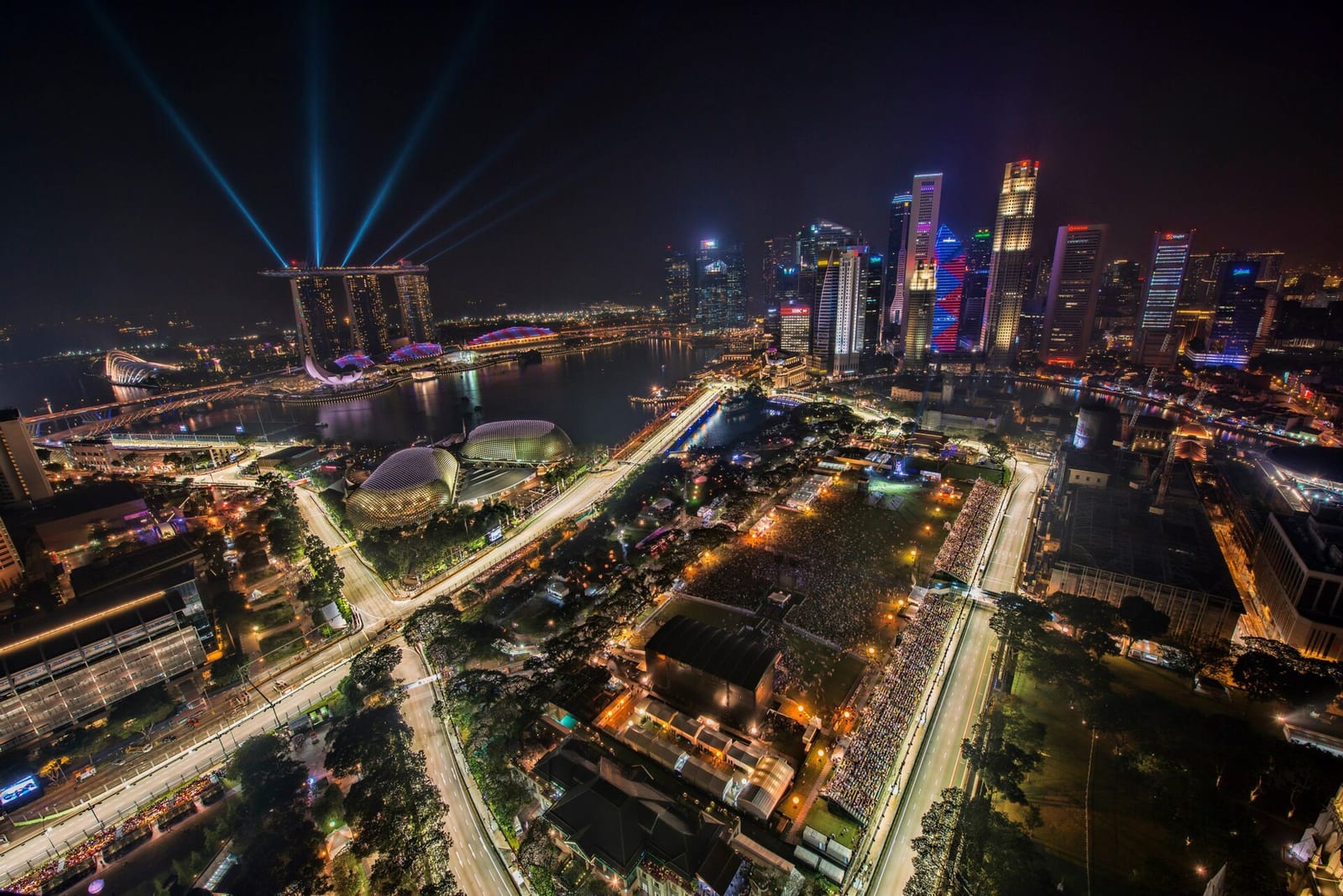
- Turn 1 to turn 3. Left, right, left. Brake in a straight line for turn 1 and be patient in turn 2. The exit of turn 3 is the one that counts.
- Turn 5. A 90 degree right onto Raffles Boulevard, the fastest part of the lap. Go to the throttle early and use the road up to the wall.
- Turn 7. The hardest stop of the lap, into a 90 degree left. Brake late and straight. This is the best passing place.
- Turn 10. A left with the wall close on the way out. Do not ask for too much.
- Turn 11 to turn 13. Over the Anderson Bridge and into the hairpin. Turn 13 is the slowest corner of the lap. Wait until the car is turned, then go.
- Turn 14. A hard stop into a 90 degree right, and the second passing place.
- Turn 16 to turn 21. Slow and tight, under the grandstand. Use the kerbs and find a rhythm. The stiff bars help you here if you are tidy and punish you if you are not.
- Turn 22 and turn 23. Two fast lefts onto the pit straight. Carry the speed and let the car run to the outside.
If you take one thing from this page: leave a small margin to the walls on every exit. A lap at 99% that you finish is faster than a lap at 101% that ends at turn 10.
Singapore in 2020
The 2020 cars never raced at Marina Bay. The Singapore Grand Prix was cancelled in June 2020, together with Azerbaijan and Japan. In the end only 17 of the 22 planned races were run, and 13 races of the original calendar did not happen. The game is the only place where you can drive the 2020 cars here.
The year before, on 22 September 2019, Charles Leclerc took pole in 1:36.217. Sebastian Vettel won the race, Leclerc was second and Max Verstappen third. It is the last win of Vettel's Formula 1 career.
The lap is 5.063 km with 23 corners, and the real race is 61 laps.
More F1 2020 setups
All 22 tracks are on the F1 2020 setups page. The track before Singapore in the game's calendar is Monza, with my F1 2020 Monza setup, and the next one is Sochi, with my F1 2020 Russia setup.
For the same track in other games, here are my F1 2019 Singapore setup, my F1 22 Singapore setup, my F1 23 Singapore setup and my F1 25 Singapore setup. The values do not carry over from one game to the next.
FAQ
What is the best F1 2020 setup for Singapore?
Front wing 9, rear wing 11, differential 50% on throttle and 52% off, suspension 1 and 8, anti-roll bars 9 and 9, ride height 1 and 3, brake pressure 100% with 50% front bias, and tyres at 21.0 and 19.5 psi.
What wing levels should I run in Singapore in F1 2020?
9 at the front and 11 at the rear. It is the same as Monaco. There is no reason to go lower here.
Why are the anti-roll bars so stiff?
So the car answers fast in the quick changes of direction. If it feels nervous on the kerbs, go to 6 and 7.
Can I use this Singapore setup in a race?
Yes. I would raise the on throttle differential to 60%, soften the bars to 7 and 8 and lower the brake pressure to 95%.
Does this setup work with a controller?
Yes. I would run 60% on throttle, softer bars and around 90% brake pressure.
Was there a Singapore Grand Prix in 2020?
No. It was cancelled in June 2020. The last race before that was in 2019, and Sebastian Vettel won it for Ferrari.
How long is the Marina Bay circuit in F1 2020?
5.063 km with 23 corners. The real race is 61 laps.