
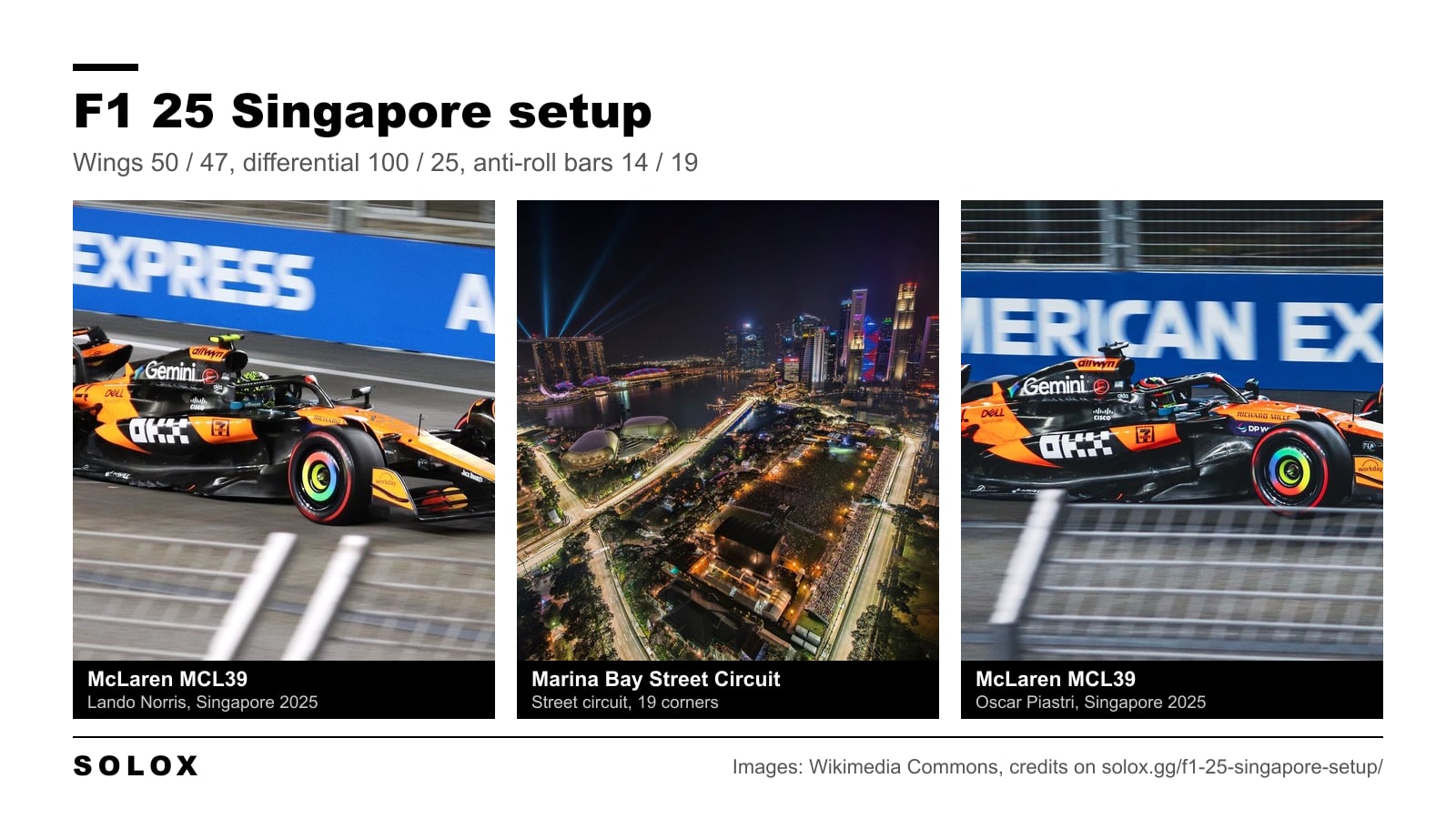
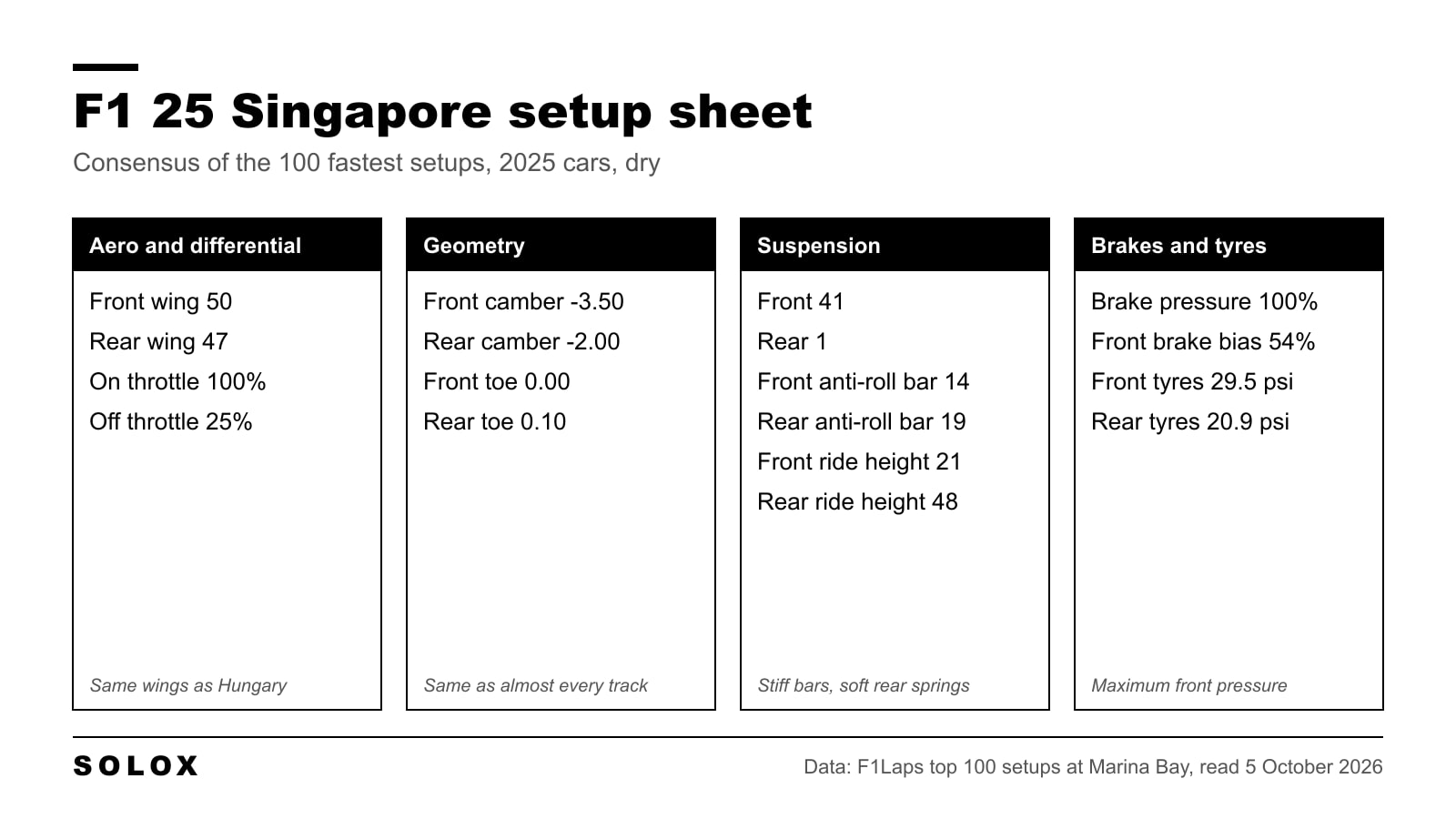
The best F1 25 Singapore setup runs wings at 50 and 47, the differential at 100% on throttle and 25% off, suspension at 41 and 1, anti-roll bars at 14 and 19, ride height at 21 and 48 and front brake bias at 54%. The front wing is at the maximum, and only Monaco runs more at the rear.
The numbers come from F1Laps, which reports what the 100 fastest setups at this track have in common. I read them on 5 October 2026. I have not tested this exact setup in the game, so take it as community data. The reading of it is mine.
F1 25 Singapore setup: dry and wet
These values are for the 2025 cars in the base game.
| Setting | Dry | Wet |
|---|---|---|
| Front wing | 50 | 50 |
| Rear wing | 47 | 47 |
| Differential on throttle | 100% | 80% |
| Differential off throttle | 25% | 25% |
| Front camber | -3.50 | -3.50 |
| Rear camber | -2.00 | -2.00 |
| Front toe | 0.00 | 0.00 |
| Rear toe | 0.10 | 0.10 |
| Front suspension | 41 | 41 |
| Rear suspension | 1 | 1 |
| Front anti-roll bar | 14 | 15 |
| Rear anti-roll bar | 19 | 18 |
| Front ride height | 21 | 21 |
| Rear ride height | 48 | 50 |
| Brake pressure | 100% | 100% |
| Front brake bias | 54% | 54% |
| Front tyre pressures | 29.5 psi | 23.7 psi |
| Rear tyre pressures | 20.9 psi | 21.3 psi |
Why this setup works at Singapore
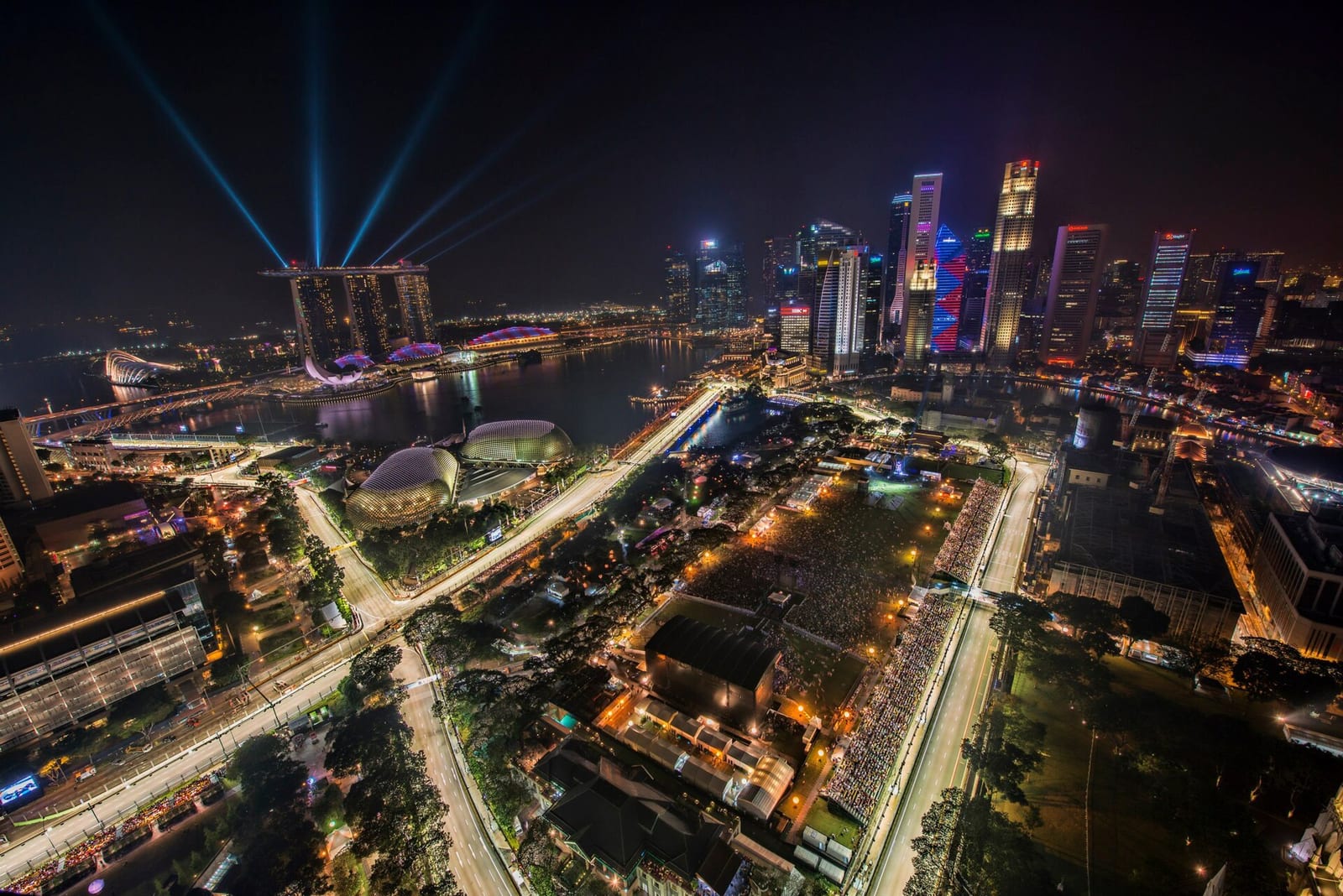
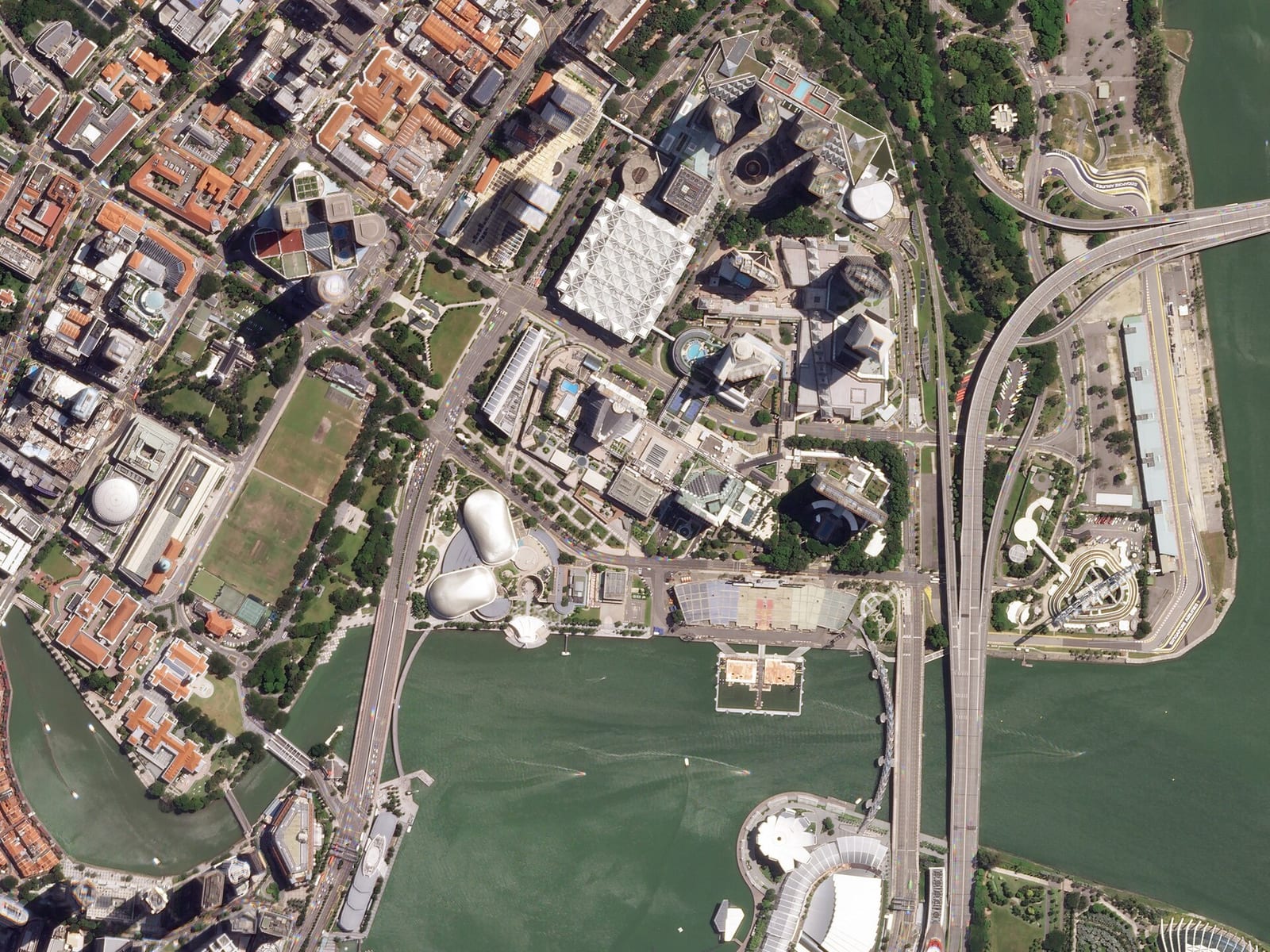
Marina Bay is a street circuit of just under 5 km with 19 corners, and most of them are slow, 90 degree turns between walls. The lap runs anticlockwise. It is one of the longest laps of the year in time, and there is almost nowhere to rest your hands.
On a track like this, lap time comes from three things: rotation in slow corners, traction out of them, and confidence next to the walls. The setup is built around those three.
Wings at 50 and 47. The front wing is at the maximum, shared only with Monaco and Hungary. The rear at 47 matches Hungary, and only Monaco runs more. Drag costs very little here because the straights are short. You can compare it with every other track in my F1 25 setups for every track.
Differential at 100% and 25%. Fully locked on throttle, like 19 of the 24 tracks, for traction out of all those slow corners. Off throttle, 25% is on the open side. Only Suzuka, Zandvoort and Jeddah run less, seven tracks run the same and fourteen run more. An open differential on entry helps the car turn in tight corners.
Camber and toe. Camber is -3.50 and -2.00 and toe is 0.00 and 0.10, the values almost every track uses.
Suspension at 41 and 1. The stiffest front any track runs, shared by fourteen of them, and the softest rear, shared with Shanghai, Suzuka, Mexico City, Zandvoort and Spa. A stiff front gives a sharp turn in. A soft rear puts the power down.
Anti-roll bars at 14 and 19. This is what stands out. The front bar at 14 is the second stiffest of any track. Twenty two run less and only Jeddah runs more. The rear at 19 matches Imola and Lusail, and only Mexico City, Zandvoort and Spa run more. Stiff bars make the car change direction quickly, and Singapore is full of quick left and right combinations.
Ride height at 21 and 48. The front is in the middle of the range. Five tracks run less, nine run the same and ten run more. The rear is high. Eighteen tracks run less, Montreal, Las Vegas and Monza run the same, and only Imola and Monaco run more. The high rear gives the car room over the bumps and kerbs of a street surface.
Brake bias at 54%. The value seventeen of the 24 tracks use. Brake pressure is 100%.
Tyres at 29.5 and 20.9 psi. The fronts are at the highest value any track uses. The rears are low. Only Monaco runs less, and Mexico City, Zandvoort, Barcelona and Austin run the same. Low rear pressures help traction and keep the rear tyres alive over a long lap of acceleration zones.
How to drive it
Brake in a straight line. Most corners here are short and tight. Do the braking before you turn, rotate the car quickly at the apex and get back on the throttle. Trail braking deep into a 90 degree corner between walls costs more than it gives.
Be patient with the throttle. The differential is locked, so both rear tyres spin together if you ask for too much. Feed the throttle in over the first part of the exit and go to full only when the wheel is nearly straight.
The first three corners decide the start of the lap. Turn 1 is a left, Turn 2 a right and Turn 3 a slow left. Give up a little speed in Turn 1 to be on the right line for Turn 3, because the exit of Turn 3 leads onto a straight.
Use the kerbs with care. The high rear ride height lets you take some kerb, but the stiff anti-roll bars make the car jump if you take too much. In the quick changes of direction, touch the kerb, do not ride it.
Leave a margin on exits. The walls are on the outside of almost every exit. Aim to finish each corner half a car width from the wall while you learn the lap, then close the gap.
Look after the rear tyres in a race. A lap with this many traction zones overheats the rears. Short shift out of the slowest corners and the tyres last much longer.
How to adjust it to your driving
Change one thing at a time and drive three clean laps before you judge it.
- The rear slides on corner exit. Lower the on throttle differential from 100% to 85%. This is the first change I would make here.
- The car snaps in the changes of direction. Soften the rear anti-roll bar from 19 to 15.
- The car understeers in slow corners. Soften the front anti-roll bar from 14 to 10.
- The car bounces over the kerbs. Raise the rear ride height from 48 to 50, the value the wet set uses.
- The fronts lock. Move the brake bias back from 54% to 53%, or lower the brake pressure to 97%.
- The rear tyres overheat in the race. Lower the on throttle differential to 80% and be smoother on the throttle.
- You are on a controller. Start with the on throttle differential at 80% and the rear anti-roll bar at 14. My F1 25 controller settings cover the calibration side.
Do not take wing off. There is no straight here long enough to pay it back.
Wet setup for Singapore
The wet setup is almost the same car. Compared with the dry setup:
- The on throttle differential drops from 100% to 80%.
- The front anti-roll bar goes up from 14 to 15 and the rear comes down from 19 to 18.
- The rear ride height goes up from 48 to 50.
- The front tyres drop from 29.5 to 23.7 psi and the rears go up from 20.9 to 21.3.
Wings, off throttle differential, camber, toe, suspension, front ride height, brake pressure and brake bias all stay the same.
The wings are already at or near the maximum, so there is nothing to add for the rain. The one change that matters is the differential. At 80% the rear tyres can turn at different speeds on exit, and the car is far easier to control on a wet street surface.
Singapore setup for the 2026 Season Pack car
The 2026 cars arrived in F1 25 with the 2026 Season Pack. They have their own setups, and a 2025 setup does not carry over. F1Laps files these cars under F1 26. These are the sets for Singapore as I read them on 5 October 2026.
| Setting | 2026 car, dry | 2026 car, wet |
|---|---|---|
| Front wing | 50 | 50 |
| Rear wing | 50 | 49 |
| Differential on throttle | 100% | 80% |
| Differential off throttle | 30% | 30% |
| Engine braking | 50% | 50% |
| Front camber | -3.50 | -3.50 |
| Rear camber | -2.00 | -2.00 |
| Front toe | 0.00 | 0.01 |
| Rear toe | 0.10 | 0.11 |
| Front suspension | 41 | 38 |
| Rear suspension | 3.5 | 4 |
| Front anti-roll bar | 4 | 5 |
| Rear anti-roll bar | 12 | 10 |
| Front ride height | 21 | 22 |
| Rear ride height | 48 | 48 |
| Brake pressure | 100% | 99% |
| Front brake bias | 56% | 56% |
| Front tyre pressures | 23.7 psi left, 24 psi right | 23.7 psi |
| Rear tyre pressures | 20.9 psi | 20.9 psi |
The 2026 car runs both wings at the maximum, 50 and 50. The differential is 100% on throttle and 30% off. The rear suspension goes from 1 to 3.5, and the anti-roll bars come down a long way, from 14 and 19 to 4 and 12. Brake bias is 56%, and the tyres run close to 24 psi at the front and 20.9 at the rear.
The 2026 data on F1Laps still moves from one day to the next. Treat it as a starting point and check the source before a league race.
Other tracks and older games
For the other street circuit at maximum front wing, see my F1 25 Monaco setup. For the permanent track that runs the same 50 and 47 wings, see my F1 25 Hungary setup. For the next track down in wing level, see my F1 25 Zandvoort setup. For another night race with the rear anti-roll bar at 19, see my F1 25 Qatar setup. If you are on an older game, I have a Singapore setup for F1 23.
FAQ
What is the best setup for Singapore in F1 25?
Wings 50 and 47, differential 100% on throttle and 25% off, camber -3.50 and -2.00, toe 0.00 and 0.10, suspension 41 and 1, anti-roll bars 14 and 19, ride height 21 and 48, brake pressure 100%, front brake bias 54%, front tyres 29.5 psi and rear tyres 20.9 psi.
What wing level should I run at Singapore in F1 25?
50 at the front and 47 at the rear, in the dry and in the wet. The front is at the maximum and only Monaco runs more at the rear.
Is Singapore a high downforce track in F1 25?
Yes, it is one of the four maximum downforce tracks, with Monaco, Hungary and Zandvoort. Singapore and Hungary run the same wings.
What is the best wet setup for Singapore in F1 25?
The dry setup with four changes: the on throttle differential at 80%, anti-roll bars at 15 and 18, rear ride height at 50, and tyres at 23.7 psi front and 21.3 rear.
Does the F1 25 Singapore setup work on the 2026 cars?
No. The 2026 Season Pack car runs wings at 50 and 50, the differential at 100% and 30%, suspension at 41 and 3.5, anti-roll bars at 4 and 12 and brake bias at 56%. Use the 2026 table on this page.
Where does this setup come from?
From F1Laps, which analyses the 100 fastest setups its users have driven at Singapore. I read the numbers on 5 October 2026. They can move when the game is patched.