
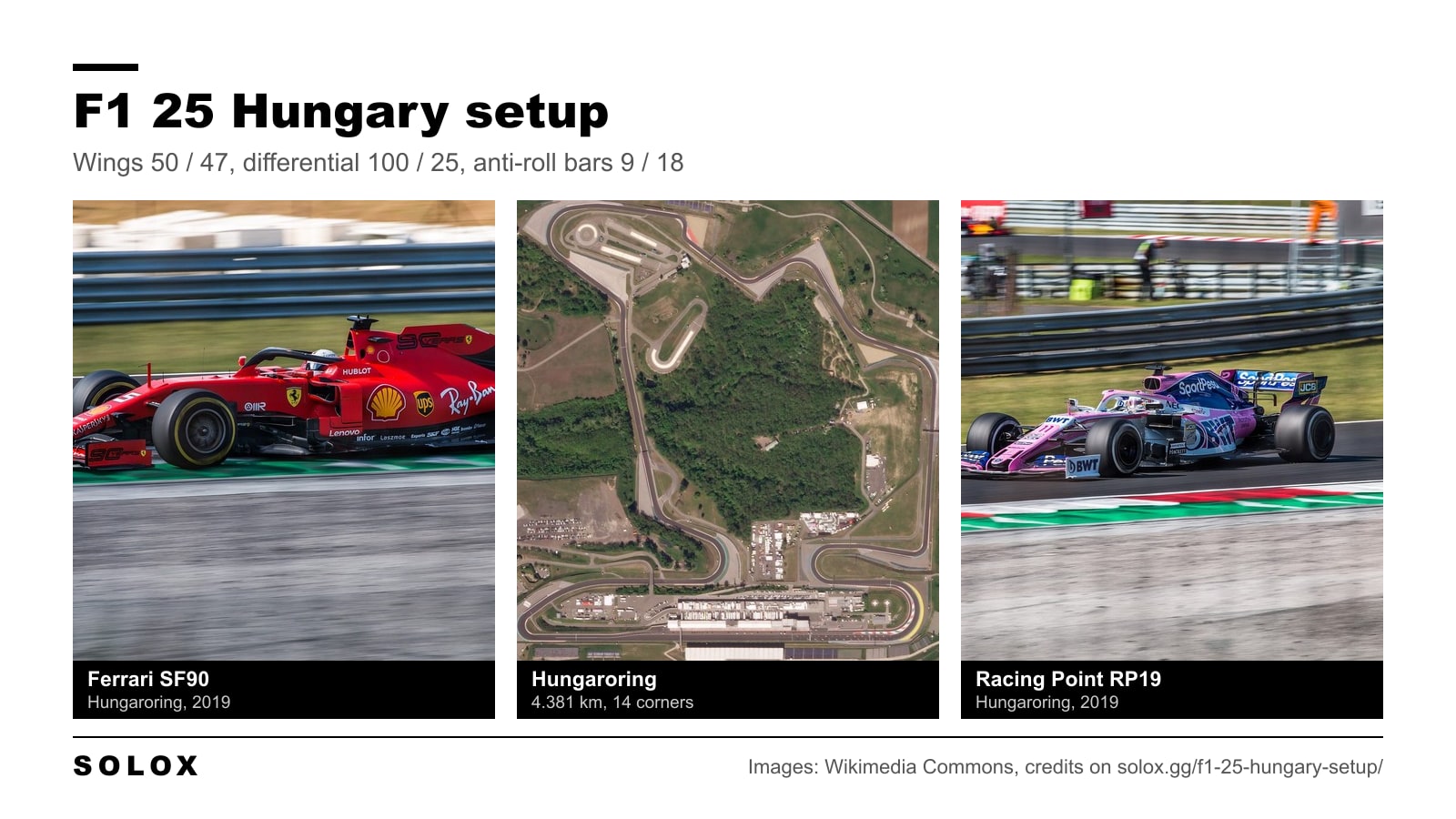
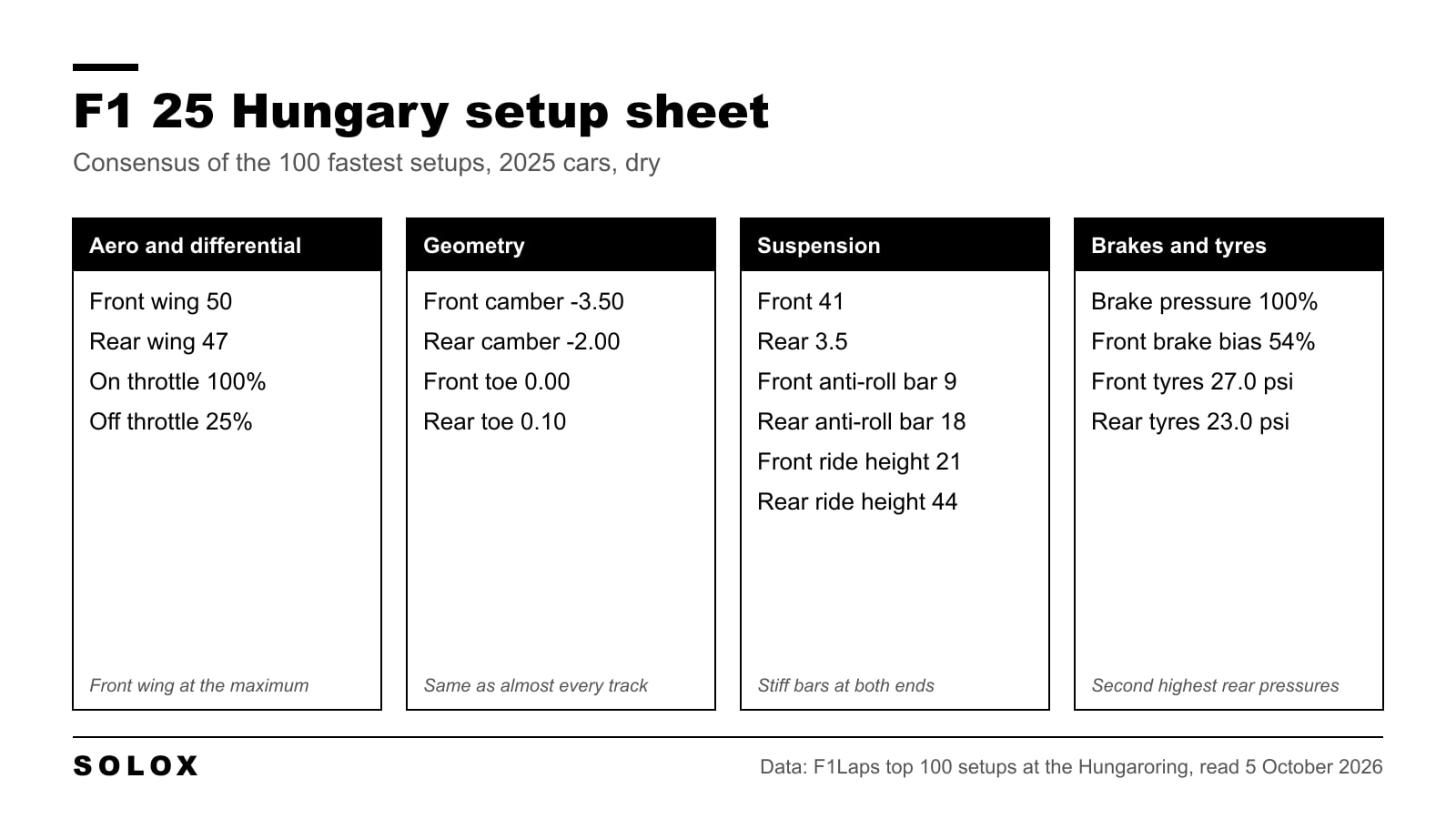
The best F1 25 Hungary setup runs wings at 50 and 47, the differential at 100% on throttle and 25% off, suspension at 41 and 3.5, anti-roll bars at 9 and 18, ride height at 21 and 44 and front brake bias at 54%. It is a maximum downforce setup. The front wing cannot go any higher.
The numbers come from F1Laps, which reports what the 100 fastest setups at this track have in common. I read them on 5 October 2026. I have not tested this exact setup in the game, so take it as community data. The reading of it is mine.
F1 25 Hungary setup: dry and wet
These values are for the 2025 cars in the base game.
| Setting | Dry | Wet |
|---|---|---|
| Front wing | 50 | 48 |
| Rear wing | 47 | 47 |
| Differential on throttle | 100% | 72.5% |
| Differential off throttle | 25% | 30% |
| Front camber | -3.50 | -3.50 |
| Rear camber | -2.00 | -2.00 |
| Front toe | 0.00 | 0.00 |
| Rear toe | 0.10 | 0.10 |
| Front suspension | 41 | 41 |
| Rear suspension | 3.5 | 4 |
| Front anti-roll bar | 9 | 9 |
| Rear anti-roll bar | 18 | 11 |
| Front ride height | 21 | 21 |
| Rear ride height | 44 | 47 |
| Brake pressure | 100% | 100% |
| Front brake bias | 54% | 54% |
| Front tyre pressures | 27 psi | 26.9 psi |
| Rear tyre pressures | 23 psi | 21.05 psi left, 20.9 psi right |
Why this setup works at the Hungaroring
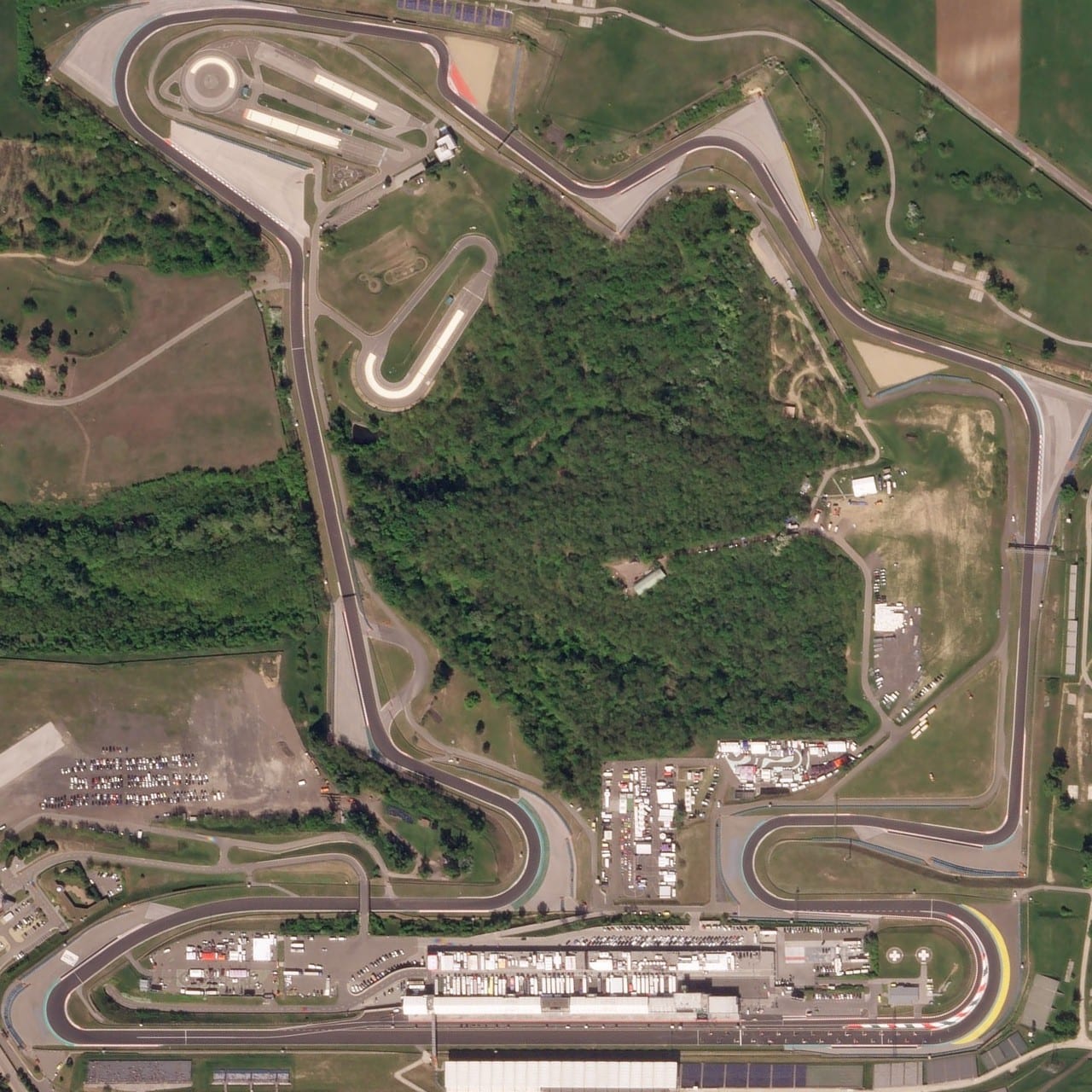
The Hungaroring is 4.381 km long and has 14 corners. I have raced here in real cars, and it feels like a big kart track. One corner leads straight into the next, and the only real rest is the pit straight. There is almost nowhere to use top speed, so drag costs you very little.
That is why the wings are where they are. Every corner is slow or medium speed, and most of them come in pairs, so a mistake in one ruins the next.
Wings at 50 and 47. The front is at the maximum, the same as Monaco and Singapore. At the rear, 47 matches Singapore and only Monaco runs more. This puts Hungary in the maximum downforce group of my F1 25 setups for every track.
Differential at 100% and 25%. Fully locked on throttle, like 19 of the 24 tracks. Off throttle, 25% is on the low side. Only Suzuka, Zandvoort and Jeddah run less, seven tracks run 25%, and fourteen run more. A more open differential off throttle helps the car rotate into the long corners.
Camber and toe. Camber is -3.50 and -2.00 and toe is 0.00 and 0.10, the values almost every track uses.
Suspension at 41 and 3.5. The front at 41 is the stiffest any track runs, shared by fourteen of them. The rear at 3.5 is in the middle of the range, the same as Melbourne and Austria. Eleven tracks run a softer rear and ten run a stiffer one.
Anti-roll bars at 9 and 18. Both are on the stiff side. Fourteen tracks run a softer front bar, and Bahrain and Austin match it. Fifteen run a softer rear bar, and Interlagos matches it. Stiff bars make the car change direction quickly, which is what you need through the chicane and the fast left and right sequences in the middle of the lap.
Ride height at 21 and 44. The front is close to the middle of the range. The rear at 44 is lower than most. Only Interlagos, Suzuka, Mexico City, Zandvoort and Spa run lower, and Jeddah and Silverstone match it.
Brake bias at 54%. The value 17 of the 24 tracks use. Brake pressure is 100%.
Tyres at 27.0 and 23.0 psi. The rear pressures are the second highest in the game. Only Spa runs more. The fronts are lower than at most tracks. Six tracks run less and seventeen run more.
How to drive it
Turn 1 is the overtaking spot. It is the hardest braking zone of the lap and it goes downhill. Brake in a straight line and take a late apex. The exit opens up, so you can use all of the kerb on the way out.
Turn 2 needs patience. It is a long downhill left. Turn in too early and you run out of track before Turn 3. Hold the car in the middle of the road, then cut back to the apex late.
Commit to Turn 4. The fast uphill left is blind on entry. With 50 of front wing the car turns in. A short lift is enough. If you brake here you lose time all the way to Turn 5.
Do not attack the chicane kerbs. At Turns 6 and 7 the stiff anti-roll bars make the car jump if you take too much kerb. Take a little of the first one and stay off the second.
Find a rhythm from Turn 8 to Turn 11. Left, right, left, right, each one a little faster than the last. Lift instead of braking where you can, and place the car for the next corner, not the one you are in. This is where most of the lap time is.
The last two corners decide the straight. Turn 13 is a long left and Turn 14 is a long right onto the pit straight. Be patient with the throttle in both. With the differential locked, too much throttle too early pushes the front wide and you arrive on the straight slower.
How to adjust it to your driving
Change one thing at a time and drive three clean laps before you judge it.
- The rear slides on corner exit. Lower the on throttle differential from 100% to 90%. With this many traction zones, it is the first change I would make.
- The rear is nervous in the fast sequence. Soften the rear anti-roll bar from 18 to 14.
- The car understeers in the long corners. Soften the front anti-roll bar from 9 to 7. The front wing is already at the maximum, so the bar is the tool you have left.
- The car jumps over the chicane kerbs. Raise the rear ride height from 44 to 46.
- The rear tyres overheat in a race. Drop the rear pressures from 23.0 to 22.0 psi and soften the rear anti-roll bar a few clicks.
- The fronts lock into Turn 1. Move the brake bias back from 54% to 53%.
- You are on a controller. Start with the on throttle differential at 80% and the rear anti-roll bar at 12. My F1 25 controller settings cover the calibration side.
Do not take wing off to gain speed on the straight. There is one straight, and what you gain there you lose three times over in the corners.
Wet setup for Hungary
Compared with the dry setup:
- The front wing drops two clicks, from 50 to 48. The rear stays at 47, which moves the balance towards the rear.
- The on throttle differential drops a lot, from 100% to 72.5%. Off throttle goes up from 25% to 30%.
- The rear anti-roll bar goes down from 18 to 11.
- The rear suspension goes up half a click, from 3.5 to 4.
- The rear ride height goes up from 44 to 47.
- Tyre pressures drop. The fronts go from 27.0 to 26.9 psi. The rears go from 23.0 to 21.05 on the left and 20.9 on the right.
Camber, toe, front suspension, front anti-roll bar, front ride height, brake pressure and brake bias do not change.
Everything here is about traction and a calmer rear. That makes sense. In the rain the Hungaroring is one traction zone after another, and a locked differential with a stiff rear bar would spin the car on every exit.
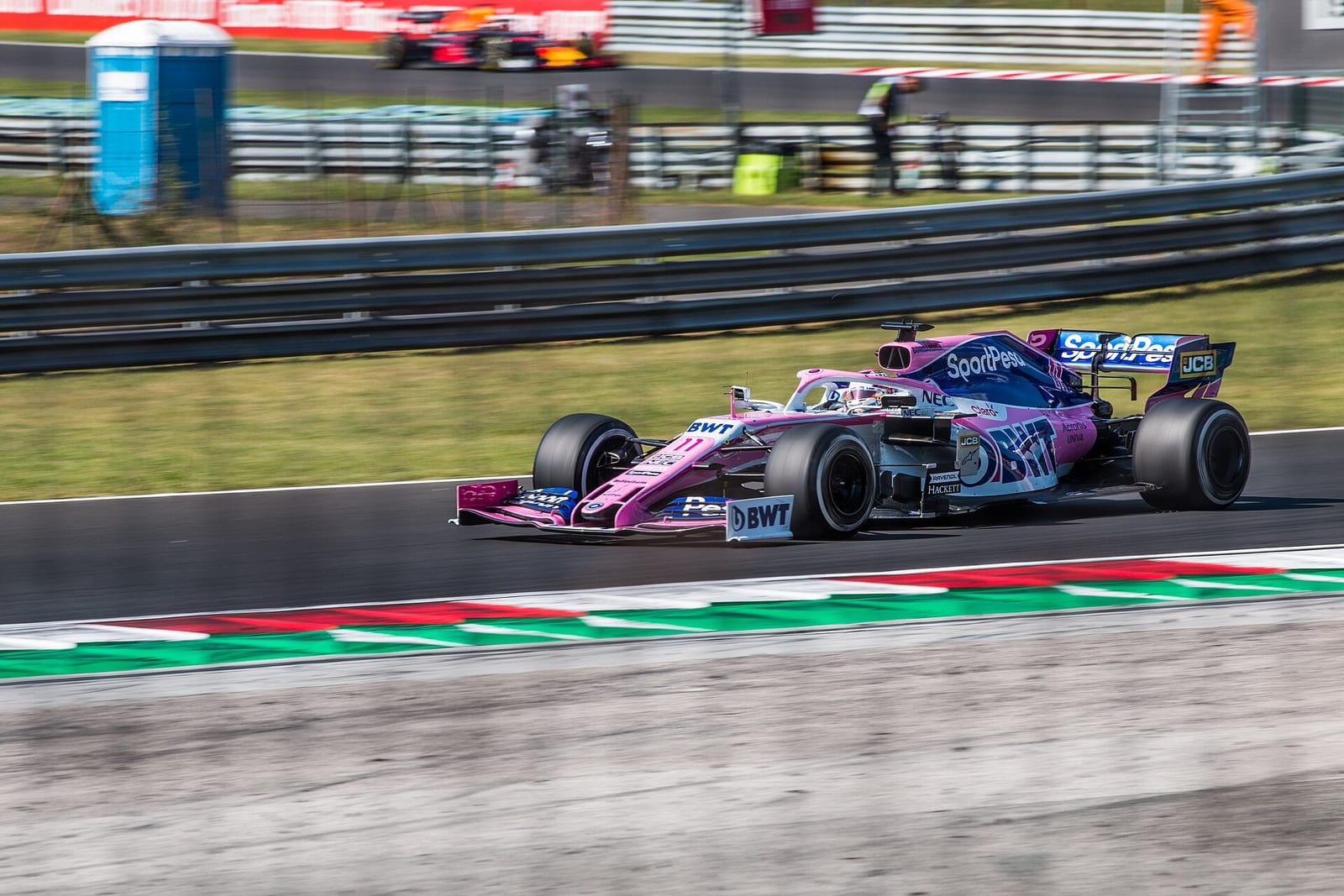
Hungary setup for the 2026 Season Pack car
The 2026 cars arrived in F1 25 with the 2026 Season Pack. They have their own setups, and a 2025 setup does not carry over. F1Laps files these cars under F1 26. These are the sets for Hungary as I read them on 5 October 2026.
| Setting | 2026 car, dry | 2026 car, wet |
|---|---|---|
| Front wing | 50 | 50 |
| Rear wing | 46 | 41 |
| Differential on throttle | 100% | 80% |
| Differential off throttle | 30% | 40% |
| Engine braking | 50% | 50% |
| Front camber | -3.50 | -3.50 |
| Rear camber | -2.00 | -2.00 |
| Front toe | 0.00 | 0.00 |
| Rear toe | 0.10 | 0.10 |
| Front suspension | 41 | 39 |
| Rear suspension | 13 | 16 |
| Front anti-roll bar | 3 | 5 |
| Rear anti-roll bar | 12 | 10 |
| Front ride height | 22 | 22 |
| Rear ride height | 45 | 46 |
| Brake pressure | 100% | 100% |
| Front brake bias | 57% | 56% |
| Front tyre pressures | 28 psi | 28 psi |
| Rear tyre pressures | 22 psi | 21.5 psi |
The 2026 car keeps the wings almost the same, 50 and 46. The differential is 100% on throttle and 30% off. The big changes are in the suspension: the rear goes from 3.5 to 13, the front anti-roll bar from 9 down to 3 and the rear bar from 18 down to 12. Ride height is 22 and 45, brake bias is 57%, and the tyres run 28.0 and 22.0 psi.
The 2026 data on F1Laps still moves from one day to the next. Treat it as a starting point and check the source before a league race.
Other tracks and older games
For the track that runs even more rear wing, see my F1 25 Monaco setup. For another tight, technical lap with a lot of wing, see my F1 25 Imola setup. For the opposite end of the scale, see my F1 25 Monza setup. For the next step down in wing on the same kind of lap, see my F1 25 Zandvoort setup. For the street circuit that runs the same 50 and 47 wings, see my F1 25 Singapore setup. For the other track with the rear anti-roll bar at 18, see my F1 25 Brazil setup. If you are on an older game, I have a Hungary setup for F1 23.
FAQ
What is the best setup for Hungary in F1 25?
Wings 50 and 47, differential 100% on throttle and 25% off, camber -3.50 and -2.00, toe 0.00 and 0.10, suspension 41 and 3.5, anti-roll bars 9 and 18, ride height 21 and 44, brake pressure 100%, front brake bias 54%, front tyres 27.0 psi and rear tyres 23.0 psi.
What wing level should I run at the Hungaroring in F1 25?
50 at the front and 47 at the rear in the dry. In the wet, 48 and 47. Do not go lower to gain top speed. The lap has one straight and fourteen corners.
Is Hungary a high downforce track in F1 25?
Yes, it is one of the four maximum downforce tracks, with Monaco, Singapore and Zandvoort. The front wing is at 50, the highest value the game allows.
What is the best wet setup for Hungary in F1 25?
Wings 48 and 47, differential 72.5% and 30%, suspension 41 and 4, anti-roll bars 9 and 11, ride height 21 and 47 and brake bias 54%. Front tyres run 26.9 psi and rear tyres about 21.
Does the F1 25 Hungary setup work on the 2026 cars?
No. The 2026 Season Pack car runs wings at 50 and 46, the differential at 100% and 30%, suspension at 41 and 13, anti-roll bars at 3 and 12, ride height at 22 and 45 and brake bias at 57%. Use the 2026 table on this page.
Where does this setup come from?
From F1Laps, which analyses the 100 fastest setups its users have driven at the Hungaroring. I read the numbers on 5 October 2026. They can move when the game is patched.