
Every new ACC driver asks the same question: which car is the fastest?
Wrong question. The gap between the best and the worst GT3 car on a given track is a few tenths. The gap between you in a car you know and you in a car you do not is a lot more than that.
So here is how I would choose.
The short version
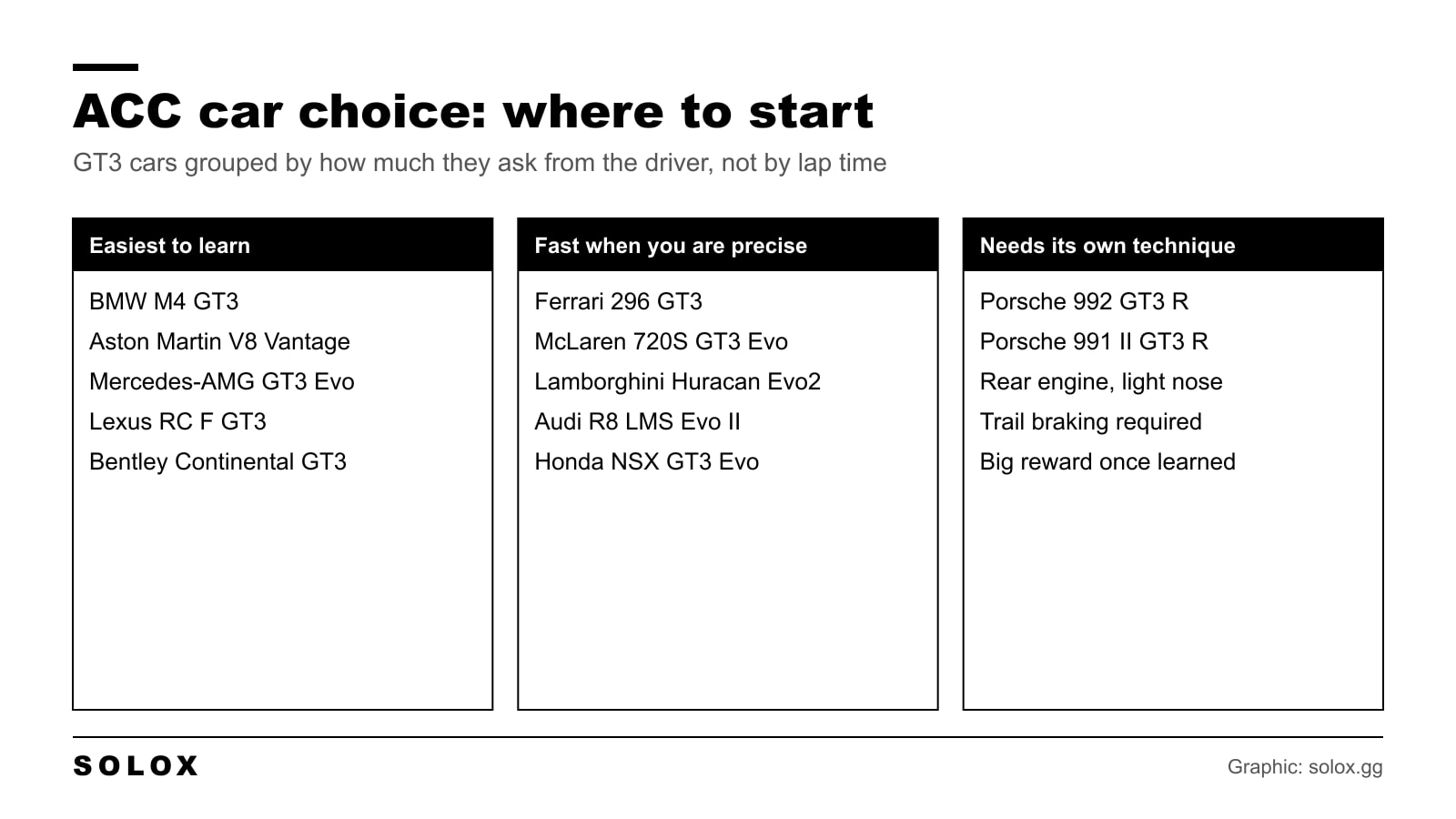
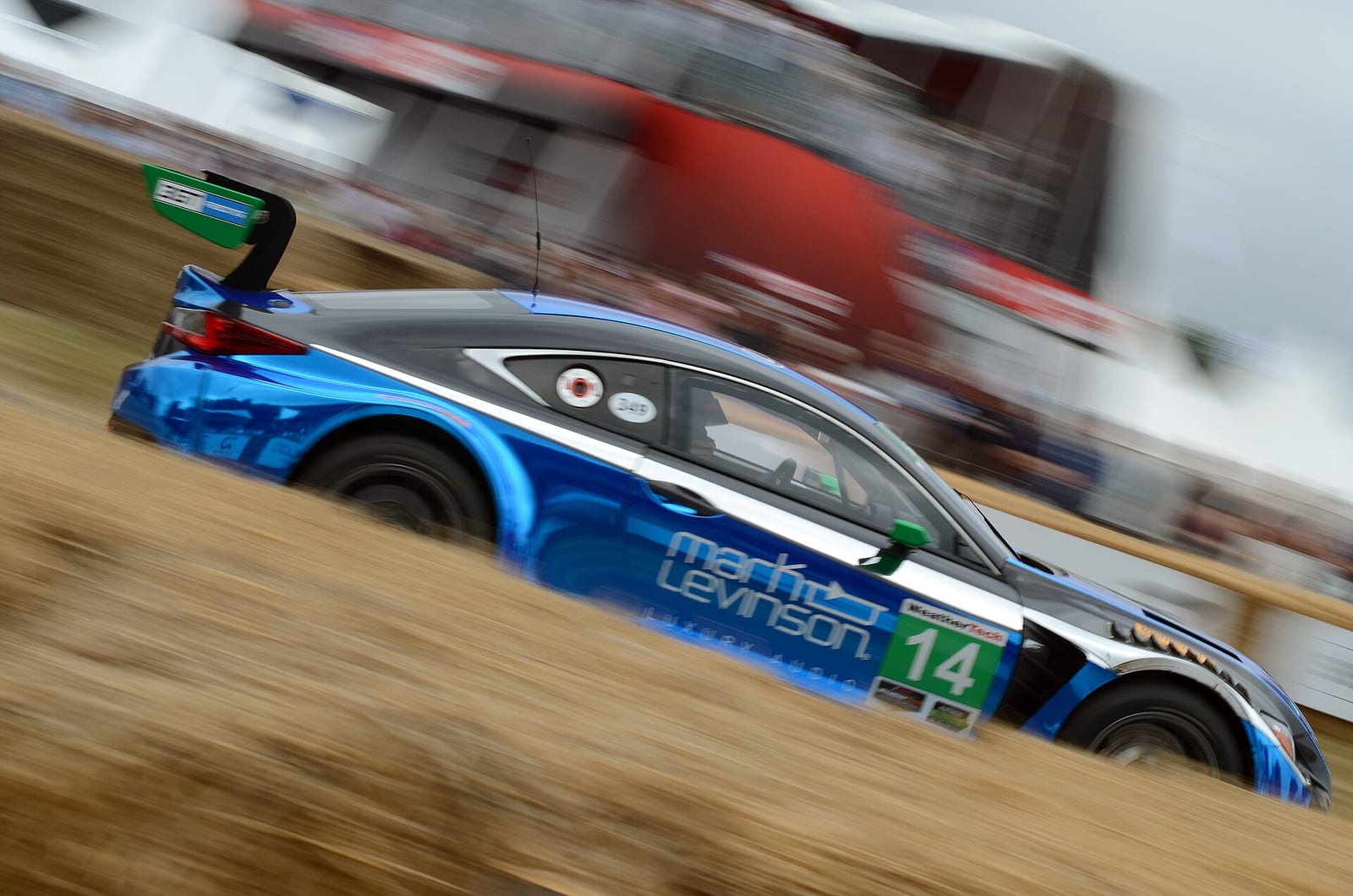
- New to ACC: take a stable front engine car. BMW M4 GT3, Aston Martin V8 Vantage, Mercedes-AMG GT3 Evo or Lexus RC F.
- Want a mid engine car from day one: the Ferrari 296 GT3 is the friendly one.
- Leave the Porsche until trail braking is automatic.
- Whatever you pick, keep it for a month before you judge it.
Why the fastest car does not matter much
GT3 racing runs on balance of performance. Weight, power and ride height limits are adjusted so that very different cars end up with similar lap times. ACC copies that, track by track.
Two things follow from it.
First, the differences are small. A leaderboard shows what the best drivers in the world do with a car at its limit. A few tenths between cars up there is noise for the rest of us.
Second, it moves. Kunos has changed the balance with updates, and the car everybody drove one season is not always the one they drive the next. At the moment the names you hear most for outright pace are the Ford Mustang GT3, the Mercedes-AMG GT3 Evo, the McLaren 720S GT3 Evo and the Ferrari 296. That is the community view today, not a law. If you want the pace side in detail, see the fastest GT3 cars in ACC.
Pick a car because of how it drives, and you never have to care about the next balance change.

The cars I would start with
| Car | Layout | Why it works for a first car | What to watch |
|---|---|---|---|
| BMW M4 GT3 | Front engine | Very stable on the brakes and over kerbs. The name that comes up in almost every beginner thread | Pushes the nose in slow corners |
| Aston Martin V8 Vantage GT3 | Front engine | Predictable and gentle when it slides | Not the quickest to change direction |
| Mercedes-AMG GT3 Evo | Front engine | Stable, strong traction, and quick enough to stay with for years | Long nose, takes a while to place the car |
| Lexus RC F GT3 | Front engine | Calm and strong in a straight line. Often overlooked | Heavy feeling in tight sections |
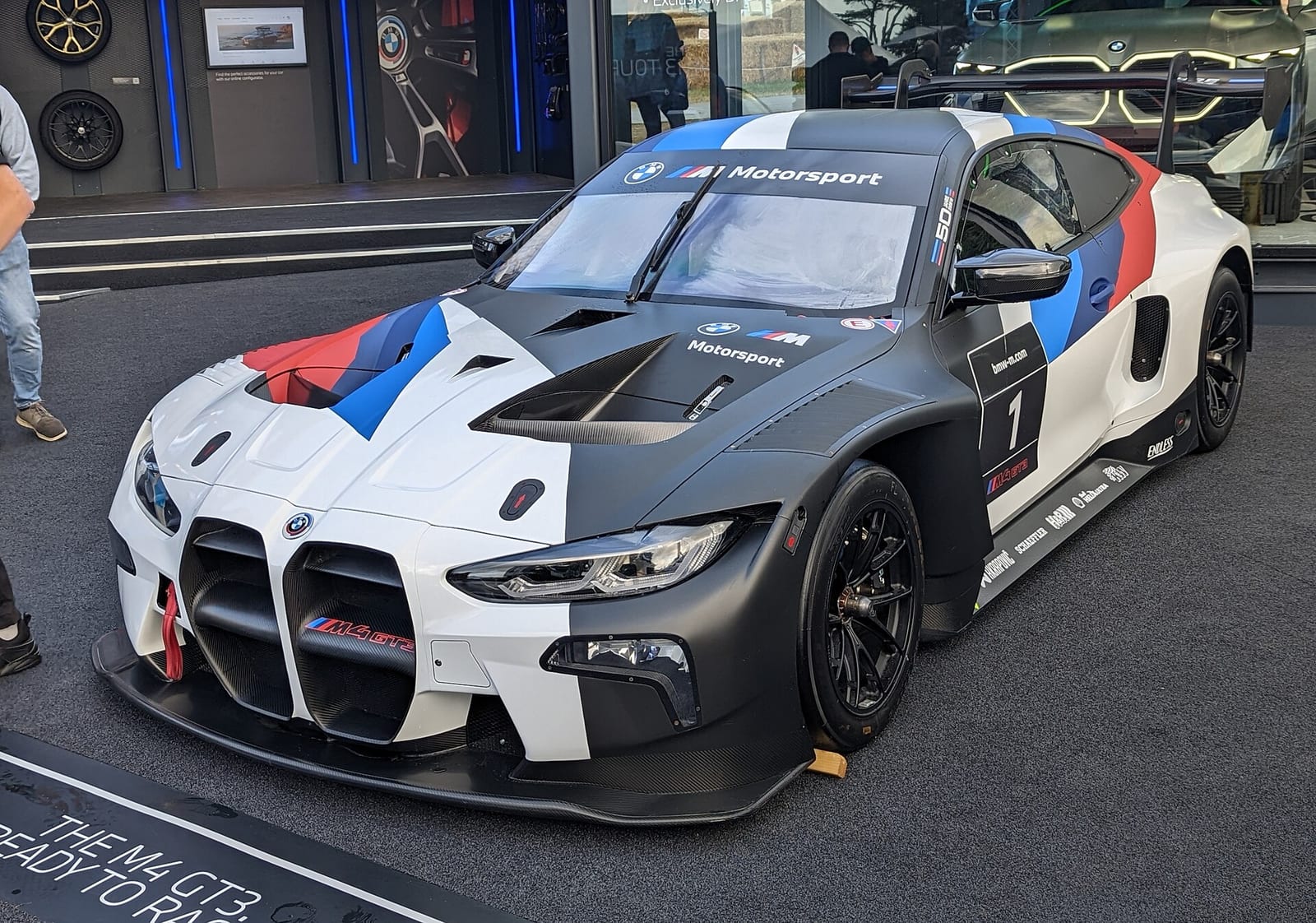
| Ferrari 296 GT3 | Mid engine | The friendliest of the mid engine cars. Good if you want to start with that layout | Still sharper than the front engine cars |
All of these have one thing in common: when you make a mistake, they give you time. The car slides slowly, you catch it, you lose two tenths and carry on. In a nervous car the same mistake is a spin and a ruined race.
Why front engine cars behave like that, and why mid and rear engine cars do not, is explained in front, mid and rear engine cars in ACC.
What changes from car to car
Forget the brand for a moment. These are the things that actually differ.
- Engine layout. Front engine cars are stable and push. Mid engine cars rotate and snap. The Porsche is its own thing.
- Braking stability. Some cars stay straight when you hit the pedal hard. Others move around and need a softer first hit.
- Kerb riding. At Monza or Imola a car that takes kerbs is worth more than a car with two more km/h.
- Top speed against downforce. Some cars are quick on the straights and need care in fast corners. Others are the opposite.
- Tyre wear. A car that is kind to its tyres is easier over a one hour race. More in the ACC tyre wear guide.
- How it feels through the wheel. This one is personal, and it counts. If you do not trust what the car tells you, you will not push it.
Car choice by track type
| Kind of track | Examples | What helps there |
|---|---|---|
| Long straights, few corners | Monza, Paul Ricard | Top speed and stability on the brakes |
| Fast and flowing | Spa, Silverstone, Suzuka | Aero grip and a stable rear in quick corners |
| Slow and twisty | Hungaroring, Zolder, Brands Hatch | Rotation and traction out of slow corners |
| Kerbs and bumps | Monza chicanes, Imola, Bathurst | A car that rides kerbs without snapping |
Use this to understand why your car feels good at one track and hard at another. Do not use it to change car every week.
If you race in a league where everybody picks one car for the season, look at the calendar. Count how many tracks are fast and how many are slow, and choose for the majority. A car that is second best everywhere beats a car that is the best at two tracks and a handful at five.
A simple test to find your car
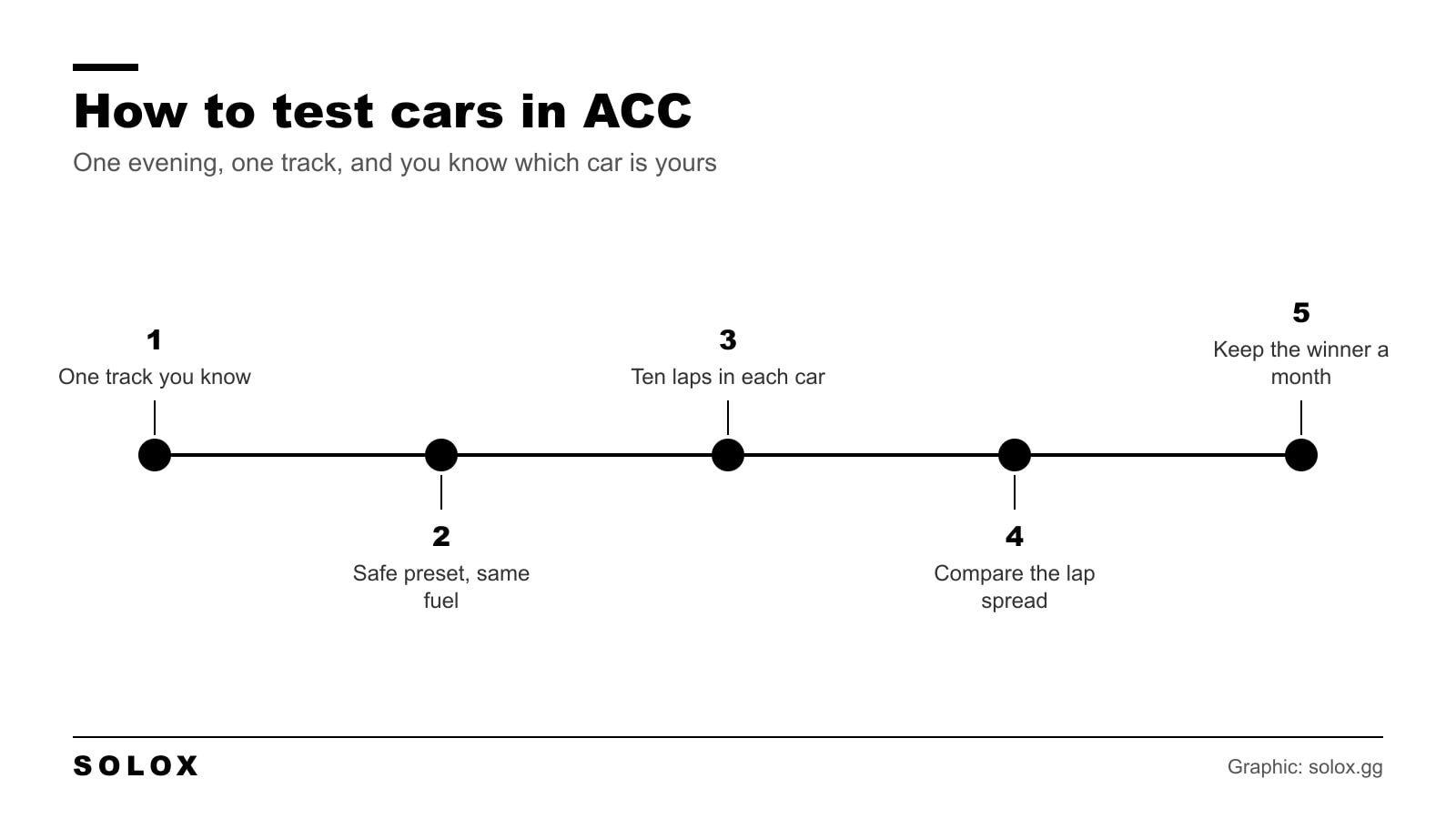
- Choose one track you know well. Not your best one, a normal one. A mix of fast and slow corners is ideal.
- Load the safe preset in every car. Same fuel, same conditions, same time of day. Check the tyre pressures are in the window, which I explain in the ACC tyre pressure guide.
- Do ten laps in each car. Five cars is enough. Throw away the first two laps.
- Look at the spread, not the best lap. The car where your eight laps sit within three or four tenths is your car. A car that gave you one great lap and three offs is not.
- Keep the winner for a month. No switching. Learn the setup with the ACC setup guide and only then decide if you want something else.
The honest signal in this test is trust. In one of those cars you will brake later without thinking about it. That is the one.
When to switch car
Not after a bad race. Everybody blames the car after a bad race.
I would switch only for one of these reasons:
- You have done a month in the car and you still fight the same problem that setup does not fix.
- Your driving has changed. You are smoother now, and a mid engine car would reward it.
- Your league or team needs a specific car.
When you do switch, give the new one the same month. The first week in a new car is always slower.
What about GT4 and the other classes?
GT4 cars are slower, softer and have less aero. They are a very good place to learn racecraft, and the same logic applies: stable car first. The differences between the two classes are in ACC GT3 vs GT4.
Most online racing is GT3 though. If your goal is public lobbies and ranked races, learn a GT3 car. Every car in the game, class by class, is in the ACC cars list.
FAQ
What is the best car for beginners in ACC?
A stable front engine GT3 car. The BMW M4 GT3 and the Aston Martin V8 Vantage are the most common answers, and the AMG Evo and Lexus RC F are just as easy.
What is the fastest car in ACC?
It depends on the track and on the current balance of performance. The Ford Mustang GT3, AMG Evo, McLaren 720S Evo and Ferrari 296 are the names you hear most at the moment.
Does car choice matter in ACC?
Less than people think. The cars are balanced to within a few tenths. How well you know your car matters far more.
Should I use a different car for each track?
No, not while you are learning. One car at every track makes you faster than the perfect car at each one.
Is the Porsche 911 GT3 R good for beginners?
Some people recommend it. I would wait. It has a light nose and needs trail braking from the first corner.
Are the older GT3 cars slower in ACC?
In general the newer versions are a little quicker and easier, so I would start with the latest model of a car.
How long should I stay with one car?
At least a month of regular driving. You need that long to learn its braking points, its setup and how it behaves on old tyres.