
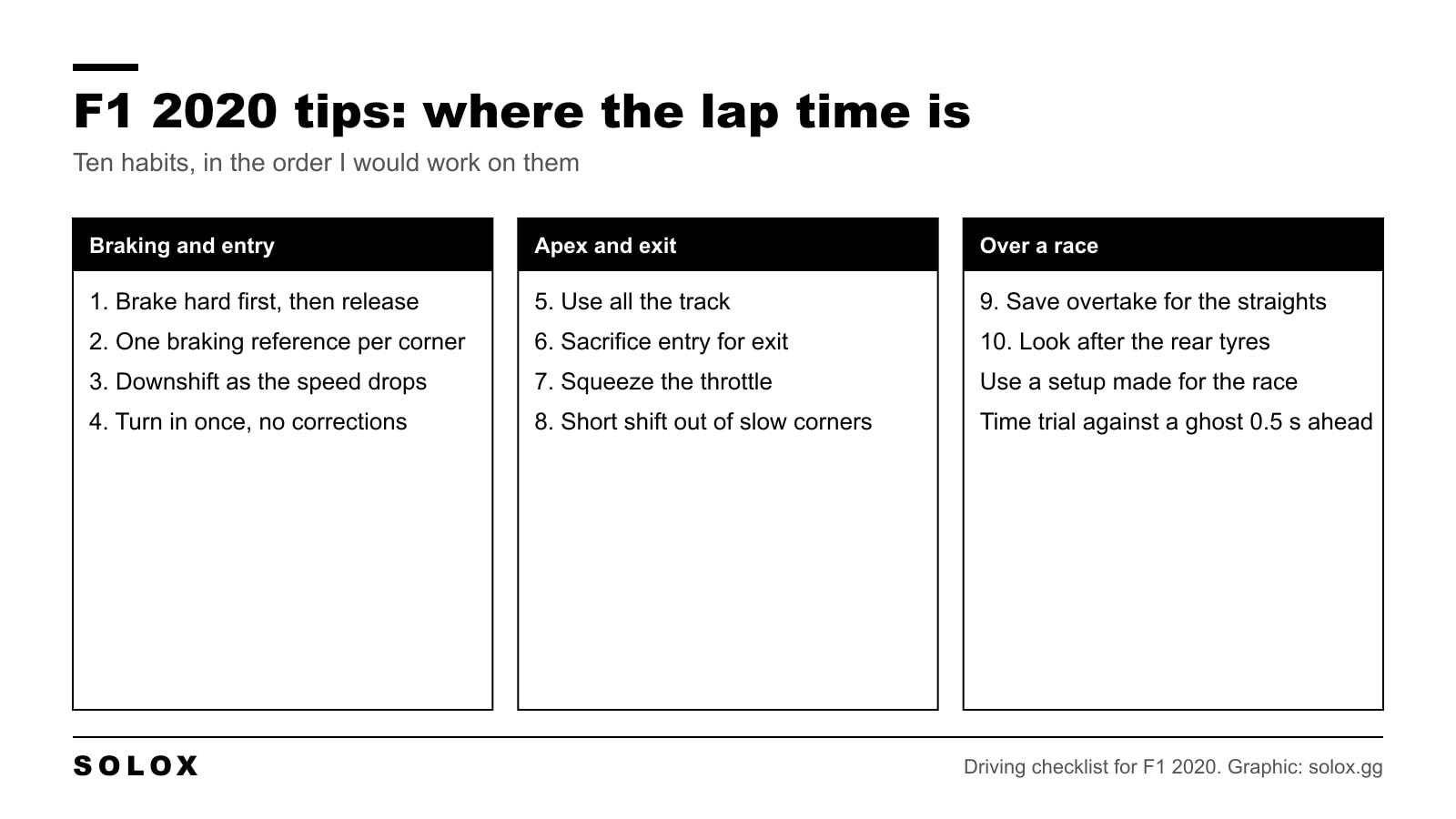
An F1 car is not hard to drive slowly. The grip is huge and the brakes are incredible. The hard part is the last second of lap time, and it comes from a few habits that are the same in the game and in a real single seater.
Here are the ten I would work on, in this order.
1. Brake hard first, then release
In a road car you press the brake softly and then harder. In an F1 car you do the opposite.
At top speed the car has its maximum downforce, so the tyres can take the most braking. Hit the pedal at 100% right away. As the speed drops, the downforce goes away, and the same pressure will now lock a wheel. So you let the pedal come up, little by little, all the way to the apex.
Hard first, then release. If you learn one thing from this page, make it this one. There is a full guide to the last part of it in my trail braking article.
2. One braking reference per corner
"I brake when it feels right" is not a braking point. You need something that does not move: the 100 metre board, the end of a kerb, a marshal post, a patch on the tarmac.
Pick one for every corner. Brake there every lap. When the lap is clean, move it 5 metres later. When you miss the apex, move it back. That is how you find the limit without crashing every second lap.
It is also why I would turn the full racing line off early. It changes colour, but it does not give you a fixed point. More on that in my F1 2020 assists guide.
3. Downshift as the speed drops
With manual gears, do not pull four downshifts in the first half second. The rear wheels slow down too fast and the back of the car steps out.
Brake first. Then go down one gear at a time as the revs fall. In the slow part of the corner, the last downshift helps the car rotate. Too early and you spin. Too late and you get understeer.
If you are still on automatic gears, this is the reason to change. Manual gives you control of how the car turns in.
4. Turn in once
Watch a replay of your own lap from the cockpit. If your hands move left, right, left in one corner, you are scrubbing speed.
A good corner has one steering input. You turn in, you hold it, you open the wheel on the exit. If you need a second input, you turned in too early or you came in too fast.
Slow hands make a fast car. With a pad it is even more true: roll the stick, do not flick it.
5. Use all the track
The track is as wide as the white lines, plus the kerbs you can drive on. Use it.
- Entry: start from the outside edge. All the way out, tyres on the line.
- Apex: touch the inside kerb. If you are a metre away, you are driving a longer and tighter corner than you need to.
- Exit: let the car run out to the exit kerb. If you have space left on the exit, you could have gone faster in the middle.
Track limits are strict in time trial. Go too far over the white line and the lap does not count, so find out in practice how much kerb the game gives you.
Not every kerb is your friend. The flat ones are fine. The high sausage kerbs unsettle the car and can spin you. Learn which is which in practice.
6. Give up the entry to win the exit
Braking very late feels fast. Often it is slow.
If you brake so late that you miss the apex, you wait longer before you can go back on the throttle. You lose that time on the whole straight after the corner. It is always a bad trade before a long straight.
Brake 5 metres earlier, get the car turned, and go to the throttle early. You will see it in the speed at the end of the straight.
The corners that matter most are the ones before the longest straights. Find them on every track and make their exits your priority.
7. Squeeze the throttle
These cars have close to 1000 horsepower. In second and third gear the rear tyres cannot take all of it.
Out of a slow corner, go from 0% to 100% in about two seconds, not in two tenths. Open the steering as you add throttle. The straighter the wheel, the more power the tyres can take.
If you spin on exits with traction control off, it is nearly always because the throttle came too fast while the wheel was still turned.
8. Short shift out of slow corners
This one is free lap time. Out of a hairpin, take third gear early, before the revs are high. Less torque goes to the rear wheels, so you get less wheelspin and you can use more throttle.
It also saves the rear tyres over a race. In the wet it is the difference between a clean exit and a spin.
9. Use overtake mode on the straights
F1 2020 made the battery simple. There is one overtake button. Press it and the car gives you extra electric power. Leave it off and the battery charges.
- Use it out of the corner onto a long straight, where the extra speed stays with you for the longest time.
- Turn it off before the braking zone. It is a toggle, and if you forget, the battery is empty in a lap or two.
- In a race, keep some for when you attack or defend. A full battery with the car behind you inside one second is worth more than a slightly faster empty lap.
In qualifying, start the lap with a full battery and use it on every real straight.
10. Look after the rear tyres
Over a race, the driver who slides less is faster at the end of the stint. Wheelspin on exits and sliding in fast corners heat the rear tyres, and hot tyres wear faster.
Watch the tyre temperatures on the multi function display. If the rears go up lap after lap, be softer with the throttle and short shift more.
You can also help the car from the cockpit. Brake bias and differential can be changed while you drive. A little less on throttle differential makes the rear calmer on the exit when the tyres are old.
A setup made for a race distance helps a lot here. Time trial setups are often too hard on the tyres. Mine are in the F1 2020 setups hub, track by track.
How to practise
Laps alone do not make you faster. Laps with one goal do.
- Go to time trial. Same car, same grip, no fuel or tyre wear. The only thing that changes is you.
- Load a ghost about half a second faster than you. Not the world record. You cannot learn from a car that leaves after two corners. You can learn from one that brakes 5 metres later than you.
- Work on one corner. Find where the ghost gains the most. Fix that corner. Then the next.
- Ten clean laps before you push. Consistency first. A driver who does ten laps inside three tenths will beat a driver with one fast lap and three spins.
- Stop when you are tired. After an hour your lap times go up and you practise mistakes.
What to fix first
| Problem | Likely cause | Fix |
|---|---|---|
| You lock the fronts into slow corners | You hold 100% brake too long | Release the pedal as the speed drops |
| You miss the apex | Braking too late | Brake 5 to 10 metres earlier |
| The rear steps out on entry | Downshifts too early | Wait for the revs to fall |
| You spin on the exit | Throttle too fast with steering on | Squeeze, open the wheel, short shift |
| Slow at the end of the straights | Bad exit, or no battery | Earlier throttle, save overtake for there |
| Fast for five laps, then slow | Rear tyres too hot | Softer throttle, less sliding |
| Lap times all over the place | No fixed references | One braking point per corner |
Next steps
- Check the basics: F1 2020 wheel settings or F1 2020 controller settings, and the camera in my F1 2020 FOV settings.
- Take the assists off in the right order with the F1 2020 assists and AI difficulty guide.
- The same habits work in every sim. My general sim racing tips go deeper.
- On the next game? Read my F1 2021 tips.
FAQ
How do you get faster in F1 2020?
Work on braking first. Brake hard at a fixed point, release the pedal as the car slows, and get on the throttle early. Then practise in time trial against a ghost that is a little faster than you.
Is F1 2020 hard for beginners?
Not with the assists on. Start with anti lock brakes, Medium traction control and the racing line in corners, then remove them one at a time.
Should I use manual gears in F1 2020?
Yes, when you know the tracks. You can short shift to stop wheelspin and use the downshifts to help the car turn. It is faster once it is a habit.
What is the best way to learn a track in F1 2020?
Time trial, ten slow laps first. Find a braking reference for each corner, then build speed. The practice programmes in career mode are also good for this.
How do you use ERS in F1 2020?
With the overtake button. Turn it on for the long straights and off again before the braking zone. The battery charges when it is off.
Why do I keep spinning in F1 2020?
Mostly because of too much throttle too early, with the steering still turned. Squeeze the throttle, open the wheel and take the next gear early. Medium traction control helps while you learn.