
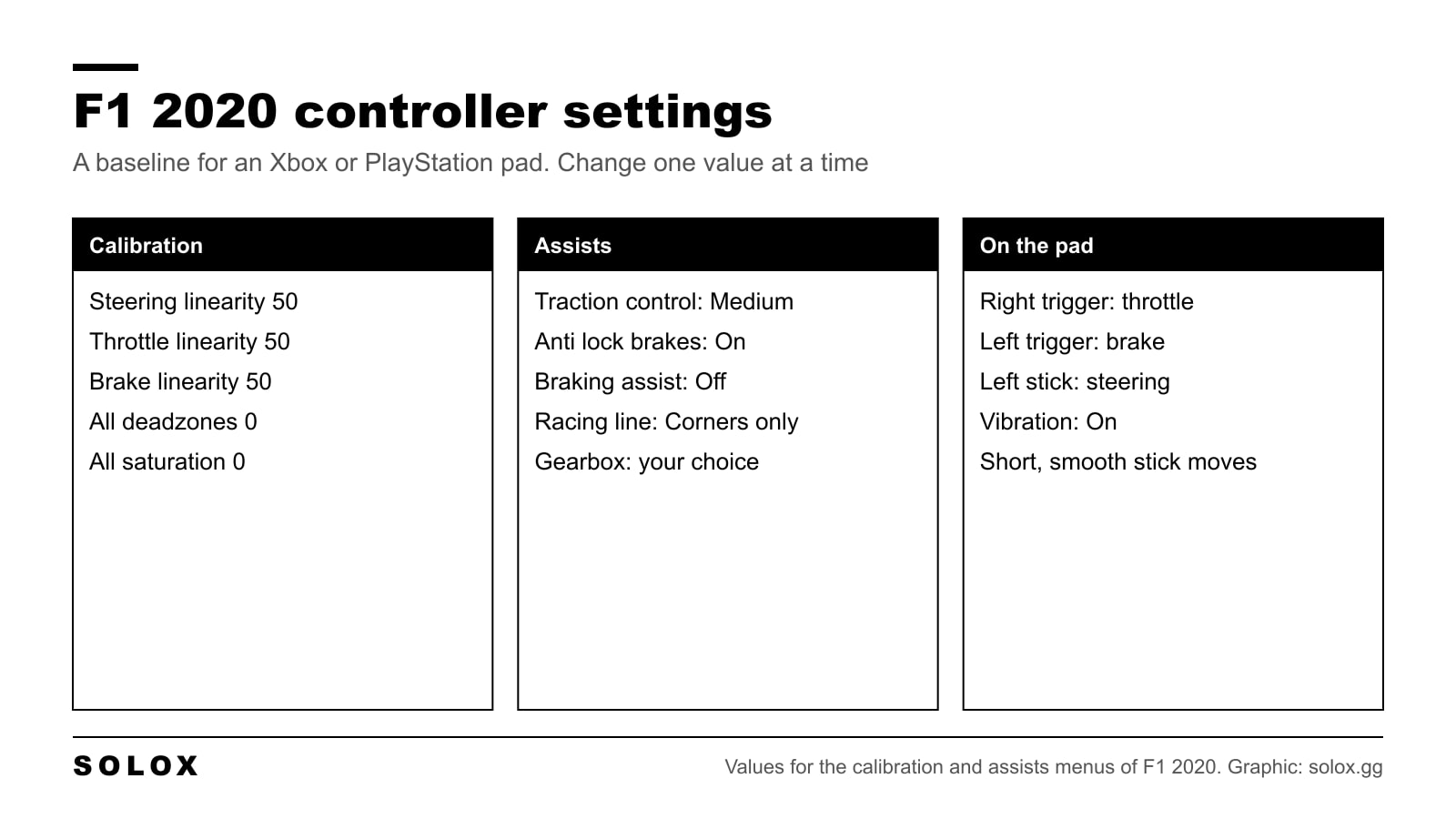
You can be quick in F1 2020 on a controller. Not as quick as on a wheel, but close enough to race clean and win online lobbies. The problem is the default calibration. The stick is too sharp around the centre, and the car changes direction every time your thumb moves 1 mm.
Three sliders fix most of it.
F1 2020 controller calibration settings
Go to Settings, Controls, pick your controller and open Calibration.
| Setting | Value |
|---|---|
| Steering deadzone | 0 |
| Steering linearity | 50 |
| Steering saturation | 0 |
| Throttle deadzone | 0 |
| Throttle linearity | 50 |
| Throttle saturation | 0 |
| Brake deadzone | 0 |
| Brake linearity | 50 |
| Brake saturation | 0 |
These work the same on an Xbox pad, a PlayStation pad and on PC.
What the three sliders do
Linearity bends the response. At 0, half of the stick gives half of the steering. At 50, the first part of the stick does less and the last part does more. You still get full lock at the end. You just get more control in the middle, where you drive most of the lap.
That is why it is 50 on all three:
- Steering. A thumbstick moves about 1 cm from centre to full lock. A real wheel moves a lot more. Linearity gives you back some of that precision on the straights and in fast corners.
- Throttle. A trigger has a short travel. With linearity, the first half gives you less power, so you can feed it in on the exit without spinning the rears.
- Brake. Same idea. It is easier to hold 60% or 70% of the brake into a corner without going straight to 100% and locking a wheel.
Deadzone is a part of the travel where the game ignores you. Keep it at 0. The only reason to raise it is an old pad with stick drift. If the car turns by itself on the straight, set steering deadzone to 2 or 3 and go up until it stops.
Saturation makes the game reach 100% before the stick or the trigger does. With a pad you already reach full lock very fast, so leave it at 0. Raise brake or throttle saturation only if a worn trigger does not reach 100% in the calibration screen.
Controller layout
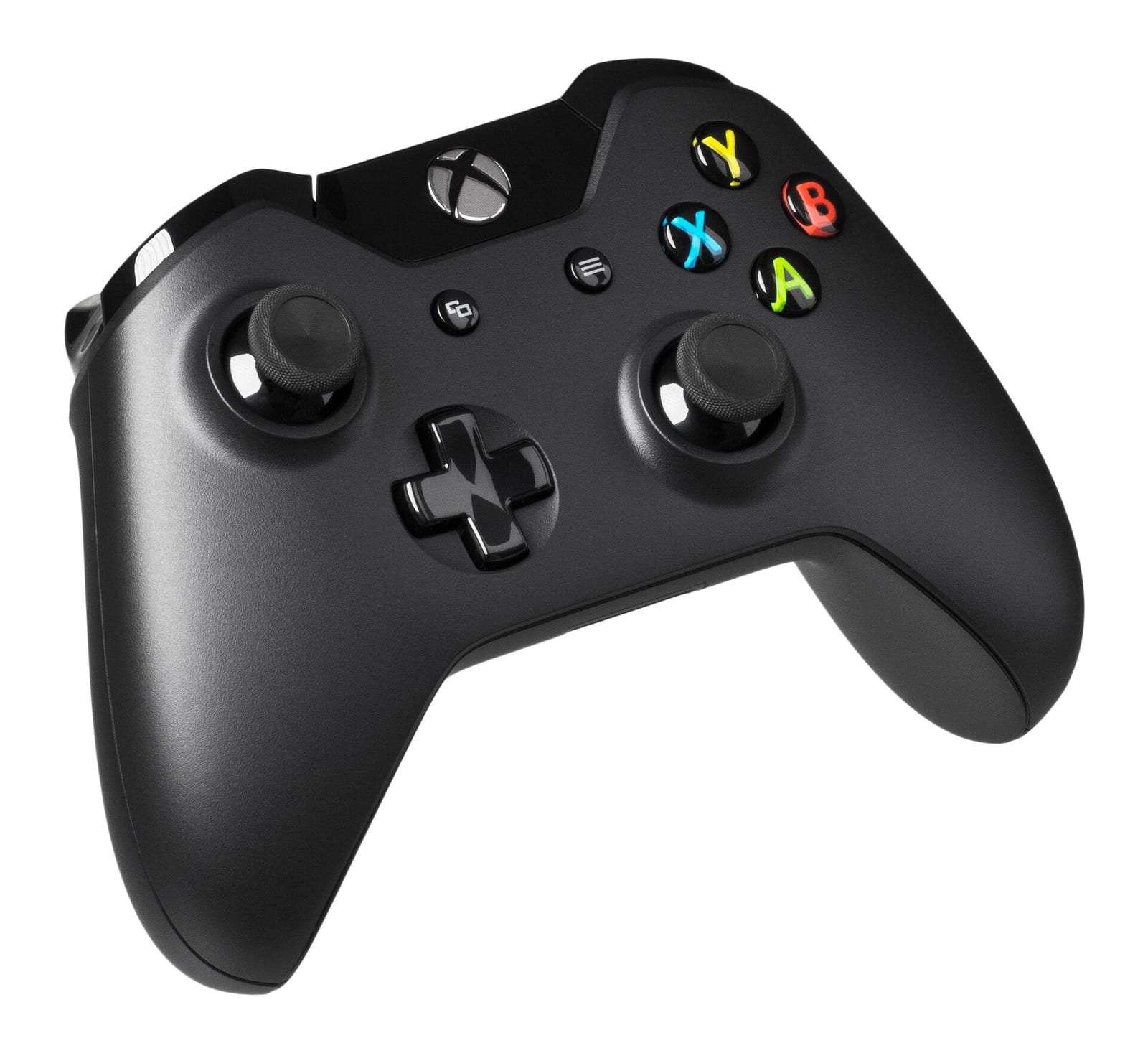
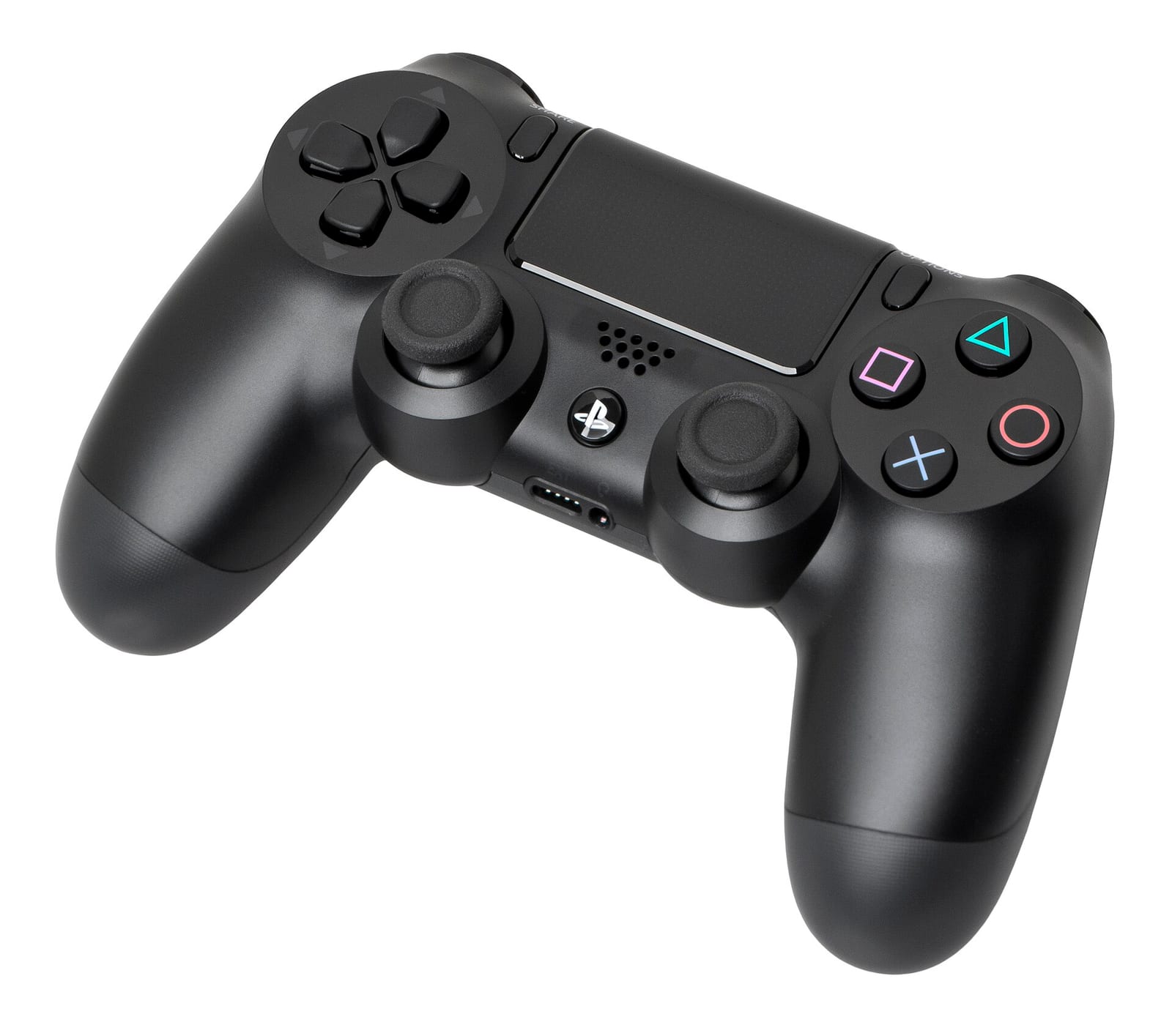
This is the layout I would use. Your game may come with something a little different, and every button can be changed in the Controls menu.
| Action | Xbox | PlayStation |
|---|---|---|
| Throttle | RT | R2 |
| Brake | LT | L2 |
| Steering | Left stick | Left stick |
| Gear up | A | Cross |
| Gear down | X | Square |
| DRS | Y | Triangle |
| Overtake | B | Circle |
| Multi function display | D-pad | D-pad |
| Look around | Right stick | Right stick |
Two rules matter more than the exact buttons:
- Never put a driving function on the left stick side. Your left thumb steers. If it has to leave the stick to press something, the car goes straight.
- Keep DRS and the overtake button under your right thumb. You use them on the straight, when your right thumb is free.
Check your own Controls screen before you learn a layout by heart. If you are on PC without a pad, here are the F1 2020 keyboard controls.
Assists for a controller
On a wheel I would tell you to turn most assists off as soon as you can. On a pad it is different. A trigger and a thumbstick are less precise than pedals and a wheel, and there is no shame in some help.
| Assist | Start with | Later |
|---|---|---|
| Steering assist | Off | Off |
| Braking assist | Off | Off |
| Anti lock brakes | On | Off, when you stop locking up |
| Traction control | Medium | Off is hard on a pad. Many fast pad drivers stay on Medium |
| Dynamic racing line | Corners only | Off, track by track |
| Gearbox | Automatic | Manual |
| Pit assist | On | Off |
| ERS and DRS assist | On | Off |
Braking assist off, always. It brakes for you, too early and too much. You never learn the braking points with it on.
Traction control Medium. Full traction control cuts so much power that you are slow out of every corner. Off needs a very soft right finger. Medium is the best place for most people on a pad.
Anti lock brakes on. With a short trigger it is easy to lock the fronts. Turn it off when you can brake at about 80% without thinking.
Manual gears when you are ready. Manual is faster, because you can short shift out of slow corners to stop wheelspin. Learn the tracks first, then switch.
There is more detail on every assist in my F1 2020 assists and AI difficulty guide.
Vibration
The force feedback menu also controls the vibration of the pad. Keep vibration on. It is the only feeling you get from the car.
- Rumble strip effects tell you when you are on a kerb. Useful.
- On track effects shake the pad on bumps. If it annoys you, lower it.
- Off track effects shake it on grass and gravel. Low is fine.
Wheel damper and understeer enhance are made for steering wheels. I would not touch them on a pad. If you do have a wheel, use my F1 2020 wheel settings instead.
How to drive F1 2020 on a pad
The settings are half of it. The other half is your thumbs.
- Move the stick slowly. Roll it to the side. Do not flick it. A fast input upsets the car, and an F1 car with a lot of downforce does not forgive that.
- Do not use full lock in fast corners. Full stick is for hairpins. In a fast corner you need maybe a third of it.
- Brake in a straight line, then release as you turn. Hard on the trigger first, then let it come up as the car slows. If you brake at 100% and turn at the same time, the fronts lock and you go straight.
- Squeeze the throttle on the exit. Count to two from 0% to 100% out of a slow corner. Flat too early is how you spin.
- Short shift. With manual gears, take third early out of a slow corner. Less torque at the rear wheels, less wheelspin.
What to change when it does not feel right
One change at a time, three laps each.
| Problem | Change | Why |
|---|---|---|
| Car is twitchy on the straights | Steering linearity up to 60 or 70 | Less reaction around the centre |
| Car feels slow to turn in | Steering linearity down to 30 or 40 | More reaction early in the stick |
| You do not get enough lock in hairpins | Steering saturation up to 10 or 20 | Full lock comes earlier |
| Car turns by itself | Steering deadzone up to 2 or 3 | Hides stick drift |
| You spin on corner exit | Throttle linearity up to 70, or traction control to Medium | Softer first half of the trigger |
| You lock the front tyres | Brake linearity up to 70, or anti lock brakes On | Softer first half of the trigger |
| Braking feels weak | Brake linearity down to 30 | More brake earlier in the trigger |
Next steps
- The car setup makes a big difference on a pad. A stable rear end is worth more than top speed. All 22 tracks are in my F1 2020 setups hub.
- Set the camera before you race. See the F1 2020 FOV settings.
- General driving advice is in my F1 2020 tips.
- On a newer game? Here are my F1 2021 controller settings, F1 22 controller settings and F1 25 controller settings.
FAQ
What are the best controller settings for F1 2020?
In the calibration menu: steering, throttle and brake linearity at 50, with every deadzone and saturation slider at 0. For assists: traction control Medium, anti lock brakes On, braking assist Off and the racing line on Corners only.
Can you play F1 2020 with a controller?
Yes. The game is made for pads as much as for wheels. With linearity at 50 and a little traction control, you can race clean and be competitive.
Are the settings the same on Xbox and PlayStation?
Yes. The calibration menu and the values are the same on Xbox One, PS4 and PC. Only the button names change.
What does steering linearity do in F1 2020?
It makes the first part of the stick less sensitive. A higher value gives you a calmer car on the straights and in fast corners. You still reach full lock at the end of the stick.
Should I use traction control on a controller?
I would use Medium. Full is slow out of corners, and Off needs very fine control of a short trigger. Try Off in time trial when you feel ready.
Is a controller slower than a wheel in F1 2020?
Over one lap a good pad driver is close to a wheel. Over a race the wheel is easier, because you have more precision on the tyres and on the throttle. If you race often, a wheel is worth it.