
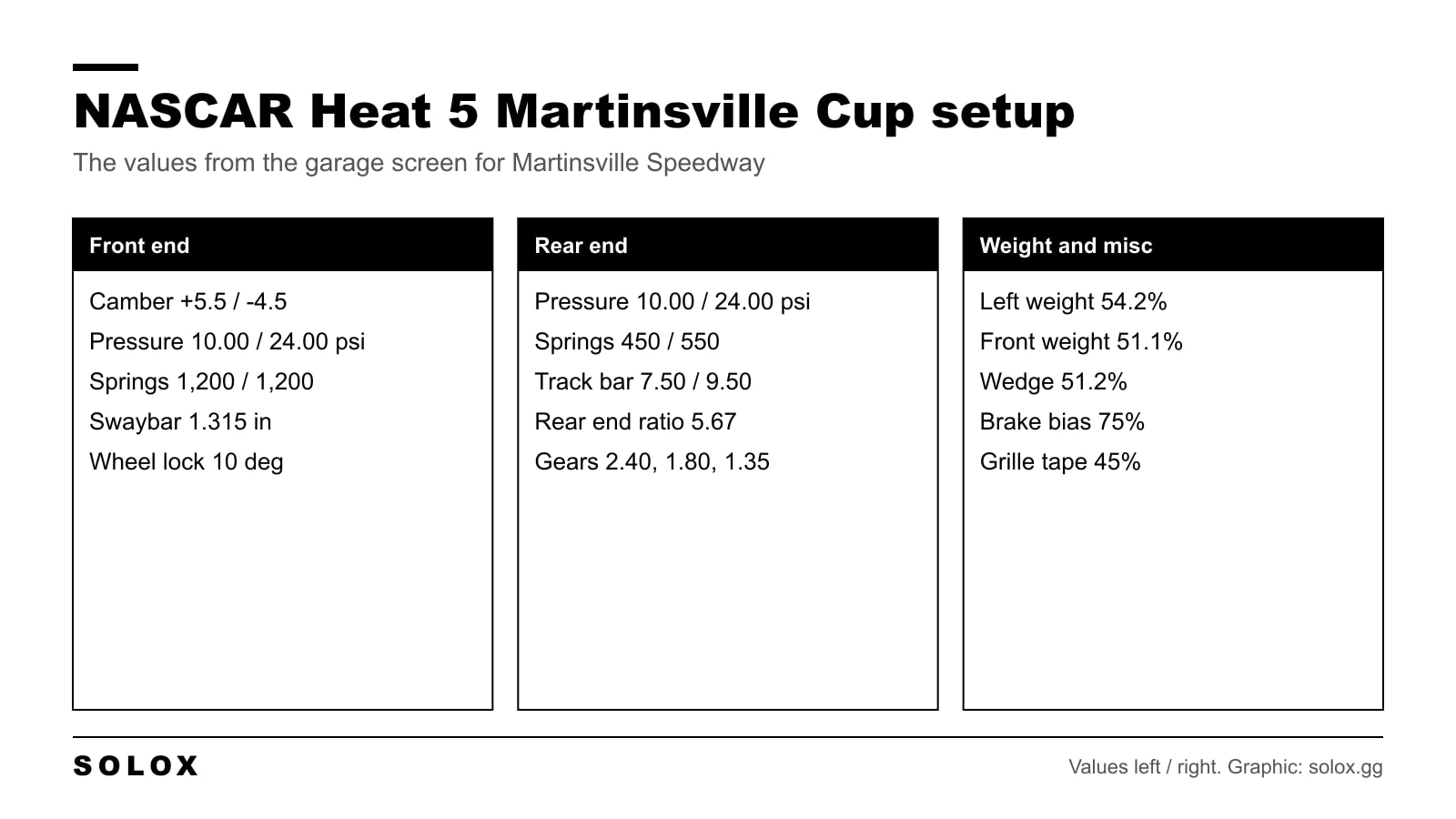
This is a NASCAR Heat 5 Cup setup for Martinsville Speedway that gets into the low 19s. Every value below is read from the garage screen on this page, so you can copy it line by line.
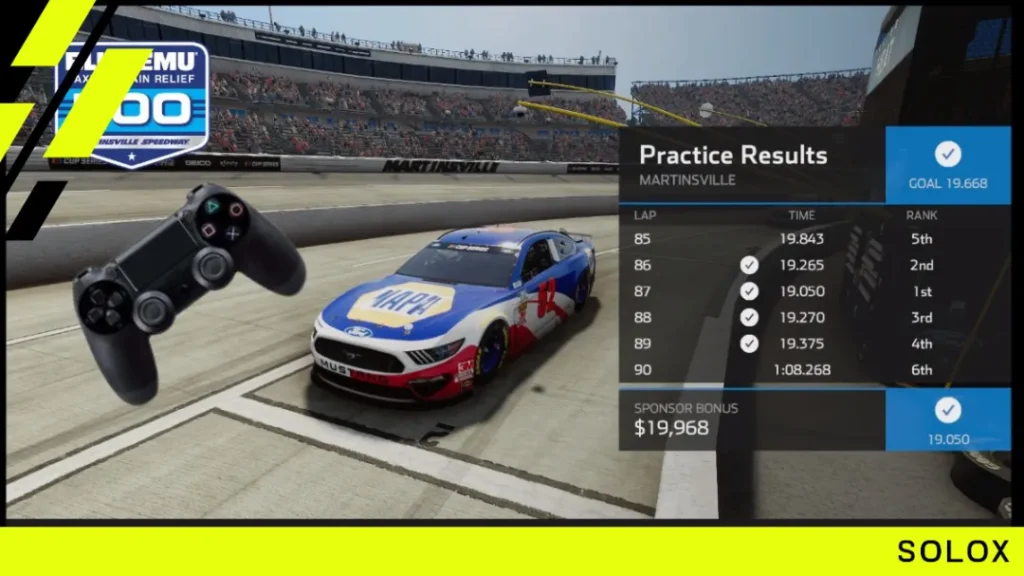
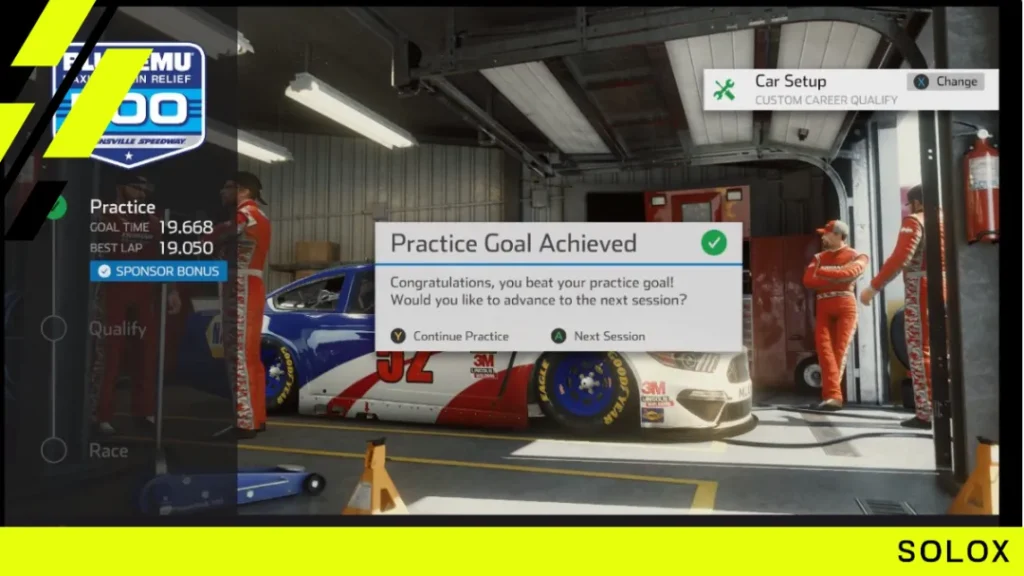
In practice it did a best lap of 19.050 seconds, against a goal of 19.668. Martinsville is two drag strips joined by two hairpins, and this setup is built for exactly that: hard braking, a tight turn, and drive off the corner.
The setup at a glance
| Setting | Value |
|---|---|
| Left front camber | +5.5 deg |
| Right front camber | -4.5 deg |
| Front swaybar | 1.315 in |
| Wheel lock | 10 deg |
| Wedge | 51.2% |
| Rear end ratio | 5.67 |
| Grille tape | 45% |
| Brake bias | 75% |
Those eight numbers do most of the work. The full sheet is below.
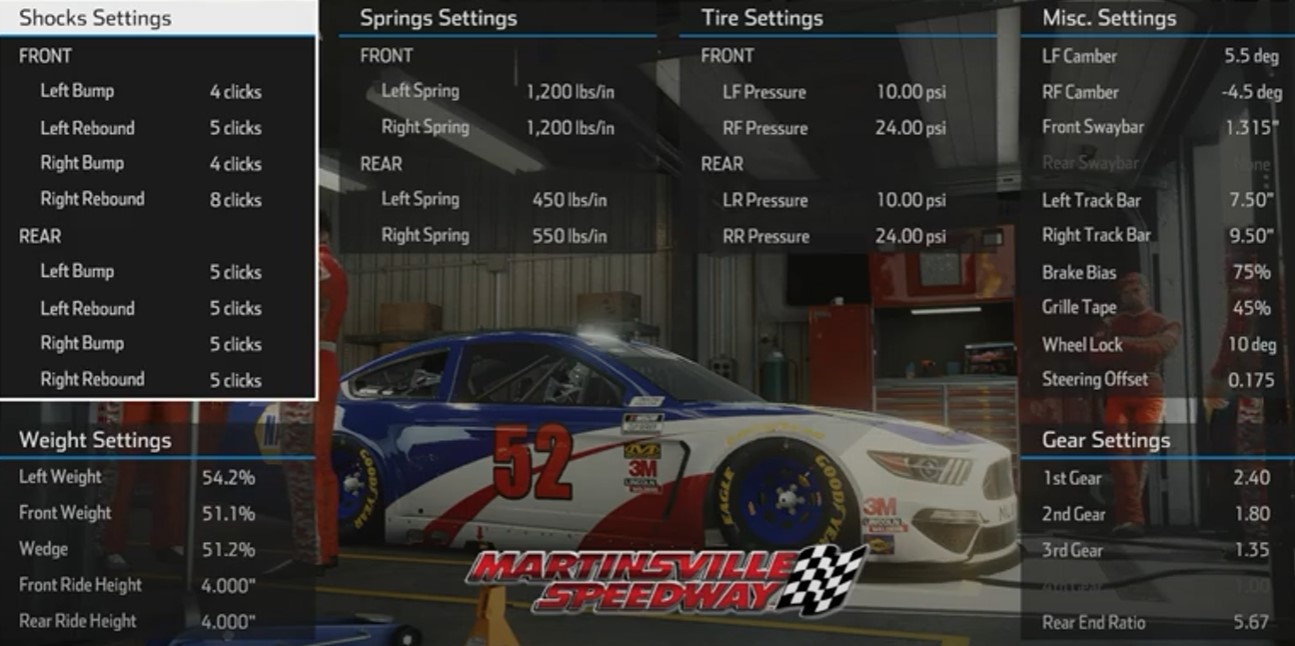
Full setup sheet
Tyres
| Tyre | Pressure |
|---|---|
| Left front | 10.00 psi |
| Right front | 24.00 psi |
| Left rear | 10.00 psi |
| Right rear | 24.00 psi |
Springs
| Spring | Rate |
|---|---|
| Front left | 1,200 lbs/in |
| Front right | 1,200 lbs/in |
| Rear left | 450 lbs/in |
| Rear right | 550 lbs/in |
Shocks
| Shock | Bump | Rebound |
|---|---|---|
| Front left | 4 clicks | 5 clicks |
| Front right | 4 clicks | 8 clicks |
| Rear left | 5 clicks | 5 clicks |
| Rear right | 5 clicks | 5 clicks |
Weight and ride height
| Setting | Value |
|---|---|
| Left weight | 54.2% |
| Front weight | 51.1% |
| Wedge | 51.2% |
| Front ride height | 4.000 in |
| Rear ride height | 4.000 in |
Misc
| Setting | Value |
|---|---|
| Left front camber | +5.5 deg |
| Right front camber | -4.5 deg |
| Front swaybar | 1.315 in |
| Rear swaybar | None |
| Left track bar | 7.50 in |
| Right track bar | 9.50 in |
| Brake bias | 75% |
| Grille tape | 45% |
| Wheel lock | 10 deg |
| Steering offset | 0.175 |
Gears
| Gear | Ratio |
|---|---|
| 1st | 2.40 |
| 2nd | 1.80 |
| 3rd | 1.35 |
| Rear end ratio | 5.67 |
4th gear is covered on the screen and I will not guess it. Leave it at the value the game gives you.
Why the camber is so big
The right front runs -4.5 and the left front +5.5. That is more than my Bristol Cup setup, which runs -3.5 and +3.0.
The reason is the banking. Bristol's turns are banked 24 to 28 degrees, so the track holds the car up. Martinsville has 12. The car leans more on its own, and the camber keeps the tyres flat on the track while it does. The big positive camber on the left front also helps the car rotate on turn in.
Why the swaybar is soft and the lock is higher
A front swaybar of 1.315 is soft. It lets the front of the car rotate into the hairpin without the rear stepping out. At Martinsville you want the car to turn on the brakes, and a stiff front bar fights that.
10 degrees of wheel lock is more than the 6 at Bristol. Martinsville's corners are tighter and flatter, so the wheel has to go further.
Why the brake bias is 75%
This is the biggest difference from the other short tracks. Bristol runs 54%. Martinsville runs 75%, a lot of front bias.
Every lap has two hard stops from top speed to almost nothing. Front bias keeps the rear stable while you brake hard in a straight line. The price is that the fronts lock if you brake too late or too hard, so build up to it.
Why the rear end ratio is 5.67
5.67 is the shortest rear end of the Cup setups on this site that list one. Bristol runs 4.86, Pocono 3.40. The corners at Martinsville are slow, the straights are short, and the lap is won by pulling off the corner, not by top speed.
Grille tape is 45%, higher than Bristol's 25%. The speeds are lower, so less air goes through the radiator. Watch the engine temperature in traffic.
The track
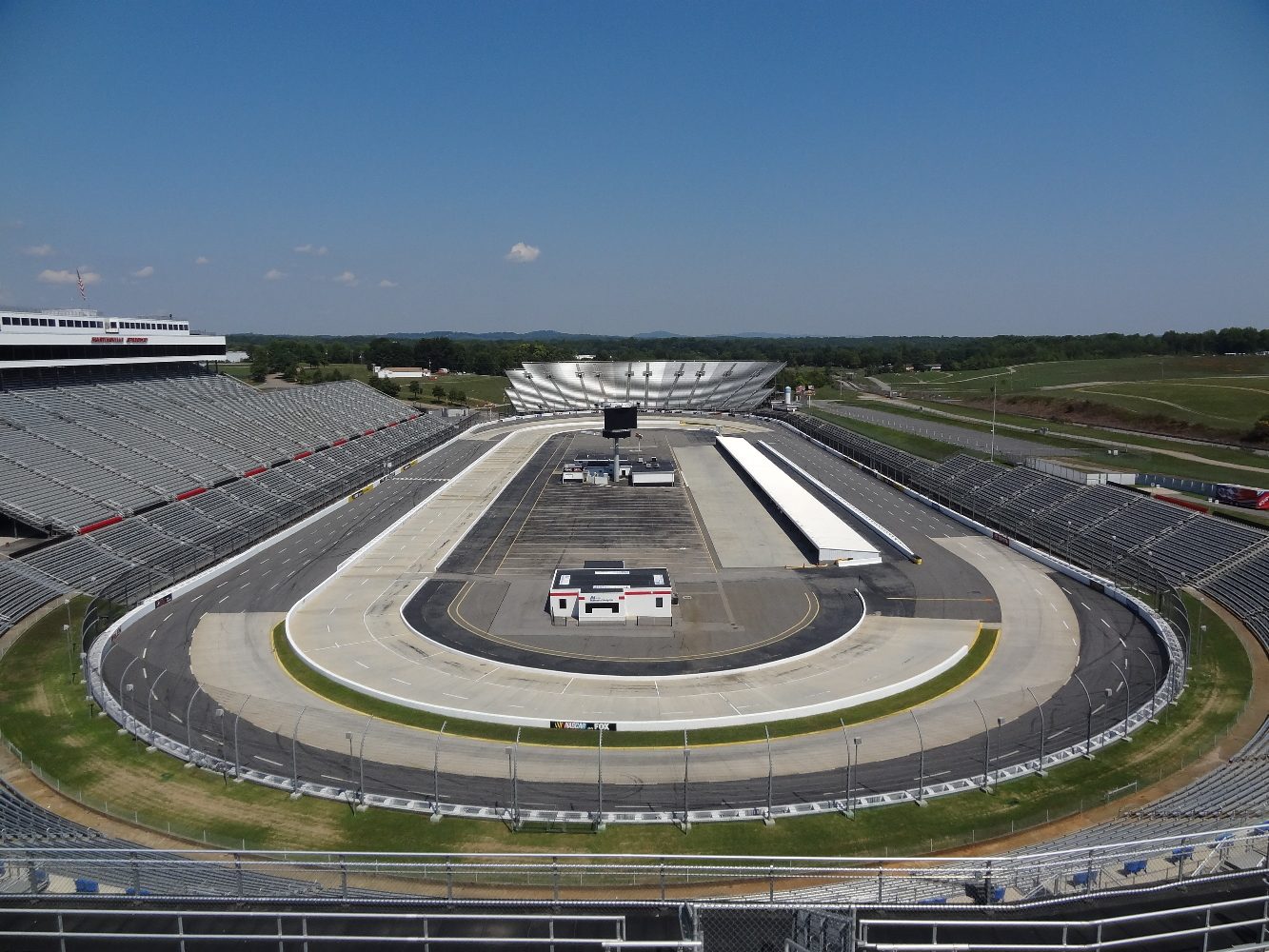
Martinsville Speedway is a 0.526 mile oval in Ridgeway, Virginia, called "The Paperclip" for its shape. The numbers that matter for the setup, from the track's Wikipedia page:
| Part of the track | Banking | Surface |
|---|---|---|
| Turns | 12 degrees | Concrete in the lower lanes, asphalt above |
| Straights | 0 degrees | Asphalt |
For scale, the Cup race lap record on Wikipedia is 18.845 seconds, set by Ross Chastain at the 2022 Xfinity 500. A 19.05 in the game is a good lap.
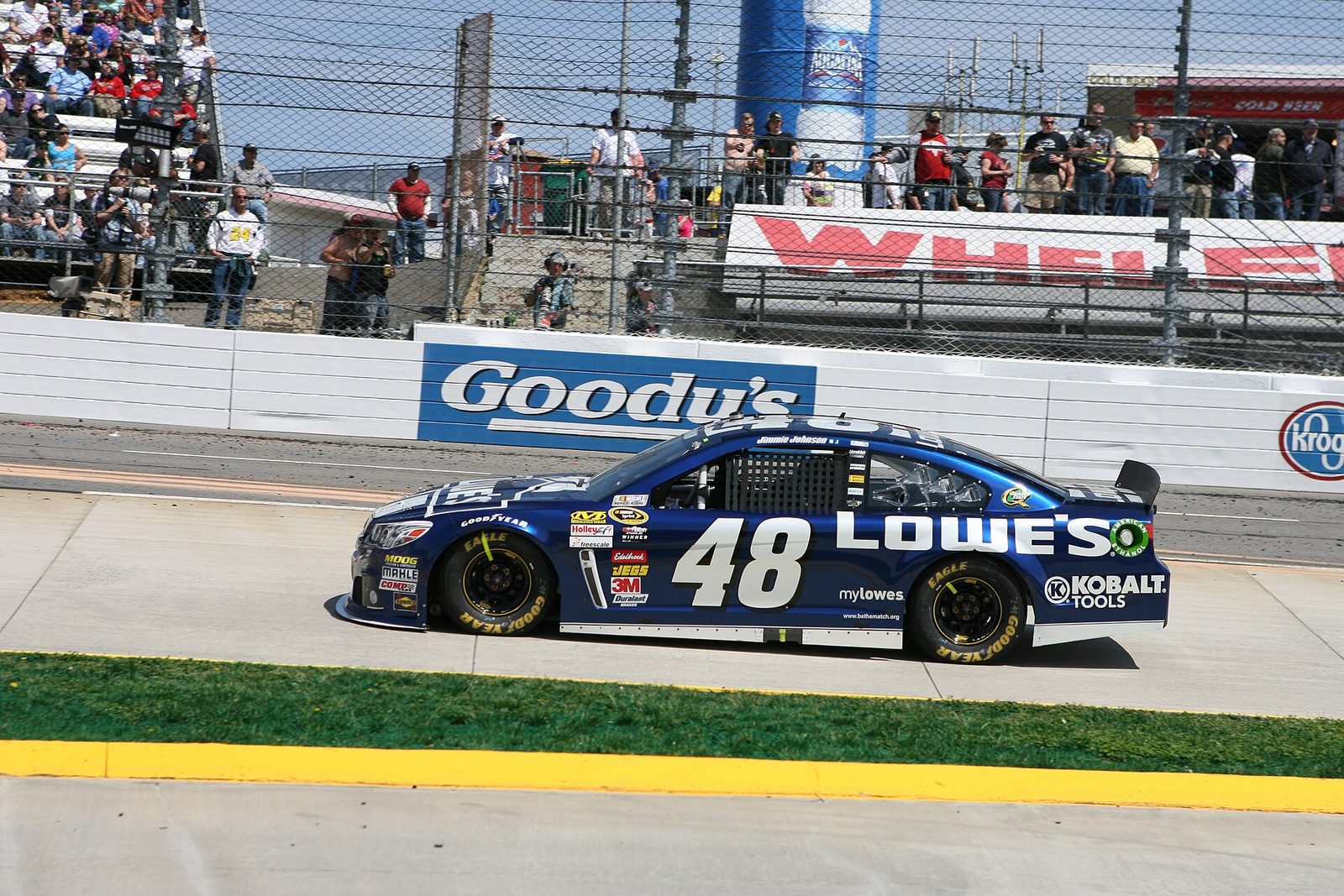
The practice result
How I would drive it
- Brake in a straight line. With 75% front bias, turning while you are hard on the brakes locks the front.
- Lift early, roll the middle. Do not try to carry speed through the hairpin. Get the car turned, then go.
- Be patient on the throttle. With 5.67 and short gears, the rear will spin off the corner if you ask too much.
- Use the bumper carefully in traffic. At Martinsville everyone is close, and a tap into the turn costs the car in front, and often you too.
How to tune it for your driving
Change one thing at a time and run five laps before you judge it. The directions below are standard stock car logic, so check each one on track.
| Problem | First change |
|---|---|
| Front locks into the turn | Lower the brake bias to 72% |
| Car will not turn in the middle of the corner | Lower the wedge a little, or soften the front swaybar one step |
| Rear steps out on entry | Raise the brake bias a little, or raise the wedge |
| Wheelspin off the corner | Lower the rear end ratio a little |
| Engine runs hot in traffic | Lower the grille tape by 5% |
With the servers closed since 1 August 2025, this setup is for career mode, quick races and split-screen. Set the AI first with my NASCAR Heat 5 AI settings, then judge the setup against them.
More NASCAR Heat 5 setups
- All 20 tracks are in my NASCAR Heat 5 Cup setups database.
- Same track, other car: Martinsville Xfinity setup.
- Other short tracks: Bristol Cup setup and Richmond Cup setup.
- Wheel not right yet? Start with my NASCAR Heat 5 FFB settings.
FAQ
What is the best camber for Martinsville in NASCAR Heat 5?
+5.5 degrees on the left front and -4.5 degrees on the right front in the Cup car.
What lap time should I expect with this setup?
Low 19s. In practice it did a best of 19.050 against a goal of 19.668.
What brake bias works at Martinsville?
75% to the front. Every lap has two hard stops, and front bias keeps the rear stable under braking.
What rear end ratio works at Martinsville?
5.67, with gears of 2.40, 1.80 and 1.35 for 1st to 3rd. Martinsville needs drive off the corner, not top speed.
What tyre pressures should I run at Martinsville?
24.00 psi on the right side and 10.00 on the left side, front and rear.
Why is it called the Paperclip?
The shape: two long straights joined by two tight turns, like a paperclip.