
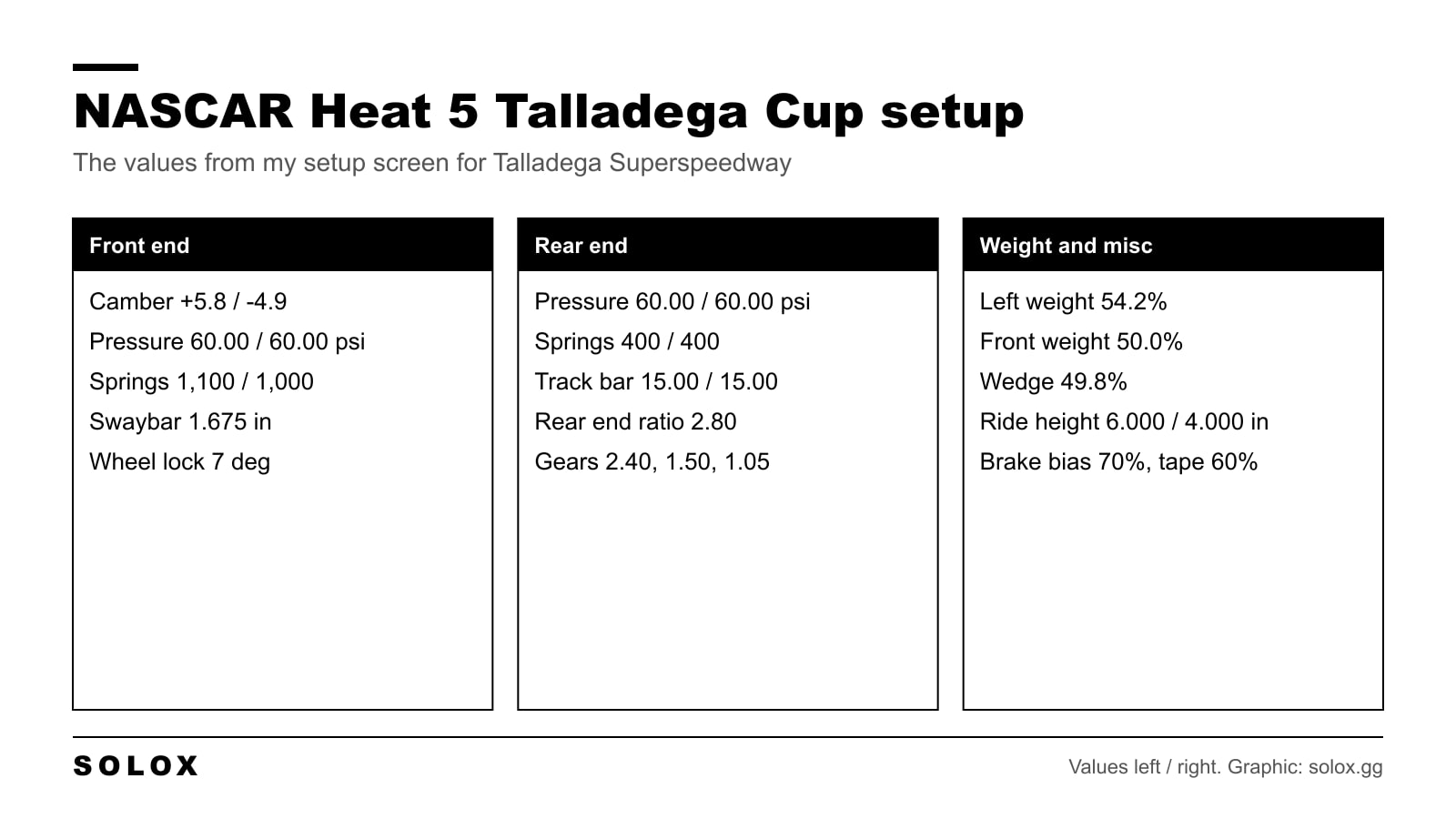
This is my NASCAR Heat 5 Cup setup for Talladega Superspeedway. Every value below is read from the garage screen, so you can copy it line by line.
The target is a lap in the low 48s on your own. In a pack the lap time is set by the draft, so the setup has one job: let the car run flat out for the whole lap without the rear getting light.
The setup at a glance
| Setting | Value |
|---|---|
| Left front camber | +5.8 deg |
| Right front camber | -4.9 deg |
| Front swaybar | 1.675 in |
| Wheel lock | 7 deg |
| Wedge | 49.8% |
| Rear end ratio | 2.80 |
| Grille tape | 60% |
| Brake bias | 70% |
Those eight numbers do most of the work. The full sheet is below.
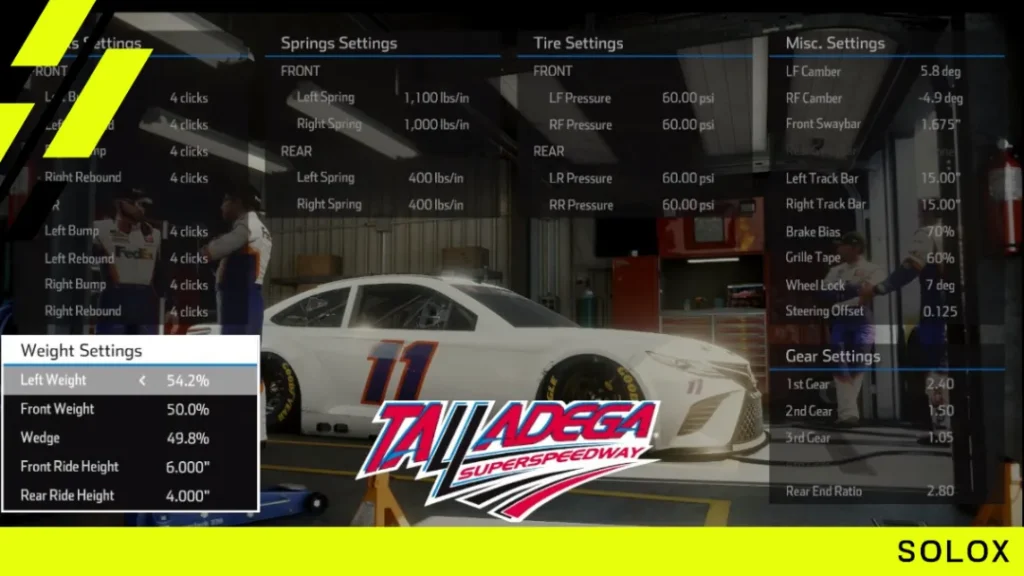
Full setup sheet
Tyres
| Tyre | Pressure |
|---|---|
| Left front | 60.00 psi |
| Right front | 60.00 psi |
| Left rear | 60.00 psi |
| Right rear | 60.00 psi |
Springs
| Spring | Rate |
|---|---|
| Front left | 1,100 lbs/in |
| Front right | 1,000 lbs/in |
| Rear left | 400 lbs/in |
| Rear right | 400 lbs/in |
Shocks
Every shock is at 4 clicks, bump and rebound, on all four corners. There is nothing to tune here at a superspeedway. The car does not pitch or roll enough for the shocks to matter.
Weight and ride height
| Setting | Value |
|---|---|
| Left weight | 54.2% |
| Front weight | 50.0% |
| Wedge | 49.8% |
| Front ride height | 6.000 in |
| Rear ride height | 4.000 in |
Misc
| Setting | Value |
|---|---|
| Left front camber | +5.8 deg |
| Right front camber | -4.9 deg |
| Front swaybar | 1.675 in |
| Left track bar | 15.00 in |
| Right track bar | 15.00 in |
| Brake bias | 70% |
| Grille tape | 60% |
| Wheel lock | 7 deg |
| Steering offset | 0.125 |
Gears
| Gear | Ratio |
|---|---|
| 1st | 2.40 |
| 2nd | 1.50 |
| 3rd | 1.05 |
| Rear end ratio | 2.80 |
Two lines are covered on my screenshot and I will not guess them: the rear swaybar and 4th gear. Leave both at the value the game gives you.
This sheet is the same as my Daytona Cup setup, line for line. That is on purpose. The two tracks ask the car for the same thing: run flat, stay stable in the pack, lose as little as possible to drag.
Why this setup is different from every other oval
On an intermediate like Kentucky I lift, turn and wait for the throttle. At Talladega I never lift. So the sheet is built for drag and stability, not for turning.
Tyre pressures at 60.00 psi all round. On an intermediate I run about 25 psi on the left side to help the car turn. Here there is no turning to help. High pressure on all four corners means less rolling resistance and less heat, and that is straight line speed.
Front ride height at 6.000 in, rear at 4.000 in. The nose is up and the tail is down. With the rear low the car punches a smaller hole in the air and the spoiler does less work. That is less drag and more top speed. I would not go lower at the rear, because the car gets loose when you get hit from behind in the pack.
Grille tape at 60%. That is more than the 45% I run at Kentucky. Less air through the grille means less drag. The price is engine temperature, so watch it in a long run and come down to 50% if it climbs.
Camber at +5.8 and -4.9. More camber than any intermediate. The banking is 33 degrees and the car is loaded on the right side for the whole lap, so the tyres live on their edge. The left front at +5.8 leans into the turn too, so both fronts are working.
Rear end ratio at 2.80. The longest gear on any sheet I have published, against 3.45 at Kentucky. The car spends the whole lap at top speed, so you want the engine to pull in 4th without hitting the limiter on the backstretch with a push from behind.
Wedge at 49.8%. Near neutral. On an intermediate I go above 50 to help the rear on exit. Here the car does not drive off corners, so I keep it flat and stable.
The track
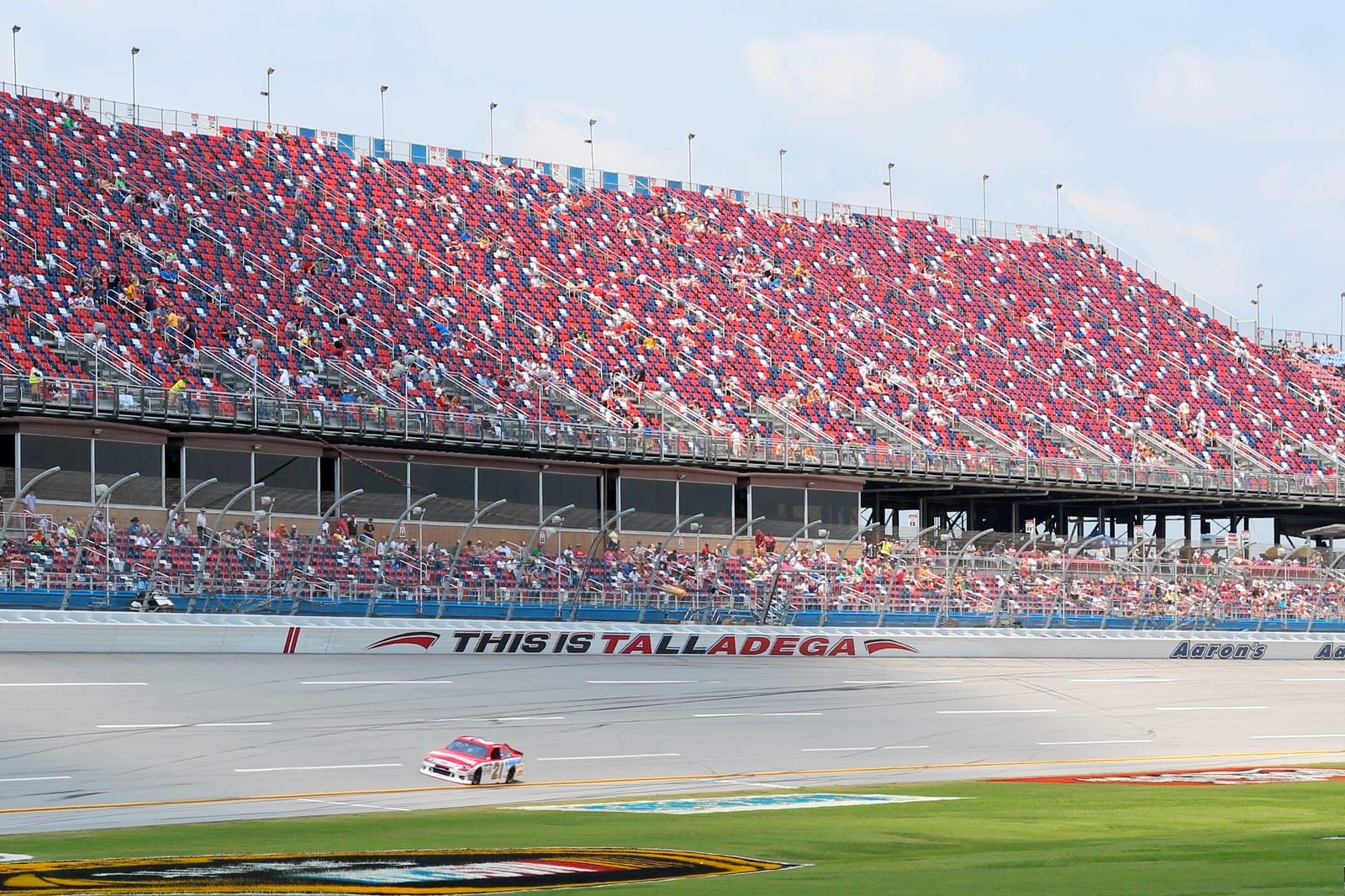
Talladega Superspeedway is in Lincoln, Alabama. It opened in September 1969 and it is the longest oval the Cup Series races on. The numbers that matter for the setup, from the track's Wikipedia page:
| Part of the track | Value |
|---|---|
| Lap length | 2.66 miles |
| Turns | 33 degrees of banking |
| Tri-oval | 16.5 degrees |
| Straights | 2 degrees |
| Last repave | 2006 |
NASCAR Heat 5 is built on the 2020 season. The 2020 spring race here was run on 22 June after a rain delay, and Ryan Blaney won it. Restrictor plates were gone by then, replaced by the tapered spacer, but the idea is the same: the engines are choked, the cars run flat out at the same speed, and the draft decides the race.
That is why the setup above spends so much effort on drag. A tenth of drag is worth more than any corner here.
How I drive it
- Stay in the draft. On your own you lose 3 to 4 tenths a lap, and in the game it can be more. The lap time comes from the car in front.
- Keep the wheel still. With 7 degrees of wheel lock, small inputs do a lot at 190 mph. Let the banking turn the car.
- Do not lift in the tri-oval. If the car gets light there, that is a setup problem, not a driving one. Add wedge or raise the rear ride height a notch.
- Pick your lane before the turn. Moving in the middle of the banking scrubs speed and upsets the car behind you.
How to tune it for your driving
Change one thing at a time and run five laps before you judge it. The directions below are standard stock car logic for a superspeedway, so check each one on track.
| Problem | First change |
|---|---|
| Car gets loose when you are pushed from behind | Raise the rear ride height to 4.250 in |
| Engine hits the limiter at the end of the backstretch | Lower the rear end ratio a step |
| Car feels slow on the straights | Add grille tape, then lower the rear ride height, in that order |
| Engine temperature climbs in a long run | Drop grille tape to 50% |
| Car does not want to turn into turn 1 | Raise the wedge a little, or soften the front swaybar one step |
With the servers closed since 1 August 2025, this setup is for career mode, quick races and split-screen. Set the AI first with my NASCAR Heat 5 AI settings, then judge the setup in a 40 car pack against them. On your own, the only number that tells you anything is the lap time on the first lap after a pit stop.
More NASCAR Heat 5 setups
- All 20 tracks are in my NASCAR Heat 5 Cup setups database.
- The other superspeedway, with the same sheet: Daytona Cup setup.
- The opposite problem, a track where you lift every lap: Kentucky Cup setup.
- Wheel not right yet? Start with my NASCAR Heat 5 FFB settings.
FAQ
What is the best camber for Talladega in NASCAR Heat 5?
I run +5.8 degrees on the left front and -4.9 degrees on the right front in the Cup car. Both tyres lean into the left turn, and the numbers are higher than on any intermediate because of the 33 degree banking.
What lap time should I expect with this setup?
The low 48s on your own. In a pack you go faster, because the draft is worth several tenths a lap. Compare lap times only in the same situation.
Why are all four tyres at 60 psi?
You never turn the car at Talladega, you only steer it. High pressure on all four corners gives less rolling resistance and less heat, which is straight line speed. On an intermediate I run the left side near 25 psi to help the car turn, and that would be wasted here.
What rear end ratio works at Talladega?
2.80, with gears of 2.40, 1.50 and 1.05 for 1st to 3rd. It is the longest gear on any sheet I have published because the car runs at top speed for the whole lap.
Is the setup the same as Daytona?
Yes, line for line. Both tracks ask for the same thing: low drag and a stable car in the pack. If you have one of them dialled in, use it at the other.
Does this setup still work in 2026?
Yes. The game no longer gets patches, so the physics are the same as when I built it. The servers closed on 1 August 2025, so you will use it offline.
Can I use this setup on a controller?
Yes. The values are the same for wheel and controller. On a pad, 7 degrees of wheel lock keeps the car calm at 190 mph, which is exactly what you want in a pack.