
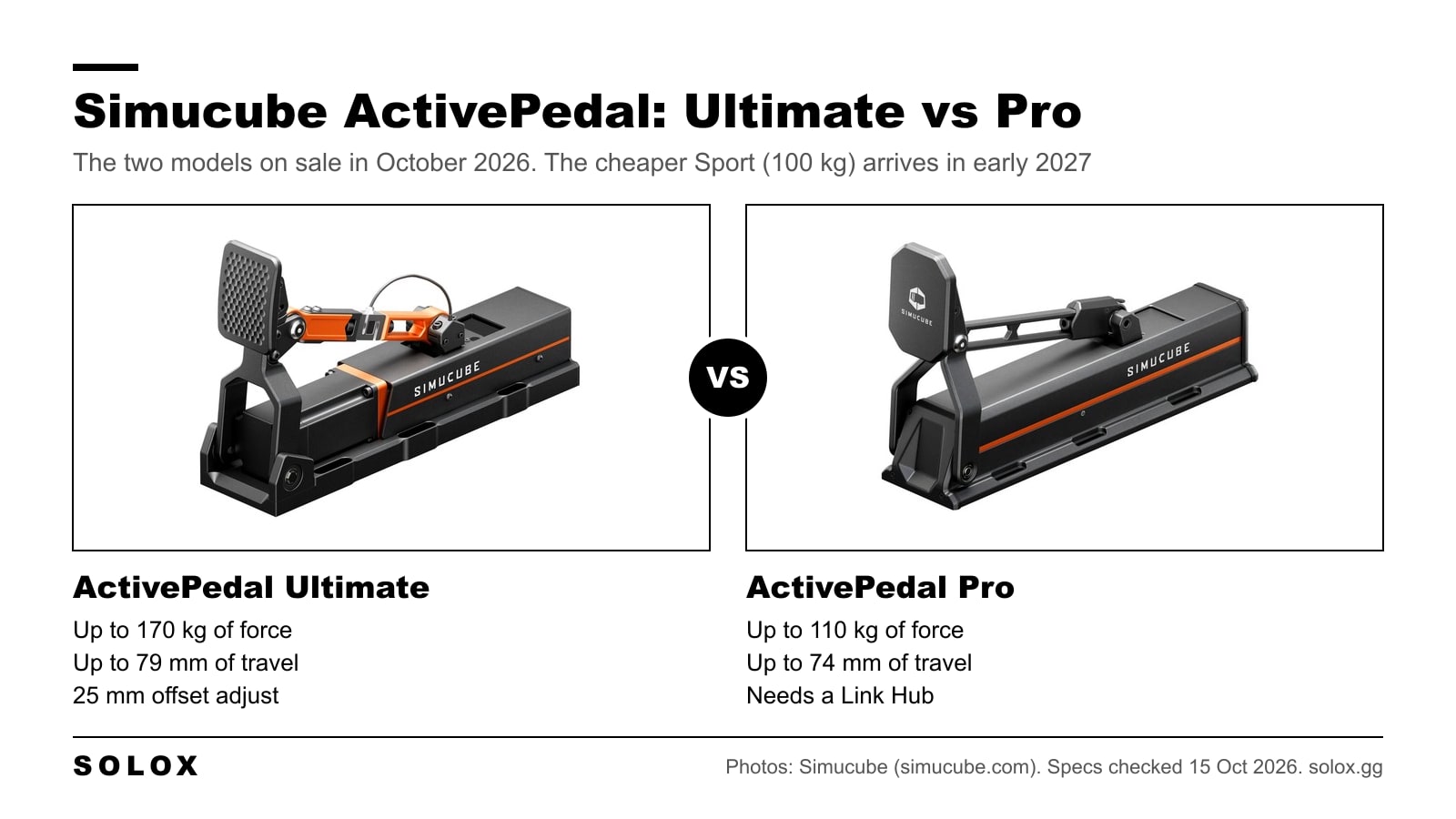
The Simucube ActivePedal is a brake (or throttle, or clutch) pedal with an electric motor inside it. The motor creates the resistance under your foot, so there are no springs or elastomers to swap. You set the force, the travel and the curve in software, and the pedal can push back at you with effects from the game, like ABS pulsing or a lock-up.
In October 2026 Simucube sells two of them, the ActivePedal Ultimate and the ActivePedal Pro, and has just revealed a cheaper third one, the ActivePedal Sport, for early 2027.
Checked on 15 October 2026 against simucube.com (the ActivePedal page, the Ultimate, Pro, Co-Pedal and ActivePedal Sport pages, Europe and US stores), the Simucube Tuner changelog and game setup list on docs.simucube.com (latest entry: Tuner 3.2.0, 7 October 2026), the Simagic P-ACTIVE store page on simagic.com, and Traxion.gg's reports of 13 and 14 October 2026. Press reports are labelled as such. I have not used an ActivePedal myself, so there is no lap-time verdict here, only what the hardware is and what it costs.
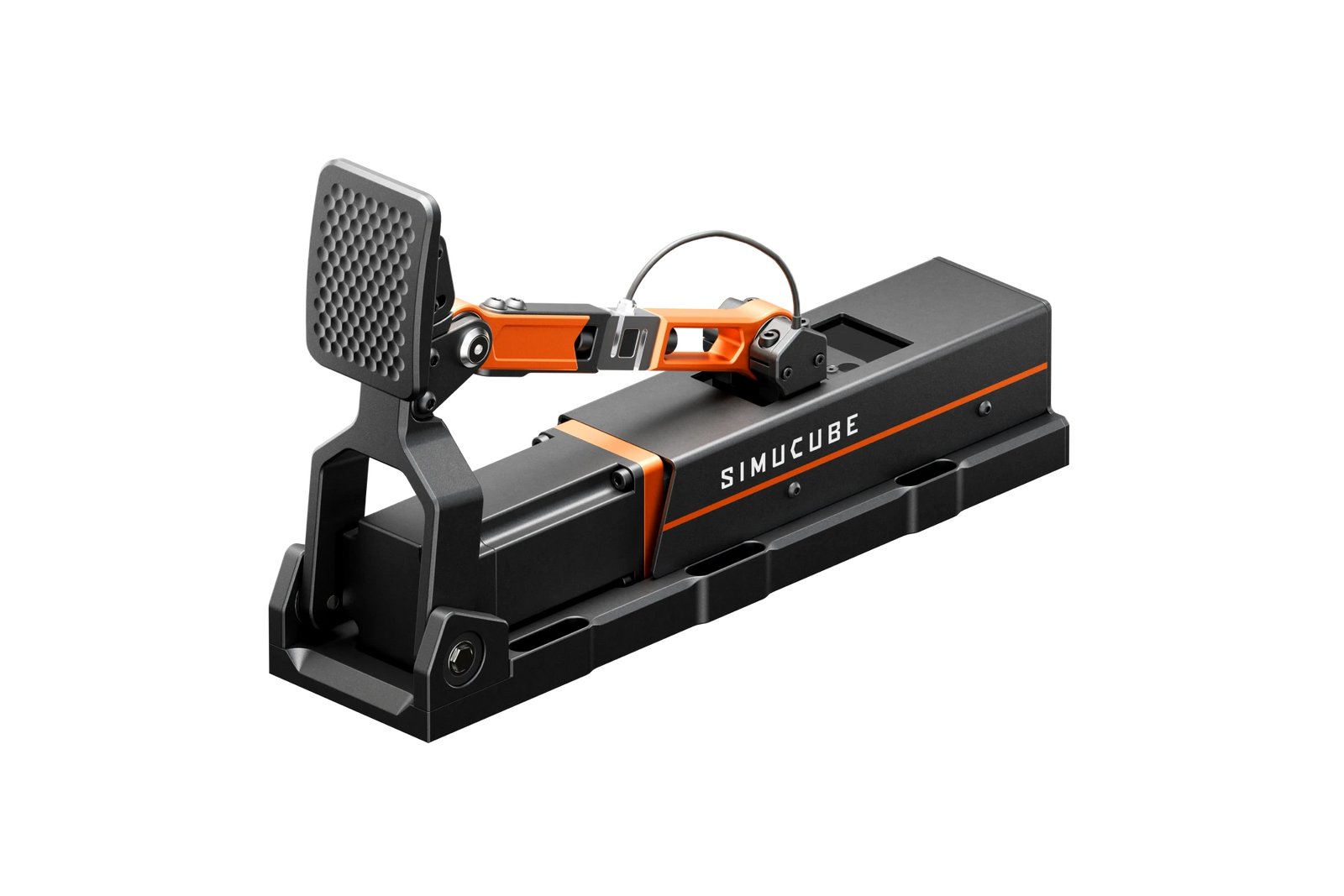
What is Simucube ActivePedal
A normal pedal reads your input. A load cell brake measures how hard you push against a stack of springs and rubbers, and that stack decides how the pedal feels. If you want it stiffer, you change parts.
The ActivePedal turns that around. A servo motor drives the pedal arm and decides how much force it takes to move it at every point of the travel. Simucube's own line on its ActivePedal page is "not a pedal. It's every pedal." Marketing, but the idea is right: the feel lives in software.
That gives you two things a passive pedal cannot do.
- Any pedal feel. Force, travel and the shape of the force curve are settings. A soft road car brake and a rock hard prototype brake are two profiles on the same hardware, and the Tuner can switch profiles automatically per car and per sim.
- Feedback through your foot. The motor can move the pedal against you. ABS becomes a pulse under the sole of your foot, a locking wheel can be felt, and the throttle can carry RPM vibration.
On the Ultimate and the Pro, Simucube lists these effects: motor vibration (with frequency and a low and high RPM balance), ABS (frequency and intensity), traction control, RPM feedback and G-force effects. The Sport page lists seven effects including ABS, traction control, G-force and brake lockup.
Why the brake is the pedal that matters
In a real race car the brake pedal barely moves. You do not brake with travel, you brake with pressure. Your leg learns a force, and the car tells you through the pedal and the seat when the front tyres are about to lock.
That is why load cell brakes were such a step up from potentiometer pedals, and I cover that in my load cell pedals guide. An active pedal goes one step further, because the pedal can tell you something back instead of only listening.
Will it make you faster? Nobody can promise that, and I would not trust anyone who does. What it can do is make the brake consistent lap after lap and let you match the pedal to the car you are driving. Simucube's Sport page makes the point that there are no springs to wear, so the feel stays the same every lap. That is a manufacturer claim, but the logic holds: a motor does not fatigue the way rubber does.
ActivePedal models in 2026
Here is the range as Simucube lists it on 15 October 2026.
| ActivePedal Ultimate | ActivePedal Pro | ActivePedal Sport | |
|---|---|---|---|
| Status | On sale | On sale | Revealed 13 Oct 2026, sales early 2027 |
| Max force | 170 kg (high force mode), 120 kg (medium) | 110 kg | 100 kg |
| Max travel | 62 mm (high), 79 mm (medium) | 74 mm | 60 mm |
| Face height adjust | 20 mm | 20 mm (22 mm in one spec list) | 20 mm |
| Face angle adjust | 18° | 18° | 18° |
| Offset adjust | 25 mm | None | Not listed |
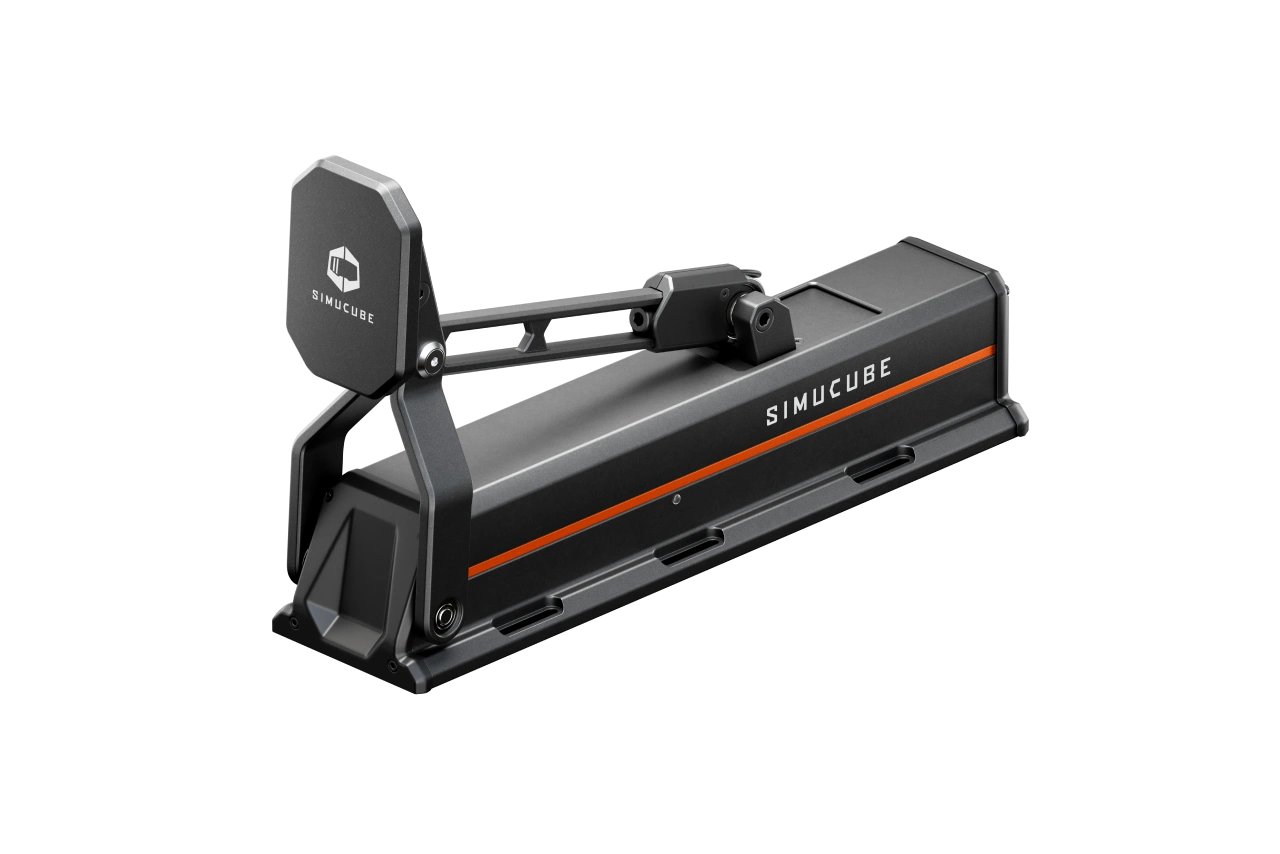
| Pedal arm | Adjustable (Formula and Le Mans style) | Fixed | Not listed |
| Weight (pedal only) | 6 kg | 5.8 kg | 3.4 kg |
| Size (W x H x D) | 100 x 250 x 400 mm | 100 x 255 x 418 mm | 250 mm long |
| Mounting | 6 x M5 slots, inverted supported | 6 x M5 slots | 4 x M5 slots |
| Connection | Simucube Link in the primary set | Needs one Simucube Link Hub per rig | Needs a Link Hub, no daisy chaining |
| Power | 360 W peak, one PSU can run several pedals | One PSU per pedal | 280 W PSU included |
| Passive pedal inputs | Two | Two | Not listed |
| Warranty | 5 years | 3 years | 36 months |
Simucube aims the Ultimate at "motorsport and sim racing professionals" and the Pro at "sim racing enthusiasts". The Ultimate is the original ActivePedal, the one the first version of this article was about.
The extra 60 kg of the Ultimate only matters if you want a really heavy brake. The things I would actually weigh between the two are the adjustable arm, the offset adjustment and the two extra years of warranty.
ActivePedal prices in October 2026
These are the "from" prices on simucube.com on 15 October 2026. The Pro and Ultimate store pages do not say whether VAT or sales tax is included, so check at checkout for your country. The Sport page states its price excluding VAT.
| Product | Europe store (EUR) | US store (USD) |
|---|---|---|
| ActivePedal Ultimate | €2,398.80 for one pedal (€2,158.80 per add-on pedal, configurations up to €6,380.58) | $2,499 for one pedal ($2,059 per add-on pedal, up to $6,290.50) |
| ActivePedal Pro | from €1,682.40 (up to €3,423.60) | from $1,849 (up to $3,767) |
| ActivePedal Sport | €901 excl. VAT | Not on the Sport page |
| Sport complete set (Sport, Co-Pedal, Link Hub) | €1,280 excl. VAT | Not on the Sport page |
| Simucube Co-Pedal | €357.60 | Not checked |
| Simucube Link Hub | Not checked | $100 |
Simucube's Sport announcement lists $1,199 excluding tax and £999 including VAT. Traxion.gg also reported the complete set at $1,798 and £1,421.35; that set price is from the press.
The ranges are wide because the store sells configurations: a single pedal, an add-on pedal for a second or third ActivePedal, and sets with a Co-Pedal and a baseplate. Simucube also sells a full "Simucube Pedals" set built around the Ultimate.
The ActivePedal Sport: the cheaper one
Simucube revealed the ActivePedal Sport on 13 October 2026, a few days before SimRacing Expo Frankfurt (16 to 18 October), where it makes its public debut. Simucube's page for it confirms the main numbers:
- 100 kg maximum force and 60 mm of travel
- 3.4 kg, 250 mm long, four M5 mounting slots
- Brake, throttle or clutch, set in Simucube Tuner
- 280 W power supply in the box, Link Hub sold separately
- 36 month warranty
- €901 excluding VAT, sales in early 2027, with a free early-access list that gets 24 hours before public sales
That price matters. Before this, the cheapest way into an active brake from Simucube was the Pro at roughly 1,700 euros on the Europe store. The Sport brings it under 1,000 euros before VAT, which puts it in the same money as a lot of high-end load cell and hydraulic sets.
What you give up: less force than the Pro, the shortest travel of the three, no daisy chaining, and the Co-Pedal page does not list the Sport as compatible yet. For most drivers 100 kg is plenty for a brake. If you like a long, soft road car pedal, 60 mm of travel is the number to think about.
Simagic P-ACTIVE: the first real rival
The same week, Simagic announced its first active pedal, the P-ACTIVE. Simagic's own store page lists it at 999 US dollars, shipping from 18 November, with up to 180 kg of brake force set in software.
I am covering it separately in my Simagic P-ACTIVE pedal article. And if you are going to Frankfurt, my SimRacing Expo 2026 preview lists who is showing what. Two cheaper active pedals in one week means this stops being a 2,000 euro niche.
Simucube Tuner: the software side
Every ActivePedal is set up in Simucube Tuner, the same software that runs Simucube wheel bases. If you already have a Simucube base, you know the app. My Simucube guide explains the rest of the ecosystem.
What you can set, from the Simucube pages and the Tuner changelog:
- Force curve. Presets Linear, Squared, S-Curve and Logarithmic A, B and C, or your own. The product pages talk about 50 adjustable points; Tuner 3.1.4 (20 August 2026) raised the force curve to up to 100 control points.
- Force and travel. Maximum force and pedal travel, within each model's limits.
- Effects. Strength and frequency for ABS, traction control, RPM, G-force and lock-up where the game supports it.
- Profiles. Automatic switching between cars and sims.
- Pedal role. Brake, throttle or clutch on any ActivePedal.
Recent Tuner releases on docs.simucube.com:
| Version | Date | What changed for pedals |
|---|---|---|
| 3.2.0 | 7 Oct 2026 | Rest position shown in mm and degrees, new passive pedal configuration and calibration views |
| 3.1.5 | 9 Sep 2026 | Swapped pedal roles now survive a restart, input curve mapping fix |
| 3.1.4 | 20 Aug 2026 | Force curve up to 100 control points |
| 3.1.3 | 17 Jun 2026 | Fixed low force values on Pro and Ultimate |
| 3.1.2 | 11 Jun 2026 | Forza Horizon 6 telemetry: RPM, G-force and brake lockup |
Supported games and effects
Two rules from Simucube's documentation decide what you get in each sim.
First, the pedal shows up in Windows as a normal USB game controller. So it works as a pedal in any racing game, telemetry or not.
Second, the game effects (ABS, TC, RPM, G-force, lock-up) only run in games that output the telemetry and that Tuner supports. Two effects need no telemetry at all and work everywhere: brake threshold vibration and clutch bite point.
The Tuner game setup page lists these titles:
| Setup | Games |
|---|---|
| Automatic (Tuner just runs in the background) | iRacing, Assetto Corsa, Assetto Corsa Competizione, Assetto Corsa EVO, RaceRoom, American Truck Simulator, Euro Truck Simulator 2, Le Mans Ultimate and EA Sports WRC (both marked with a footnote) |
| Follow Simucube's guide | Automobilista, Automobilista 2, rFactor, rFactor 2, Codemasters F1, Dirt Rally 1 and 2, Forza Horizon 6, Forza Motorsport, GTR 2, Live for Speed, BeamNG.drive, Project CARS 1 and 2, Richard Burns Rally, WRC Generations, Copa Petrobras de Marcas |
The Tuner changelog also added Project Motor Racing telemetry in version 3.0.4 (December 2025). Not every game supports every effect, and the per-game effect matrix is on Simucube's game setup page. Check it for your main sim before you buy. Every title on the list is a PC game.
What comes in the box
For the Ultimate primary set, Simucube lists: the pedal, a power supply, the Simucube Link, a USB cable, an Ethernet RJ45 cable to connect pedal and Link, fixing screws, a Torx key, a quick start guide and stickers. The add-on version (for a second or third ActivePedal) has the pedal, a daisy chain cable, an Ethernet switch, two RJ45 cables, screws and the key.
The Pro and the Sport need a Simucube Link Hub, one per rig. On the US store it is 100 dollars.
Building a full pedal set
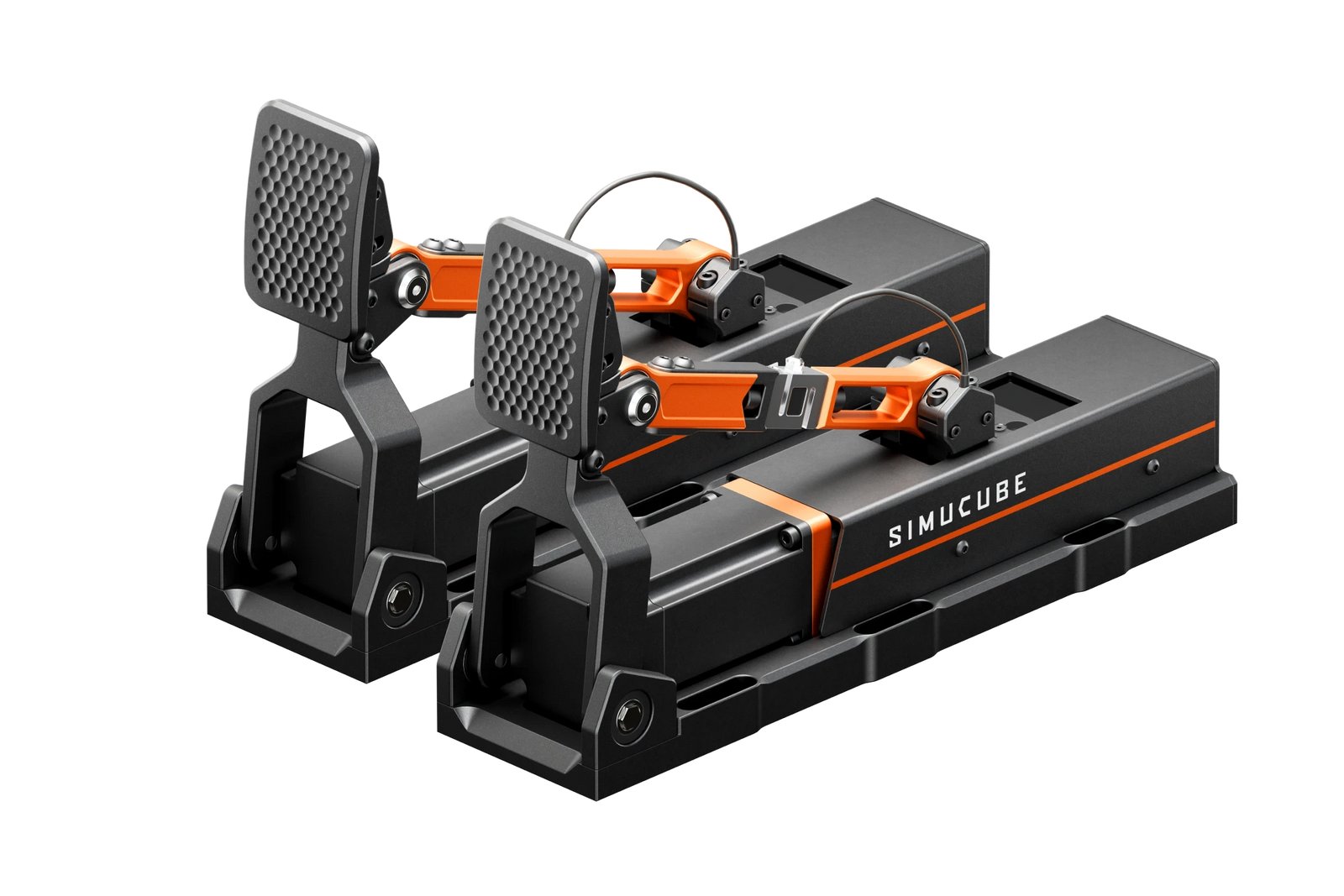
You do not need three ActivePedals. The common route is an ActivePedal on the brake and a passive throttle and clutch.
- Simucube Co-Pedal. A passive throttle or clutch with a hall angle sensor, 30, 50 or 70 mm of travel, and about 11 kg as a throttle or 25 kg as a clutch at full preload. €357.60 on the Europe store, listed as compatible with the Pro and the Ultimate.
- Third-party pedals. The Ultimate and the Pro each have two passive load cell inputs, and Simucube sells an adapter for Heusinkveld pedals. Simucube notes that a third-party throttle and clutch cannot be adjusted in the ActivePedal software.
If you are still deciding between technologies, my hydraulic pedals guide and my Heusinkveld review are the passive side of the comparison.
Is an ActivePedal worth it?
My honest take, from the spec sheet and from what the brake does in a real car:
- Buy one if you drive many different cars and want each to have its own brake, or if you want ABS and lock-up through your foot. Nothing passive does that.
- Wait for the Sport if the price was what stopped you. It is announced, priced, and due in early 2027.
- Stay with a good load cell if you drive one or two cars, you have a brake you trust, and the money is better spent on seat time. A consistent load cell brake already gives you the most important thing: pressure you can repeat.
FAQ
What is the Simucube ActivePedal?
A servo-driven sim racing pedal from Simucube. A motor makes the resistance, so force, travel and curve are software settings, and it can play ABS, traction control, RPM, G-force and lock-up effects in supported games.
How much does the Simucube ActivePedal cost in 2026?
On 15 October 2026 the Europe store lists the Pro from €1,682.40 and the Ultimate at €2,398.80 for one pedal. The US store lists $1,849 and $2,499. The new Sport is €901 excluding VAT, on sale in early 2027.
What is the difference between ActivePedal Pro and Ultimate?
The Ultimate goes to 170 kg and 79 mm, has an adjustable arm, 25 mm offset adjustment, inverted mounting and a 5 year warranty. The Pro tops out at 110 kg and 74 mm, has a fixed arm and a 3 year warranty, and needs a Link Hub.
When does the ActivePedal Sport come out?
Simucube says early 2027. It was revealed on 13 October 2026 and shown at SimRacing Expo Frankfurt. Early-access sign-ups can order 24 hours before public sales open.
Does the ActivePedal work with every racing game?
It works as a USB pedal in any PC game. The telemetry effects need a game supported by Simucube Tuner, such as iRacing, ACC, Assetto Corsa EVO, Le Mans Ultimate and RaceRoom. Brake threshold vibration and clutch bite point work everywhere.
Is there an alternative to the Simucube ActivePedal?
Yes. Simagic announced the P-ACTIVE in October 2026, at 999 US dollars on its own store page, shipping from 18 November. See my Simagic P-ACTIVE article.