
Rain is where races are won and thrown away. The grip drops, the braking points move, and the line you spent an hour learning is now the worst place on the track to be.
It is also where a careful driver beats a fast one. You cannot bully the car in the rain. You have to feel it.
Here is the setup I would run and how I would drive it. For everything dry, start from the ACC setup guide.
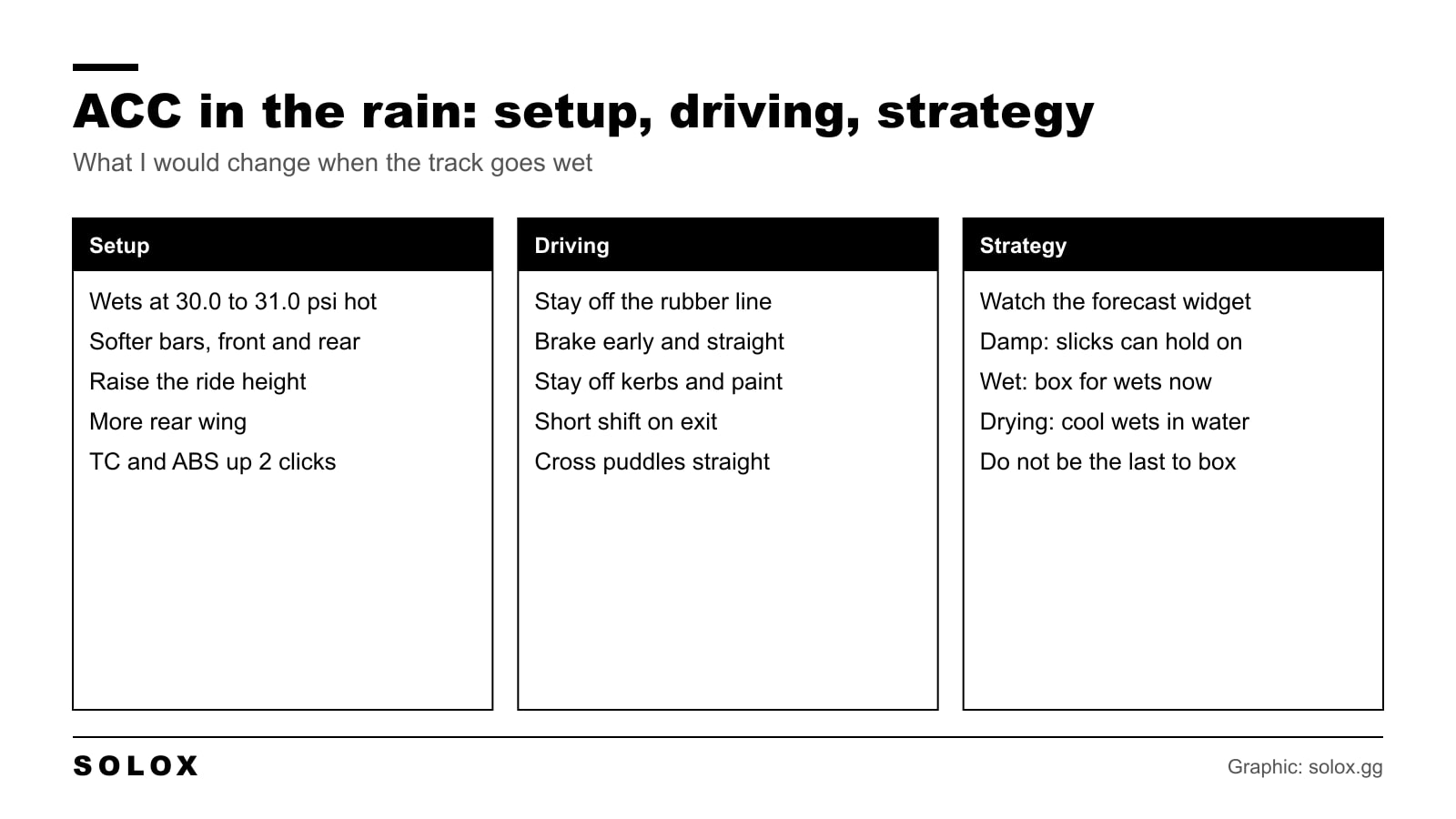
The wet setup, next to the dry one
| Setting | Dry | Wet | Why |
|---|---|---|---|
| Tyres | Dry slicks | Wets | Slicks cannot clear standing water |
| Hot pressures | 26.0 to 27.0 psi | 30.0 to 31.0 psi | The wet tyre has its own window |
| Anti roll bars | Your dry setting | Two or three clicks softer at both ends | A softer car finds more mechanical grip |
| Ride height | As low as it runs | A few millimetres higher, front and rear | Keeps the floor out of the water and lets the car roll |
| Rear wing | Track dependent | Two or more clicks higher | Drag matters less when everyone is slow |
| TC1 | Your dry setting | Two or three clicks higher | Wheelspin comes much earlier |
| ABS | Your dry setting | Two or three clicks higher | The fronts lock with far less pedal |
| Brake bias | Your dry setting | 1 to 2% rearward | Less grip means less weight goes to the front |
| Brake ducts | Set for 600 to 650 C fronts | One or two steps more closed | Rain and lower speeds cool the brakes |
| Brake pads | Pad 1 for sprints | Pad 2 or 3 | A softer bite is easier to modulate |
| Engine map | Fastest map | A wet map if the car has one | Softer throttle response |
You do not need a separate wet setup built from zero. Take your dry race setup for that track, save a copy, and make these changes. Ten minutes.
The idea behind all of it: in the dry you fight for aero grip and a stiff, precise car. In the wet there is no grip to be precise with. You want a car that moves, leans and tells you early what it is about to do.
Wet tyre pressures
Wets work at 30.0 to 31.0 psi hot. That is the number to remember.
Getting there is harder than in the dry, because the water cools the tyre and the pressure rises less over a stint. And it changes with the rain. Heavier rain means a cooler tyre and lower pressures. A drying track means a hot tyre and pressures that climb fast.
So set the cold pressures, do three laps, look at the hot numbers and correct. Same method as in the ACC tyre pressure guide, with a different target.
Track states: when you need wets
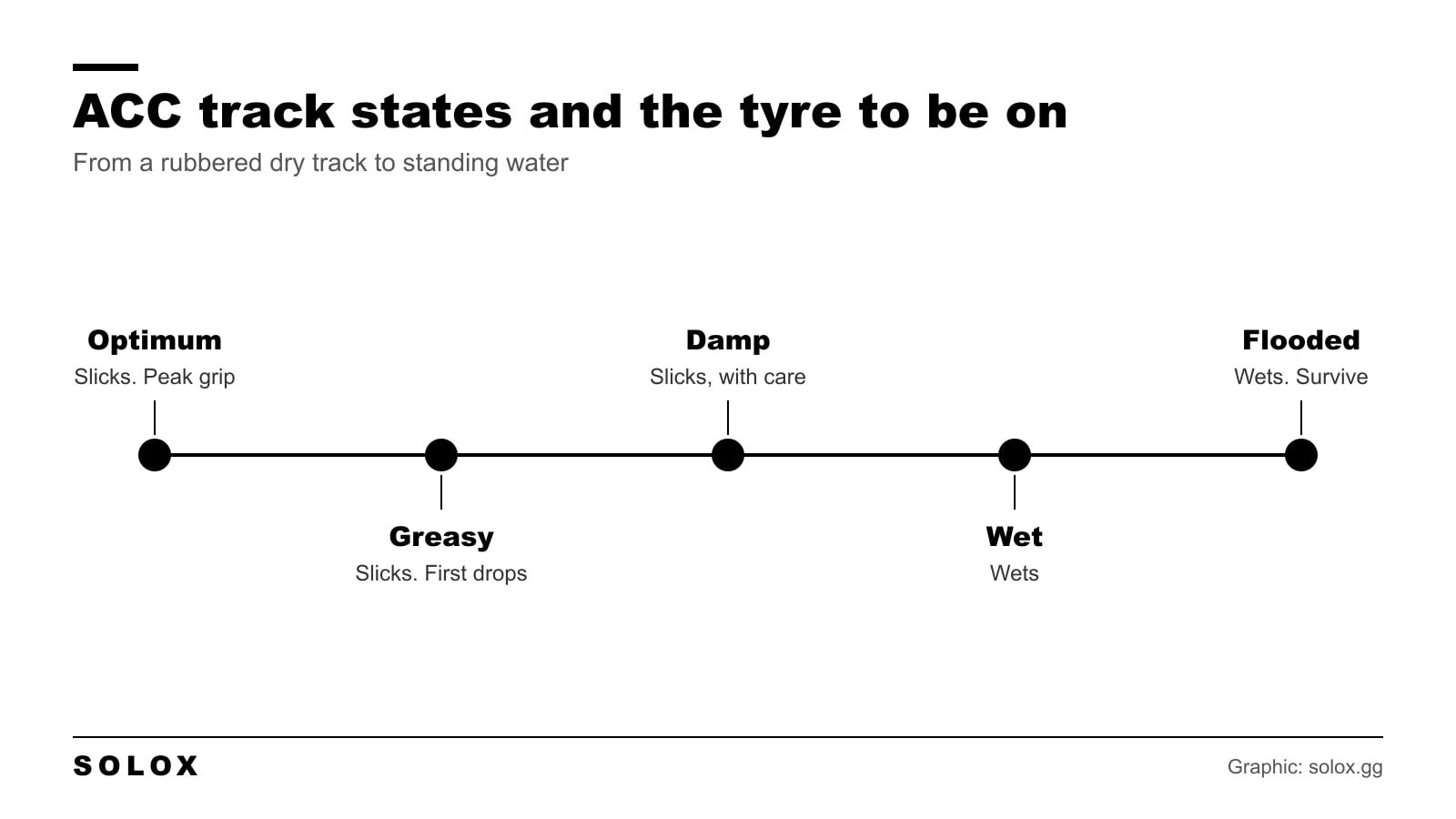
ACC tells you how wet the track is. Learn the words, because they decide your tyre.
| Track state | What it means | Tyre |
|---|---|---|
| Green, Fast, Optimum | Dry, with more rubber going down at each step | Slicks |
| Greasy | First drops on a rubbered track. Slippery, mostly on the racing line | Slicks |
| Damp | Wet surface, no standing water yet | Slicks if it is about to stop. Wets if it keeps raining |
| Wet | Water on the whole track, puddles forming | Wets |
| Flooded | Standing water everywhere. Aquaplaning on the straights | Wets, and bring it home |
Damp is the hard call. Slicks on a damp track are slow and nervous, but a pit stop costs you a lot more than a few slow laps. If the forecast says the rain is ending, stay out and be careful. If it says more is coming, box now and be on the right tyre before everyone else.
More on rain settings, forecasts and how the weather changes in the ACC weather guide.
How to drive in the wet
Get off the racing line
On a dry track the rubber on the racing line gives grip. Add water and that rubber turns to ice. ACC models this.
So in the wet you drive where nobody drives in the dry. Brake a car width off the usual line. Take a wider entry or a later apex, and look for the rough, clean tarmac. On exit, stay off the rubbered part where everyone puts the power down.
Try different lines in practice. The grip is often on the outside.
Brake early, brake straight
Braking distances grow a lot. Move your braking point back and find the limit from the safe side, one lap at a time.
Get the heavy braking done in a straight line. Trail braking still works, but with much less pedal. If the ABS is working the whole way into the corner, you are asking too much. The pedal technique is in the ACC braking guide.
Kerbs and paint
Stay off them. Wet kerbs and painted lines have almost no grip. A kerb you ride flat in the dry will spin you in the rain.
Throttle
Squeeze it, and later than you think. Short shift out of slow corners to keep the torque down. Let the TC work, but do not lean on it. If the TC light is on all the way down the straight, you lost time. TC1 and TC2 are explained here.
Puddles
ACC has standing water in set places on each track, and it gets deeper as the rain goes on. Hit a puddle with the wheels turned or the throttle open and the car aquaplanes.
Learn where they are in the first laps. Cross them with the wheel straight and a steady throttle.
When the track dries
A wet tyre on a drying track overheats in a few laps. You will feel it go soft and vague, and the pressures shoot up.
Two things help. Drive through the wet patches on the straights to cool the tyres. And decide early: once a dry line appears and the state goes back to Damp, slicks are coming. The driver who pits one lap too early loses a little. The one who stays three laps too long on dead wets loses a lot.
When you make the stop, check the pressures for the new set. Slicks going onto a cold, damp track need more cold pressure than usual to reach the window. How to set that from the pit menu is in the ACC pit stop guide.

Practise it
Most people only drive in the rain when a race forces them to. Then they are surprised that it goes badly.
Set up a practice session with the track at Wet and do 30 minutes. Then do it again with rain that starts halfway. An hour of that puts you ahead of most of a public lobby.
FAQ
What tyre pressure should I run in the wet in ACC?
30.0 to 31.0 psi hot on wet tyres. Check after three laps and correct, because the rain intensity changes how much the tyre heats up.
When should I switch to wet tyres in ACC?
When the track state reads Wet. On Damp, slicks can still work if the rain is stopping. Use the forecast to decide.
What should I change on the setup for rain in ACC?
Fit wets, soften both anti roll bars, raise the ride height, add rear wing, raise TC1 and ABS by two or three clicks and move the brake bias 1 to 2% rearward.
Where is the grip on a wet track in ACC?
Off the dry racing line. The rubber that helps in the dry is slippery when wet. Look for clean tarmac on the outside of corners.
Should I use more TC and ABS in the rain?
Yes. Two or three clicks more of each is a good start. Then lower them one click at a time if the car feels held back.
Why do my wet tyres overheat?
The track is drying. Wets need water to stay cool. Drive through the wet patches on the straights and plan your stop for slicks.
Do I need a different setup for a damp track?
No. For a damp track on slicks, keep the dry setup and add a click or two of TC and ABS. The full wet setup is for a Wet or Flooded track.