
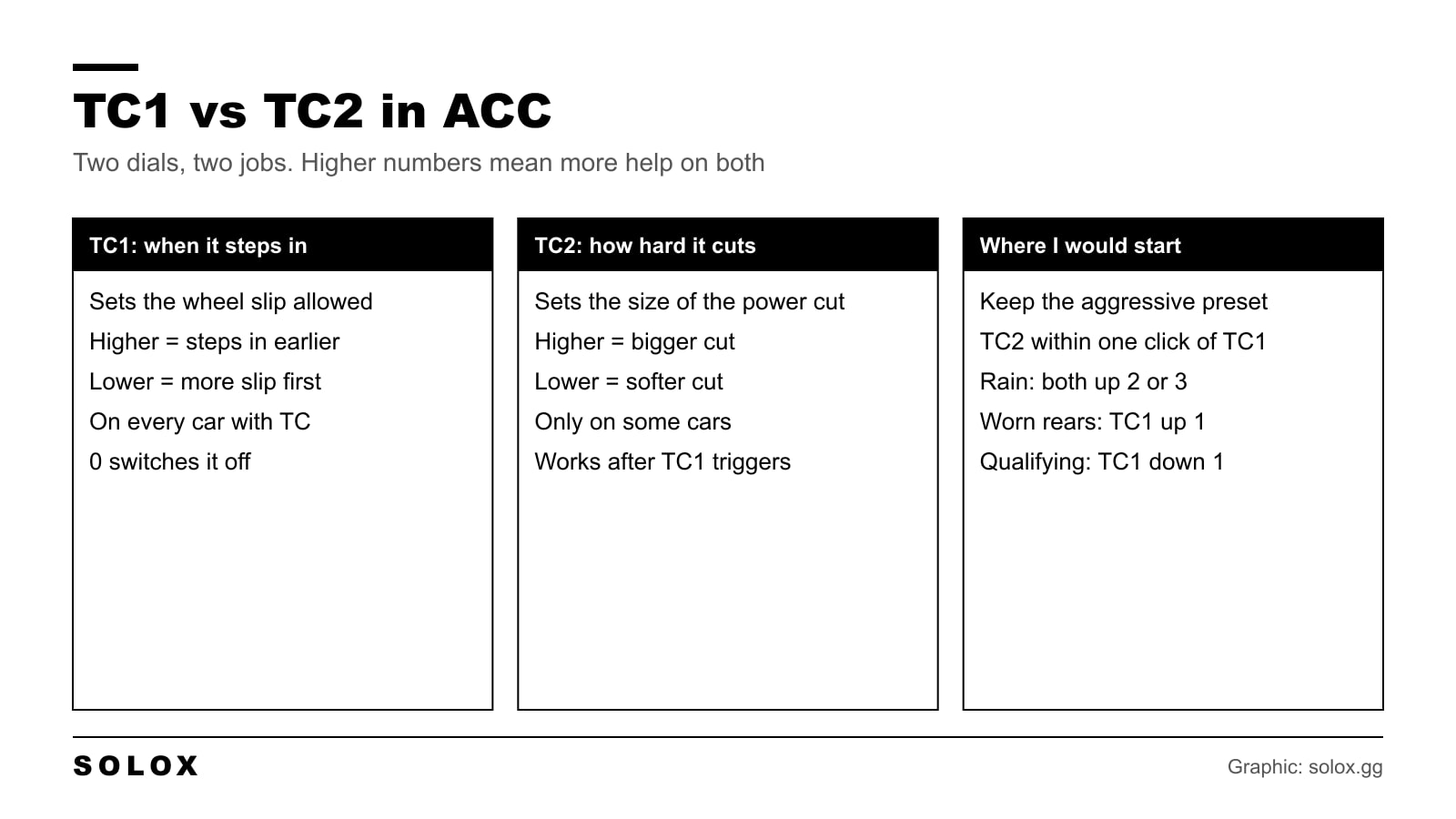
TC1 decides when traction control steps in. TC2 decides how hard it cuts the power once it has. On both, a higher number means more help and a lower number means less. That is the whole difference, and it is the opposite of what a lot of old guides say.
The rest of this page is how to use the two together, where I would start, and how to tell from the driver's seat which one is wrong. If you want the full picture of the setup screen, start with the ACC setup guide and come back here for the electronics.
TC1 vs TC2 at a glance
| TC1 | TC2 | |
|---|---|---|
| Job | Decides how much the rear wheels can slip before the system does anything | Decides how much power is cut once the system is working |
| Higher number | Steps in earlier, less slip allowed | Bigger cut, the car feels held back for longer |
| Lower number | Steps in later, more slip allowed | Smaller cut, power comes back sooner |
| Set to 0 | Traction control off | The softest cut the car allows |
| Which cars | Every car in ACC with traction control | Only some cars. The others have one TC dial |
| What you feel | When the engine starts to stutter on exit | How much the car bogs down when it does |
Think of it as two questions. TC1 answers "how much wheelspin do I accept?". TC2 answers "when I have had enough, how big is the correction?".
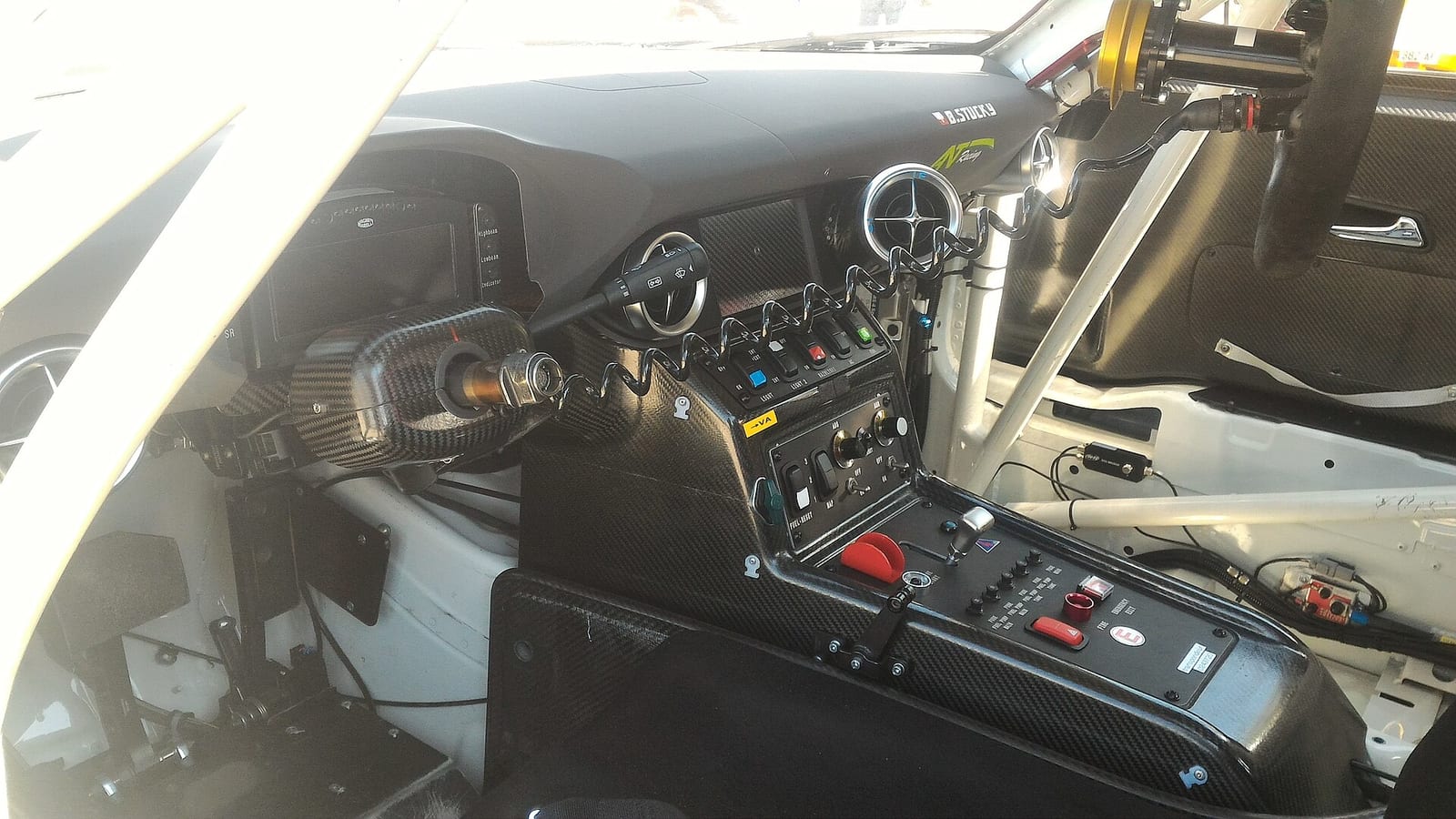
A GT3 car does not use the brakes for traction control. It cuts the engine. That is the stutter you hear on a corner exit when the TC light flashes. TC1 moves the point where that stutter starts. TC2 changes how deep and how long it is.
What TC1 does
TC1 is the threshold. The system compares the speed of the driven wheels with the speed of the car. When the rears spin faster than they should by more than the TC1 setting allows, the system steps in.
- High TC1: very little slip is allowed. The system steps in early. The car is safe and easy, but it will not accelerate as hard out of slow corners, because a tyre needs a bit of slip to give its best traction.
- Low TC1: more slip is allowed. You get better drive if your right foot is good, and a snap of oversteer if it is not.
- TC1 at 0: traction control is off.
The number range is not the same on every car. Each car in ACC has its own number of steps, the same as the real ones. So "TC 4" on one car is not "TC 4" on another. Always think in clicks from the preset, not in absolute numbers.
What TC2 does
TC2 only matters once TC1 has triggered. It sets the size of the power cut.
- High TC2: a big cut. The slide is killed quickly, but the car bogs down and takes longer to pick up again.
- Low TC2: a small cut. Power comes back sooner. The slip is trimmed, not killed, so you have to do more of the work yourself.
This is why you see fast drivers running TC2 lower than TC1, and some of them running it at 0. Their throttle is smooth enough that a light correction is all they need, and a light correction costs less time. It works for them. If you are still learning the car, a TC2 of 0 with a clumsy right foot gives you a system that steps in and then does not do enough.
Which ACC cars have TC2
Not all of them. Some cars have a single traction control dial, and on those there is nothing to compare. You have TC and that is it.
The quick way to check your car: open the setup, go to the electronics page and look for a second TC line. If TC2 is there, your car has it. If the line is missing, it does not, and you only bind one pair of buttons.
I am not going to print a list of cars here. The car list has changed with every DLC and I could not find a current one I trust. The setup screen is always right. For the cars themselves, see the ACC cars list.
Where I would start
Load the aggressive preset for the track and look at what Kunos gave you. Those TC values are a sensible base. Then work from there in single clicks.
| Situation | TC1 | TC2 | Why |
|---|---|---|---|
| First laps in a new car | Preset value | Preset value | The aggressive preset is a sensible base. Learn the car before you touch it |
| Qualifying, new tyres | 1 lower | Same or 1 lower | Fresh rears can take more slip, and a little slip is where the lap time is |
| Race, full tank | Preset value | Preset value | You want the rear tyres alive at the end of the stint |
| Rear tyres going off | 1 higher | Same | Catch the slip earlier before it cooks the tyre |
| Damp track | 1 or 2 higher | 1 higher | Less grip, so the slip comes sooner and bigger |
| Full wet | 2 or 3 higher | 2 or 3 higher | The car has to be calm on the throttle or you will not finish |
Two rules that keep you out of trouble:
- Keep TC1 and TC2 close. Within one click of each other is a good habit. A very high TC1 with a very low TC2, or the other way round, gives you a car that reacts in a way that is hard to read.
- Run as much TC as you can without losing lap time. Not as little as you can survive. More TC means less wheelspin, and less wheelspin means cooler rear tyres that last longer. Over a 60 minute race that is worth more than a tenth in qualifying trim. I go into that in the ACC tyre wear guide.
How to tell which one is wrong
Drive five laps and pay attention to slow corner exits. That is where traction control shows itself.
| What the car does | What I would change |
|---|---|
| Engine stutters early on every exit and the car will not accelerate | TC1 down one click |
| TC light barely flickers but the car feels dead for a long time after | TC2 down one click |
| Rear steps out before the TC does anything | TC1 up one click |
| TC catches the slide but the rear still snaps again right after | TC2 up one click |
| Rear tyre temperatures and wear run away in the stint | TC1 up one click, and look at your throttle trace |
| Fast on lap one, slow by lap ten | TC1 up one click for the race |
Change one thing, drive five more laps, compare. If you move both dials at once you learn nothing.
One warning. A lot of what feels like a TC problem is a throttle problem. If the TC light is on for the whole exit of every slow corner, lowering TC1 will make you spin, not make you faster. Squeeze the throttle. Get the car straight first. Then look at the dials. If the rear is loose before you even touch the throttle, that is balance, and the understeer and oversteer guide is the page you need.
Changing TC while you drive
You should not set TC once in the garage and forget it. The track grips up, the tyres wear, the fuel burns off, the rain comes. The real drivers move these dials all race and so should you.
- Keyboard: Shift + T raises traction control and Ctrl + T lowers it. The full table is in the ACC keyboard shortcuts list.
- Wheel: bind TC up and TC down to two buttons or a rotary encoder in the controls menu. If your car has TC2, it has its own pair of bindings. If you are short of buttons, give them to TC1 and leave TC2 where the setup put it.
The current values show on the dash and in the HUD, so you can check what you are on without opening a menu.
What I would do in a stint: start on the race value, and when the rear starts to move on exits it handled fine ten laps ago, go up one click on TC1. Do not wait until you have had the big moment.
TC in the wet
Rain is where these two dials earn their place. Grip is low, the slip comes with very little throttle, and a spin costs you far more than a slow exit.
Go up 2 or 3 clicks on both TC1 and TC2 from your dry values as a starting point. On a damp track that is drying, come back down one click at a time as the line appears. Pair it with a wet engine map if your car has one, because a softer throttle map does half of the traction control's job for it. The rest of the wet setup is in the ACC wet weather guide.
Mistakes I see all the time
- Reading the scale backwards. Higher is more help. 1 is not the safest setting, it is close to the least.
- Copying TC numbers from another car. The ranges are different. Copy the idea, not the number.
- Setting TC2 to 0 because a fast driver does. It suits a smooth right foot. Earn it.
- Turning TC off to be quick. Real GT3 drivers race with it on.
- Never touching it in the race. The right value on lap 2 is the wrong value on lap 25.
FAQ
What is the difference between TC1 and TC2 in ACC?
TC1 sets how much the rear wheels can slip before traction control steps in. TC2 sets how much power is cut once it has stepped in. TC1 is when, TC2 is how hard.
Is a higher TC number more or less traction control in ACC?
More. A higher number means the system steps in earlier on TC1 and cuts more power on TC2. A value of 0 on TC1 switches traction control off.
Do all cars in ACC have TC2?
No. Only some cars have a second traction control dial. Open the electronics page of the setup. If there is no TC2 line, your car has a single TC setting.
What should I set TC1 and TC2 to?
Start from the aggressive preset for your car and track. Keep TC2 within one click of TC1. Go one click lower on TC1 for qualifying, and 2 or 3 clicks higher on both in the rain.
Why do fast drivers set TC2 to 0?
A low TC2 gives a smaller power cut, so the car picks up again sooner. With a smooth throttle that is quicker. With a rough throttle it means the system does not do enough when you need it.
Does traction control affect tyre wear in ACC?
Yes. More traction control means less wheelspin, and less wheelspin keeps the rear tyres cooler and makes them last longer. In a long race a higher TC value is often the faster choice.
How do I change TC while driving in ACC?
On a keyboard, Shift + T raises traction control and Ctrl + T lowers it. On a wheel, bind TC up and TC down to buttons or a rotary encoder in the controls menu.