
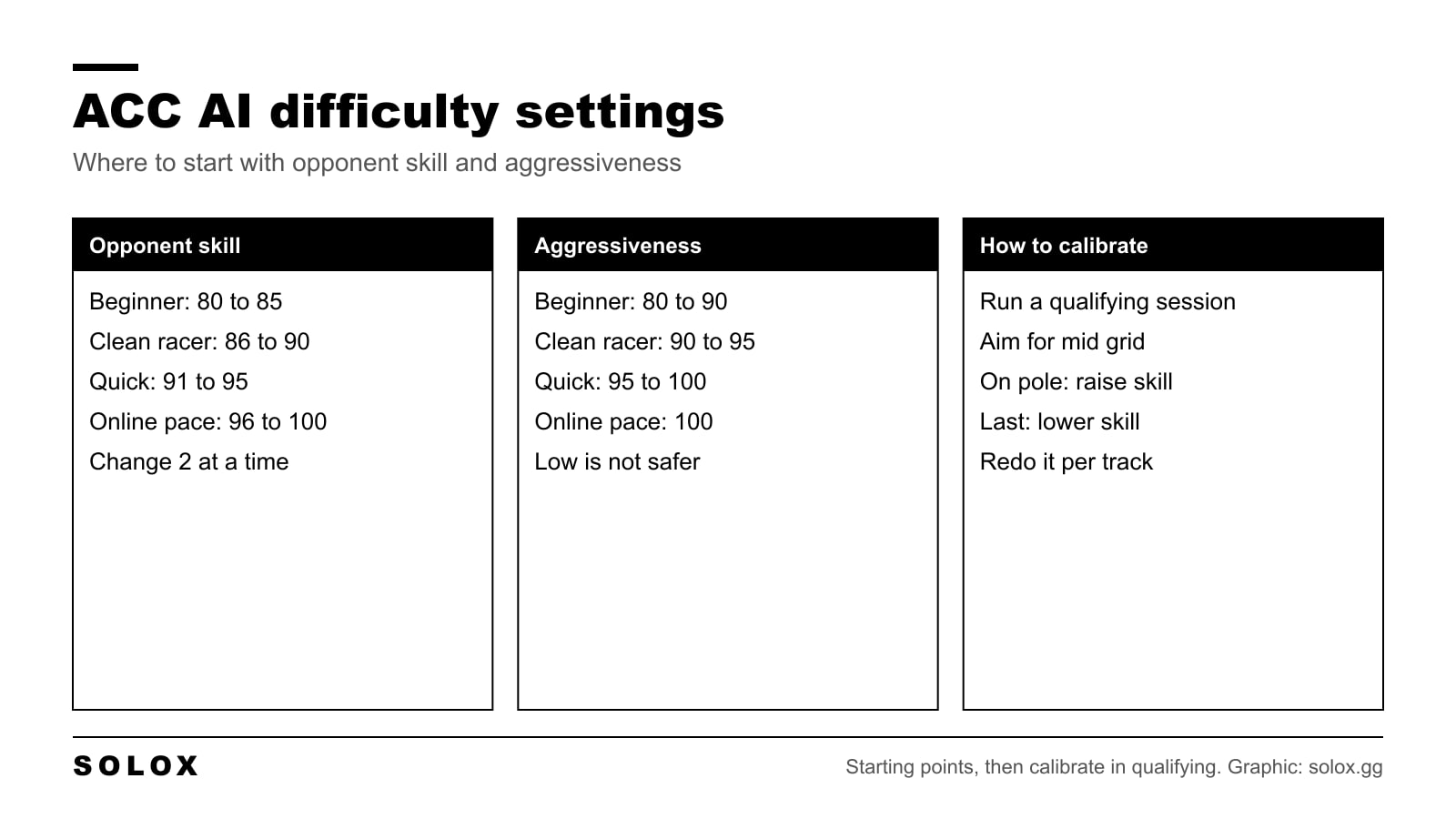
If the AI in Assetto Corsa Competizione is too slow for you, the fix is two sliders in the single player menu: opponent skill and aggressiveness. Raise the first one until you qualify in the middle of the grid, and keep the second one high.
That is the short version. Below are the values I would start with by level, a way to find your own number in ten minutes, and what the AI does well and badly, so you know what to expect.
ACC AI difficulty settings: where to start
| Your level | Opponent skill | Aggressiveness |
|---|---|---|
| New to ACC, still learning the track | 80 to 85 | 80 to 90 |
| You finish races without spinning | 86 to 90 | 90 to 95 |
| You are within 2 seconds of a good online lap | 91 to 95 | 95 to 100 |
| You are on the pace of fast online lobbies | 96 to 100 | 100 |
These are starting points. Kunos does not publish what one point of skill is worth in lap time, and it is not the same on every track. So take the row that sounds like you, then calibrate with the method further down.
You find both sliders in Single Player, in the settings of a quick race, a custom race weekend or a championship, next to the number of opponents. If you are new to the offline modes, start with my guide to ACC single player.

What opponent skill does
Opponent skill is the pace of the AI. Higher number, faster laps. At 100 the AI drives the car close to its limit. Lower the number and they brake earlier, carry less speed in the corners and get on the throttle later.
Three things to know:
- The useful range is the top of the slider. Players who test it report values from about 80 to 100. Below that the field is so slow that the race teaches you nothing.
- It is not linear across tracks. The AI is stronger on some circuits than on others. A value that gives you a fight at Monza can leave you ten seconds clear at another track, or five seconds behind.
- The AI is consistent. It does the same lap again and again. Your lap times move, theirs do not. So if you match them in qualifying, expect them to be hard to beat over 30 minutes.
That last point is the one that surprises people. In real racing the gap between a good driver and a great one is rarely the best lap. It is the tenth lap, and the twentieth. The AI is good at exactly that.
What aggressiveness does
Aggressiveness is how the AI behaves when another car is close. Does it try the move, does it defend, does it stay next to you in a corner.
A lot of people lower it because they think it makes the AI safer. From what players report, and it matches how the AI races, it is the other way round:
- At a high value the AI commits. It goes for a gap, holds its line next to you, and gets the pass done.
- At a low value the AI hesitates. It lifts in places where you do not expect it, sits behind slower cars, and brakes early when you are alongside. That is how you end up in the back of one.
So I would keep it at 90 or more at any level, and at 100 once you are confident wheel to wheel. If you want an easier race, lower the skill, not the aggressiveness.
How to find your number in ten minutes
Do not guess. Measure it.
- Pick the track and the car you want to race.
- Set up a custom race weekend with a qualifying session of 10 minutes and a full grid. Use the same weather and time of day you will race in.
- Set opponent skill from the table above and aggressiveness at 95.
- Do the qualifying session properly. Out lap, two or three push laps.
- Look at where you are on the grid, and use the table below.
| Result | What to do |
|---|---|
| You are on pole by more than a second | Raise skill by 3 |
| You are on pole by a few tenths | Raise skill by 1 or 2 |
| You qualify in the middle of the field | Leave it. This is the right level |
| You are last by a second or more | Lower skill by 3 |
| You match them in qualifying but they drive away in the race | Keep the skill. Work on your race pace and tyres |
| You match them in qualifying and pull away in the race | Raise skill by 1 and qualify lower |
The target is the middle of the grid. From there you have cars to attack and cars to defend from, and that is where you learn racecraft. Starting on pole and driving away alone is hot lapping with extra steps.
Write the number down for that track. Then redo it at the next one. It takes ten minutes and it saves you a wasted evening.
The right level is one you can barely beat
When I coach karting drivers I tell them the same thing: you do not get faster by winning easy races. You get faster by chasing someone who is two tenths quicker than you.
Use the AI like that. Set it so you finish fifth to tenth on a normal day and on the podium on a very good one. When you start winning, raise the skill by 1 or 2 and go again. That slow climb is worth more than a jump to 100 that leaves you alone at the back, overdriving the car.
And be honest with the grid position. If you set the AI where you can win from last place, you are not racing them. You are passing traffic.
What the AI does well and badly
Knowing its habits makes the racing better.
It does well:
- Consistent lap times, lap after lap.
- Clean lines in fast corners.
- Side by side racing, when aggressiveness is high.
It does badly:
- One line. The AI follows the same line and brakes at the same points. If you brake later than it expects, on its line, it can run into you. Leave room in the first laps until you know where they brake.
- Lap one. The field is packed and cautious into the first corner. Be patient. See my ACC race starts guide.
- Strategy. The AI is simple with pit stops, and often much of the field stops around the same lap. Plan your own stop with my ACC pitstop guide and you can gain places there.
- Changing weather. Its pace in the wet does not always drop the way yours does. If it rains, lower the skill a few points. More on that in ACC wet weather driving and setup.

Problems and fixes
| Problem | Fix |
|---|---|
| The AI is too slow everywhere | Raise opponent skill 2 points at a time |
| The AI is fast on one track and slow on another | Normal. Save a value per track |
| The AI hits you from behind under braking | Brake where they brake for the first laps, or lower aggressiveness by 5 |
| The AI never tries to pass you | Raise aggressiveness to 95 or 100 |
| The AI is much faster in the rain | Lower skill by 3 to 5 for wet races |
| You win every race from the back | Raise skill, and start from your real qualifying position |
| The whole field pits on the same lap | It is how the AI handles strategy. Use it to plan your own stop |
Is the AI slow, or is the setup doing the work?
One more thing before you put the AI at 100. The AI runs its own setup. If you race it with a time trial setup, low fuel and soft tyres in the perfect pressure window, you are not comparing the same thing.
Race them with a race setup and race fuel. Get the tyre pressures right for a long run, not for one lap. Then judge the level. My ACC setup guide covers the rest.
It works the other way too. If the AI is too fast for you at 85, the answer may be in your driving, not in the slider. Most of the time lost by new ACC drivers is on the brakes. See ACC braking technique.
AI or online?
The AI is a good training partner. It is always there, it does not rage quit, and it lets you practice starts, traffic and long stints in peace.
It is not a replacement for people. Humans make mistakes, defend in strange ways and change their line. When you can run a clean 30 minute race against the AI in the 90s, go online. My ACC multiplayer guide explains how to start, and the ACC driver rating system explains the numbers the game gives you. Racing the AI cleanly is also a calm way to build those ratings before your first lobby.
FAQ
What are the best AI difficulty settings in ACC?
There is no single best value. Start with opponent skill at 86 to 90 and aggressiveness at 90 to 95 if you can finish a race cleanly, then adjust until you qualify in the middle of the grid.
How do I make the AI faster in ACC?
Raise opponent skill in the single player race settings. Go up 2 points at a time and check your grid position after a qualifying session.
What does aggressiveness do in ACC?
It changes how the AI races near other cars: how willing it is to attack, defend and stay alongside. It does not change its lap time in clean air much.
Should I lower aggressiveness to avoid crashes?
I would not. A passive AI lifts and brakes early in traffic, which causes its own contacts. Lower the skill for an easier race and keep aggressiveness at 90 or more.
Why is the ACC AI faster on some tracks?
The AI is not equally strong everywhere. The same skill value gives a different gap from track to track, and with some cars too. Calibrate once per track and write the number down.
Is ACC AI at 100 the same as fast online drivers?
No. The fastest online drivers are quicker than the AI at 100 over one lap. The AI is very consistent, though, so it is still a hard race for most people.
Does the AI difficulty affect my driver ratings?
The difficulty itself is not a rating. Your ratings come from how you drive: consistency, car control, pace and how cleanly you race near other cars.
Why does the AI crash into me under braking?
Usually because you brake later or on a different line than it expects. Learn where the AI brakes in the first laps and leave a little room before you start to attack.