
Most online ACC races are decided twice: in qualifying and in the first two corners. You can be the fastest driver on the server and still finish last because of 30 seconds at the start.
A good start is not about a hero move. It is a routine. Here is the one I would use.
How a start works in ACC
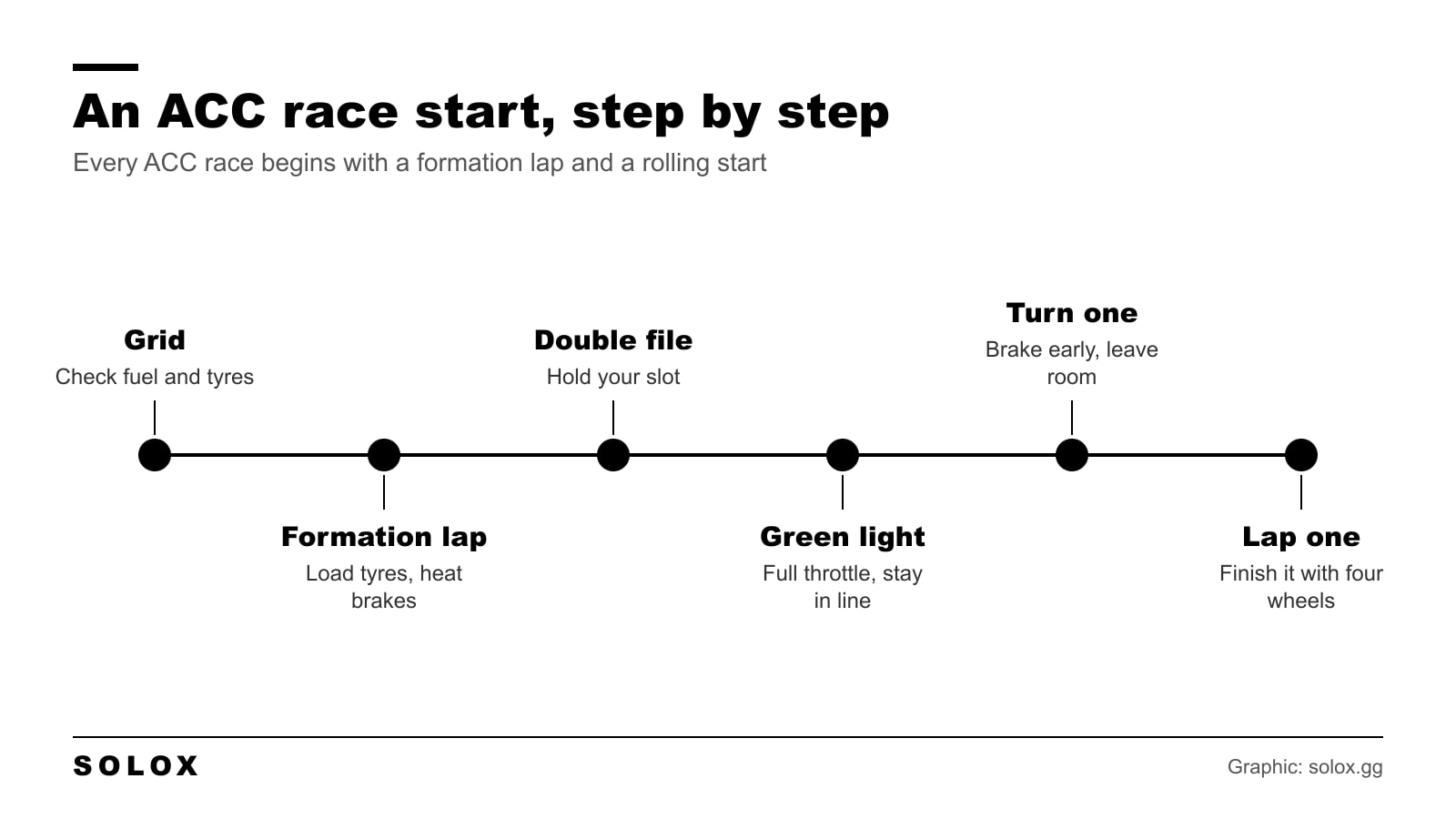
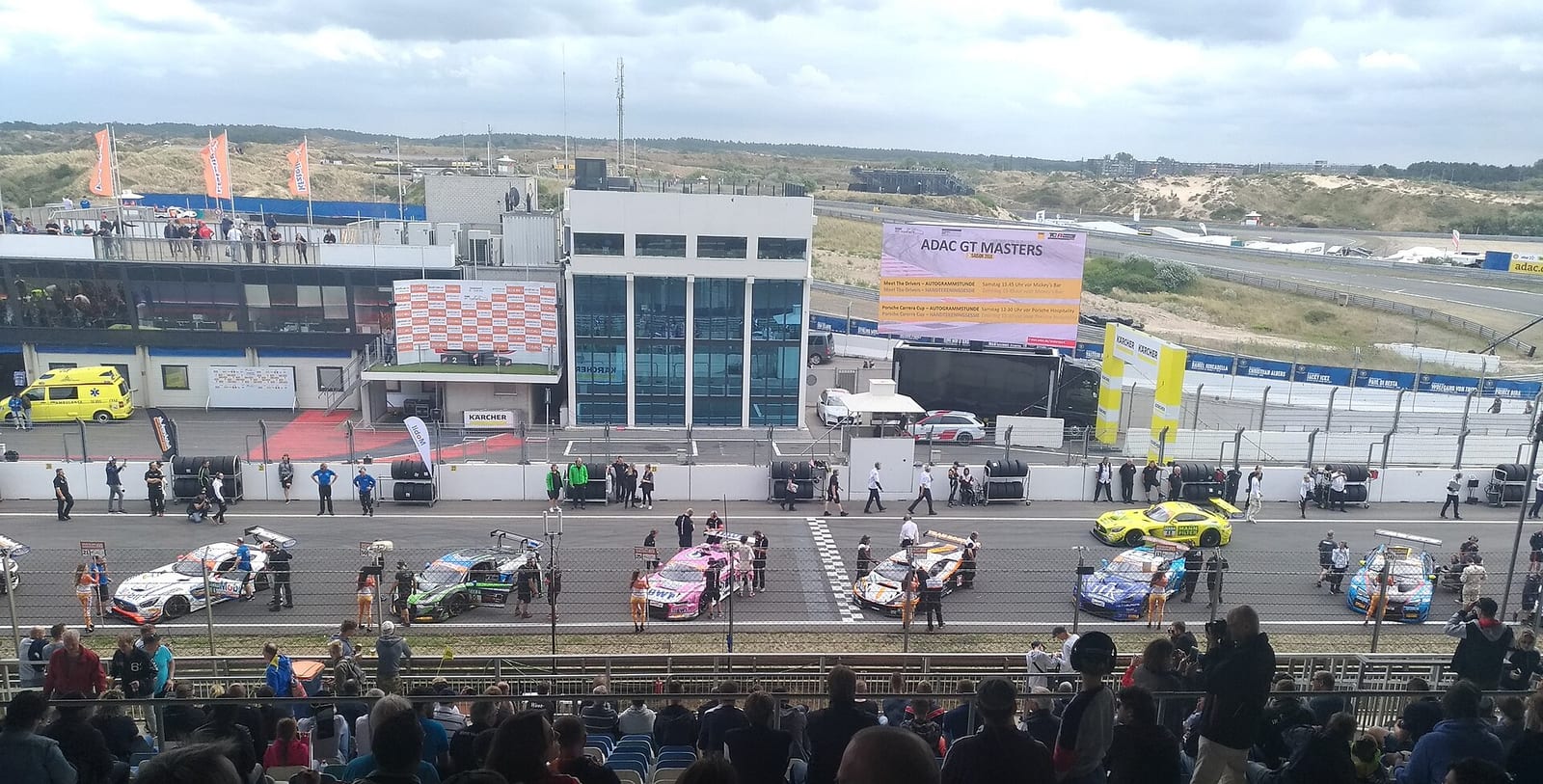
ACC has rolling starts only. There is no standing start. The cars leave the grid, do a formation lap, line up in double file and take the green light at speed.
On the default formation lap the game guides you. An on screen widget shows where you should be compared with the car ahead, and it tells you when to close up into double file. Stay where it wants you. If you are out of position when the lights go green, you can get a penalty.
The widget, the radar and the rest of the screen are covered in the ACC HUD guide. Turn the radar on before your first online race. You will need it in turn one.
The three formation types
Server admins choose how the formation lap runs. The Kunos server handbook lists three types.
| Formation type | What happens | Where you meet it |
|---|---|---|
| Default | A full formation lap with position control and an on screen guide that tells you where to be | Almost every public server and league |
| Old limiter lap | The cars run the formation on the limiter and the game holds the pace for you | Some older or casual servers |
| Free | No control from the game. The drivers manage the lap and the start themselves | Private servers and leagues with their own rules |
If you join a league, read its start rules. A free start means the drivers police themselves, and the league will have its own rule for when you may accelerate. The server side of online racing is in the ACC multiplayer guide.
Use the formation lap
This is where most drivers lose the start before it happens. They cruise.
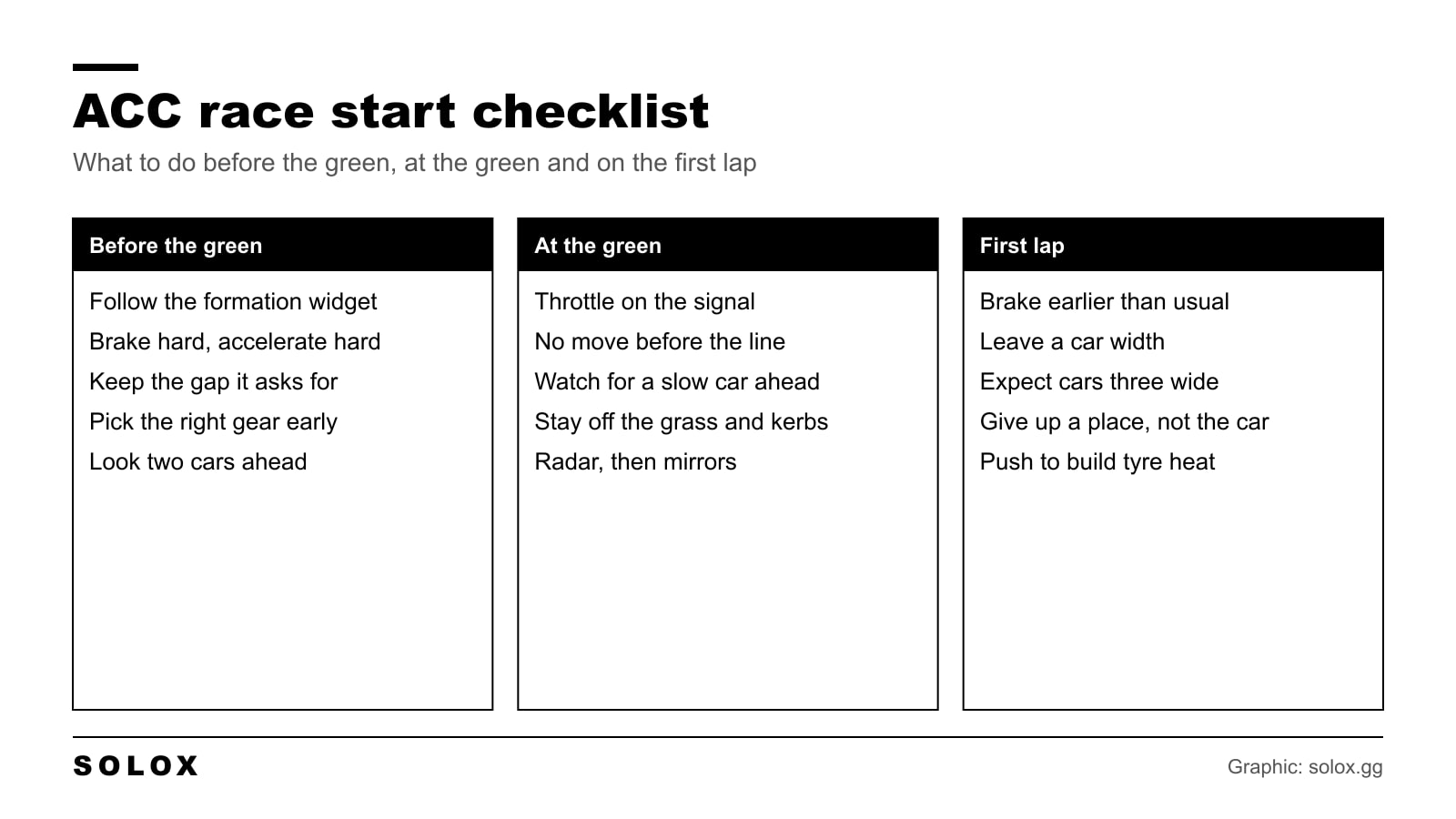
Tyres build temperature under load. Driving slowly in a straight line does nothing for them. So on the formation lap, load them: brake hard, accelerate hard, lean on the car in the corners as much as the gap to the car ahead allows.
It is the same thing I teach in karting. On cold tyres the kart feels like it is on ice, and the instinct is to back off. That is wrong. The driver who gets the tyres to working temperature first has the advantage in the opening laps, and the only way to get there is to push.
The brakes need heat too. A cold GT3 brake does not bite, and the first big stop of the race is turn one. Do four or five hard stops on the formation lap, when the car behind has room.
Two warnings:
- Do not hit the car ahead. Hard braking in a queue needs a gap. Build it first, then brake.
- Do not fall out of your slot. Warm the car inside the window the widget gives you.
Your pressures will be below the hot target at the green. On slicks the target is 26.0 to 27.0 psi hot, and you reach it after a lap or two of racing, not on the formation lap. That is normal. The ACC tyre pressure guide shows how to set the cold values so you land there. The rest of the car is in the ACC setup guide.
The green light
When the field closes into double file, three things matter.
Gear. Pick it before the last corner. In most GT3 cars at formation pace I would be in second. Too high and the car bogs down. Too low and you hit the limiter in one second.
Gap. Keep the gap the game asks for. If you hang back to get a run, you risk being out of position. If you sit on the bumper ahead, you have nowhere to go when that car is slow away.
Eyes. Look two cars ahead, not at the bumper in front of you. If the row ahead hesitates, you see it early and you lift instead of crashing.
On the green, go to full throttle and stay in your lane until you are past the line. Then you can move. The cars around you are doing the same speed with the same grip, so most passes at the green come from someone else's mistake. Be ready to take that gift and do not try to make one.
Turn one
Turn one on lap one is a different corner from the one you qualified in.
- Brake earlier. The pack brakes earlier than a single car, and the cars concertina. Your qualifying marker will put you in someone's boot. The technique is in the ACC braking guide.
- Use the radar. It shows the cars beside you that the mirrors miss. If there is a car next to you, leave a car width. Always.
- Pick a side early. Changing lanes in the braking zone is how pile ups start.
- Inside is safer, outside is faster. The inside line protects your place. The outside can gain two places or end in the gravel. On lap one I would take the inside.
- Expect the worst. Someone will miss the brake point. If you left a margin, they miss you.
Risk versus reward
Count it. A place gained in turn one is worth one position. Contact in turn one is worth a spin, damage and a trip to the pits. In a 20 minute sprint, repairs end your race.
So the rule I would follow is simple. If the gap is there and it will still be there at the apex, take it. If you have to hope the other driver sees you, wait. There are more laps.
This matters more the further back you start. At the front you race two cars. In the middle you race ten, and half of them are looking at each other. From the back, the best first lap is often a quiet one: you gain places from the cars that crash.
The first laps
The start is not over after turn one. For two laps the tyres are still coming in and the field is still packed.
Brake a little earlier than normal at every corner and move the brake point later as the grip arrives. Read it corner by corner. And keep loading the tyres. If the car has no grip on lap one, the answer is to work the tyres harder, because temperature is the only thing you can still change once the race is on.
Then settle. Once the field strings out, the race becomes about pace and stops. That part is in ACC race strategy tips and the ACC pit stop guide.
Common mistakes
| Mistake | What it costs | The fix |
|---|---|---|
| Cruising the formation lap | Cold tyres and cold brakes into turn one | Brake hard and accelerate hard several times on the lap |
| Out of your slot at the green | A penalty, or a slow launch while you recover | Follow the on screen guide and settle early |
| Wrong gear at the green | The car bogs down or sits on the limiter | Pick the gear before the last corner and hold it |
| Braking at your qualifying marker | You hit the car ahead | Brake earlier on lap one. The pack brakes early |
| Diving for a gap that is closing | Contact, damage, race over | If you have to hope, it is not a gap |
| Defending every place on lap one | You lose the tow and two more places | Let a faster car go and follow it |
How to practise starts
You do not need a full server to practise this.
- Single player race, full AI grid. Start from the middle. Do the formation lap and the first two laps, then restart. Ten times.
- Change the grid slot. Front row, middle, last. Each one is a different start.
- Set a rule. No contact for ten starts in a row. If you touch a car, the count goes back to zero.
Set the AI to a level that keeps you in the pack. The ACC AI difficulty guide helps with that. After thirty starts, the first corner of an online race will feel slow.
FAQ
Does ACC have standing starts?
No. ACC uses rolling starts only. Every race begins with a formation lap and a double file run to the green light.
How does the formation lap work in ACC?
On the default setting the game guides you with an on screen widget. You follow the car ahead, close into double file when told and accelerate at the green.
Can I skip the formation lap in ACC?
In single player you can choose a short formation. Online it depends on the server. The admin picks the formation type.
How do I warm the tyres on the formation lap?
Load them. Brake hard and accelerate hard, and corner as fast as the gap allows. Slow weaving in a straight line does very little.
What gear should I be in at the start in ACC?
In most GT3 cars, second gear at formation pace. Choose it before the last corner and do not change it while waiting for the green.
Why did I get a penalty at the start in ACC?
Usually for being out of your slot when the lights went green. Stay where the formation widget puts you until the start.
How do I avoid crashes in turn one?
Brake earlier than in qualifying, pick your side before the braking zone, watch the radar and leave a car width to anyone beside you.