
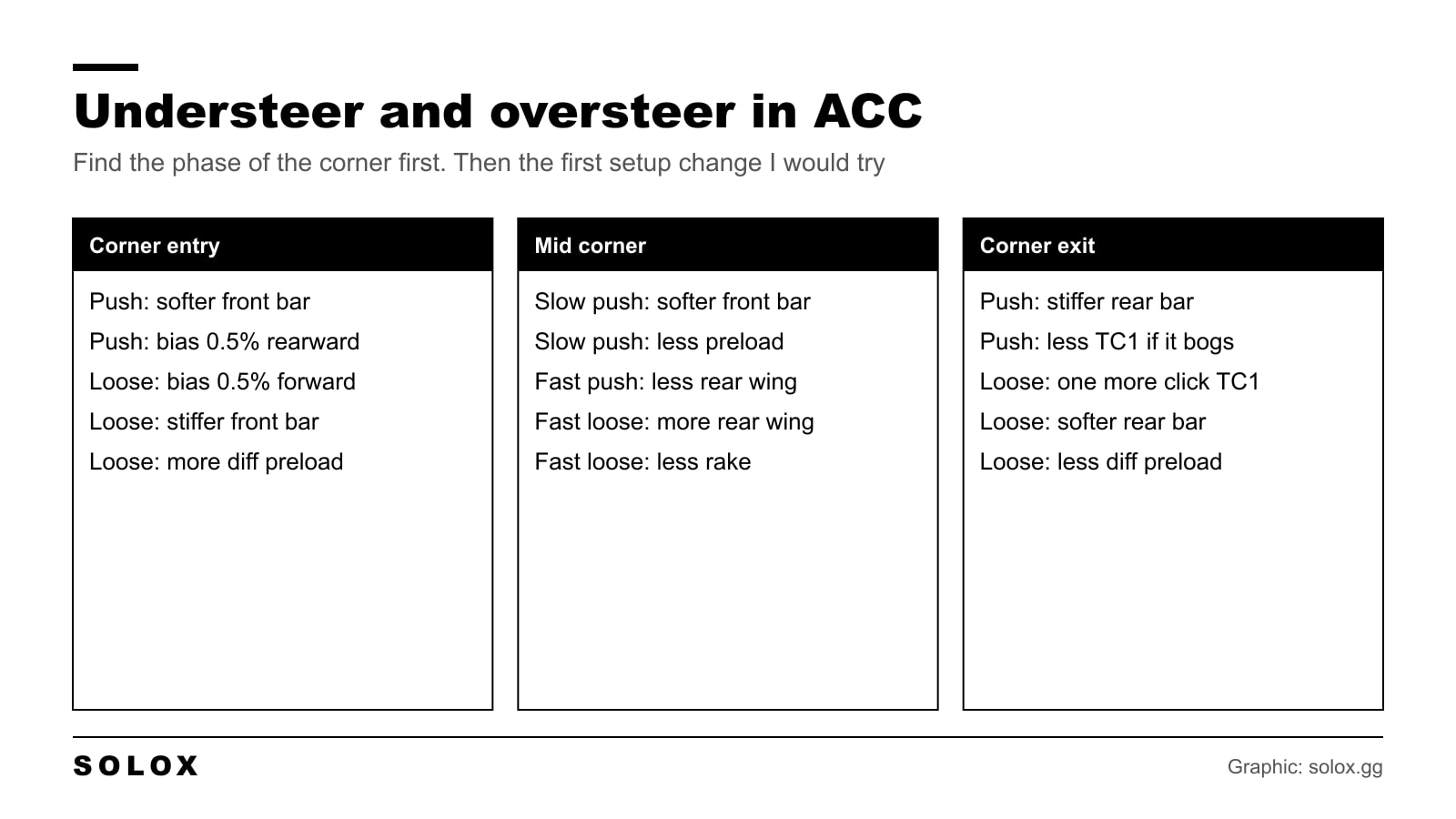
Understeer is when you turn the wheel and the car goes straighter than you asked. The front tyres slide first. Oversteer is the opposite: the rear slides first and the car turns more than you asked.
Every balance problem in ACC is one of those two. The fix depends on where in the corner it happens. A push on the way in and a push on the way out have different causes and different cures, so "my car understeers" is not enough to work with.
Step one: find the phase
Do five laps and for each problem corner, ask:
- Entry, mid corner or exit? On the brakes, at the apex or on the throttle.
- Slow corner or fast corner? Under about 120 km/h the grip is mostly mechanical. Above that the wings take over.
- Every corner or just one? If it is one corner, it is almost always you.
Real engineers ask the same three questions in a debrief. If you cannot answer them, they cannot help you. Neither can the setup screen.
How to fix understeer in ACC
| Where it pushes | First change | Second change | Why |
|---|---|---|---|
| On entry, as you turn in | Soften the front anti roll bar one click | Brake bias 0.5% rearward | More grip at the front axle, and more weight kept on the nose |
| Mid corner, slow corners | Soften the front anti roll bar | Lower the diff preload | The front works harder and the diff lets the car turn |
| Mid corner, fast corners | One click less rear wing | Raise the rear ride height a step | Moves the aero balance forward |
| On exit, when you add throttle | Stiffen the rear anti roll bar one click | A touch more front toe out | Frees the rear so the car keeps rotating |
Understeer is the safer problem. The car tells you early and it does not spin. But it is slow, and it eats the front tyres. If the fronts are gone after 20 minutes, the push will get worse lap by lap.
How to fix oversteer in ACC
| Where it steps out | First change | Second change | Why |
|---|---|---|---|
| On entry, on the brakes | Brake bias 0.5% forward | Stiffen the front anti roll bar | Less work for the rear tyres while the weight is off them |
| On entry, off the brakes | Raise the diff preload | A little more rear toe in | Locks the rear axle together and steadies it |
| Mid corner, fast corners | One click more rear wing | Lower the rear ride height a step | Moves the aero balance rearward |
| On exit, on throttle | One more click of TC1 | Soften the rear anti roll bar | Less wheelspin, more traction |
| Over kerbs | Soften the rear anti roll bar | Soften fast bump at the rear | Lets the wheel follow the kerb |
Oversteer is faster to drive around for one lap and much harder to live with for a stint. A rear that slides overheats its tyres, and hot rear tyres slide more. If you are catching the car twice a lap, calm it down. You will be quicker over a race.
The tools, one by one
Anti roll bars
Start here every time. One click is enough to feel, and it does not change anything else on the car.
- Softer front or stiffer rear: less understeer.
- Stiffer front or softer rear: less oversteer.
If you have to pick, soften the end that lacks grip instead of stiffening the other end. A softer car is easier over kerbs and kinder to the tyres.
Rear wing and rake
These only matter where the car is fast. If the balance is fine in the hairpins and wrong in the fast sweepers, it is aero.
More rear wing adds rear grip and drag. More rake, which means a higher rear ride height, moves grip to the front. They work against each other, and that is the point. Add wing for stability, then add a little rake to get the front back. The detail is in the ACC aerodynamics guide.
Brake bias
Bias is the entry tool. Forward for stability, rearward for rotation. Move it 0.5% at a time. It is on a button, so you can change it during the race as the fuel burns off. I cover the pedal side in the ACC braking guide.
Differential preload
Lower preload lets the rear wheels turn at different speeds, so the car rotates on entry and through slow corners. Higher preload ties them together: stable on entry, and more likely to push the rear wide when you get on the power.
Traction control
TC1 is the quickest cure for exit oversteer, and you can change it from the wheel. One click up. If the car now bogs down on exit, you went too far. How the two dials work is in TC1 vs TC2 in ACC.
Toe and camber
Small tools. More front toe out sharpens turn in. More rear toe in steadies the rear on throttle. Camber should be set from the tyre temperatures, not used to chase balance.
Tyre pressures
Do not fix balance with pressures. They have a window, 26.0 to 27.0 psi hot in the dry, and all four tyres should be in it. But check them first, because a car with the fronts at 28 psi will push no matter what you do to the bars. The method is in the ACC tyre pressure guide.
Check your driving first
A lot of setup problems are inputs. Before you change a click, be honest about this table.
| What you feel | What is often the real cause | Try this before the setup |
|---|---|---|
| Push on entry | You arrive too fast or come off the brake too early | Brake a little earlier and trail the pedal into the corner |
| Push mid corner | Too much steering lock. The front tyres are past their peak | Unwind the wheel a little. Less lock often turns more |
| Push on exit | You are on the throttle before the car has turned | Wait, then go to full throttle once |
| Loose on entry | You are still braking hard while turning | Finish the heavy braking in a straight line |
| Loose mid corner | You lift suddenly | Hold a small, steady throttle through the middle |
| Loose on exit | The throttle goes on too fast | Squeeze it. Aim for full throttle as the wheel comes straight |
The most common one: mid corner understeer that is really too much steering. The driver feels the push, adds lock, and the front tyres slide more. The fix is in the hands, not in the garage.
If you want proof, log the laps and look at the steering and throttle traces. The ACC MoTeC guide shows how.
The balance changes during a race
A car that is neutral on lap one is not neutral on lap twenty.
- Fuel burns off. The car gets lighter and the weight distribution shifts, so the balance moves. Be ready to move the brake bias.
- Tyres wear. The axle that works harder goes first. A car that pushes a little at the start will push a lot at the end. See the ACC tyre wear guide.
- The track changes. More rubber means more grip, and usually more understeer. A cooler track at night does the opposite.
So set the car up for the middle of the stint, not the first lap. A touch of understeer at the start is fine if it means a balanced car when it counts.
One change at a time
Change one thing. Drive five laps. Write down what it did. Then decide.
If you change the bar, the wing and the bias together, you learn nothing, even when the car is better. The whole setup screen, tab by tab, is in the ACC setup guide.
FAQ
What is the difference between understeer and oversteer?
Understeer is the front tyres sliding first, so the car runs wide. Oversteer is the rear tyres sliding first, so the car turns too much and can spin.
How do I fix understeer in ACC?
Soften the front anti roll bar first. If it pushes in fast corners, take off a click of rear wing or raise the rear ride height. In slow corners, lower the diff preload.
How do I fix oversteer in ACC?
On exit, add a click of TC1 or soften the rear anti roll bar. On entry, move the brake bias forward by 0.5%. In fast corners, add a click of rear wing.
Is understeer or oversteer faster in ACC?
A car with a slightly loose rear can be faster over one lap. Over a race, a small amount of understeer is easier on the rear tyres and on you. I would pick the car I can place every lap.
Does tyre pressure cause understeer in ACC?
It can. Front tyres outside the 26.0 to 27.0 psi hot window lose grip and the car pushes. Get all four tyres in the window before you change anything else.
Why does my car understeer on corner exit?
Usually because you are on the throttle before the car has finished turning. The weight moves to the rear and the front goes light. Wait a moment longer, or stiffen the rear anti roll bar a click.
Which ACC cars understeer or oversteer the most?
Front engined cars tend to be stable and push. Mid engined cars rotate more and can be loose on entry. Rear engined cars are light at the front on entry and strong on traction.