
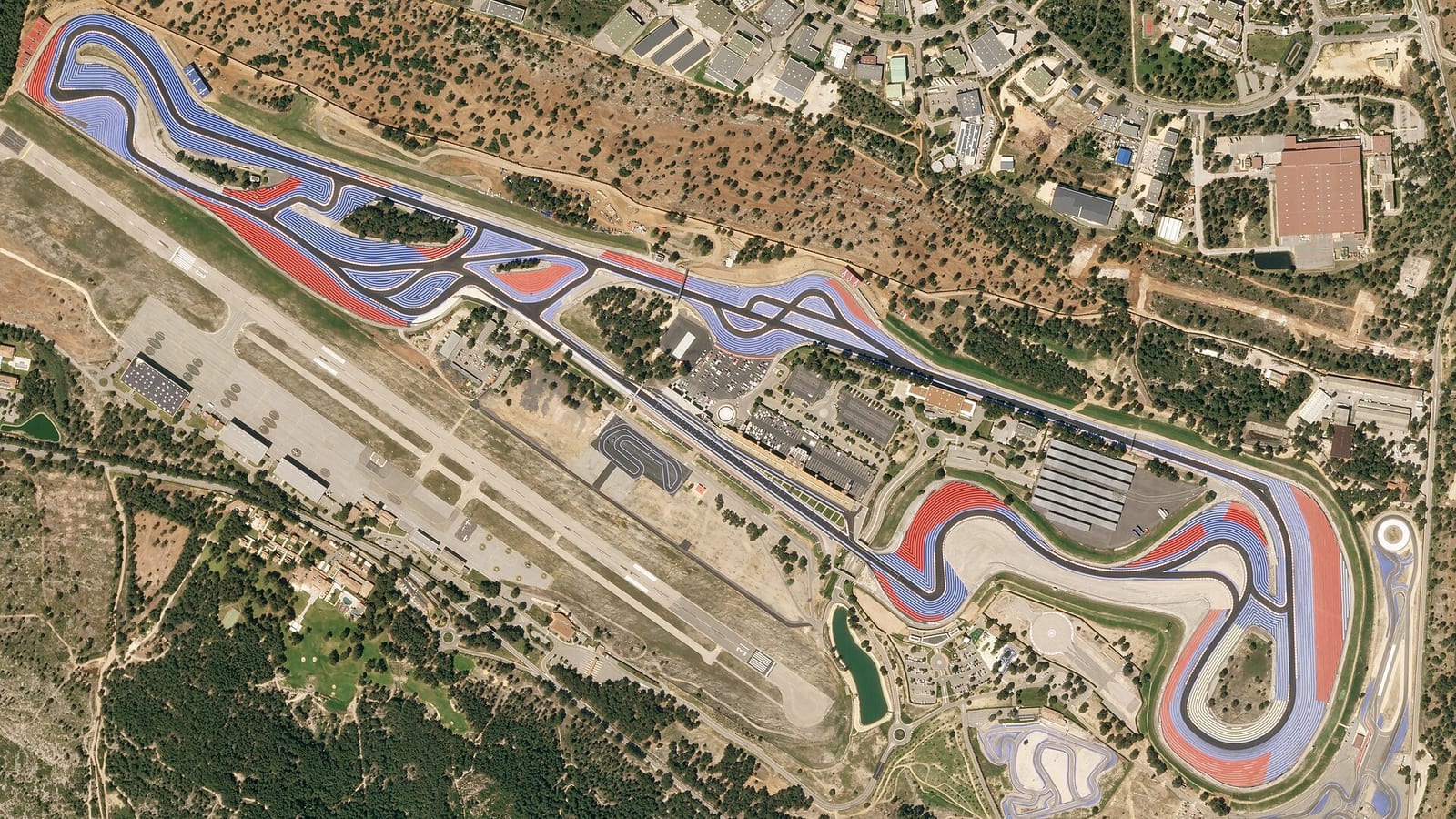
Paul Ricard is a lap of long corners. Turn 6, Signes, Beausset: you sit in each of them for a long time, and the car wants to push wide at the front the whole way. Between them there is the Mistral straight, cut in two by a chicane.
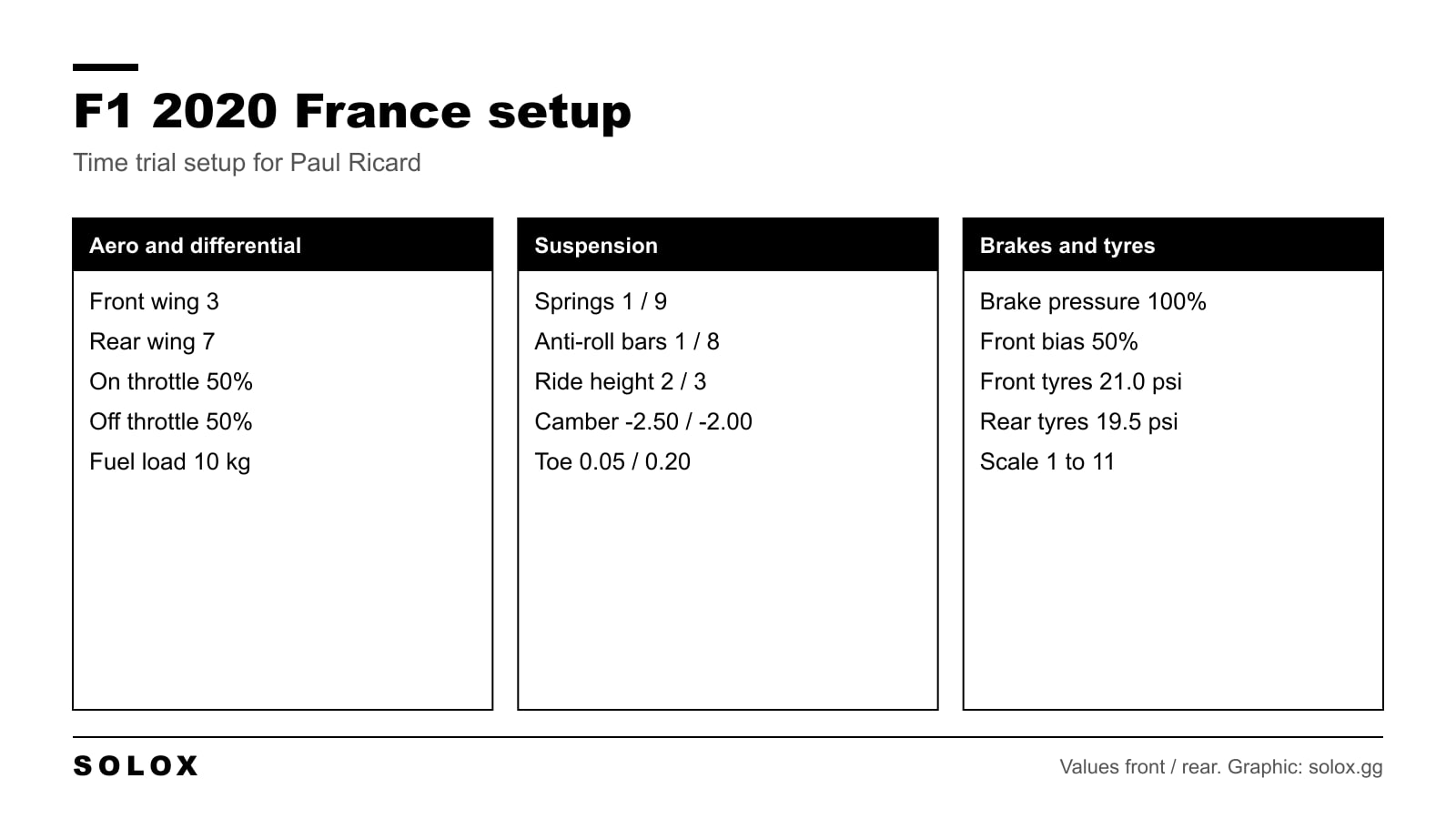
So this F1 2020 France setup has a soft front end to fight the understeer and a medium wing level. It is a time trial setup, saved with 10 kg of fuel.
F1 2020 France setup
| Setting | Front | Rear |
|---|---|---|
| Wing | 3 | 7 |
| Camber | -2.50 | -2.00 |
| Toe | 0.05 | 0.20 |
| Suspension | 1 | 9 |
| Anti-roll bar | 1 | 8 |
| Ride height | 2 | 3 |
| Tyre pressure | 21.0 psi | 19.5 psi |
| Setting | Value |
|---|---|
| Fuel load | 10 kg |
| Differential on throttle | 50% |
| Differential off throttle | 50% |
| Brake pressure | 100% |
| Front brake bias | 50% |
In F1 2020 the wings, suspension, anti-roll bars and ride height all use a scale from 1 to 11. The differential goes from 50%, fully open, to 100%, locked.
This setup was collected for the site in 2022 from a fast time trial lap, like the rest of my F1 2020 setups. Use it as a base and adjust it with the table further down.

The lap on board
Why this setup works at Paul Ricard
The wings. 3 and 7. A middle of the road level. The rear at 7 holds the car in Signes, which you take at very high speed at the end of the Mistral, and gives you traction out of the slow last part. The front at 3 keeps the drag down. The front grip you are missing comes from the suspension, not from the wing.
The differential. 50% on throttle and 50% off. Fully open. Only seven of my 22 setups run it like this. In a long corner you are on the throttle for a long time, and a locked differential pushes the front wide. Open, the car keeps turning while you add power. You notice it most in turn 6 and in Beausset.
The tyre pressures. 21.0 psi front and 19.5 psi rear, the lowest the menu allows. The biggest contact patch you can get.
The camber. -2.50 front, the least the game allows, and -2.00 rear. The 2 degrees at the rear help in the long corners, where the outside rear tyre carries the car for seconds at a time.
Soft front, stiff rear
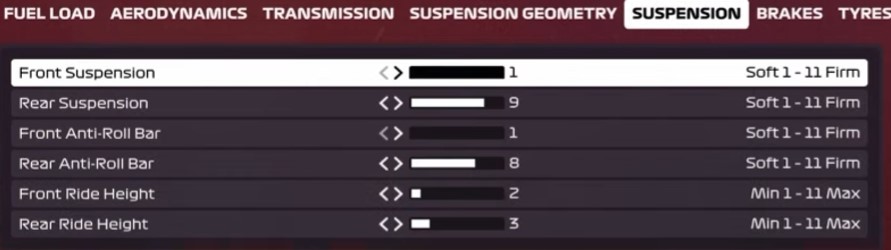
Front springs 1, front anti-roll bar 1. That is the softest front end the menu allows, and it is all the mechanical front grip the game can give you. At a track where the problem is understeer in long corners, it is the right place to start.
The rear is the opposite: springs 9, anti-roll bar 8. A stiff rear rolls less and helps the car rotate. Put together with the soft front, the balance moves towards the front tyres, and that is what you want in Beausset.
It is the same idea as the wings and the differential. Three parts of the setup all work against the same problem.
Ride height is 2 and 3. Low, so the floor works in the fast corners. If the car hits the kerbs in the first chicane, go up one click at both ends.
The brakes
Brake pressure 100%, front bias 50%. Every setup in my F1 2020 database runs 100% pressure.
The two big stops are the Mistral chicane and turn 1 after the pit straight. Both are in a straight line, so you can use all the pressure. The tricky one is turn 3, where you brake with some steering still on. If the fronts lock there, brake a little earlier before you change the setup. If they lock everywhere, go to 95%.
What to change
One change at a time, three laps, then decide.
| Problem | Change | Why |
|---|---|---|
| Understeer in Beausset and turn 6 | Front wing 3 to 4 | More front grip in the long corners |
| The rear moves in Signes | Rear wing 7 to 8 | More rear grip at high speed |
| Too slow on the Mistral | Rear wing 7 to 6 | Less drag |
| The rear steps out on the power | Rear anti-roll bar 8 to 6 | A softer rear bar gives traction |
| Wheelspin out of the last corner | On throttle differential 50% to 60% | A little lock makes both rear wheels push |
| The rear slides on the way into turn 1 | Off throttle differential 50% to 55% | A little lock steadies the rear on entry |
| Front tyres lock at the chicane | Brake pressure 100% to 95% | Less peak pressure, easier to hold at the limit |
For a race
Paul Ricard is hard on the front left tyre. The long corners, turn 6, Signes and Beausset, are all right handers, and the front left does the work in every one of them. Before a 25% or 50% race I would change this:
- Front wing 3 to 4. Less understeer means less sliding, and less sliding means a front left that lasts.
- On throttle differential 50% to 60%. Less wheelspin out of the slow last part.
- Brake pressure 100% to 95%. A heavy car locks its fronts more easily.
- Fuel. The 10 kg is a time trial number. In a race the game sets the load for the distance.
On a pad, I would go to 60% on throttle and take the brake pressure down to around 90%. In the long corners, hold the stick still. Small corrections scrub the front tyres.
F1 2020 manages the ERS for you and gives you an overtake button. Use it on the Mistral, on both sides of the chicane.
Where the lap time is at Paul Ricard
- Turn 1 and turn 2. A fast left and a tighter right. The entry is quicker than it looks. Give a little away in turn 2 so the car is straight for the next braking zone.
- Turn 3, 4 and 5. A slow chicane and then a right hander. Use the flat kerb on the inside and stay off the big one behind it.
- Turn 6. A long right that opens onto the Mistral. Late apex, early throttle. With the open differential the car keeps turning as you add power, so use that.
- The Mistral chicane, turn 8 and turn 9. Brake in a straight line and do not cut too much. The game is strict with track limits here.
- Signes, turn 10. A very fast right at the end of the straight. Turn in once and keep the steering still. If the rear moves, add rear wing before you start lifting.
- Beausset, turn 11. A long double apex right. Go in slower than you want, hold the inside and wait for the second apex before full throttle.
- Turn 12 to turn 15. The slow part. The last corner leads onto the pit straight, so the exit is what counts.
If you take one thing from this page: be patient in the long corners. The time comes from the exit, and a car that slides on the way in will not turn on the way out.
France in 2020
There was no French Grand Prix in 2020. In April the organisers confirmed that the race would not be held because of the pandemic. It was one of 13 races from the original 22 race calendar that were never run.
So in F1 2020 you drive a lap that the real 2020 cars never did. The year before, in 2019, Lewis Hamilton had won at Paul Ricard from pole for Mercedes, ahead of Valtteri Bottas and Charles Leclerc.
The circuit is at Le Castellet, near Marseille. It opened in 1970 and was paid for by Paul Ricard, who made his money with pastis. The Grand Prix layout is 5.842 km with 15 corners. Formula 1 raced here on and off from 1971 until 2022.
More F1 2020 setups
All 22 tracks are on the F1 2020 setups page. The track before France in the game's calendar is Montreal, with my F1 2020 Canada setup, and the next one is the Red Bull Ring, with my F1 2020 Austria setup.
For the same track in other games, here are my F1 2018 France setup, my F1 2019 France setup, my F1 2021 Paul Ricard setup and my F1 2022 France setup. The values do not carry over from one game to the next.
FAQ
What is the best F1 2020 setup for France?
Front wing 3, rear wing 7, differential 50% on throttle and 50% off, suspension 1 and 9, anti-roll bars 1 and 8, ride height 2 and 3, brake pressure 100% with 50% front bias, and tyres at 21.0 and 19.5 psi.
What wing levels should I run at Paul Ricard in F1 2020?
3 at the front and 7 at the rear. If the car understeers in the long corners, go to 4 at the front.
Why is the differential fully open?
Because of the long corners. An open differential lets the car keep turning while you add throttle, so it pushes less at the front.
Can I use this France setup in a race?
Yes. I would add one click of front wing to protect the front left tyre, raise the on throttle differential to 60% and lower the brake pressure to 95%.
Does this setup work with a controller?
Yes. I would run 60% on throttle and around 90% brake pressure.
Was there a 2020 French Grand Prix?
No. In April 2020 the organisers confirmed it would not be held.
How long is Circuit Paul Ricard?
The Grand Prix layout in the game is 5.842 km with 15 corners, with a chicane on the Mistral straight.