
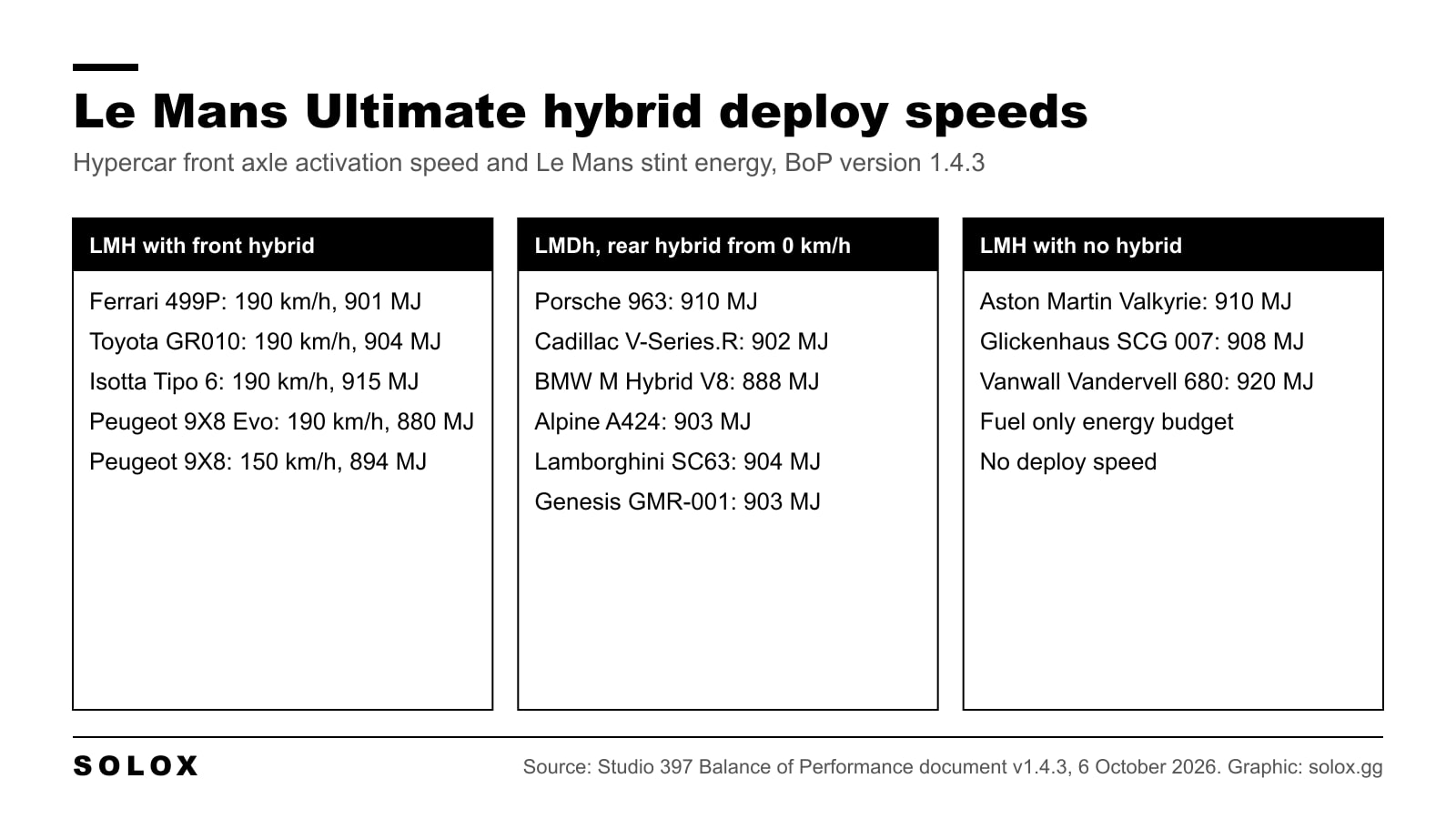
In Le Mans Ultimate, Virtual Energy (written NRG in the game) is the total energy your car is allowed to use in one stint, fuel and battery counted together. Run it to 0% and you get a 100 second stop and go. The hybrid does not give you extra power on top of the engine. It replaces engine power, so the car burns less fuel and the stint lasts longer.
Checked on 15 October 2026 against Studio 397's official guide pages on Virtual Energy, the Hypercar class, the HUD and the MFD, Studio 397's Balance of Performance document for version 1.4.3 (dated 6 October 2026), the Le Mans Ultimate update notes on Steam up to version 1.4.3, and the FIA WEC Committee decisions published on fia.com in 2025. Where something is not published, I say so instead of filling the gap.
Virtual Energy in the real WEC
The game copies a real rule. In the WEC the regulators limit how much energy the car puts through its driveshafts in a stint.
The FIA WEC Committee decision WEC_2025_D06, dated 12 February 2025, spells out how it works:
- The maximum energy a car may deploy per stint is set in the Balance of Performance table. The rulebook calls it PPUEnergyStint and tracks it as a virtual tank.
- Energy is measured from the driveshaft torque sensors.
- It counts from pit out to pit in.
- If the virtual tank drops below zero, the team takes a penalty and has to pay back the deficit at the next stop.
- The tank refills at PPUEnergyStint divided by 40 seconds, so a full refill takes 40 seconds, after an extra "docking time" set in the BoP.
The BoP gives each car its own budget, so the regulators can balance stint lengths between very different cars.
How Le Mans Ultimate does it
Studio 397's guide describes the game's version:
- NRG is the maximum combined energy, fuel plus battery, you may use per stint.
- The Hypercars (LMH and LMDh) and the LMGT3 cars both run it.
- On an LMGT3, and on an LMH with no hybrid, it is fuel only.
- At each stop you choose how much NRG to take. More energy means a longer stop.
- At 0% you get a 100 second stop and go. Repeat it and the penalties get harsher.
The guide also says what the hybrid is for. The battery supplements the engine to reduce fuel use. It does not add to total power. Studio 397's Hypercar page puts the combined limit for both LMH and LMDh at 500 kW (671 bhp).
So do not think boost button. Think efficiency.
Where you see it on the HUD and MFD
| Where | What it shows |
|---|---|
| Speedo, right side | Battery level on hybrids. The bar is blue when deploying and green when charging |
| Speedo, bottom | Fuel and Virtual Energy levels |
| Standings | The Virtual Energy left in your rivals' cars |
| MFD, Fuel page | Fuel or Virtual Energy (switch with left and right), save targets, expected pit lap, the NRG your engineer recommends, laps or stints to the end |
| MFD, Pit menu | The amount of Virtual Energy and the Fuel Ratio for your next stop |
The standings column is underrated. If the car in front has less energy than you with the same laps to the stop, he has to save and you do not.
How the hybrid deploys: LMH vs LMDh
The two Hypercar rulebooks work differently. Studio 397's Hypercar page summarises them:
- LMH hybrids can deploy up to 200 kW, usually through a motor on the front axle, which gives four wheel drive above a set speed.
- LMDh cars all use a spec motor limited to 50 kW, on the rear axle only.
- Not every LMH has a hybrid. The Aston Martin Valkyrie, Glickenhaus and Vanwall do not. Every LMDh does.
The speed where the front axle switches on is a Balance of Performance value, and Studio 397 publishes it. Here is the Le Mans table from its BoP document for version 1.4.3, dated 6 October 2026.
| Car | Type | Deploy activation speed | Max stint energy |
|---|---|---|---|
| Ferrari 499P | LMH, hybrid | 190 km/h | 901 MJ |
| Toyota GR010 | LMH, hybrid | 190 km/h | 904 MJ |
| Isotta Tipo 6 | LMH, hybrid | 190 km/h | 915 MJ |
| Peugeot 9X8 Evo | LMH, hybrid | 190 km/h | 880 MJ |
| Peugeot 9X8 | LMH, hybrid | 150 km/h | 894 MJ |
| Porsche 963 | LMDh | 0 | 910 MJ |
| Cadillac V-Series.R | LMDh | 0 | 902 MJ |
| BMW M Hybrid V8 | LMDh | 0 | 888 MJ |
| Alpine A424 | LMDh | 0 | 903 MJ |
| Lamborghini SC63 | LMDh | 0 | 904 MJ |
| Genesis GMR-001 | LMDh | 0 | 903 MJ |
| Aston Martin Valkyrie | LMH, no hybrid | none | 910 MJ |
| Glickenhaus SCG 007 | LMH, no hybrid | none | 908 MJ |
| Vanwall Vandervell 680 | LMH, no hybrid | none | 920 MJ |
The deploy speeds are the same at every track in the 1.4.3 document, with one exception. The older Peugeot 9X8 deploys from 150 km/h at most circuits and from 135 km/h at Bahrain and Fuji.
The real numbers line up. In the FIA's 2025 BoP decisions for Qatar (WEC_2025_D09, 20 February 2025) and São Paulo (WEC_2025_D36, 7 July 2025), the Ferrari 499P, Peugeot 9X8 and Toyota GR010 Hybrid all have a front deployment speed of 190 km/h, dry and on wets. The LMDh cars and the Valkyrie have no value in that column.
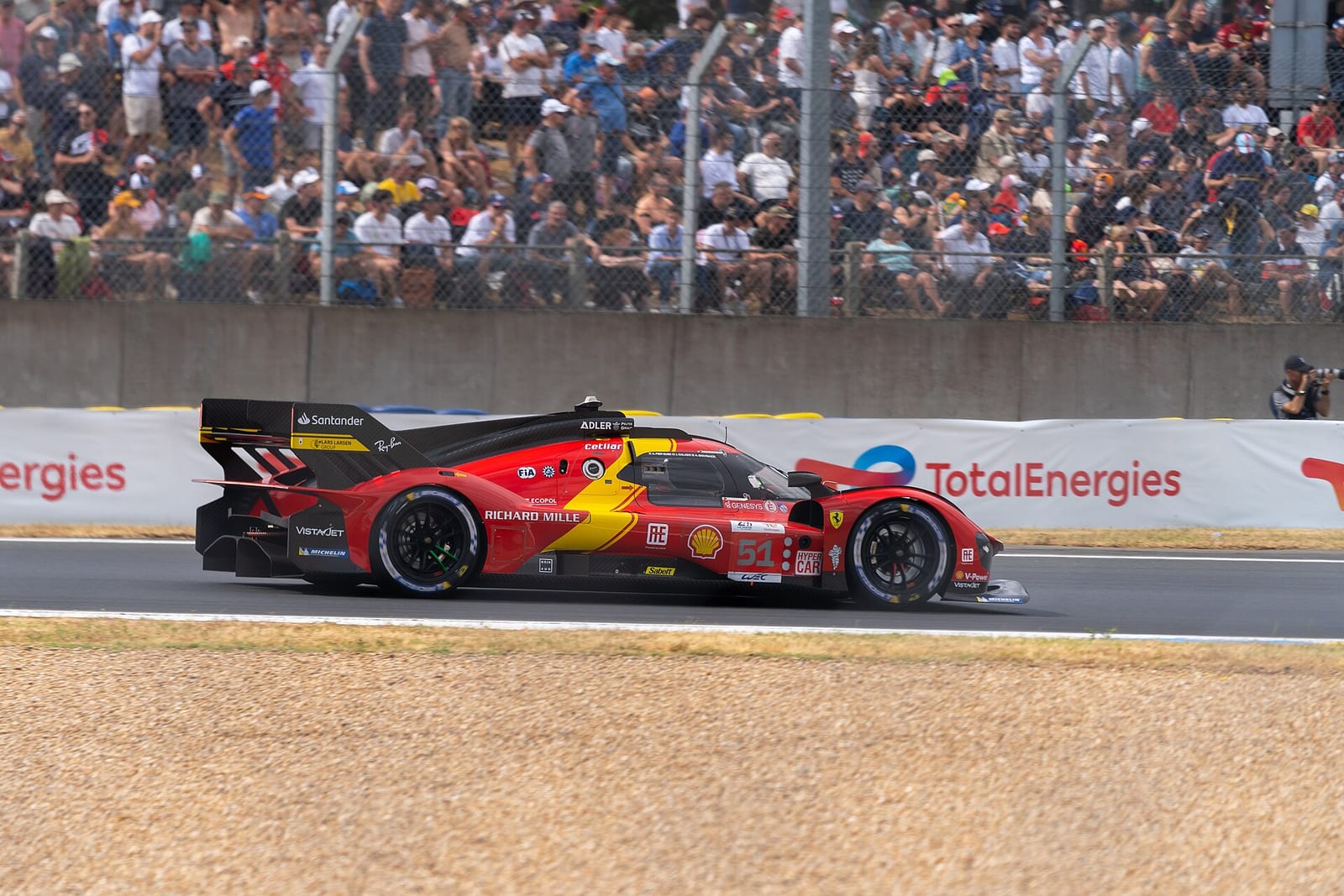
What it means in the car: in a 499P or a GR010, the hybrid does nothing for you out of a hairpin. Below 190 km/h you are a rear wheel drive car, so traction out of slow corners is all about your right foot. Above 190 the front axle helps, and the car feels more planted on the exit of fast corners. In an LMDh like the Porsche 963 the deploy speed is 0, so the electric motor can work on the rear axle from the moment you get on the throttle.
Studio 397 does not publish how much power each car deploys at what state of charge, so I will not guess.
Electric Motor Map and Regen Level
On a hybrid Hypercar you control the battery with two settings. Studio 397 names them like this:
- Electric Motor Map (battery deployment): how much power the battery gives. A higher map uses more battery under acceleration.
- Regen Level (regenerative braking): how much braking energy goes back into the battery. More regen harvests more energy.
The guide gives three rules I agree with:
- Do not let the battery reach 100%. A full battery cannot regenerate, so the brakes do all the work, they get hotter and you lock up more easily.
- Do not run the battery to 0% before a stop, especially in an LMDh. Studio 397 says those cars use the battery for pit lane power, and you can get stranded.
- Adjust the settings in the race to suit traffic, conditions and the stint.
One known issue to be aware of. Studio 397's Known Issues page says motor map and regen settings cannot be changed after loading a save file, and in co-op they cannot be changed after loading into a session. So set them in the garage before you go out in those modes.
Fuel ratio, the garage and the pit stop
Virtual Energy is in the car setup and in the pit menu, next to a second value: Fuel Ratio. Studio 397's Hypercar page says the fuel ratio decides how much fuel you carry against your NRG. The June 2025 patch notes confirm both sit together in the setup screen, along with the number of laps the energy and fuel should last.
The practical rule from the guide: do not overfill fuel. Extra fuel is extra weight, and it gives you no extra energy budget. The NRG is the limit, not the tank.
The stop itself follows the real rule. Every Hypercar has a docking time in the BoP, the time the hose has to be connected before the energy refill starts. In version 1.4.3:
| Car type | Docking time |
|---|---|
| LMH with hybrid (499P, GR010, 9X8, Tipo 6) | 1.2 s |
| LMDh (963, V-Series.R, M Hybrid V8, A424, SC63, GMR-001) | 1.0 s |
| LMH without hybrid (Valkyrie, SCG 007, Vandervell 680) | 0.0 s |
Studio 397 does not publish the in-game refill rate, so I cannot tell you if it is the same 40 seconds for a full stint as in the FIA document. What it does say is that more energy means a longer stop. Take only what you need to reach the next stop or the flag, and use the engineer's recommendation on the MFD Fuel page as your starting number.
If you race in teams, this was fixed in version 1.2 in December 2025: before that, the Hypercar battery was refilled when the car was handed to a teammate.
Energy per stint changes by track
Studio 397 sets the stint energy per car and per track, the same way the FIA does. In version 1.4.3 most tracks sit between 874 and 925 MJ for the Hypercars. COTA is the outlier. Version 1.4.2 on 22 September 2026 cut the Hypercar stint length there, and the 1.4.3 table now has COTA between 767 MJ (Peugeot 9X8) and 805 MJ (Isotta Tipo 6 and Vanwall). So a strategy you built at Le Mans does not carry over to Austin.
Patch notes list these changes car by car in MJ. If your stint comes up a lap short after an update, check the BoP document before you blame your driving.
If you want a setup built around the stint and not one qualifying lap, read my Le Mans Ultimate setups guide. The track list tells you which of these circuits are in the base game.
Lift and coast
When the MFD says you are short, there are two driving tools, and Studio 397's guide names both:
- Lift and coast: come off the throttle before the braking zone and let the car roll before you brake.
- Short shifting: change up earlier so the engine runs lower revs.
Since the June 2025 update the clutch pedal is disabled above first gear, so you cannot cheat the coast with the clutch. Studio 397's words were that players now have to lift and coast normally. Some cars also have lift and coast lights on the dash, and version 1.1 in September 2025 fixed those lights not working with aggressive fuel saving.
This is how I would do it. It is my method, not a published value. Lift where the car is at top speed and the lap time cost is lowest: the end of the longest straights. Lift in one clean step, do not feather it, and brake a touch later than normal because the car has already slowed. Start small, then look at the save target on the MFD after two laps and add more only if the number tells you to.
What I would not do is short shift out of slow corners in a 499P or a GR010 to save energy. You are already below the 190 km/h deploy speed there, the rear tyres are doing everything, and an early upshift just makes the exit slower. Save at the top of the straight, not at the bottom.
What changed in recent updates
These are the energy changes from the official Steam notes since early 2025:
| Version and date | Change |
|---|---|
| Update 4 Patch 2, March 2025 | Full BoP rework of weight, power, max stint energy and drag at every track and layout |
| June 2025 update | Clutch disabled above first gear. Fuel page on the MFD revised with save targets and engineer warnings |
| V1.1, September 2025 | BoP rework for all classes. Lift and coast lights fixed with aggressive saving |
| V1.2, December 2025 | Battery no longer refilled on a driver swap. Corrected a low energy warning on a car dash |
| V1.2.4, February 2026 | Soft clipping on Hypercar batteries increased from 5% to 15% |
| V1.4, July 2026 | Improved LMH vs LMDh acceleration balance |
| V1.4.2, September 2026 | Hypercar stint length cut at COTA |
The battery soft clipping change is one Studio 397 does not explain further in the notes, so I will not guess what it does at the wheel.
If you race hybrids in iRacing too, my iRacing hybrid explainer shows how differently the two sims handle the same cars. And if you are still choosing between them, I compared them in Le Mans Ultimate vs iRacing.
FAQ
How does virtual energy work in Le Mans Ultimate?
Each car gets a maximum amount of energy per stint, fuel and battery together, set per car and track in the BoP. You choose how much to take at each stop. If the gauge reaches 0% you get a 100 second stop and go.
Does the hybrid give more power in Le Mans Ultimate?
No. Studio 397 says the battery supplements the engine to reduce fuel use, not to add total power. LMH and LMDh are both capped at 500 kW combined.
At what speed does the hybrid deploy on the Ferrari 499P and Toyota GR010?
190 km/h, in Studio 397's version 1.4.3 BoP and in the FIA's 2025 BoP decisions. Below that speed the front axle does not drive.
Do LMDh cars have a deploy speed limit?
No. In the 1.4.3 BoP the LMDh cars have a deploy activation speed of 0. Their 50 kW motor drives the rear axle only.
Why should I not let the battery reach 100%?
A full battery cannot take regen. The brakes do all the work, they run hotter and the car locks up more easily.
Do GT3 cars use virtual energy in Le Mans Ultimate?
Yes. The LMGT3 cars run Virtual Energy too, based only on fuel.
What is Fuel Ratio in Le Mans Ultimate?
It sets how much fuel you carry against your Virtual Energy. Do not overfill. Extra fuel adds weight but gives you no extra energy.