
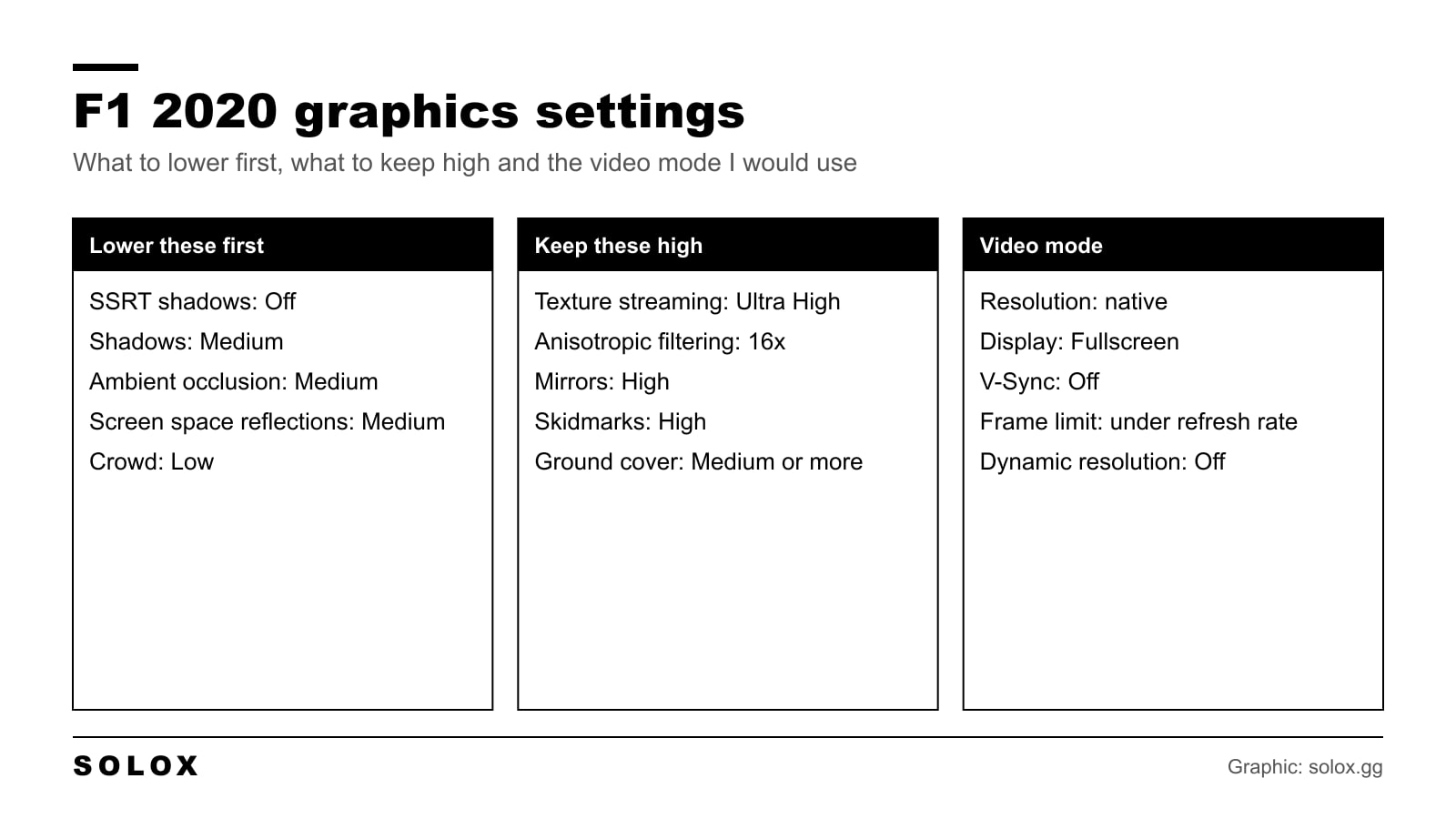
F1 2020 runs well on almost any gaming PC. The game is from 2020 and the engine was already light back then. So this is not about making it playable. It is about a stable frame rate in the worst moments, and a picture where you can see the braking boards.
In a race car you drive with your eyes. A frame rate that drops from 120 to 70 at the start of the race is worse than a flat 90, because your braking reference moves. Stable first, pretty second.
Here is the video mode I would use, every advanced option in three presets, and what to do when it stutters.
Video mode settings
You find these under Game Options, Settings, Graphics Settings, Video Mode.
| Setting | What I would use | Why |
|---|---|---|
| Resolution | Native resolution of your monitor | Anything lower looks soft. Use an upscaler before you drop the resolution |
| Display mode | Fullscreen | Lowest input lag. Borderless only if you alt tab all the time |
| Refresh rate | The highest your monitor has | It is often left at 60 Hz on a 144 Hz screen. Check it |
| V-Sync | Off | It adds input lag. Use G-Sync or FreeSync if your monitor has it |
| Frame rate limit | On, 3 FPS under the refresh rate | With G-Sync or FreeSync. Without them, leave it off or set it to what you can hold |
| Anti-aliasing | TAA, or DLSS / FidelityFX Upscaling if you need frames | TAA is the clean default. See the upscaling section below |
| Anisotropic filtering | 16x | Almost free and it keeps the track sharp in the distance |
| Dynamic resolution | Off | It changes sharpness from corner to corner. Fix the frame rate with settings |
| HDR | Off, unless you have a real HDR screen | On a normal monitor it only washes the picture out |
The one people miss is the refresh rate. If you bought a 144 Hz monitor and the game is at 60 Hz, no graphics setting will make it feel right.
Advanced graphics settings
The game has five global presets, from Ultra Low to Ultra High. I would not use them as they are. Pick one of the three columns below and set the options by hand under Advanced Setup.
- Performance: older cards, laptops, or if you want 144 FPS and more.
- Balanced: what I would run on most PCs. It looks close to the top preset when the car is moving.
- Quality: a strong card and frames to spare.
| Setting | Performance | Balanced | Quality | FPS cost |
|---|---|---|---|---|
| Lighting quality | Medium | High | Ultra High | Medium |
| Post process | Low | High | High | Medium |
| Shadows | Low | Medium | High | High |
| Smoke shadows | Off | Low | High | Low |
| Particles | Low | Medium | High | Low, more in rain |
| Crowd | Low | Low | High | Medium at the start |
| Mirrors | Medium | High | Ultra High | Medium |
| Ambient occlusion | Off | Medium | HBAO+ | High |
| Screen space reflections | Off | Medium | High | High |
| Texture streaming | High | Ultra High | Ultra High | Low. It needs video memory, not GPU power |
| Vehicle reflections | Low | Medium | Ultra High | Medium |
| Weather effects | Low | Medium | High | High in rain |
| Ground cover | Low | Medium | High | Low |
| Skidmarks | Low | High | High | Very low |
| Skidmarks blending | Off | On | On | Very low |
| SSRT shadows | Off | Off | On if you have the frames | Very high |
| Asynchronous compute | Test it | Test it | Test it | Depends on the card |
The FPS cost column is how much each option matters when you lower it, not a number of frames. That number changes with every PC. The order does not change much.
The settings that cost the most
SSRT shadows. This is the heavy one. It adds fine contact shadows traced in screen space, and it is the only option in the menu that can take a big part of your frame rate on its own. At speed you do not see it. Off, unless you play at 60 FPS on a big card and you like replays.
Shadows. High to Medium is the best trade in the game. The shadows get a bit softer and you get frames back on every track.
Ambient occlusion. The soft shading under the car and around the kerbs. HBAO+ is the nicest and the heaviest. Medium is enough.
Screen space reflections. Reflections on the wet track and on the bodywork. In the dry it costs little. In the rain it costs a lot, and the rain is where your frame rate is already at its lowest.
Crowd and mirrors. You only feel these at the start, with twenty cars around you and the grandstands full. That is also the moment where a drop hurts you most.
The settings to keep high
Texture streaming. It uses video memory, not GPU power. If your card has 6 GB or more, leave it on Ultra High. With 4 GB or less, go one step down if textures arrive late.
Anisotropic filtering. 16x. The track surface stays sharp far ahead, and far ahead is where you should be looking.
Mirrors. Do not go to the lowest step to save a few frames. You race with the mirrors. If you can not see the car behind, you will turn in on it.
Skidmarks. Almost free, and the rubber on the track helps you read the line.
DLSS, FidelityFX Upscaling and FidelityFX Sharpening
All three are in the Anti-aliasing option, so you choose one of them. You can not combine them.
- TAA. The default. Native resolution, clean picture. Use it if your frame rate is already fine.
- DLSS. Added with a patch after launch. NVIDIA RTX cards only. The game renders at a lower resolution and rebuilds the picture. NVIDIA said up to 1.5 times the frame rate. It is the first version of the technology in this game, so it is softer than what you know from newer titles. I would use it at 1440p and 4K, not at 1080p.
- TAA and FidelityFX Upscaling. Works on NVIDIA and AMD cards. Same idea: a lower render resolution, scaled up and sharpened. F1 2020 was the first game with official support for it. This is the one to try on a GTX or Radeon card that needs frames.
- TAA and FidelityFX Sharpening. No upscaling, so no extra FPS. It only sharpens the TAA picture. Use it if plain TAA looks too soft to you and you have frames to spare.
My order would be: TAA if you hold your target, then FidelityFX Upscaling or DLSS before you lower the resolution by hand.
DirectX 11 or DirectX 12
On Steam the game asks you which one to start. I would start with DirectX 12 on any card from the last few years. If you get stutter that no setting fixes, try DirectX 11. On older cards DirectX 11 is often the smoother one.
Asynchronous compute is in the same family. On some cards it helps, on some it does nothing or makes things worse. Run the benchmark with it on and off and keep the better one.
How to test your settings
F1 2020 has a benchmark in the graphics menu. Use it, but use it the right way.
- Open Graphics Settings and choose Benchmark Mode.
- Pick a heavy track. Monaco and Singapore have the most buildings and lights.
- Set the weather to wet. The dry number tells you very little.
- Run it and look at the minimum FPS, not the average.
- Change one option, run it again.
Your target is a minimum that stays above your monitor refresh rate, or at least above the frame cap you set. If the minimum in the wet at Monaco is fine, every other session will be fine.
F1 2020 system requirements
| Minimum | Recommended | |
|---|---|---|
| OS | Windows 10 64 bit | Windows 10 64 bit |
| CPU | Intel Core i3 2130 or AMD FX 4300 | Intel Core i5 9600K or AMD Ryzen 5 2600X |
| RAM | 8 GB | 16 GB |
| GPU | NVIDIA GT 640 or AMD HD 7750 | NVIDIA GTX 1660 Ti or AMD RX 590 |
| DirectX | 11 | 12 |
| Storage | 80 GB | 80 GB |
The minimum is very low. A GT 640 will start the game, but on the lowest preset at 720p. With the recommended GTX 1660 Ti or RX 590 I would expect the Balanced column at 1080p with a high frame rate.
Problems and fixes
| Problem | What I would try first |
|---|---|
| FPS fine alone, drops at the race start | Crowd to Low, mirrors down one step, shadows down one step |
| FPS drops only in the rain | Weather effects and particles down, screen space reflections to Medium or Off |
| Stutter every few seconds | Switch between DX11 and DX12, toggle asynchronous compute, cap the frame rate |
| Textures load late or look blurry | Texture streaming down one step if your card has 4 GB or less |
| Picture looks soft | Dynamic resolution off, check the resolution is native, try TAA and FidelityFX Sharpening |
| Screen tearing | G-Sync or FreeSync on with a frame cap under the refresh rate. V-Sync only as a last option |
| The game feels slow to react | V-Sync off, Fullscreen, and check the refresh rate in the video mode menu |
Settings that matter more than graphics
Once the frame rate is stable, the next things to set are the camera and the wheel. A wrong field of view makes you misjudge every braking point, and no graphics option fixes that.
- F1 2020 FOV and camera settings
- F1 2020 wheel and force feedback settings
- F1 2020 controller settings and keyboard controls
- F1 2020 in VR with vorpX, which has its own graphics limits
- F1 2020 setups for every track and my F1 2020 tips
FAQ
What are the best graphics settings for F1 2020?
Native resolution, Fullscreen, V-Sync off, TAA, anisotropic filtering 16x and dynamic resolution off. In the advanced menu, SSRT shadows off, shadows and ambient occlusion on Medium, textures and mirrors high.
How do I get more FPS in F1 2020?
Turn off SSRT shadows first. Then lower shadows, ambient occlusion and screen space reflections one step each. If that is not enough, use DLSS or FidelityFX Upscaling in the anti-aliasing option.
Does F1 2020 have DLSS?
Yes. It was added in a patch after launch and it works on NVIDIA RTX cards. You select it in the anti-aliasing option.
What is the difference between FidelityFX Upscaling and FidelityFX Sharpening?
Upscaling renders at a lower resolution and scales it up, so you gain FPS. Sharpening keeps the native resolution and only makes the picture crisper, so you gain nothing in FPS.
Should I use DirectX 11 or DirectX 12 in F1 2020?
DirectX 12 on a recent card. If you get stutter, try DirectX 11. Run the benchmark in both and keep the one with the better minimum FPS.
Should V-Sync be on or off in F1 2020?
Off. It adds input lag, and in a racing game you feel it on the steering. Use G-Sync or FreeSync with a frame cap if your monitor has it.
Can my PC run F1 2020?
Almost certainly. The minimum is a Core i3 2130, 8 GB of RAM and a GT 640 or HD 7750. For 1080p on high settings the game asks for a GTX 1660 Ti or an RX 590.