
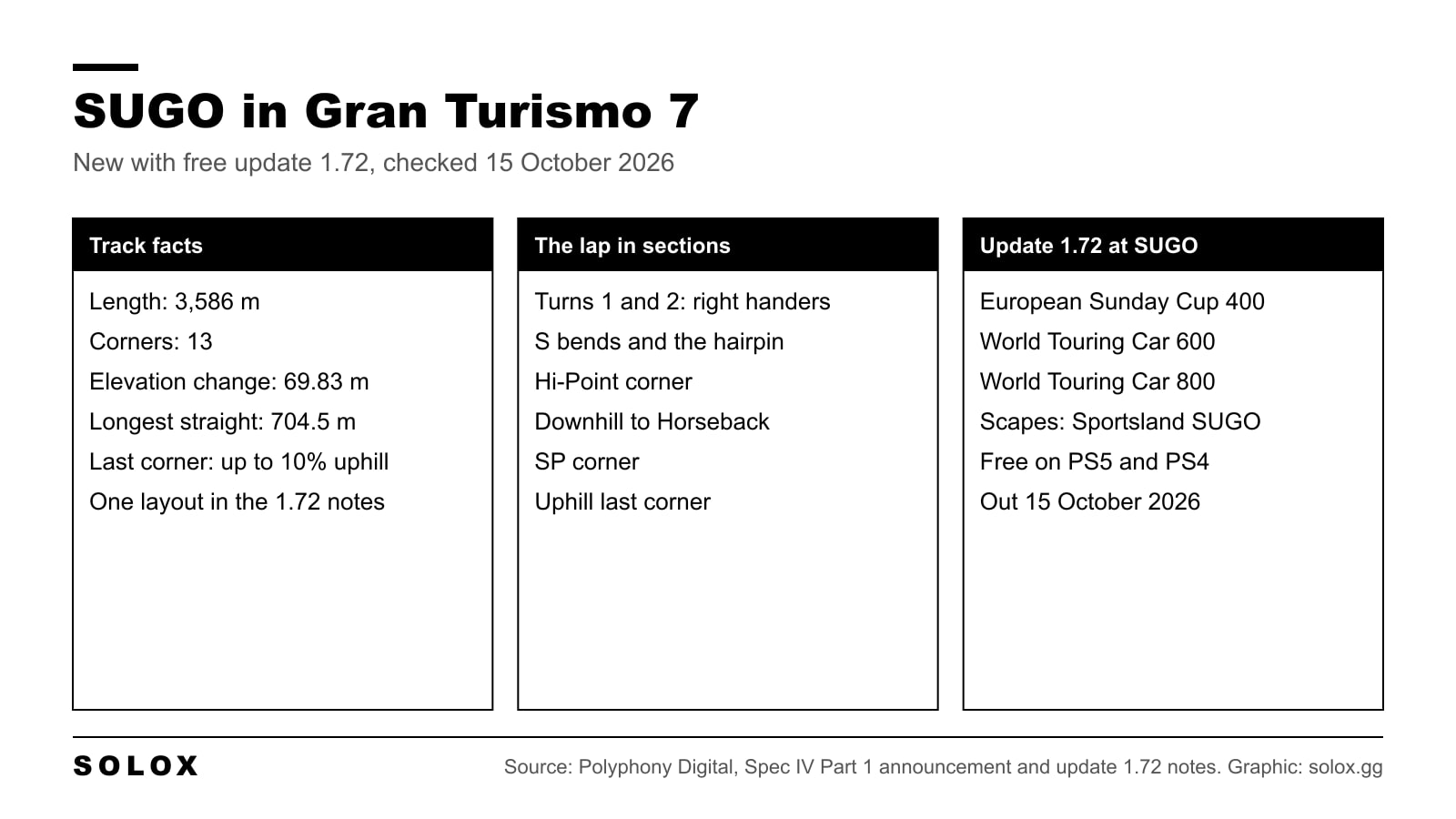
SUGO is the new track in Gran Turismo 7. It arrived with free update 1.72 on 15 October 2026, the first half of Spec IV, and in the game it is called SUGO International Racing Course. Polyphony Digital gives it as 3,586 m long with 13 corners and 69.83 m of elevation change per lap. This page covers the facts, the lap section by section, and the events where you will race it.
Checked on 15 October 2026 against Polyphony Digital's Spec IV Part 1 announcement (14 October 2026) and the Update Notice (1.72) on gran-turismo.com, plus the English and Japanese Wikipedia pages for Sportsland SUGO. Where something is not published, I say so instead of filling the gap.
What update 1.72 adds
Update 1.72 is Part 1 of the Spec IV update. It is free on PS5 and PS4. Part 2 is planned for December 2026.
SUGO is the headline. Around it, Polyphony added six cars, including the Ferrari F355 Berlinetta '94 and the MAZDA RX-VISION GT3 EVO '26, six new World Circuits events, Car Concierge, a Car Viewer in the Garage, three new Café Extra Menus and a Collector Level cap of 90.
Two changes matter for anyone driving SUGO in a race car. Default suspension and differential settings were adjusted for Gr.1, Gr.2, Gr.3 and Gr.4 cars. And ballast now has limits: lighter cars may get a cap on maximum ballast, and placement may be restricted to keep the weight balance reasonable. If you saved a Gr.3 or Gr.4 tune before the update, check it again before you judge the new track with it.
The full list of cars, dealers and features is on my GT7 Spec IV update page.
Sportsland SUGO, the real circuit
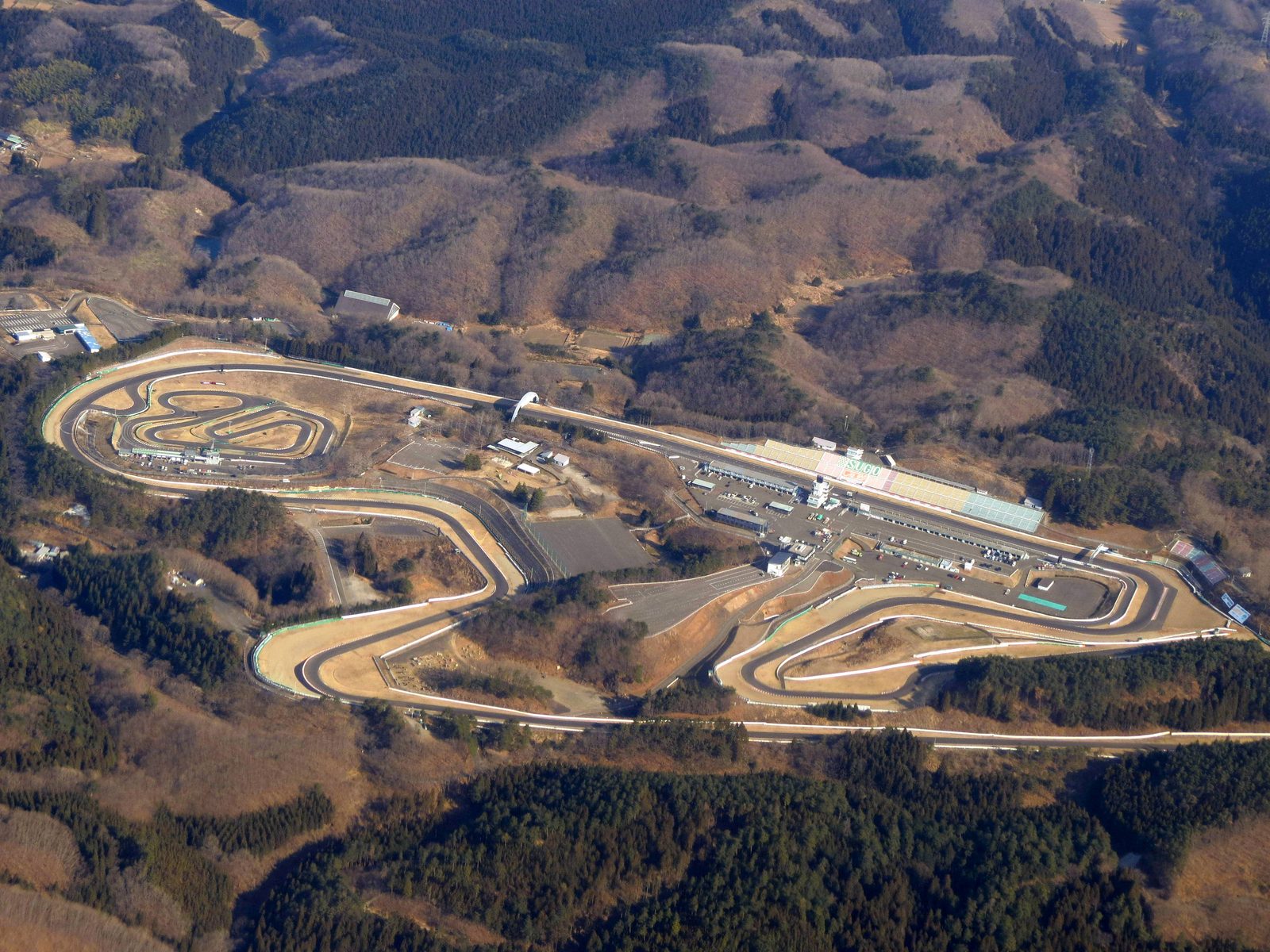
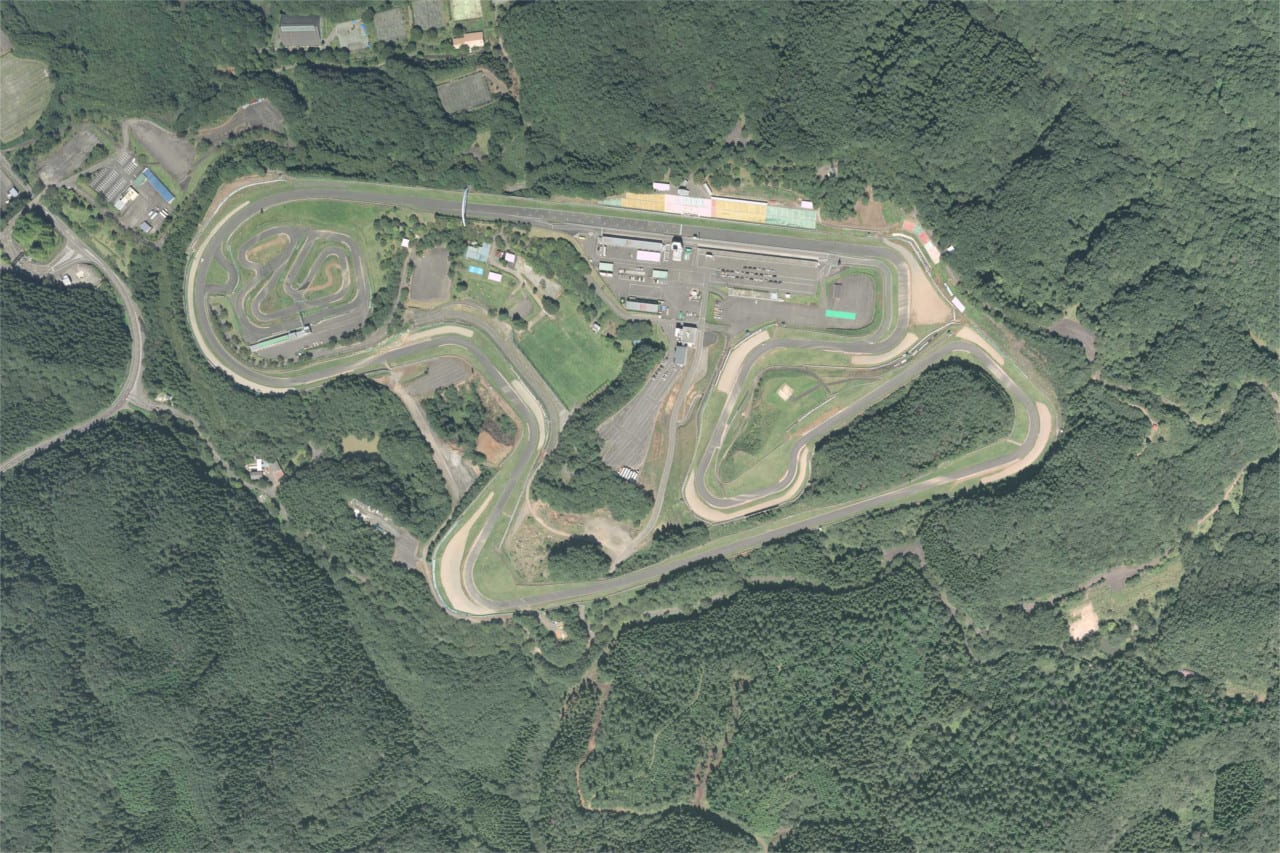
Sportsland SUGO is in Murata, Miyagi Prefecture, in the north of Japan. It opened in May 1975 and is owned by Yamaha Motor. It is an FIA Grade 2 circuit with road, motocross, trials and kart courses on the same site.
It runs clockwise. It is built on a hillside, and Japanese Wikipedia says the course has no flat sections at all. It goes up or down the whole lap. Run off is tight, and the Japanese racing saying about it translates as "a demon lives at SUGO" because of how many incidents the hills and tight corners produce.
The real calendar tells you what kind of track it is. Super GT has raced there since 1994 (with a gap in 2020). Super Formula has been there since 1987. Formula Regional Japan, Super Taikyu and the All Japan Road Race Championship for motorcycles race there too, and World Superbike visited from 1988 to 2003. The car race lap record is a 1:06.350 by Nick Cassidy in a Super Formula Dallara SF19 in 2020.
SUGO in GT7: the numbers
| In GT7 (Polyphony's figures) | |
|---|---|
| Name in game | SUGO International Racing Course |
| Length | 3,586 m |
| Corners | 13 |
| Elevation change per lap | 69.83 m |
| Longest straight | 704.5 m |
| Last corner | Uphill onto the main straight, up to 10 percent gradient |
| Layouts in the 1.72 notes | One. No reverse is mentioned |
The sources do not agree on length and corner count, so here is the honest version. English Wikipedia lists the car circuit at 3.704 km with 12 turns. Japanese Wikipedia lists the four wheel course at 3.586 km, measured without the motorcycle chicane before the last corner, and counts 11 corners. Polyphony's 3,586 m matches that Japanese figure. Corner counts change with how you count a multi apex bend, so do not worry about 11, 12 or 13.
Polyphony does not say whether the motorcycle chicane is drawn in the game. On the real track, cars go straight past it.
The lap, section by section
I have not raced SUGO in real life, and there are no published braking markers for the GT7 version yet. So I will not give you distances. What I can give you is how I approach each type of corner this layout throws at you, from what Polyphony and the circuit's own corner names describe.
Corner names below are the circuit's own (from Japanese Wikipedia). The order follows Polyphony's description of the lap. On your first laps, check each one against the in-game track map.
Turns 1 and 2: two right handers off the straight
You arrive here at the end of the 704.5 m straight, the fastest point of the lap. Polyphony describes it as two right handers. Japanese Wikipedia calls Turn 1 a high speed corner and the biggest challenge on the circuit.
A fast corner after a long straight is where people lose the race on lap one. Brake in a straight line, get the car turned in, and think about where Turn 2 wants you to be. If you take Turn 1 so wide that you are on the wrong side for Turn 2, you have given away both. In a race, the inside line into Turn 1 is the obvious pass, so defend it once and early.
The S bends and the hairpin
Next come the S bends and the hairpin. This is the slow part of the lap.
In an S, the first corner is a setup for the second. Sacrifice the entry of the first so the car is straight and settled when you change direction. Two half good corners beat one perfect corner and one disaster.
For the hairpin, brake hard and in a straight line, then release the brake slowly while you turn. Do not chase a late apex so far that you need half the exit to stop the car rotating. Hairpins are also passing places in a slow car, because the braking zone is long and the car in front has to commit to a line.
Hi-Point corner
The name tells you where you are. On a hill circuit, the top is where the car goes light. Over a crest the tyres have less load, so the same steering input gives less grip.
What I do on any corner like this is finish the hard braking before the top, then let the car breathe over it. Do not ask for full lock and full brake at the moment the car is lightest. If the rear steps out here, that is usually the cause.
Down the back to Horseback
After the high point the lap goes back down. The Japanese name is Uma no Se, which means horse's back. That name describes a hump.
Downhill braking is the trap at SUGO. The car is pushing forward and the brakes have more work to do, so you brake earlier than your eyes tell you. Over a hump the tyres unload again. Brake before it or after it, not on it. In GT7 with ABS on you will not lock a wheel, but you will run wide, and the run off here is not generous.
SP corner
Polyphony's description of the lap includes multi apex curves, and SP is the long corner section on the way back towards the bottom of the hill. Long corners reward patience.
Turn in a little later than feels natural, hold a steady speed through the middle, and open the steering before you go to full throttle. If you have to lift twice in the middle, you went in too fast. On a narrow track like this one, the car on the outside here has nowhere to go, so pick your moment.
The last corner onto the straight
The last corner climbs onto the main straight at up to a 10 percent gradient, and it feeds the 704.5 m straight. This is the most important corner on the track.
Every km/h you carry out of here you keep until the braking point for Turn 1. Uphill, the car stops better than you expect and the rear finds traction more easily, so you can be on throttle earlier than on a flat corner of the same shape. Get the exit right and you get a tow, or you deny one. In a race, this is where you set up the pass into Turn 1.
How I would learn SUGO in GT7
This is a short lap with a lot of elevation. That makes it fast to learn the layout and slow to learn the limit.
- Start in a road car you know. Something below 600 PP. Fewer variables, and you learn the hills before the speed.
- Ten laps with the ideal line shown, then turn it off. The line helps you find where the track goes over a crest. After that it gets in the way. My GT7 assist settings page has what I would leave on and what I would switch off.
- Learn the downhill braking zones first. That is where you lose the most time and where you crash.
- Then work on the last corner exit. Watch your speed at the end of the straight. If it goes up, you are getting it right.
- Only then take a race car there. And check the new default settings first, because Gr.1 to Gr.4 defaults changed in 1.72.
If you want the general technique behind these steps, my Gran Turismo 7 driving tips cover braking, trail braking and exit speed.
Which events and cars use SUGO
The 1.72 notes add three World Circuits events at SUGO:
| Event | Where |
|---|---|
| European Sunday Cup 400 | World Circuits, SUGO International Racing Course |
| World Touring Car 600 | World Circuits, SUGO International Racing Course |
| World Touring Car 800 | World Circuits, SUGO International Racing Course |
In GT7 the number in an event name like these is its PP limit. I have not seen the full entry rules for each event, so check the regulations screen before you buy a car for it. For how the WTC 600 series works and what I would bring, see my World Touring Car 600 guide.
Polyphony has not tied any of the six new cars to SUGO, and as of today no Sport mode Daily Race at SUGO has been announced. The track also appears in Scapes, where Sportsland SUGO is one of the two new featured Curations, so you can shoot photos there too.
For where SUGO sits among the other Japanese circuits, real and fictional, see my GT7 Japanese tracks list. The full track list is on the GT7 track list page.
FAQ
Is Sportsland SUGO in Gran Turismo 7?
Yes. It was added with update 1.72 on 15 October 2026. In the game it is called SUGO International Racing Course.
How long is SUGO in GT7?
Polyphony gives it as 3,586 m with 13 corners. English Wikipedia lists the real car circuit at 3.704 km, while Japanese Wikipedia gives 3.586 km for the car course without the motorcycle chicane.
How many layouts does SUGO have in GT7?
The 1.72 notes list one, SUGO International Racing Course. No reverse layout is mentioned.
Is update 1.72 free?
Yes. It is Part 1 of the free Spec IV update, on PS5 and PS4. Part 2 is planned for December 2026.
Which GT7 events race at SUGO?
European Sunday Cup 400, World Touring Car 600 and World Touring Car 800, all in World Circuits.
What is the hardest part of SUGO?
The downhill braking zones and the uphill last corner. Downhill you need to brake earlier than it looks. The last corner decides your speed on the whole main straight.
Which real series race at SUGO?
Super GT and Super Formula are the big ones. Formula Regional Japan, Super Taikyu and the All Japan Road Race Championship for motorcycles also race there.