
Forza Horizon 5 is built around a controller. On a Logitech G29 or G920 the default setup feels heavy in the middle and noisy on dirt, and most people give up after one evening.
It does not have to be like that. Three menus and about ten values fix most of it.
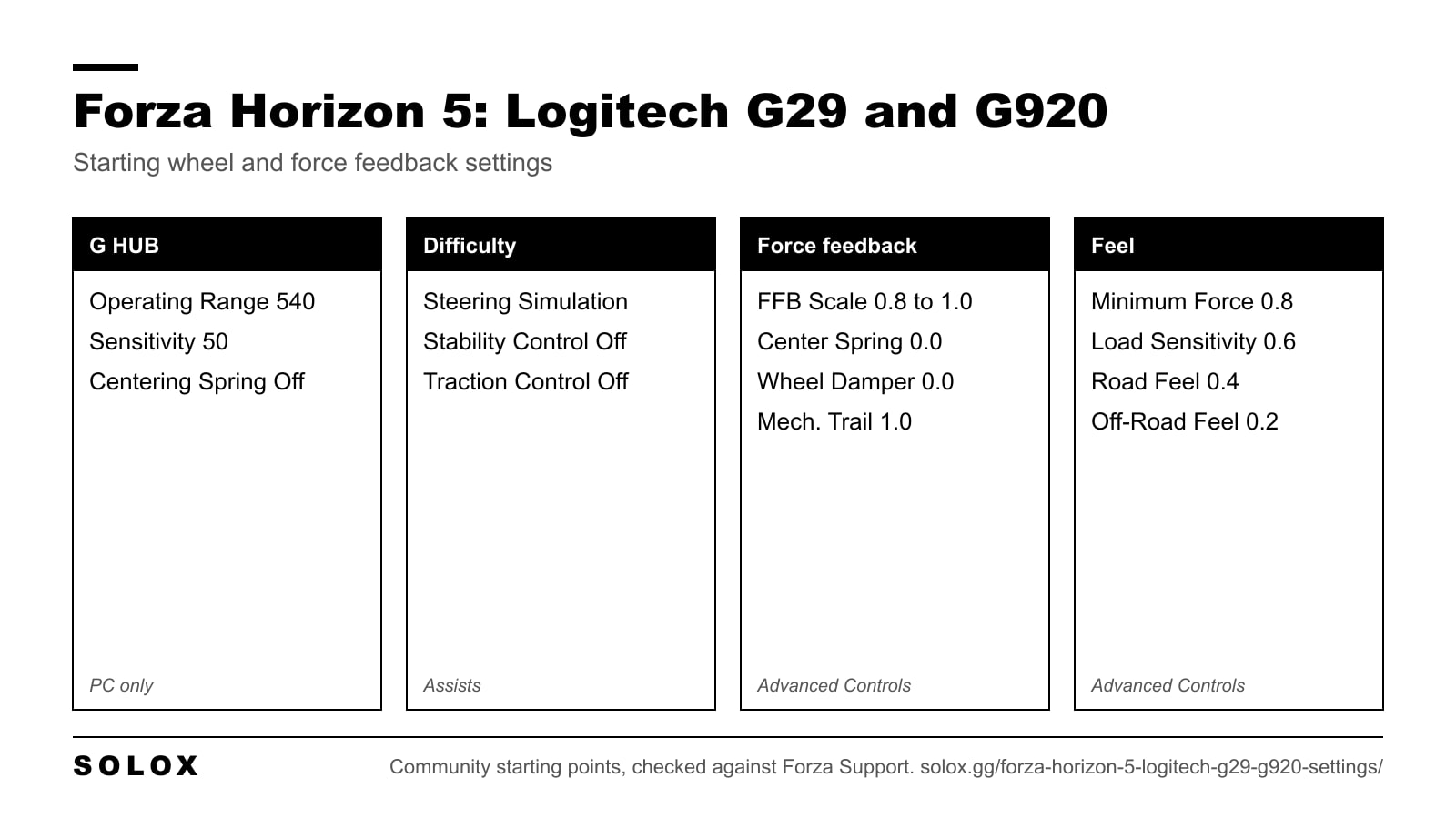
The numbers below are community tested starting points, and I checked them on 5 October 2026 against the wheel setup guide on Forza Support. They are not official Logitech values, because Logitech does not publish any for this game. The G923 uses the same settings.
The quick version
| Where | Setting | Value |
|---|---|---|
| G HUB (PC) | Operating Range | 540 |
| G HUB (PC) | Sensitivity | 50 |
| G HUB (PC) | Centering Spring | Off |
| Difficulty | Steering | Simulation |
| Difficulty | Stability Control | Off |
| Advanced Controls | Force Feedback Scale | 0.8 to 1.0 |
| Advanced Controls | Center Spring Scale | 0.0 |
| Advanced Controls | Wheel Damper Scale | 0.0 |
| Advanced Controls | Mechanical Trail Scale | 1.0 |
| Advanced Controls | Road Feel Scale | 0.4 |
| Advanced Controls | Off-Road Feel Scale | 0.2 |
Step 1: G HUB on PC
If you play on PC, open Logitech G HUB before you start the game.
| Setting | Value |
|---|---|
| Operating Range | 540 degrees |
| Sensitivity | 50 |
| Centering Spring | Off |
The wheel's default is 900 degrees. That is fine for a road car on a motorway, but Horizon races are full of tight corners and you end up crossing your arms all the time. 540 makes the car react with less steering.
There is a second reason to do it in G HUB and not in the game. The game has no soft lock. If you shorten the steering with the in game slider, the wheel keeps turning past the point where the car has run out of lock, and you never feel where the end is. Setting the range in G HUB puts a real stop there.
On PlayStation and Xbox there is no G HUB. Skip to step 2 and use the Steering Sensitivity slider in step 4.
Step 2: Difficulty settings
Go to Settings, then Difficulty.
| Setting | Value |
|---|---|
| Steering | Simulation |
| Traction Control | Off |
| Stability Control | Off |
| Braking | ABS On |
| Shifting | Your preference |
Steering on Simulation is the one that counts. Forza Support explains why: Standard steering changes how the car rotates to keep it stable for controller players, and that makes the force feedback feel less sharp. Simulation switches those layers off.
Stability control is the second one. It brakes individual wheels when the car slides, and through the wheel that feels like the steering going numb in the middle of a corner.
Traction control off is faster once you are used to it. If this is your first week on a wheel, leave it on for a few days and take it off later. There is no prize for spinning on every exit.
Step 3: Deadzones and linearity
Go to Settings, then Advanced Controls.
| Setting | Value |
|---|---|
| Vibration | On |
| Invert Force Feedback | Off |
| Steering Axis Deadzone Inside | 0 |
| Steering Axis Deadzone Outside | 100 |
| Steering Linearity | 50 |
| Acceleration Axis Deadzone | 0 inside, 100 outside |
| Deceleration Axis Deadzone | 0 inside, 100 outside |
| Clutch Axis Deadzone | 0 inside, 100 outside |
| E-Brake Axis Deadzone | 0 inside, 100 outside |
0 inside and 100 outside means the game uses the full travel of the wheel and the pedals. Nothing is cut off at the start or at the end.
Steering Linearity at 50 is a straight 1:1 response. That is how Forza Support describes it. Leave it there.
One exception. Old pedal sets sometimes send a small signal when your foot is off. If the car creeps or drags the brake on its own, raise the inside deadzone of that pedal to 2 or 3. If you cannot reach full brake because the G29 brake pedal is so stiff at the end, lower the Deceleration outside deadzone to 90.
Step 4: Force feedback
Same menu, further down.
| Setting | Value |
|---|---|
| Vibration Scale | 0.5 |
| Force Feedback Scale | 0.8 to 1.0 |
| Center Spring Scale | 0.0 |
| Wheel Damper Scale | 0.0 |
| Mechanical Trail Scale | 1.0 |
| Force Feedback Minimum Force | 0.8 |
| Force Feedback Load Sensitivity | 0.6 |
| Road Feel Scale | 0.4 |
| Off-Road Feel Scale | 0.2 |
| Steering Sensitivity | 0.5 |
Start at the low end of Force Feedback Scale. Drive ten minutes on tarmac and ten on dirt before you touch anything, and then change one slider at a time. If you move four at once you will not know which one did what.
What each slider does
Force Feedback Scale. This is the most misunderstood setting in the game. It is not a master volume. Forza Support says it scales the forces that come from the front tires, and that it does not scale the spring or the damper. Two things follow from that. Do not set it to zero, because you delete the only useful information. And do not crank it up to make the wheel stronger, because on a gear driven Logitech it turns jerky, mostly on dirt.
Center Spring Scale. A spring that pulls the wheel to the middle. It has nothing to do with grip. Forza Support advises against turning it up, because it covers what the tires are doing. On these wheels, 0.
Wheel Damper Scale. Adds resistance, so the wheel feels heavier and moves slower. The official guide is direct about it: wheels with less torque, and it names the G920 and the G29, need little to no damper. It also makes drifting harder, because the wheel cannot spin back fast enough.
Mechanical Trail Scale. Changes how the wheel feels when the front tires go past their grip. Lower and the wheel goes lighter in understeer. Higher and it stays heavy. The developers recommend leaving it at the default, and I agree. Drifters are the exception: some run it higher for more self centering.
Force Feedback Minimum Force. Boosts or cuts the force around the centre. Higher gives you more feel in the middle, but it can make the wheel shake on the straights. 0.8 keeps a Logitech calm.
Force Feedback Load Sensitivity. Decides how soon the force reaches its peak as the tires load up. If fast cars with a lot of grip make the wheel feel like a block of concrete, this is the slider to change. Follow the description in the game menu for the direction, and move it 0.1 at a time.
Road Feel Scale and Off-Road Feel Scale. The small vibrations from the surface. They add no steering weight. On a gear driven wheel they add noise, so keep them low.
Steering Sensitivity. Changes the steering ratio. 0.5 is the default. Higher means less wheel movement for the same turn.
Why less is more on a Logitech
The G29 and G920 are gear driven and make a bit over 2 Nm. That is a small budget. Every effect you add, spring, damper, road noise, takes a share of it, and what is left for the tires gets smaller.
In a real car, the steering goes light a moment before the front lets go. That is the message you want from the wheel. A strong spring and a thick damper make the wheel feel expensive in the car park and tell you nothing in the corner.
So the setup is: fake forces off, tire forces at about default, vibrations low.
Console: PlayStation and Xbox
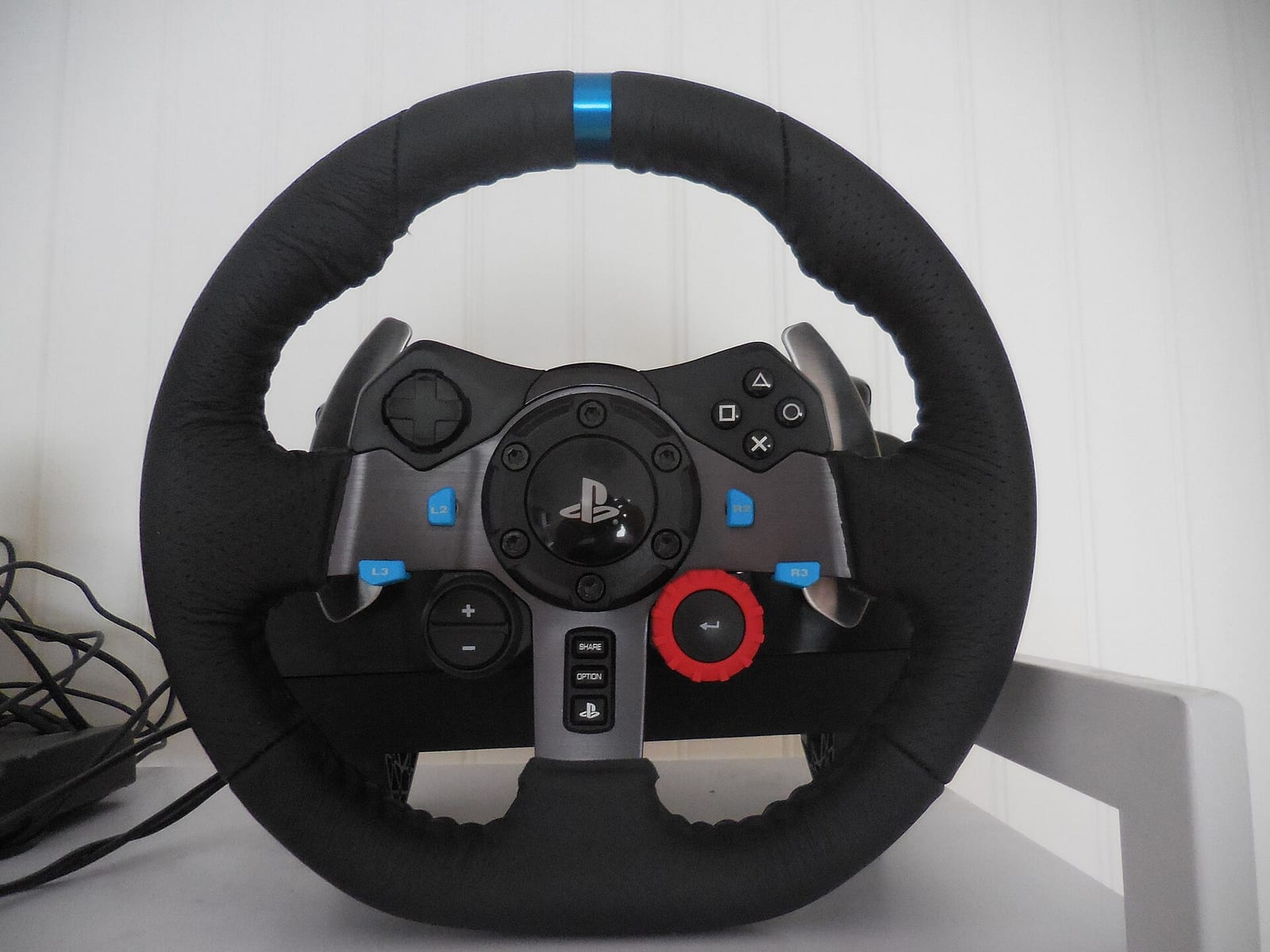
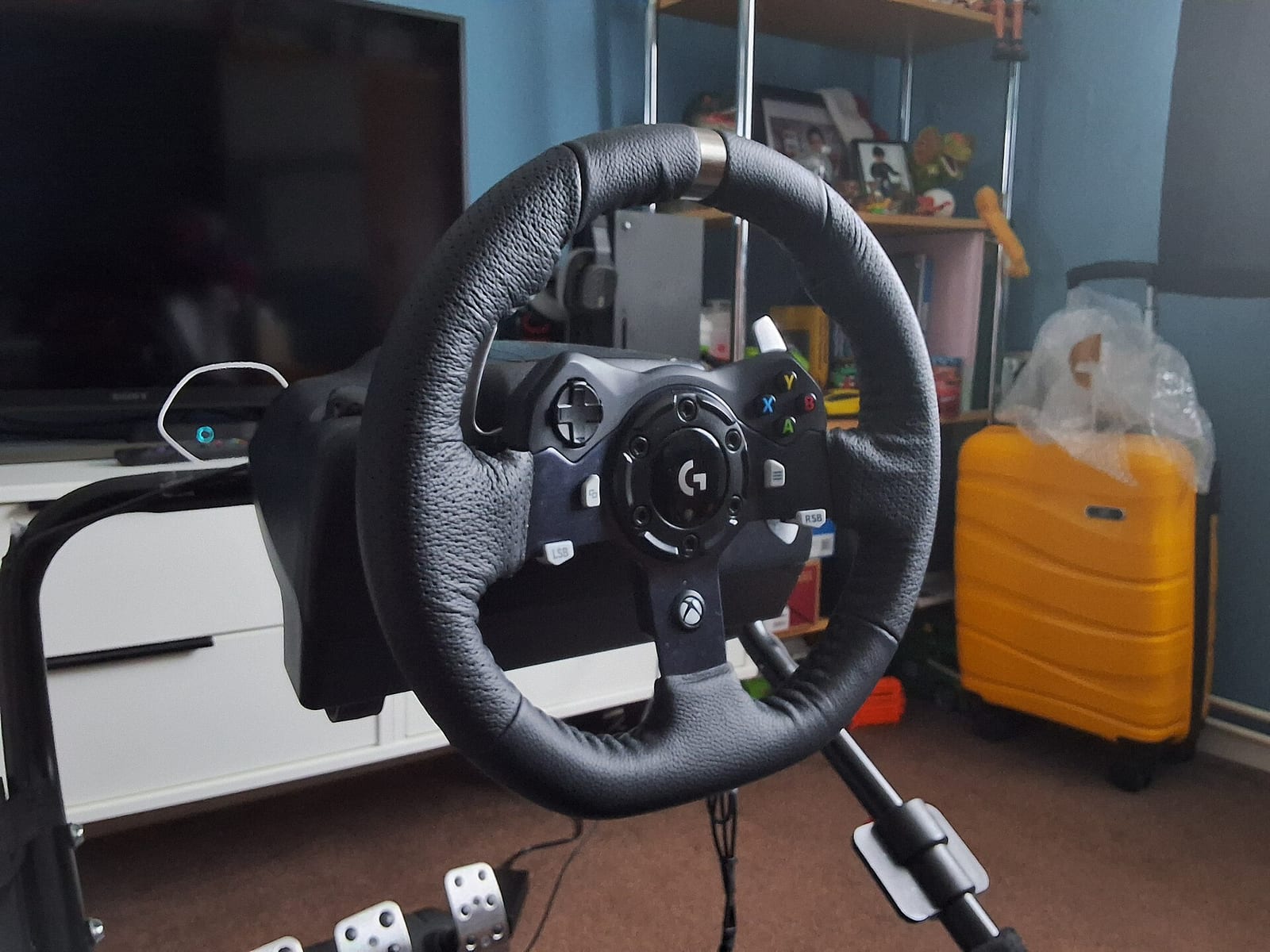
The G920 works on Xbox and the G29 on PlayStation 5, where the game arrived in 2025. The in game menus are the same as on PC.
What you do not have is G HUB, so the wheel stays at its full rotation. Two options:
- Leave Steering Sensitivity at 0.5 and get used to more arm movement. This is the cleanest option.
- Raise Steering Sensitivity to 0.6 or 0.7 for a quicker steering. Remember there is no soft lock, so do not go too far.
Everything else in this guide applies as written.
Fixes for common problems
The wheel is heavy in the middle and will not go light. Check that Centering Spring is off in G HUB and that Center Spring Scale is at 0.0 in the game. Brian Koponen, who tested these wheels on PC, reports a bug where the game can force the centering spring on anyway. If that happens to you, restart the game and reconnect the wheel before you start changing sliders.
The wheel rattles on dirt. Lower Off-Road Feel Scale to 0.1, then Road Feel Scale, then Force Feedback Scale. In that order.
The wheel shakes left and right on a straight. Lower Force Feedback Minimum Force by 0.1 at a time. If that is not enough, add a little Wheel Damper Scale, 0.1 or 0.2. This is the one case where a bit of damper helps.
The car feels slow to turn. Check that the Operating Range in G HUB is 540 and not 900. On console, raise Steering Sensitivity one step.
No force feedback at all on PC. Unplug other controllers, start G HUB first, then the game.
The steering wheel on screen barely moves. That is the animation. It only shows about 90 degrees each way and has nothing to do with the real steering angle. Use the dashboard or bonnet camera if it bothers you.
Different settings for drifting?
A little. For drift builds I would change three things:
- Operating Range 900 in G HUB, so you have room to catch the car.
- Wheel Damper Scale at 0.0, so the wheel can spin back on its own.
- Mechanical Trail Scale a step or two above 1.0 for more self centering.
Be honest with yourself about the hardware, though. A gear driven wheel does not spin back as fast as a belt or direct drive base, and that is what drifting on a wheel lives on.
Other wheels and other games
- On another brand, see my Forza Horizon 5 wheel settings, the Fanatec settings and the Thrustmaster settings.
- Moved on to the new game? Here are my Forza Horizon 6 wheel settings, with a Logitech section.
- Thinking about an upgrade? Read G29 vs G923 before you spend money.
FAQ
What are the best Forza Horizon 5 settings for the Logitech G29?
Steering on Simulation, Force Feedback Scale 0.8 to 1.0, Center Spring Scale 0.0, Wheel Damper Scale 0.0, Mechanical Trail Scale 1.0, Road Feel Scale 0.4 and Off-Road Feel Scale 0.2. On PC, set 540 degrees in G HUB.
Are the settings the same for the G29 and the G920?
Yes. They are the same wheel inside with different buttons. The G923 uses the same values too.
What steering angle should I use in Forza Horizon 5?
540 degrees for racing, set in G HUB on PC. 900 degrees for drifting or cruising.
Why does my Logitech wheel feel so heavy in Forza Horizon 5?
Usually the centering spring and the damper. Set both to 0.0 in Advanced Controls and switch Centering Spring off in G HUB. If it stays heavy on PC, restart the game and reconnect the wheel.
Should I turn Force Feedback Scale up for a stronger wheel?
No. It is not an overall gain. It only scales the forces from the front tires, and too much makes a Logitech wheel jerky. Stay between 0.8 and 1.0.
Does the Logitech G29 work with Forza Horizon 5 on PS5?
Yes. The G29 is a PlayStation wheel and the game supports it on PlayStation 5. You set everything in the game, because G HUB is only for PC.
Why does the steering wheel in the car only turn 90 degrees?
It is only the animation. The real steering angle in the physics is larger and does not match what you see in the cockpit.
Is Forza Horizon 5 good with a Logitech wheel?
It is good fun once it is set up, but it is still an arcade game made for a controller. Do not expect the feel of a sim. Expect a relaxed drive with enough feedback to catch a slide.