
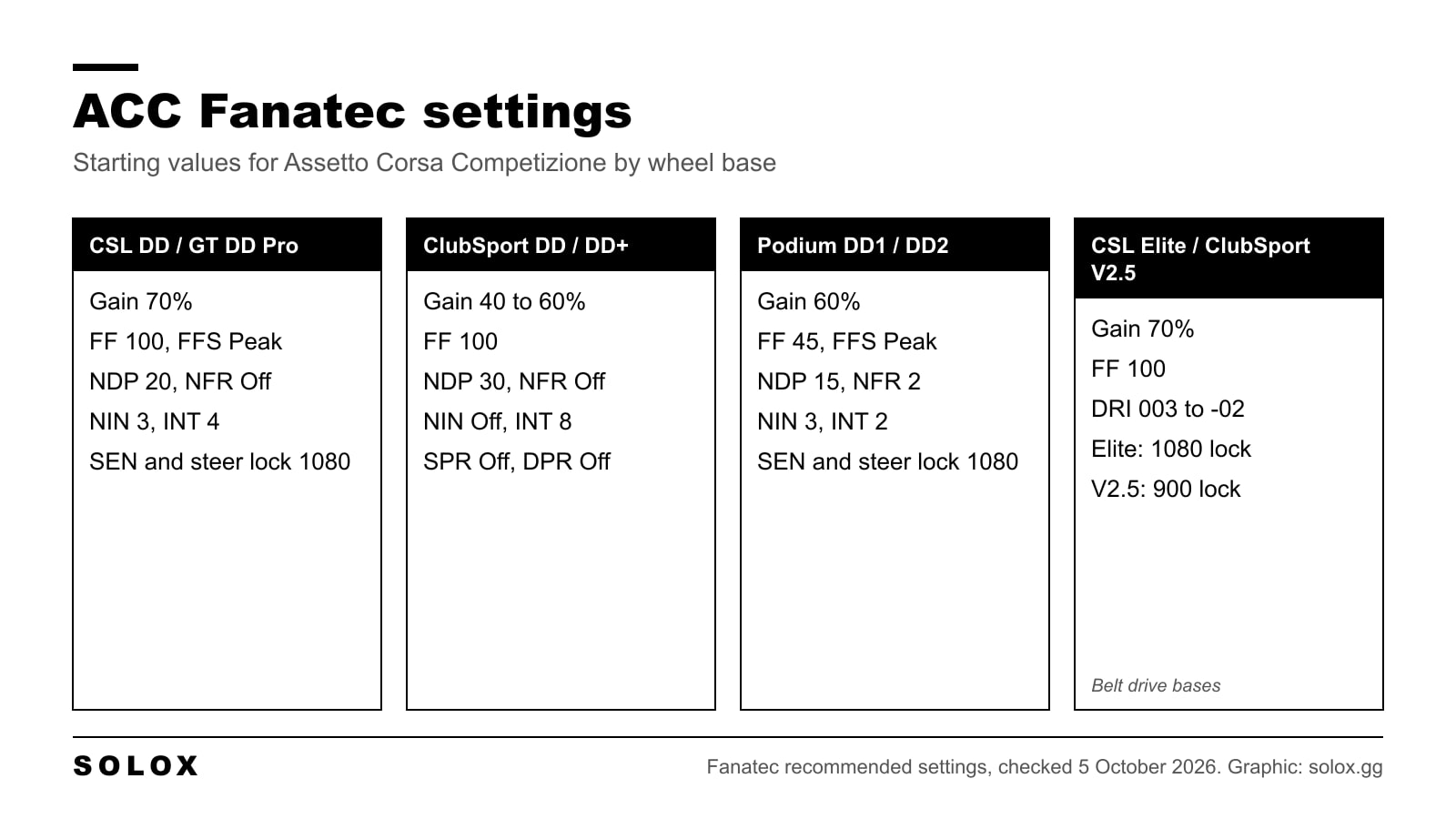
These are the Fanatec settings I would start from in Assetto Corsa Competizione, for every base from the CSL Elite to the Podium DD2. You need two sets of numbers: the tuning menu on the wheel base, and the force feedback block inside the game. One without the other does not work.
The values come from Fanatec's own recommended settings. I checked them again on 5 October 2026 and added how I would adjust them from there, because a baseline is only where you begin.
The short version
| Wheel base | Gain in ACC | FF on the base | SEN and steer lock |
|---|---|---|---|
| CSL DD / GT DD Pro | 70% | 100 | 1080 |
| ClubSport DD / DD+ | 40 to 60% | 100 | Auto, or 1080 on both |
| Podium DD1 / DD2 | 60% | 45 | 1080 |
| CSL Elite (all versions) | 70% | 100 | 1080 |
| ClubSport V2 / V2.5 | 70% | 100 | 900 |
Minimum force is 0% on all of them. Road effects start at 0%.
Where the settings are
There are two places.
In the game: Options, then Controls. Pick your wheel on the left and load the Fanatec preset for your rim so the buttons are mapped. The force feedback values are in the block on the right of the same screen.
On the base: the tuning menu. Press the tuning menu button on the wheel and scroll through the values on the display, or change them on the PC in the Fanatec software. Save them in one of the setup slots (S1 to S5) and call it ACC, so you do not overwrite it when you set up another game.
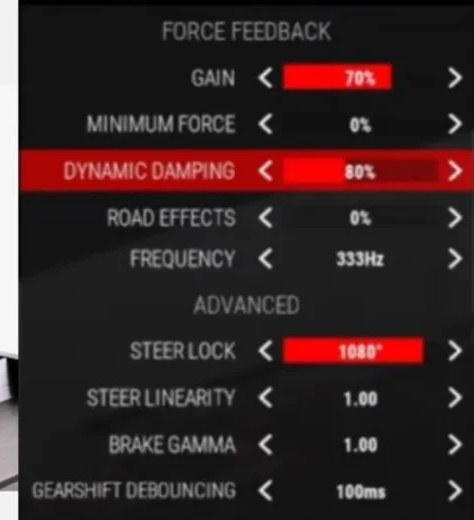
In-game settings for every Fanatec base
| Wheel base | Gain | Min force | Dynamic damping | Road effects | Steer lock |
|---|---|---|---|---|---|
| CSL DD / GT DD Pro | 70% | 0% | 100% | 0% | 1080 |
| ClubSport DD / DD+ | 40 to 60% | 0% | 0 to 10% | 0 to 15% | Same as SEN |
| Podium DD1 / DD2 | 60% | 0% | 100% | 0% | 1080 |
| CSL Elite (all versions) | 70% | 0% | 100% | 0% | 1080 |
| ClubSport V2 / V2.5 | 70% | 0% | 100% | 0% | 900 |
The rest is the same for every base:
| Setting | Value |
|---|---|
| Frequency | 400 Hz, or the highest value your game offers |
| Steer linearity | 1.00 |
| Brake gamma | 1.00 to start, see below |
Tuning menu: CSL DD, GT DD Pro, ClubSport DD and Podium
| Setting | CSL DD / GT DD Pro | ClubSport DD / DD+ | Podium DD1 / DD2 |
|---|---|---|---|
| SEN | 1080 | Auto | 1080 |
| FF | 100 | 100 | 45 |
| FFS | Peak | Peak | Peak |
| NDP | 20 | 30 | 15 |
| NFR | Off | Off | 2 |
| NIN | 3 | Off | 3 |
| INT | 4 | 8 | 2 |
| FEI | 100 | 100 | 100 |
| FOR | 100 | 100 | 100 |
| SPR | 100 | Off | 100 |
| DPR | 50 | Off | 100 |
| SHO | 100 | 100 | 100 |
| BLI | Your choice | Your choice | Your choice |
| BRF | Your choice | Your choice | Your choice |
Three notes on this table.
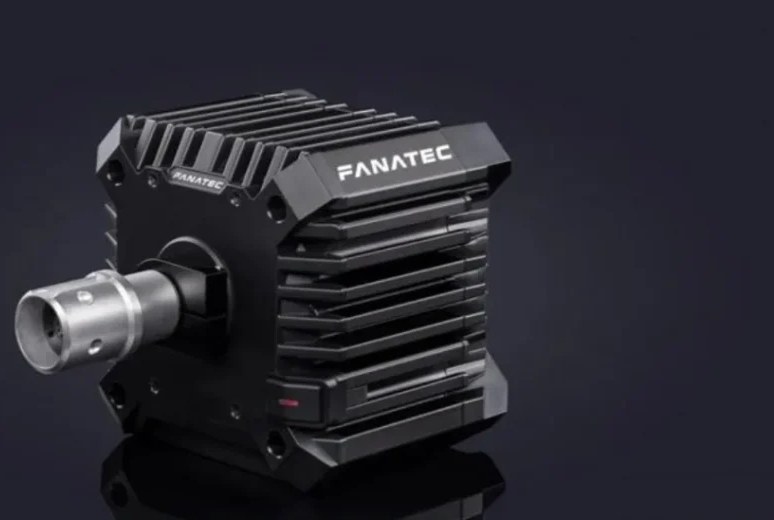
The GT DD Pro is the PlayStation version of the CSL DD. Same motor, same 5 Nm, or 8 Nm with the Boost Kit 180. It takes the same numbers.
The ClubSport DD column is the newest one. Fanatec published it on 14 October 2025 for the ClubSport DD+ on PlayStation, and it follows a different idea from the older columns: spring and damper off on the base, very little damping in the game, and a lot of interpolation instead. The ClubSport DD is the same base with 12 Nm instead of 15, so I would start it from the same values.
The Podium numbers assume the torque key is plugged in. FF 45 looks low. It is not. 45% of 25 Nm is still more than the CSL DD gives you flat out.
Tuning menu: CSL Elite and ClubSport V2 and V2.5
| Setting | CSL Elite (V1) | CSL Elite V1.1 / Elite + | ClubSport V2 | ClubSport V2.5 |
|---|---|---|---|---|
| SEN | 1080 | 1080 | 900 | 900 |
| FF | 100 | 100 | 100 | 100 |
| SHO | 100 | 100 | 100 | 100 |
| DRI | 003 | -02 | 003 | -01 |
| FOR | 100 | 100 | 100 | 100 |
| SPR | 100 | 100 | 100 | 100 |
| DPR | 100 | 100 | 100 | 100 |
| FEI | 100 | 070 | Not listed | 100 |
| BLI | Your choice | Your choice | Your choice | Your choice |
| BRF | Your choice | Your choice | Your choice | Your choice |
The belt drive bases have a shorter menu. There is no natural damper, friction or inertia, and DRI (drift mode) takes their place. A negative DRI value adds a little damping, a positive one makes the wheel turn more freely.
Why the gain goes down as the base gets stronger
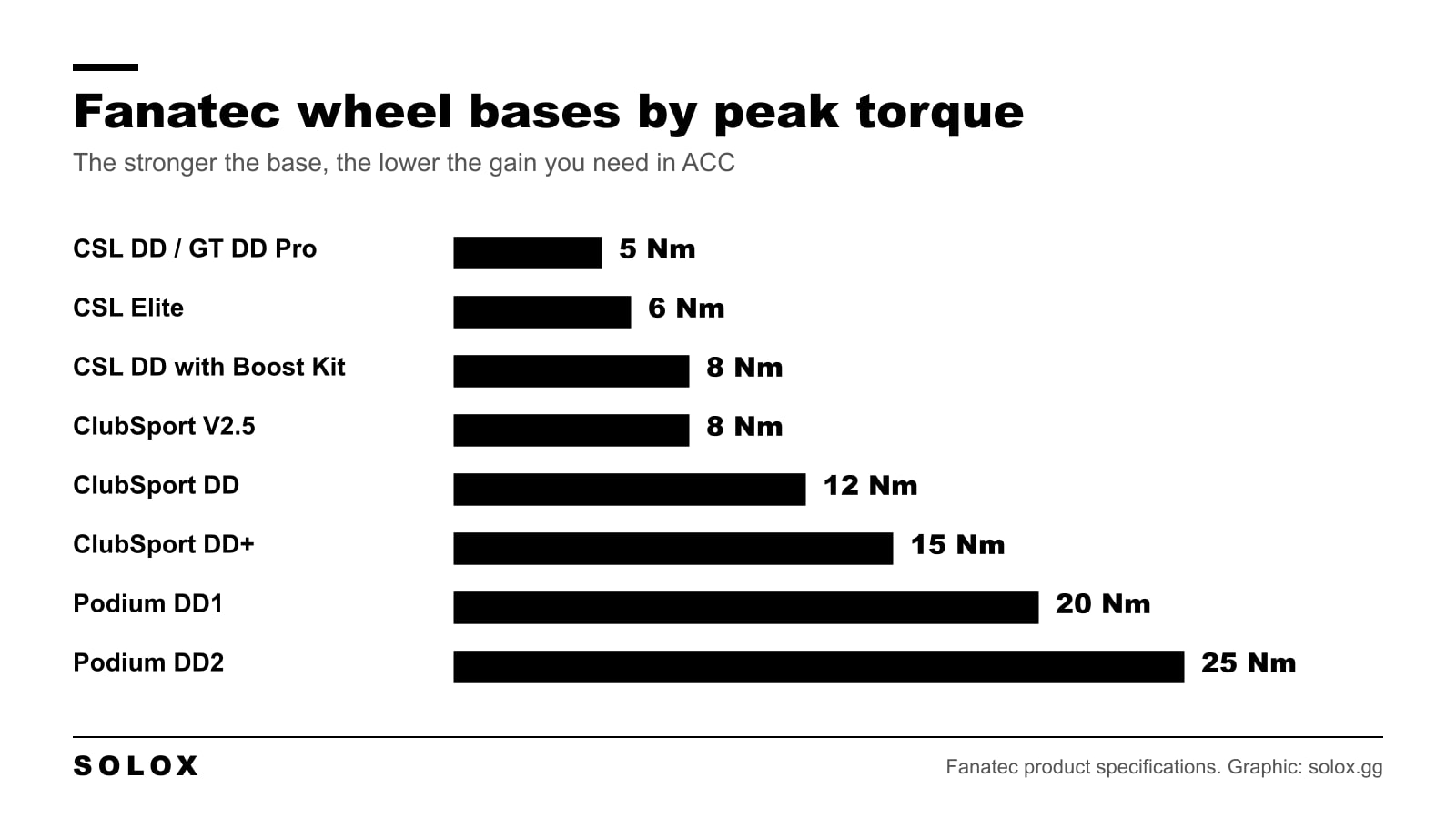
Gain is the one setting that matters most. It decides how strong the signal from the game is before it reaches the base.
Too high and the signal clips. Clipping means the game asks for more force than the scale allows, so everything above the limit feels the same. You lose exactly the part you need: the load building up in a fast corner and the moment it drops when the front tyres let go.
A 5 Nm base needs a strong signal to give you any weight at all, so 70% makes sense. A 20 or 25 Nm base has torque to spare, so you send it a cleaner, lower signal and limit the output on the base with FF.
To check it, switch on the FF bar in the HUD and drive a few laps. If the bar sits at the top through every fast corner, lower the gain by 5% and go again. A flash of full scale over a kerb is fine. My ACC HUD guide explains the rest of the screen.
What each tuning menu value does
| Value | Meaning | What to do with it in ACC |
|---|---|---|
| SEN | Steering rotation in degrees | Same number as the steer lock in the game |
| FF | Maximum strength of the base | 100 on small bases, 45 on a Podium |
| FFS | Linear or Peak scaling | Peak |
| NDP | Natural damper | Raise it if the wheel shakes on the straights |
| NFR | Natural friction | Off or very low. It adds weight but hides detail |
| NIN | Natural inertia | Low. It makes a light rim feel heavier |
| INT | Interpolation, a smoothing filter | Raise it if the feedback feels grainy |
| FEI | Force effect intensity | 100 for sharp kerbs, lower to soften them |
| FOR, SPR, DPR | Multipliers for force, spring and damper effects | As in the tables |
| DRI | Drift mode on belt bases | As in the table |
| SHO | Vibration motors in the rim | 100, or lower if they annoy you |
| BLI | Brake level indicator | Your choice |
| BRF | Brake force for load cell pedals | Your choice, see below |
How I would adjust from the baseline
Change one thing at a time and drive at least five laps before you judge it.
The wheel feels too light. Raise the gain by 5%, check the FF bar, stop when it starts to clip. Do not chase weight. A real GT3 car has power steering, and the steering is lighter than most people expect. What you read through the wheel is the change in load, not the load itself.
The wheel shakes on the straights. That is oscillation, and it is common on direct drive bases. Raise NDP in steps of 5. Keep both hands on the wheel while you test it.
The feedback feels grainy or notchy. Raise INT by one or two steps.
The kerbs hit too hard. Lower FEI to 80 or 70.
You want to feel more of the road. Raise road effects a little, to 10 or 15%. I would not go further. Road effects are added on top of the physics signal, and too much of them covers what the tyres are telling you.
Brake force and brake gamma. With load cell pedals, set BRF so you reach 100% only with a proper hard push, the kind you can repeat lap after lap without thinking. Leave brake gamma at 1.00 first. Braking is where most of the lap time is in a GT3 car, so spend time here. My guide to braking technique in ACC goes through it.
Steering lock
Set SEN on the base and the steer lock in ACC to the same number. When they match, the game applies the real steering lock of each car by itself, so you never have to change it when you switch from one GT3 to another. If they do not match, the wheel on screen and the wheel in your hands turn at different rates and your inputs feel wrong. The table of the real values is in my ACC steering lock guide.
If the wheel is not recognised
Fanatec's notes for the CSL DD recommend compatibility mode for ACC. If the game does not see your base, or the preset for your rim is missing, switch the base to compatibility mode and try again. Update the driver and the firmware first. Old firmware is behind most of the strange force feedback problems.
For wheels with multi position switches, set the switches to constant mode so ACC reads each position.
Other wheels and other guides
These values are for Fanatec only. For the general logic and for other brands, start from my ACC FFB settings guide. There are separate pages for Thrustmaster wheels in ACC and for the Logitech G29 and G920 in ACC. If you are still choosing a base, read my Fanatec CSL DD review and direct drive wheels explained.
FAQ
What are the best Fanatec CSL DD settings for ACC?
Gain 70%, minimum force 0%, dynamic damping 100% and road effects 0% in the game. On the base: SEN 1080, FF 100, FFS Peak, NDP 20, NFR Off, NIN 3, INT 4, FEI 100, FOR 100, SPR 100 and DPR 50.
Do the same settings work for the GT DD Pro?
Yes. The GT DD Pro uses the same motor as the CSL DD, so the tuning menu and the in-game values are the same.
What gain should I use on a Podium DD1 or DD2?
60% in the game with FF at 45 on the base. Then watch the FF bar in the HUD and lower the gain if it clips in fast corners.
Should minimum force be above 0% on a Fanatec wheel?
No. Minimum force is there to hide the dead zone of gear driven wheels. Fanatec belt and direct drive bases do not have one, so leave it at 0%.
What steering lock should I use in ACC with a Fanatec wheel?
1080 on the base and 1080 in the game for the CSL DD, the Podium bases and the CSL Elite, and 900 on both for the ClubSport V2 and V2.5. With matching values ACC sets the right lock for each car.
Why does my Fanatec wheel shake on the straights in ACC?
That is oscillation from the direct drive motor. Raise NDP on the base in steps of 5 until it stops, and keep dynamic damping in the game where the table has it.
Are these settings the same on PS5 and Xbox?
The tuning menu is the same. The in-game force feedback menu on console has the same main values, so start from the same gain and adjust it with the FF bar.