
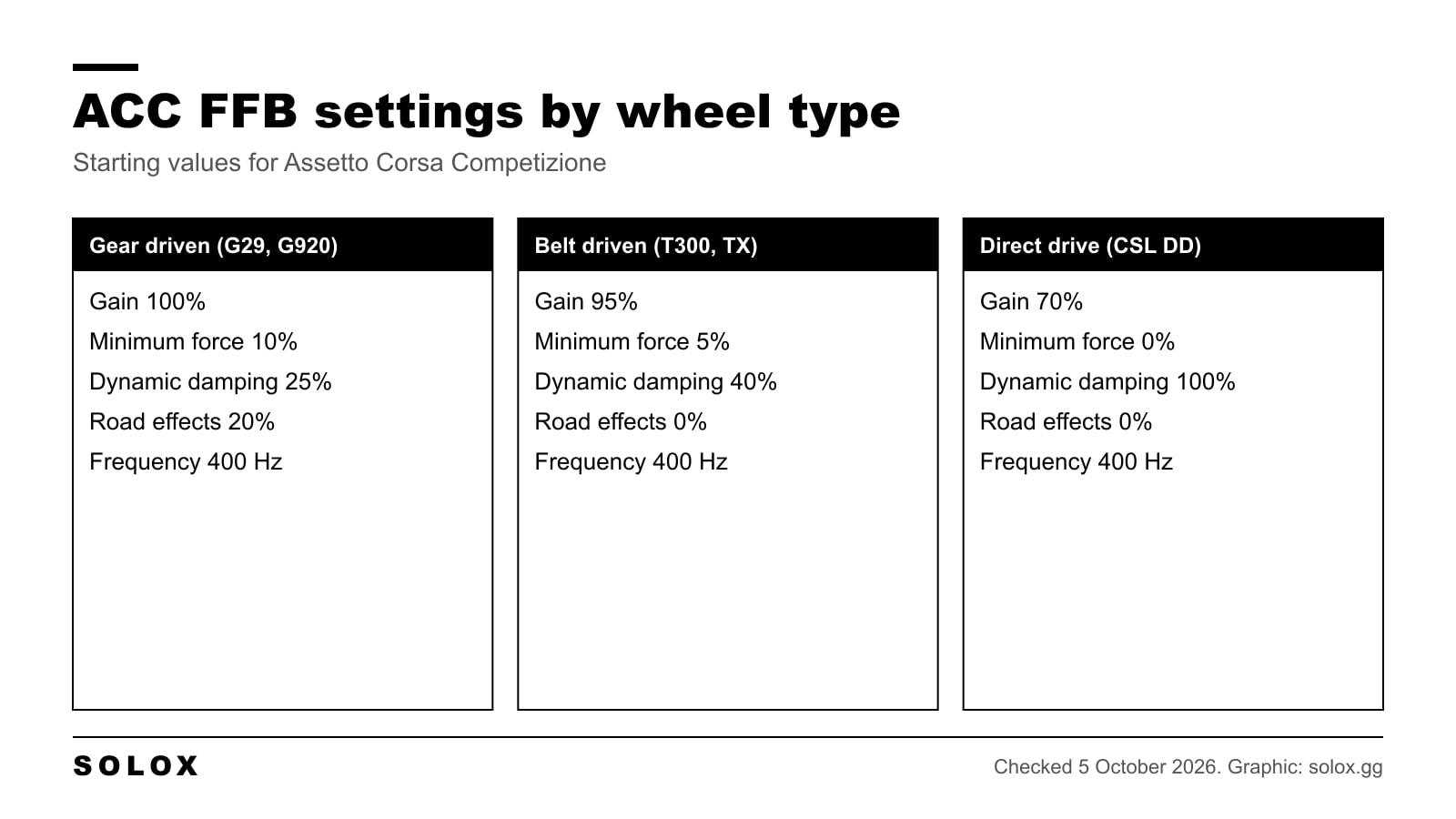
The force feedback menu in Assetto Corsa Competizione has six values, and the right numbers depend on one thing: how strong your wheel is. A 2 Nm Logitech and a 25 Nm Podium need opposite settings.
So this page is organised by wheel type. Find yours in the table, put the numbers in, and then use the second half of the page to adjust them. I checked every value again on 5 October 2026. The old version of this page still had 333 Hz and 1080 degrees for every wheel, which is not right any more.
ACC FFB settings by wheel type
| Wheel type | Examples | Gain | Minimum force | Dynamic damping | Road effects |
|---|---|---|---|---|---|
| Gear driven | Logitech G29, G920, G923 | 100% | 10% | 25% | 20% |
| Belt driven | Thrustmaster T300, TX, T248 | 95% | 5% | 40% | 0% |
| Small direct drive | Fanatec CSL DD, GT DD Pro, MOZA R5 and R9 | 70 to 90% | 0% | 100% | 0% |
| Big direct drive | Fanatec ClubSport DD, Podium DD1 and DD2 | 40 to 60% | 0% | 0 to 100%, see the Fanatec page | 0% |
These are the same for every wheel:
| Setting | Value |
|---|---|
| Frequency | 400 Hz, the highest value in the list |
| Steer lock | The full rotation of your wheel: 900 or 1080 |
| Steer linearity | 1.00 |
| Brake gamma | 1.00 to start |
| Gearshift debouncing | 50 ms |
| Manufacturer extras | On |
That table is where you begin. Each brand also has its own software or its own menu on the base, and those values matter as much as the ones in the game. I have a full page for each:
- ACC Logitech G29 and G920 settings, with the G HUB values
- ACC Thrustmaster settings, with the control panel values
- ACC Fanatec settings, with the tuning menu for every base
Where the menu is
From the main menu go to Options, then Controls. Pick your wheel on the left and load its preset, so the buttons and the pedals are mapped. The force feedback block is on the same screen.
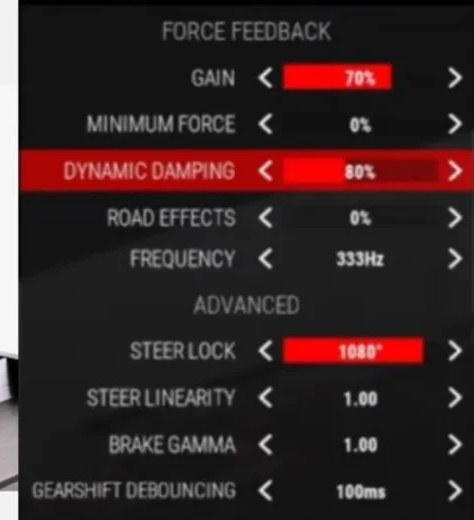
What each setting does
Gain
The strength of the signal the game sends to the wheel. It is the most important value on the screen.
The logic is simple. A weak wheel cannot give you much force, so you ask for all of it: gain at 95 or 100%. A strong wheel has more force than you need, and if you send it a full signal the peaks get cut off. So the gain goes down as the base gets stronger.
Minimum force
Gear and belt wheels have a small dead zone around the centre. Light forces get lost in the mechanism and never reach your hands. Minimum force lifts every small force above that zone.
On a Logitech G29 or G920 start at 10%. On a belt driven Thrustmaster about 5% is enough. A direct drive base has no gears and no belt, so it has no dead zone: leave it at 0%. If the wheel shakes by itself on the straight, your minimum force is too high.
Dynamic damping
Resistance that grows with the speed of the car. It makes the wheel calmer on the straights and gives the steering some weight.
A direct drive base has force to spare, so it can run at 100%. A G29 has not, and at 100% the steering goes heavy and slow and you lose detail. That is why the number goes down as the wheel gets weaker.
Road effects
Bumps and surface noise added on top of the physics signal. It is an effect, not information from the tyres. On a direct drive base you already feel the road through the main signal, so 0% is the cleanest. On a weaker wheel 10 to 20% helps you feel the surface.
Frequency
How many times per second the game updates the force feedback. Take the highest value in the list, 400 Hz. There is no reason to go lower on a modern PC or console.
Steer lock
Set it to the full rotation of your wheel, and set the same number in the software of the wheel. 900 on a Logitech, 900 or 1080 on a Thrustmaster depending on the model, 1080 on most Fanatec bases. When the two numbers match, ACC gives every car its real steering lock by itself, and you never touch it again when you change car. The real lock of each car is in my ACC steering lock guide.
Logitech: G29, G920 and G923
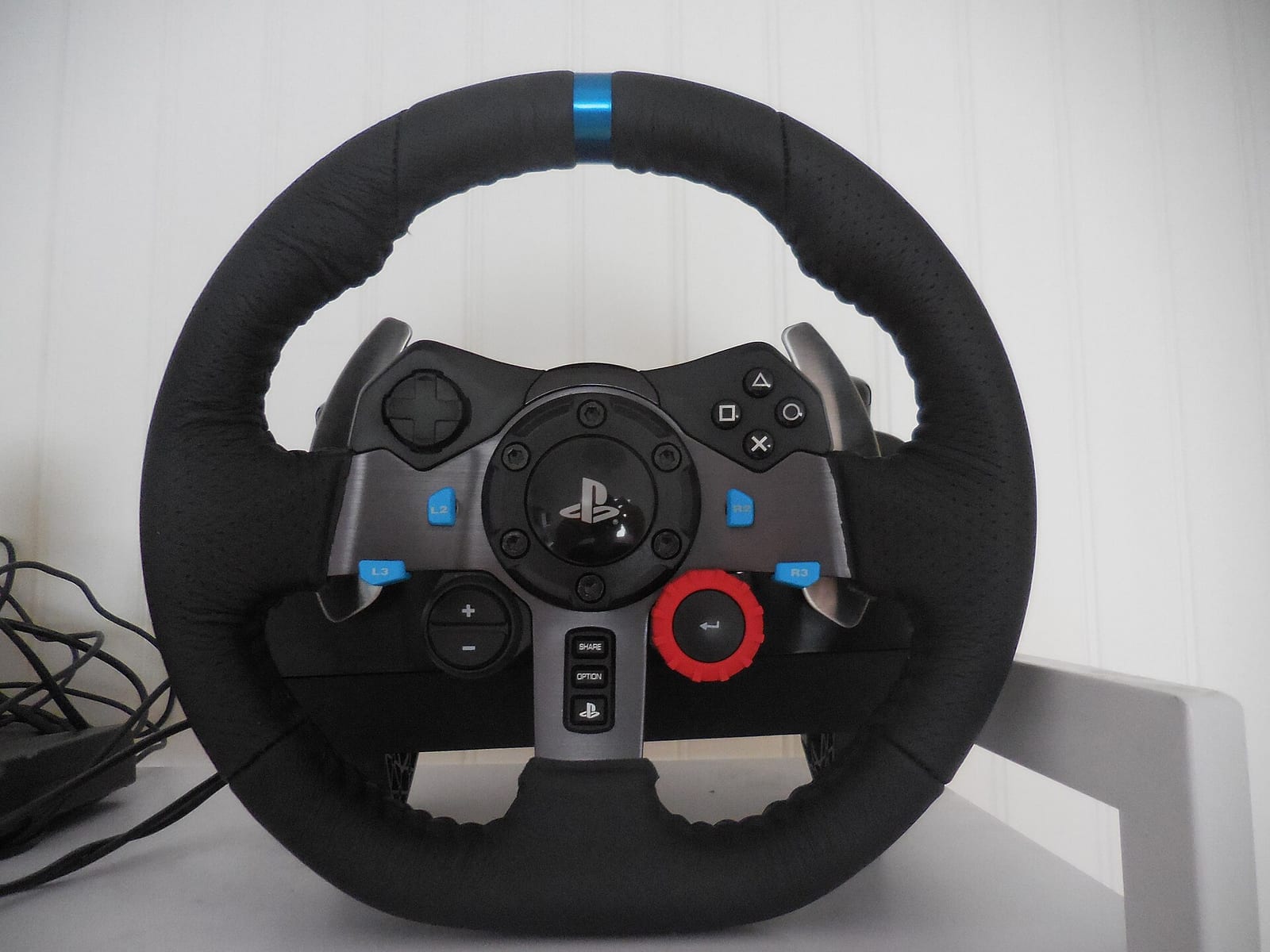
| Setting | Value |
|---|---|
| Gain | 100% |
| Minimum force | 10% |
| Dynamic damping | 25% |
| Road effects | 20% |
| Frequency | 400 Hz |
| Steer lock | 900 |
In G HUB: operating range 900, sensitivity 50, centering spring off.
The value to work on is minimum force. Go up 2% at a time if the centre feels empty, and stop before the gears start to rattle. The rest is on the Logitech page, with the brake pedal, which is the real weak point of that set.
Thrustmaster: T300, TX, T248, T150 and TMX
| Setting | T300 / TX | T248 | T150 / TMX |
|---|---|---|---|
| Gain | 95% | 95% | 100% |
| Minimum force | 5% | 4% | 7% |
| Dynamic damping | 40% | 65% | 90% |
| Road effects | 0% | 10% | 0% |
| Frequency | 400 Hz | 400 Hz | 400 Hz |
| Steer lock | Same as the control panel | 900 | Same as the control panel |
In the Thrustmaster control panel leave constant, periodic, spring and damper at 100%, and set the overall strength between 65 and 80%. The belt in a T300 or a TX gets warm in a long stint, and when it does the force fades. Running the overall strength below 100% keeps it consistent for longer.
Community baselines for these wheels do not all agree on damping, so treat the dynamic damping number as a range. If the steering feels slow, take 10% off. Model by model values are on the Thrustmaster page.
Fanatec: CSL DD, GT DD Pro, ClubSport and Podium
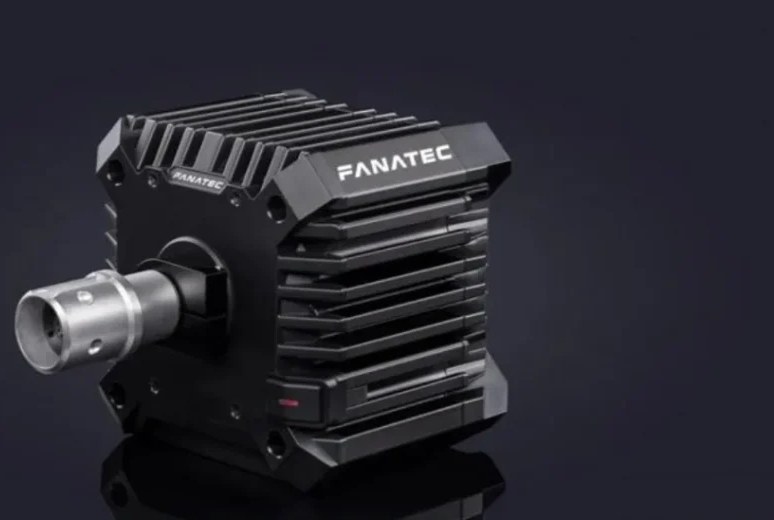
| Wheel base | Gain | FF on the base | Minimum force | Dynamic damping | Road effects | Steer lock |
|---|---|---|---|---|---|---|
| CSL DD / GT DD Pro | 70% | 100 | 0% | 100% | 0% | 1080 |
| ClubSport DD / DD+ | 40 to 60% | 100 | 0% | 0 to 10% | 0 to 15% | Same as SEN |
| Podium DD1 / DD2 | 60% | 45 | 0% | 100% | 0% | 1080 |
| CSL Elite | 70% | 100 | 0% | 100% | 0% | 1080 |
On a Fanatec the strength is split in two: the gain in the game and FF in the tuning menu of the base. On the small bases FF stays at 100 and you work with the gain. On a Podium you do the opposite and turn the base down to 45, because 20 or 25 Nm at full scale in a GT3 car is more than anybody needs. The full tuning menu, value by value, is on the Fanatec page.
MOZA: R5, R9 and the bigger bases
| Setting | Value |
|---|---|
| Gain | 90% |
| Minimum force | 0% |
| Dynamic damping | 100% |
| Road effects | 0% |
| Frequency | 400 Hz |
| Steer lock | Same number as the maximum steering angle in Pit House |
With a MOZA you keep the game values the same for every base and set the strength in Pit House. Game force feedback intensity at 100% on an R5 or an R9, and 70 to 90% on an R16 or R21. Check the FF bar after the first laps and lower the gain in the game if it clips. What the other sliders do is in my MOZA Pit House settings guide.
How to check for clipping
Clipping is what happens when the game asks for more force than the wheel can give. Above that ceiling everything feels the same, so you lose the information right when the car is loaded the most, in the middle of a fast corner.
To see it:
- Switch on the FF bar in the HUD. My ACC HUD guide shows where it is.
- Do three laps at race pace.
- Watch the bar in the fastest corners of the lap.
A flash at the top over a kerb is fine. If the bar sits at the top through a whole corner, lower the gain by 5% and go again. Repeat until it only touches the top on the kerbs.
How to adjust from here
Change one value at a time, then do five laps before you judge.
| Problem | Change |
|---|---|
| The force goes flat in fast corners | Gain down 5% |
| The wheel feels too light everywhere | Gain up 5%, then check the FF bar |
| Dead feeling around the centre (gear or belt wheel) | Minimum force up 2% |
| The wheel shakes on the straights | Minimum force down 2%, or dynamic damping up 10% |
| The steering feels heavy and slow | Dynamic damping down 10 to 25% |
| The kerbs are too loud | Road effects down to 0% |
One thing about weight. A GT3 car has power steering, and the real wheel is lighter than most people expect. A heavy wheel does not make you faster. It makes you tired, and it hides the small changes. What you want to feel is the load building when you turn in and the moment it drops when the front starts to slide. If you can read that, the settings are right.
Then go and use it where the lap time is. In a GT3 that is the braking zone, and my guide to braking technique in ACC covers it. If you are thinking about a stronger base, read direct drive wheels explained before you spend the money.
FAQ
What are the best FFB settings for ACC?
It depends on the wheel. Logitech G29: gain 100%, minimum force 10%, dynamic damping 25%, road effects 20%. Fanatec CSL DD: gain 70%, minimum force 0%, dynamic damping 100%, road effects 0%. Frequency 400 Hz on both.
What gain should I use in ACC?
95 to 100% on a gear or belt wheel, 70 to 90% on a small direct drive base, 40 to 60% on a big one. Lower it if the FF bar stays at the top in fast corners.
What does minimum force do in ACC?
It lifts the small forces above the dead zone of gear and belt wheels, so you can feel the steering around the centre. Direct drive bases do not need it.
What does dynamic damping do in ACC?
It adds resistance that grows with the speed of the car. The wheel is calmer on the straights and the steering has more weight. Weak wheels need less of it.
Should I use 333 Hz or 400 Hz in ACC?
400 Hz. Use the highest value the list offers.
What steer lock should I set in ACC?
The full rotation of your wheel, with the same number in the wheel software: 900 on a Logitech, 1080 on most Fanatec bases. ACC then sets the real lock of each car by itself.
Why does my wheel feel light in ACC?
GT3 cars have power steering, so the wheel is lighter than in other sims. If it feels empty only around the centre on a gear or belt wheel, raise the minimum force.